
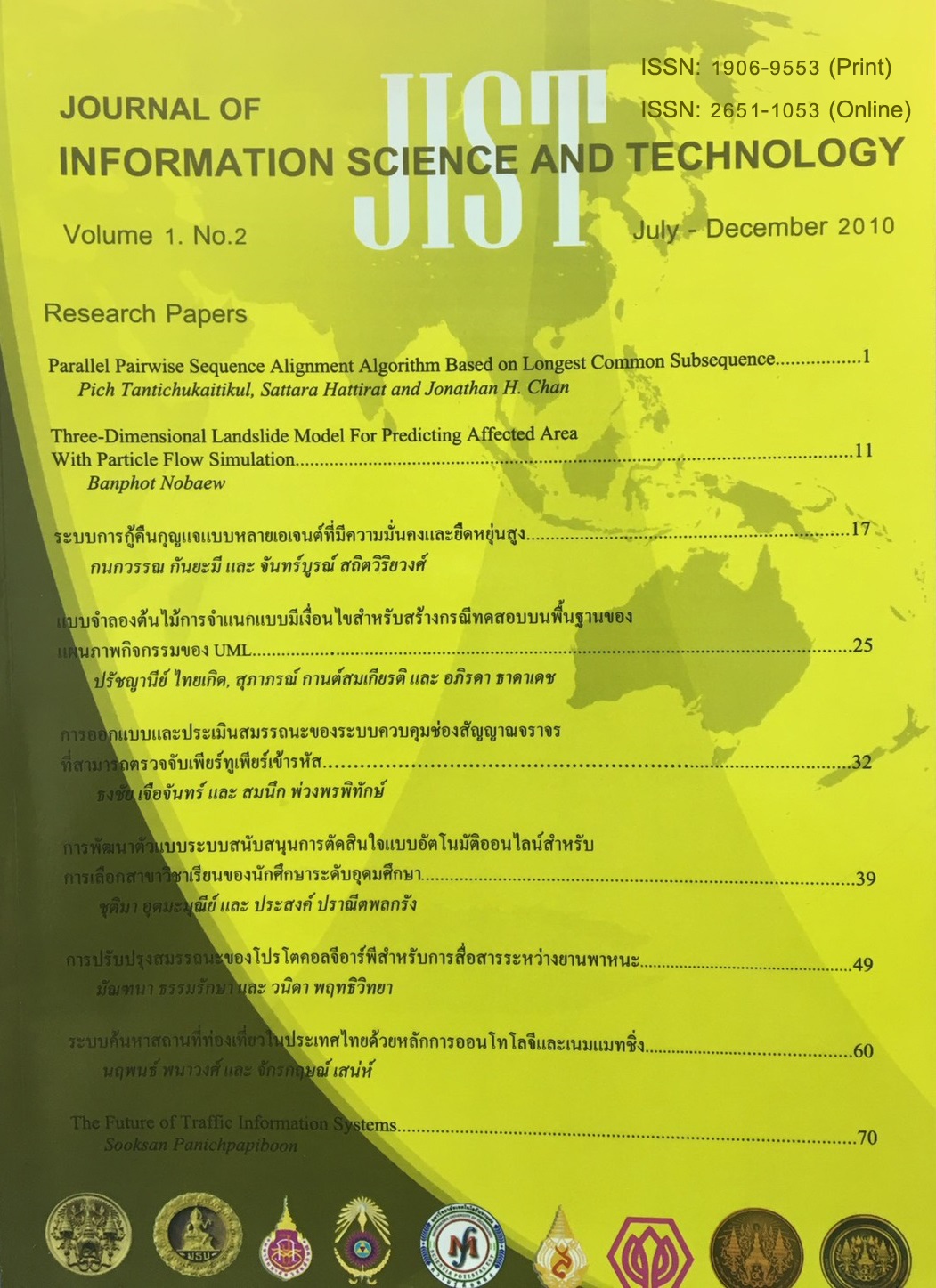
การพัฒนาตัวแบบระบบสนับสนุนการตัดสินใจแบบอัตโนมัติออนไลน์สำหรับการเลือกสาขาวิชาเรียนของนักศึกษาระดับอุดมศึกษา
Article Sidebar
Main Article Content
บทคัดย่อ
- การวิจัยครั้งนี้ มีความมุ่งหมายเพื่อสร้างตัวแบบสำหรับหาปัจจัยที่มีผลต่อการ ตัดสินใจในการเลือกสาขาวิชาเรียนของนักศึกษา และพัฒนาตัวแบบระบบสนับสนุนการตัดสินใจอย่างอัตโนมัติแบบออนไลน์สำหรับแนะแนวทางการเลือกสาขาวิชาเรียนของนักศึกษาในระดับอุดมศึกษา ตัวแบบเชิงความน่าจะเป็นได้สร้างขึ้นภายใต้เทคนิคการจัดทำเหมืองข้อมูล ซึ่งในการทดสอบแบบจำลองที่ได้จะทำการทดสอบผลบนพื้นฐานของวิธี K - fold cross validation โดยใช้โปรแกรมWEKA (Waikato Environment for Knowledge Analysis)ในการสร้างแบบจำลอง หลังจากนั้นได้นำผลลัพธ์ที่ดีที่สุดจากเทคนิคข่ายงานเบย์ มาสร้างตัวแบบในขั้นสุดท้ายและได้เปรียบเทียบความถูกต้องของตัวแบบกับผลการวิเคราะห์ความถดถอยเชิงพหุคูณ ทั้งนี้ผู้วิจัยได้ใช้ข้อมูลด้านการเรียนของกลุ่มตัวอย่างจากนักศึกษาในระดับอุดมศึกษา จากมหาวิทยาลัยทั้ง ภาครัฐบาลและภาคเอกชนจำนวน 9 มหาวิทยาลัยผลการวิจัยที่ได้แสดงให้เห็นว่า ตัวแบบความน่าจะเป็นโดยใช้เทคนิคการจัดทำเหมืองข้อมูลตามวิธีของข่ายงานเบย์ สามารถบ่งบอกตัวแปรสำคัญที่มีผลต่อการตัดสินใจในการเลือกสาขาวิชาเรียนของนักศึกษาในระดับอุดมศึกษาได้ และให้ค่าความแม่นยำในการทำนายสูงถึง ร้อยละ 91.35 จากตัวแบบดังกล่าวทำให้ทราบว่าตัวแปรสำคัญที่มีผลต่อการตัดสินใจในการเลือกสาขาวิชาเรียนของนักศึกษาในระดับอุดมศึกษา ได้แก่ เกรดเฉลี่ยวิชาคณิตศาสตร์ก่อนศึกษา เกรด เฉลี่ยวิชาคณิตศาสตร์ขณะกำลังศึกษา เกรดเฉลี่ยวิชาเขียนโปรแกรม ความรู้ในการพัฒนาระบบคอมพิวเตอร์และซอฟต์แวร์ความรู้ด้านวิชาเรียน 1 ความรู้ด้านวิชาเรียน 2 และ ความถนัด นอกจากนั้น ตัวแปรรายวิชาที่ค้นพบที่มีผลต่อการเลือกสาขาวิชานั้น มีความสอดคล้องกับผลที่ได้จากการวิเคราะห์ความถดถอยเชิงพหุคูณ จึงน่าเชื่อว่าตัวแปรที่ได้จากการพัฒนาตัวแบบระบบสนับสนุนการตัดสินใจ ด้วยข่ายงานเบย์ดังกล่าวมีความน่าเชื่อถืออยู่ในระดับที่ยอมรับได้
Article Details

This work is licensed under a Creative Commons Attribution-NonCommercial-NoDerivatives 4.0 International License.
I/we certify that I/we have participated sufficiently in the intellectual content, conception and design of this work or the analysis and interpretation of the data (when applicable), as well as the writing of the manuscript, to take public responsibility for it and have agreed to have my/our name listed as a contributor. I/we believe the manuscript represents valid work. Neither this manuscript nor one with substantially similar content under my/our authorship has been published or is being considered for publication elsewhere, except as described in the covering letter. I/we certify that all the data collected during the study is presented in this manuscript and no data from the study has been or will be published separately. I/we attest that, if requested by the editors, I/we will provide the data/information or will cooperate fully in obtaining and providing the data/information on which the manuscript is based, for examination by the editors or their assignees. Financial interests, direct or indirect, that exist or may be perceived to exist for individual contributors in connection with the content of this paper have been disclosed in the cover letter. Sources of outside support of the project are named in the cover letter.
I/We hereby transfer(s), assign(s), or otherwise convey(s) all copyright ownership, including any and all rights incidental thereto, exclusively to the Journal, in the event that such work is published by the Journal. The Journal shall own the work, including 1) copyright; 2) the right to grant permission to republish the article in whole or in part, with or without fee; 3) the right to produce preprints or reprints and translate into languages other than English for sale or free distribution; and 4) the right to republish the work in a collection of articles in any other mechanical or electronic format.
We give the rights to the corresponding author to make necessary changes as per the request of the journal, do the rest of the correspondence on our behalf and he/she will act as the guarantor for the manuscript on our behalf.
All persons who have made substantial contributions to the work reported in the manuscript, but who are not contributors, are named in the Acknowledgment and have given me/us their written permission to be named. If I/we do not include an Acknowledgment that means I/we have not received substantial contributions from non-contributors and no contributor has been omitted.
เอกสารอ้างอิง
2. กฤษณะ ไวยมัย ชิดชนก ส่งศิริ และธนาวินท์ รักธรรมา นนท์“การใช้เทคนิคดาต้าไมน์นิงเพื่อพัฒนาคุณภาพการศึกษาคณะวิศวกรรมศาสตร์ คณะวิศวกรรมศาสตร์”, NECTEC Technical Journal Vol. III, No. 11 หน้า 134-142. 2001.
3. ปฐมพงษ์ ขาวจันทร์, “การใช้ดาต้าไมนิงเพื่อวิเคราะห์คะแนนและแนวการศึกษา,” โครงงานพิเศษในเทคโนโลยีสารสนเทศ วิทยาสตรมหาบัณฑิต สาขาวิชาเทคโนโลยี สารสนเทศ บัณฑิตวิทยาลัย มหาวิทยาลัยศรีปทุม, 2547.
4. J. Han and M. Kamber, “Data Mining Concepts and Techniques”, The Morgan Kaufmann Publishers, 2001.
5. G. J. Hendricks, “An Analysis of Student Graduation Trends in Texas State Technical Colleges Utilizing Data Mining and Other Statistical Techniques”, Doctoral Thesis of Educational Administration, Baylor University, Texas, U.S.A., 2000.
6. R. R. Bouckaert, “Bayesian Network Classifiers in Weka”, Department of Computing Science, University of Waikato, New Zealand, 2005.
7. R. Kirkby and E. Frank, “Weka Explorer User Guide”, University of Waikato,New Zealand, 2005.
8. J. R. Roiger and W. M. Geatz, “Data Mining : A Tutorial – Based Primer”, Addison Wesley Publishing Company, 2003.
9. I. H. Witten and E. Frank, “Data Mining: Practical Machine Learning Tools and Techniques”, Second Edition, Morgan Kaufmann, San Francisco, 2005.
10. U. M. Fayyad, G. Piatetsky-Shapiro, P. Smyth, and R. Uthurusamy, “Advances in Knowledge Discovery and Data Mining”, AAAI/MIT Press, 1996.
11. R. Groth., “Data Mining : Building Competitive Advantage”, Englewood Cliffs , NJ : Prentice Hall. 12. M. H. S. Svetlana Vinnik, “Decision Support System for Managing Education Capacity”, 2003.
13. จามร เหล่าเกียรติกุล และ จิรารัตน์ สิทธิวรชาติ, “ระบบ อัจฉริยะเพื่อสนับสนุนการให้คำปรึกษาทางวิชาการระดับอุดมศึกษา ในสาขาวิชาเทคโนโลยีสารสนเทศ โดยเทคนิค แบบผสมผสาน (An Intelligent Academic Consultant System for Higher Education using a Multi - Approach)”, the National Conference of Information Technology, 2006.
14. ประเวศน์ วงษ์คำชัย, “ใช้งาน AJAX และ PHP แบบมือ อาชีพ”, พิมพ์ครั้งที่1, กรุงเทพ: ไทย เจริญการพิมพ์, 2550.
15. D. Olson and Y. Shi, “Introduction to Business Data Mining”, McGraw Hill International Edition, 2007.
16. S. Mitra and T. Acharya, “Data Mining Multimedia, Soft Computing, and Bioinformatics”, John Wiley & Sons, Hoboken, New Jersey, 2003.
17. WEKA, https://www.cs.waikato.ac.nz/ml/weka, 17 September 2007.
18. M. Xenos, “Prediction and assessment of Student Behaviour in Open and Distance Education in Computers Using Bayesian Networks”, Computer & Education, Volume 43, Issue 4, 2004, pp. 345-359.
