
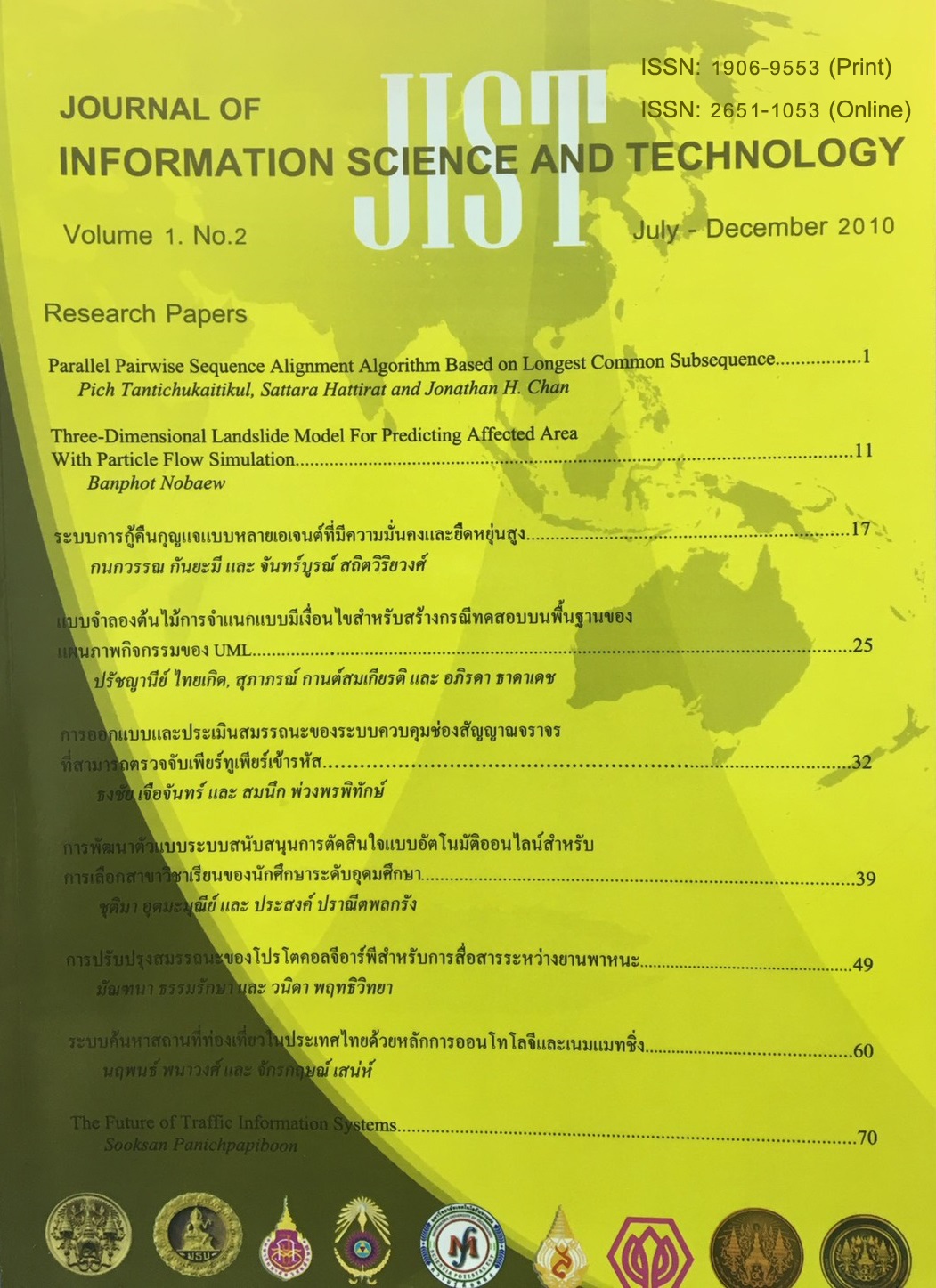
The Future of Traffic Information Systems
Article Sidebar
Main Article Content
บทคัดย่อ
- การรณรงค์การท่องเที่ยวในประเทศไทยมีการกระตุ้นและมีการพัฒนาอย่างต่อเนื่องเพื่อทำให้เศรษฐกิจไทยฟื้นตัวและเพิ่มมูลค่าทางเศรษฐกิจ ปัจจุบันมีระบบต่างๆ ที่จะช่วยให้ข้อมูลต่างๆ กับนักท่องเที่ยวไม่ว่าจะอยู่ในรูปแบบสื่อมัลติมีเดียหรือเว็บไซต์ต่างๆ แต่การที่นักท่องเที่ยวจะสืบค้นในการไปเที่ยวสถานที่แห่งใดแห่งหนึ่งนั้น นักท่องเที่ยวจำเป็นจะต้องรู้สถานที่ท่องเที่ยว ที่พัก ร้านอาหาร ร้านขายของฝาก ร้านสินค้าหนึ่งตำบล หนึ่งผลิตภัณฑ์ของบริเวณหรือจังหวัดนั้นๆ ซึ่งระบบการค้นหาสถานที่ท่องเที่ยวโดยผ่านเสิร์ชเอนจินต่าง ๆ ทั่วไปนั้นจะให้ผลลัพธ์เฉพาะเรื่องที่ต้องทำการค้นหาอย่างเดียวทำให้ต้องเสียเวลาในการเข้าถึงข้อมูลจากหลายเว็บไซต์เพื่อให้ได้ผลลัพธ์ตรงความต้องการทั้งหมด ดังนั้นผู้วิจัยจึงได้นำหลักการออนโทโลจีมาประยุกต์ใช้ในการพัฒนาระบบค้นหาสถานที่ท่องเที่ยวในประเทศไทยเพื่อให้ข้อมูลออนไลน์ที่ แตกต่างกันในเนื้อหาเดียวกันโดยสามารถเชื่อมโยงข้อมูลการท่องเที่ยวต่าง ๆ อย่างมีความสัมพันธ์ต่อกัน อีกทั้งผู้วิจัยได้ใช้ทฤษฎีเนมแมทชิ่งมาพัฒนาอัลกอริทึมในการค้นหาคำที่มีความหลายหลายและเขียนผิดหรือไม่ถูกต้องตามหลักภาษาไทยและภาษาอังกฤษที่สามารถค้นเจอในเว็บไซต์ต่าง ๆ ได้อีกด้วย และยังช่วยประชาสัมพันธ์แหล่งท่องเที่ยวที่มีการเขียนผิดในอินเทอร์เน็ตสามารถถูกค้นพบได้และได้ผลลัพธ์ที่ตรงกับความต้องการในการค้นหาคำตอบในครั้งเดียว
Article Details

This work is licensed under a Creative Commons Attribution-NonCommercial-NoDerivatives 4.0 International License.
I/we certify that I/we have participated sufficiently in the intellectual content, conception and design of this work or the analysis and interpretation of the data (when applicable), as well as the writing of the manuscript, to take public responsibility for it and have agreed to have my/our name listed as a contributor. I/we believe the manuscript represents valid work. Neither this manuscript nor one with substantially similar content under my/our authorship has been published or is being considered for publication elsewhere, except as described in the covering letter. I/we certify that all the data collected during the study is presented in this manuscript and no data from the study has been or will be published separately. I/we attest that, if requested by the editors, I/we will provide the data/information or will cooperate fully in obtaining and providing the data/information on which the manuscript is based, for examination by the editors or their assignees. Financial interests, direct or indirect, that exist or may be perceived to exist for individual contributors in connection with the content of this paper have been disclosed in the cover letter. Sources of outside support of the project are named in the cover letter.
I/We hereby transfer(s), assign(s), or otherwise convey(s) all copyright ownership, including any and all rights incidental thereto, exclusively to the Journal, in the event that such work is published by the Journal. The Journal shall own the work, including 1) copyright; 2) the right to grant permission to republish the article in whole or in part, with or without fee; 3) the right to produce preprints or reprints and translate into languages other than English for sale or free distribution; and 4) the right to republish the work in a collection of articles in any other mechanical or electronic format.
We give the rights to the corresponding author to make necessary changes as per the request of the journal, do the rest of the correspondence on our behalf and he/she will act as the guarantor for the manuscript on our behalf.
All persons who have made substantial contributions to the work reported in the manuscript, but who are not contributors, are named in the Acknowledgment and have given me/us their written permission to be named. If I/we do not include an Acknowledgment that means I/we have not received substantial contributions from non-contributors and no contributor has been omitted.
เอกสารอ้างอิง
2. การท่องเที่ยวแห่งประเทศไทย, “โครงการเที่ยวไทยครึกครื้น เศรษฐกิจไทยคึกคัก”, สืบค้นเมื่อ 20 ธันวาคม 2552, จาก http://thai.tourismthailand.org
3. C. Snae, M. Brückner, and P. Wongthongtham, “Localorganization and business ontology (LOBO)”, IEEE International Conference on Digital Ecosystems and Technologies, Rydges Tradewinds Cairns, Australia,Feb. 2007, pp. 292-295.
4. C. Snae, N. Singhadech, B. Emapana, and M. Brückner, “Interactive transliteration tools for explanation level language system (IT-TELLS)”, International Technical Conference on Circuits/Systems Computers and Communication, Chiang Mai, Thailand, Jul. 2006, pp. 245-248.
5. C. Snae and M. Brückner, “LOWCOST: Localorganization search with consolidated ontologies for name, space and time”, International Conference on Software Engineering, Innsbruck, Austria, Feb. 2007, pp. 13-15.
6. M. Brückner, C. Snae and J. Payakpate, “Ontology-based name matching of toponyms for geographical information systems (ONTO-GIS)”, IADIS International Conference ICT, Society and Human Beings, Amsterdam, The Netherlands, Jul. 2008, pp. 108-114.
7. จุฑามาศ ศิริรัชนีกรและฤทธิกร เล้าอรุณ, “ระบบการค้นหาข้อมูลแบบซับซ้อนสำหรับข้อมูลการท่องเที่ยวในประเทศไทย”, สืบค้นเมื่อ 20 ธันวาคม 2552, จาก http://cpe.kmutt.ac.th/previousproject/2006/26/Index.htm
8. N. Guarino, “Formal ontology and information systems”, the First International Conference (FOIS'98), Amsterdam: IOS Press, Jun.1998, pp 3-15.
9. H. Andrade and J. Saltz, “Towards a knowledge base management system KBMS: an ontology-aware database management system DBMS”, the 14th Brazilian Symposium on Database, Florianopolis, Brazil, Oct. 1999, pp 27-39.
10. H. Andrade and J. Saltz, “Query optimization in kess an ontology-based KBMS”, the 15th Brazilian Symposium on Databases (SBBD’2000). Joao Pessoa, Brazil 2000, pp 35-48.
11. T. Gruber, “Ontology”, Retrieved October, 2 2009, from http://tomgruber.org/writing/ontology-definition-2007.htm
12. B. Chandrasekaran, J.R. Josephson and V.R. Benjamins, “What are ontologies and why do we need them”, IEEE Intelligent System. Volume 14 no.1, pp. 20-26, 1999.
13. B. Smith and C. Welty, “Formal ontology in information systems”, the 2nd International Conference on formal Ontology in Information Systems, Ogunquit, Maine, New York: ACM Press, Oct. 2001.
14. N.F. Noy and D.L. McGuinness, “Ontology development: a guide to creating your first ontology”, California : Stanford Knowledge Systems Laboratory Technical Report, 2001
15. I. Murua, E. Llado and B. Llodra, “The semantic web for improving dynamic tourist packages commercialisation”, 2006, Retrieved December, 20 2009, from http://www.ibit.org/dades/doc/1108_ca.pdf
16. W. V. Siricharoen, “Learning semantic web from etourism” in the 2nd KES International conference on Agent and Multi-Agent Systems: Technologies and Applications, Inha University, Korea, Mar. 2008, pp. 516–525.
17.D. Buhalisa and R. Law, “Progress in information technology and tourism management: 20 years on and 10 years after the Internet the state of Tourism research”, Tourism Management, Elsevier Ltd., 2008
18. T. Dema, “eTourPlan: A knowledge-based tourist route and activity planner”, Master thesis, M.Sc., University of New Brunswick, 2008
19. M. Ball and B. Craig, “Object oriented jDREW”, Retrieved January 21, 2010, from http://jdrew.org/oojdrew.
20. Protégé, “The Protégé Ontology Editor and Knowledge Acquisition System”, Retrieved January, 19 2010, from http://protege.stanford.edu
21. C. Snae and M. Brückner, “Concept and rule based naming system”, The Information Universe. Journal of Issues in Informing Science and Information Technology, Volume 3, pp. 619-634, 2006.
22. C. Snae, “A comparison and analysis of name matching algorithms”, International Journal of Applied Science. Engineering and Technology, Volume 4 no. 1, pp. 252- 257, 2007.
