Optimal PV Sizing and Location Based on Volt – Var Control and UPFC Using Particle Swarm Optimization for Microgrid System
Keywords:
photovoltaic, VAR and UPFC, sizing and locationAbstract
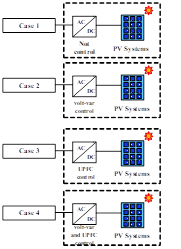
This research article details the creation and execution of a photovoltaic (PV) control system augmented with Volt-VAR (VAR) and Universal Power Flow Control (UPFC) to boost power system efficiency. The research examines the IEEE 13 bus test system, assessing four principal control strategies for effective power demand management: PV control, PV-VAR control, PV-UPFC control, and their amalgamation with Particle Swarm Optimization (PSO) for load forecasting. The PSO method is utilized to enhance load forecasting precision, facilitating accurate synchronization of PV generation with 24-hour power demand variations. The research examines the mechanisms of photovoltaic regulation, with the objective of optimizing photovoltaic resource usage and ensuring smooth integration with the electrical grid. The PV-VAR control system is examined to improve reactive power management, voltage stability, and grid resilience. The integration of photovoltaic systems with unified power flow controllers is examined to attain accurate control over power flow dynamics in the distribution network. The Open Distribution System Simulator (OpenDSS) is employed to assess electricity flow and examine grid performance under diverse load scenarios. Simulation findings illustrate the efficacy of the proposed technology, indicating a direct linkage between the photovoltaic system and the power grid optimized by particle swarm optimization. The ideal dimensions and location of the PV system were determined to be 100 kV at Bus 680, underscoring the system's capacity to conform to grid demands. This study offers essential insights into the obstacles and opportunities associated with the integration of photovoltaic systems into contemporary electricity grids. The research enhances the creation of sustainable, efficient, and resilient distribution networks in the renewable energy sector through comprehensive simulations and analysis.
References
K. M. Hughes and C. C. Phillips, “A quantitative analysis of the need for high conversion efficiency PV technologies in carbon mitigation strategies,” Solar, vol. 4, no. 2, pp. 209–221, 2024.
F. Reverter and M. Gasulla, “A Novel General-Purpose Theorem for the Analysis of Linear Circuits,” in IEEE Transactions on Circuits and Systems II: Express Briefs, vol. 68, no. 1, pp. 63-66, Jan. 2021, doi: 10.1109/TCSII.2020.3000834.
P. Prabpal, Y. Kongjeen, and K. Bhumkittipich, “Optimal battery energy storage system based on VAR control strategies using particle swarm optimization for power distribution system,” Symmetry (Basel), vol. 13, no. 9, p. 1692, 2021.
H. Mataifa, S. Krishnamurthy, and C. Kriger, “Volt/VAR optimization: A survey of classical and heuristic optimization methods,” IEEE Access, vol. 10, pp. 13379–13399, 2022.
Y. Zhang, X. Wang, J. Wang, and Y. Zhang, “Deep reinforcement learning based volt-VAR optimization in smart distribution systems,” IEEE Trans. Smart Grid, vol. 12, no. 1, pp. 361–371, 2021.
R. A. Jabr, “Robust volt/VAr control with photovoltaics,” IEEE Trans. Power Syst., vol. 34, no. 3, pp. 2401–2408, 2019.
H. Yoshida, K. Kawata, Y. Fukuyama, S. Takayama, and Y. Nakanishi, “A particle swarm optimization for reactive power and voltage control considering voltage security assessment,” IEEE Trans. Power Syst., vol. 15, no. 4, pp. 1232–1239, 2000.
M. A. Mquqwana and S. Krishnamurthy, “Particle swarm optimization for an optimal hybrid renewable energy microgrid system under uncertainty,” Energies, vol. 17, no. 2, p. 422, 2024.
G. A. D. Vargas, D. J. Mosquera, and E. R. Trujillo, “Optimization of topological reconfiguration in electric power systems using genetic algorithm and nonlinear programming with discontinuous derivatives,” Electronics (Basel), vol. 13, no. 3, p. 616, 2024.
X. Zhang, Y. Li, C. Wang, Y. Peng, J. Liu, and F. Chang, “Coordinated voltage control based on projected gradient descent algorithm for PV-rich distribution network,” in 2023 IEEE 6th International Electrical and Energy Conference (CIEEC), 2023.
I. Dagal, B. Akın, and E. Akboy, “A novel hybrid series salp particle Swarm optimization (SSPSO) for standalone battery charging applications,” Ain Shams Eng. J., vol. 13, no. 5, p. 101747, 2022.
H. Mataifa, S. Krishnamurthy, and C. Kriger, “Comparative Analysis of the Particle Swarm Optimization and Primal-Dual Inte-rior-Point Algorithms for Transmission System Volt/VAR Optimization in Rectangular Voltage Coordinates,” Mathematics, vol. 2023.
A. Al-Sabounchi, J. Gow, M. Al-Akaidi, and H. Al-Thani, “Optimal sizing and location of a PV system on three-phase unbalanced radial distribution feeder avoiding reverse power flow,” in 2011 IEEE Electrical Power and Energy Conference, 2011.
P. Prakash, “Optimal DG allocation using particle swarm optimization,” in 2021 International Conference on Artificial Intelligence and Smart Systems (ICAIS), 2021.
M. H. Albadi et al., “Optimal allocation of PV systems in distribution networks using PSO,” in 2017 7th International Conference on Modeling, Simulation, and Applied Optimization (ICMSAO), 2017.
S. M. Dawoud, L. Xiangning, F. M. F. Flaih, and M. I. Okba, “PSO algorithm for optimal placement of multiple SPV based distributed generators in Microgrids,” in 2016 IEEE PES Asia-Pacific Power and Energy Engineering Conference (APPEEC), 2016.
S. Bhuyan, M. Das, and K. C. Bhuyan, “Particle swarm optimizations based DG allocation in local PV distribution networks for voltage profile improvement,” in 2017 International Conference on Computer, Electrical & Communication Engineering (ICCECE), 2017.
M. F. Abu Haggar, E. Beshr, and M. B. Eteiba, “Minimizing power loss in distribution system by optimal sizing and sitting of distributed generators with network reconfiguration using grey wolf and particle swarm optimizers,” in 2018 IEEE International Conference on Environment and Electrical Engineering and 2018 IEEE Industrial and Commercial Power Systems Europe (EEEIC / I&CPS Europe), 2018.
R. F. Hakiim, Wardaniawan, V. R. Afrina, L. M. Putranto, and Tiyono, “Optimal PV farm size and location determination in kudus distribution system using particle swarm optimization (PSO),” in 2020 International Conference on Sustainable Energy Engineering and Application (ICSEEA), 2020.
Y. Kongjeen, K. Buayai, and K. Kerdchuen, “Improving voltage of microgrid system based on VAR control strategies by intergrating solar power system,” in Proceedings of the International Conference on Power Energy and Innovations, vol. 2020, Chiang Mai, Thailand, 2020, pp. 14–16.
H. V. Padullaparti, P. Chirapongsananurak, S. Santoso, and J. A. Taylor, “Edge-of-grid voltage control: Device modeling, strategic placement, and application considerations,” IEEE Power Energy Technol. Syst. J., vol. 4, no. 4, pp. 106–114, 2017.
A. Aurairat and B. Plangklang, “An alternative perturbation and observation modifier maximum power point tracking of PV systems,” Symmetry (Basel), vol. 14, no. 1, p. 44, 2021.
R. Dugan and D. Montenegro, The Open Distribution System Simulator (OpenDSS); California EPRI. Washington, DC, USA, 2020.
L. Gyugyi, C. D. Schauder, S. L. Williams, T. R. Rietman, D. R. Torgerson, and A. Edris, “The unified power flow controller: a new approach to power transmission control,” IEEE Trans. Power Deliv., vol. 10, no. 2, pp. 1085–1097, 1995.
C. Bulac, M. Eremia, R. Balaurescu, and V. Stefanescu, “Load flow management in the interconnected power systems using upfc devices,” in 2003 IEEE Bologna Power Tech Conference Proceedings, 2004.
P. C. Stefanov and A. M. Stankovic, “Modeling of UPFC operation under unbalanced conditions with dynamic phasors,” IEEE Trans. Power Syst., vol. 17, no. 2, pp. 395–403, 2002.
A. Mete and T. Mehmet, “Mathematical modeling and analysis of a unified power flow controller: A comparison of two approaches in power flow studies and effects of UPFC location,” Electr. Power Energy Syst, vol. 29, pp. 617–629, 2007.
D. Montenegro, J. Taylor, and R. Dugan, “‘Open source unified power flow controller model for quasi-static time series simulation,” in Grid Future Symp, Proc.CIGRE U.S. Nat. Committee, Ed. 2016.
N. Chitgreeyan et al., “Multi-period optimization of energy demand control for electric vehicles in unbalanced electrical power systems considering the center load distance of charging station areas,” Engineering Access, vol. 10, no. 2, pp. 90–102, 2024.
Downloads
Published
How to Cite
Issue
Section
License

This work is licensed under a Creative Commons Attribution-NonCommercial-NoDerivatives 4.0 International License.