Unveiling Insights: A Comprehensive Bibliometric Analysis of Generative Artificial Intelligence
Keywords:
Artificial intelligence, Bibliometric analysis, Generative artificial intelligence, Merging bibliometric data, PRISMA, Scopus, Web of ScienceAbstract
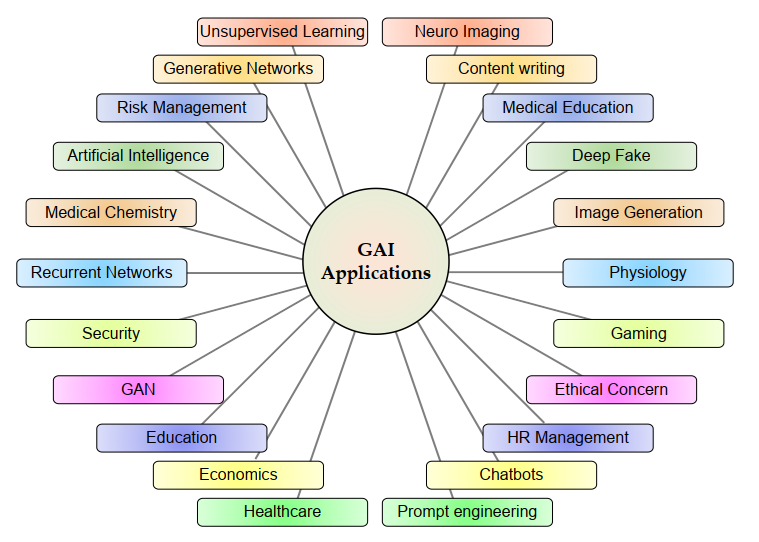
Generative artificial intelligence (GAI) has become prominent in recent days. It has changed the facets of artificial intelligence and is widely implemented in various fields. GAI and its applications have a great influence on society. Hence, to understand its importance and influence well, a comprehensive bibliometric analysis of GAI is proposed in this paper. This bibliometric analysis aims to explore the bibliometric data in terms of challenges, proposed methods, applications, and insights. Further, it is a quantitative tool for evaluating scholarly publications. The proposed bibliometric analysis is performed on the bibliometric data collected from the Scopus (753 records) and Web of Science (400 records) databases ranging from 2013 to 2024 and 448 unique records are considered for the analysis. Further, after scrutiny of these records, 46 records are considered to discuss various applications of GAI. The proposed review is executed systematically by using the PRISMA model. To conduct the analysis, ten critical research questions are identified, and the answers are obtained through the results of the proposed analysis. The key results of this bibliometric analysis unveil various insights into GAI research in terms of impactful applications (22), patterns, research trends, the progress of GAI over the years, scholarly articles production, trending topics, acknowledged collaborative dynamics of authors, affiliations, and countries (10), top influencing authors (10), affiliations (10), and sources (10). These insights drive future aspiring researchers to understand the significance of GAI in various applications and enable them to carry out fruitful research.
References
A. Barrett and A. Pack, “Not quite eye to A.I.: student and teacher perspectives on the use of generative artificial intelligence in the writing process,” Int J Educ Technol High Educ, vol. 20, no. 1, Art. no. 1, Nov. 2023, doi: https://doi.org/10.1186/s41239-023-00427-0.
P. Zhang and M. N. Kamel Boulos, “Generative AI in Medicine and Healthcare: Promises, Opportunities and Challenges,” Future Internet, vol. 15, no. 9, Art. no. 9, Aug. 2023, doi: https://doi.org/10.3390/fi15090286.
A. Banerjee, A. Ahmad, P. Bhalla, and K. Goyal, “Assessing the Efficacy of ChatGPT in Solving Questions Based on the Core Concepts in Physiology,” Cureus, Aug. 2023, doi: https://doi.org/10.7759/cureus.43314.
C. Gong et al., “Generative AI for brain image computing and brain network computing: a review,” Front. Neurosci., vol. 17, p. 1203104, Jun. 2023, doi: https://doi.org/10.3389/fnins.2023.1203104.
T. I. Leung, A. Sagar, S. Shroff, and T. L. Henry, “Can AI Mitigate Bias in Writing Letters of Recommendation?,” JMIR Med Educ, vol. 9, p. e51494, Aug. 2023, doi: https://doi.org/10.2196/51494.
M. M. Shoja, J. M. M. Van De Ridder, and V. Rajput, “The Emerging Role of Generative Artificial Intelligence in Medical Education, Research, and Practice,” Cureus, Jun. 2023, doi: https://doi.org/10.7759/cureus.40883.
G. Gupta, K. Raja, M. Gupta, T. Jan, S. T. Whiteside, and M. Prasad, “A Comprehensive Review of DeepFake Detection Using Advanced Machine Learning and Fusion Methods,” Electronics, vol. 13, no. 1, Art. no. 1, Dec. 2023, doi: https://doi.org/10.3390/electronics13010095.
I. M. Tsidylo and E. S. Chele, “Artificial Intelligence As A Methodological Innovation In The Training Of Future Designers: Midjourney Tools,” ITLT, vol. 97, no. 5, Art. no. 5, Oct. 2023, doi: https://doi.org/10.33407/itlt.v97i5.5338.
K. A. Justs et al., “Mitochondrial phosphagen kinases support the volatile power demands of motor nerve terminals,” The Journal of Physiology, vol. 601, no. 24, Art. no. 24, Dec. 2023, doi: https://doi.org/10.1113/JP284872.
G. E. Kaebnick et al., “Editors’ statement on the responsible use of generative AI technologies in scholarly journal publishing,” Med Health Care and Philos, vol. 26, no. 4, Art. no. 4, Dec. 2023, doi: https://doi.org/10.1007/s11019-023-10176-6.
M. Agarwal, A. Goswami, and P. Sharma, “Evaluating ChatGPT-3.5 and Claude-2 in Answering and Explaining Conceptual Medical Physiology Multiple-Choice Questions,” Cureus, Sep. 2023, doi: https://doi.org/10.7759/cureus.46222.
Y. You, Y. Chen, Y. You, Q. Zhang, and Q. Cao, “Evolutionary Game Analysis of Artificial Intelligence Such as the Generative Pre-Trained Transformer in Future Education,” Sustainability, vol. 15, no. 12, Art. no. 12, Jun. 2023, doi: https://doi.org/10.3390/su15129355.
N. Lucchi, “ChatGPT: A Case Study on Copyright Challenges for Generative Artificial Intelligence Systems,” Eur. j. risk regul., pp. 1–23, Aug. 2023, doi: https://doi.org/10.1017/err.2023.59.
B. Lim et al., “Using Generative Artificial Intelligence Tools in Cosmetic Surgery: A Study on Rhinoplasty, Facelifts, and Blepharoplasty Procedures,” JCM, vol. 12, no. 20, Art. no. 20, Oct. 2023, doi: https://doi.org/10.3390/jcm12206524.
J. Franganillo, “Generative artificial intelligence and its impact on the creation of media content,” m.rcs, vol. 11, no. 2, Art. no. 2, Sep. 2023, doi: https://doi.org/10.17502/mrcs.v11i2.710.
S. Ali et al., “Children as creators, thinkers and citizens in an AI-driven future,” Computers and Education: Artificial Intelligence, vol. 2, p. 100040, 2021, doi: https://doi.org/10.1016/j.caeai.2021.100040.
P. Budhwar et al., “Human resource management in the age of generative artificial intelligence: Perspectives and research directions on ChatGPT,” Human Res Mgmt Journal, vol. 33, no. 3, Art. no. 3, Jul. 2023, doi: https://doi.org/10.1111/1748-8583.12524.
J. Haase and P. H. P. Hanel, “Artificial muses: Generative artificial intelligence chatbots have risen to human-level creativity,” Journal of Creativity, vol. 33, no. 3, Art. no. 3, Dec. 2023, doi: https://doi.org/10.1016/j.yjoc.2023.100066.
F. E. Babl and M. P. Babl, “Generative artificial intelligence: Can CHATGPT write a quality abstract?,” Emerg Medicine Australasia, vol. 35, no. 5, Art. no. 5, Oct. 2023, doi: https://doi.org/10.1111/1742-6723.14233.
“ChatGPT in higher education: Considerations for academic integrity and student learning,” JALT, vol. 6, no. 1, Art. no. 1, Mar. 2023, doi: https://doi.org/10.37074/jalt.2023.6.1.17.
F. French, D. Levi, C. Maczo, A. Simonaityte, S. Triantafyllidis, and G. Varda, “Creative Use of OpenAI in Education: Case Studies from Game Development,” MTI, vol. 7, no. 8, Art. no. 8, Aug. 2023, doi: https://doi.org/10.3390/mti7080081.
W. Zaitsu and M. Jin, “Distinguishing ChatGPT(-3.5, -4)-generated and human-written papers through Japanese stylometric analysis,” PLoS ONE, vol. 18, no. 8, Art. no. 8, Aug. 2023, doi: https://doi.org/10.1371/journal.pone.0288453.
P. Korzynski, G. Mazurek, P. Krzypkowska, and A. Kurasinski, “Artificial intelligence prompt engineering as a new digital competence: Analysis of generative AI technologies such as ChatGPT,” EBER, vol. 11, no. 3, Art. no. 3, 2023, doi: https://doi.org/10.15678/EBER.2023.110302.
T. F. Tan et al., “Generative Artificial Intelligence Through ChatGPT and Other Large Language Models in Ophthalmology,” Ophthalmology Science, vol. 3, no. 4, Art. no. 4, Dec. 2023, doi: https://doi.org/10.1016/j.xops.2023.100394.
F. M. Megahed, Y.-J. Chen, J. A. Ferris, S. Knoth, and L. A. Jones-Farmer, “How generative AI models such as ChatGPT can be (mis)used in SPC practice, education, and research? An exploratory study,” Quality Engineering, vol. 36, no. 2, Art. no. 2, Apr. 2024, doi: https://doi.org/10.1080/08982112.2023.2206479.
A. Barcaui and A. Monat, “Who is better in project planning?Generative artificial intelligence or project managers?,” Project Leadership and Society, vol. 4, p. 100101, Dec. 2023, doi: https://doi.org/10.1016/j.plas.2023.100101.
I. Seth et al., “Utilizing GPT-4 and generative artificial intelligence platforms for surgical education: an experimental study on skin ulcers,” Eur J Plast Surg, vol. 47, no. 1, Art. no. 1, Jan. 2024, doi: https://doi.org/10.1007/s00238-024-02162-9.
M. Hueso, R. Álvarez, D. Marí, V. Ribas-Ripoll, K. Lekadir, and A. Vellido, “Is generative artificial intelligence the next step toward a personalized hemodialysis?,” RIC, vol. 75, no. 6, Art. no. 6, Dec. 2023, doi: https://doi.org/10.24875/RIC.23000162.
J. Huang et al., “Generative Artificial Intelligence for Chest Radiograph Interpretation in the Emergency Department,” JAMA Netw Open, vol. 6, no. 10, Art. no. 10, Oct. 2023, doi: https://doi.org/10.1001/jamanetworkopen.2023.36100.
D. Oniani et al., “Adopting and expanding ethical principles for generative artificial intelligence from military to healthcare,” npj Digit. Med., vol. 6, no. 1, Art. no. 1, Dec. 2023, doi: https://doi.org/10.1038/s41746-023-00965-x.
X. Zheng, J. Li, M. Lu, and F.-Y. Wang, “New Paradigm for Economic and Financial Research With Generative AI: Impact and Perspective,” IEEE Trans. Comput. Soc. Syst., pp. 1–11, 2024, doi: https://doi.org/10.1109/TCSS.2023.3334306.
R. W. Qu, U. Qureshi, G. Petersen, and S. C. Lee, “Diagnostic and Management Applications of ChatGPT in Structured Otolaryngology Clinical Scenarios,” OTO Open, vol. 7, no. 3, Art. no. 3, Jul. 2023, doi: https://doi.org/10.1002/oto2.67.
C. Davila et al., “Online Forums as a Tool for Broader Inclusion of Voices on Health Care Communication Experiences and Serious Illness Care: Mixed Methods Study,” J Med Internet Res, vol. 25, p. e48550, Dec. 2023, doi: https://doi.org/10.2196/48550.
D. Najafali et al., “Bard Versus the 2022 American Society of Plastic Surgeons In-Service Examination: Performance on the Examination in Its Intern Year,” Aesthetic Surgery Journal Open Forum, vol. 6, p. ojad066, Jan. 2024, doi: https://doi.org/10.1093/asjof/ojad066.
K. Ali, N. Barhom, F. Tamimi, and M. Duggal, “ChatGPT—A double‐edged sword for healthcare education? Implications for assessments of dental students,” Eur J Dental Education, vol. 28, no. 1, Art. no. 1, Feb. 2024, doi: https://doi.org/10.1111/eje.12937.
T. Lancaster, “Artificial intelligence, text generation tools and ChatGPT – does digital watermarking offer a solution?,” Int J Educ Integr, vol. 19, no. 1, Art. no. 1, Jun. 2023, doi: https://doi.org/10.1007/s40979-023-00131-6.
X. Zhai, M. Nyaaba, and W. Ma, “Can Generative AI and ChatGPT Outperform Humans on Cognitive-Demanding Problem-Solving Tasks in Science?,” Sci & Educ, Jan. 2024, doi: https://doi.org/10.1007/s11191-024-00496-1.
R. Michel-Villarreal, E. Vilalta-Perdomo, D. E. Salinas-Navarro, R. Thierry-Aguilera, and F. S. Gerardou, “Challenges and Opportunities of Generative AI for Higher Education as Explained by ChatGPT,” Education Sciences, vol. 13, no. 9, Art. no. 9, Aug. 2023, doi: https://doi.org/10.3390/educsci13090856.
T. Farrelly and N. Baker, “Generative Artificial Intelligence: Implications and Considerations for Higher Education Practice,” Education Sciences, vol. 13, no. 11, Art. no. 11, Nov. 2023, doi: https://doi.org/10.3390/educsci13111109.
O. V. Spivakovsky, S. A. Omelchuk, V. V. Kobets, N. V. Valko, and D. S. Malchykova, “Institutional Policies On Artificial Intelligence In University Learning, Teaching And Research,” ITLT, vol. 97, no. 5, Art. no. 5, Oct. 2023, doi: https://doi.org/10.33407/itlt.v97i5.5395.
N. Pellas, “The Effects of Generative AI Platforms on Undergraduates’ Narrative Intelligence and Writing Self-Efficacy,” Education Sciences, vol. 13, no. 11, Art. no. 11, Nov. 2023, doi: https://doi.org/10.3390/educsci13111155.
W. Zha, X. Li, D. Li, Y. Xing, L. He, and J. Tan, “Shale Digital Core Image Generation Based on Generative Adversarial Networks,” Journal of Energy Resources Technology, vol. 143, no. 3, Art. no. 3, Mar. 2021, doi: https://doi.org/10.1115/1.4048052.
K. G. Liakos, G. K. Georgakilas, F. C. Plessas, and P. Kitsos, “GAINESIS: Generative Artificial Intelligence NEtlists SynthesIS,” Electronics, vol. 11, no. 2, Art. no. 2, Jan. 2022, doi: https://doi.org/10.3390/electronics11020245.
A. Gupta, A. T. Müller, B. J. H. Huisman, J. A. Fuchs, P. Schneider, and G. Schneider, “Generative Recurrent Networks for De Novo Drug Design,” Molecular Informatics, vol. 37, no. 1–2, Art. no. 1–2, Jan. 2018, doi: https://doi.org/10.1002/minf.201700111.
K. J. Schultz, S. M. Colby, Y. Yesiltepe, J. R. Nuñez, M. Y. McGrady, and R. S. Renslow, “Application and assessment of deep learning for the generation of potential NMDA receptor antagonists,” Phys. Chem. Chem. Phys., vol. 23, no. 2, Art. no. 2, 2021, doi: https://doi.org/10.1039/D0CP03620J.
D. Merk, L. Friedrich, F. Grisoni, and G. Schneider, “De Novo Design of Bioactive Small Molecules by Artificial Intelligence,” Molecular Informatics, vol. 37, no. 1–2, Art. no. 1–2, Jan. 2018, doi: https://doi.org/10.1002/minf.201700153.
S.-T. Tsai, E. Fields, Y. Xu, E.-J. Kuo, and P. Tiwary, “Path sampling of recurrent neural networks by incorporating known physics,” Nat Commun, vol. 13, no. 1, Art. no. 1, Nov. 2022, doi: https://doi.org/10.1038/s41467-022-34780-x.
J. Lötsch, A. Ultsch, B. Mayer, and D. Kringel, “Artificial intelligence and machine learning in pain research: a data scientometric analysis,” PR9, vol. 7, no. 6, Art. no. 6, Nov. 2022, doi: https://doi.org/10.1097/PR9.0000000000001044.
A. Rives et al., “Biological structure and function emerge from scaling unsupervised learning to 250 million protein sequences,” Proc. Natl. Acad. Sci. U.S.A., vol. 118, no. 15, Art. no. 15, Apr. 2021, doi: https://doi.org/10.1073/pnas.2016239118.
A. A. Khan, R. K. Mahendran, K. Perumal, and M. Faheem, “Dual-3DM 3 -AD: Mixed Transformer based Semantic Segmentation and Triplet Pre-processing for Early Multi-Class Alzheimer’s Diagnosis,” IEEE Trans. Neural Syst. Rehabil. Eng., pp. 1–1, 2024, doi: https://doi.org/10.1109/TNSRE.2024.3357723.
A. Alqarafi, A. Ahmad Khan, R. Kumar Mahendran, M. Al-Sarem, and F. Albalwy, “Multi-scale GC-T2: Automated region of interest assisted skin cancer detection using multi-scale graph convolution and tri-movement based attention mechanism,” Biomedical Signal Processing and Control, vol. 95, p. 106313, Sep. 2024, doi: https://doi.org/10.1016/j.bspc.2024.106313.
J. N. Cheltha, C. Sharma, D. Prashar, A. A. Khan, and S. Kadry, “Enhanced human motion detection with hybrid RDA-WOA-based RNN and multiple hypothesis tracking for occlusion handling,” Image and Vision Computing, vol. 150, p. 105234, Oct. 2024, doi: https://doi.org/10.1016/j.imavis.2024.105234.
A. A. Khan, R. K. Madendran, U. Thirunavukkarasu, and M. Faheem, “D 2 PAM : Epileptic seizures prediction using adversarial deep dual patch attention mechanism,” CAAI Trans on Intel Tech, vol. 8, no. 3, pp. 755–769, Sep. 2023, doi: https://doi.org/10.1049/cit2.12261.
A. Ahmad Khan et al., “Detection of Omicron Caused Pneumonia from Radiology Images Using Convolution Neural Network (CNN),” Computers, Materials & Continua, vol. 74, no. 2, pp. 3743–3761, 2023, doi: https://doi.org/10.32604/cmc.2023.033924.
H. Kasaraneni and S. Rosaline, “Automatic Merging of Scopus and Web of Science Data for Simplified and Effective Bibliometric Analysis,” Ann. Data. Sci., Aug. 2022, doi: https://doi.org/10.1007/s40745-022-00438-0.
Downloads
Published
How to Cite
Issue
Section
License

This work is licensed under a Creative Commons Attribution-NonCommercial-NoDerivatives 4.0 International License.