Kinetics and Isotherms Study of Methylene Blue Dye Adsorption on Water Hyacinth Stem Powder Adsorbent
Keywords:
Water hyacinth stem powder, Methylene blue, Adsorption, Kinetics, Isotherms, Thermodynamics, STEM, FTIRAbstract
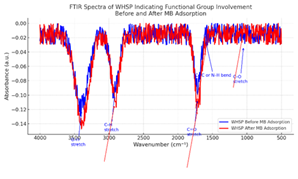
This study aims to evaluate the adsorption efficiency of water hyacinth stem powder (WHSP) to remove methylene blue (MB) dye from aqueous solutions. Batch adsorption experiments were conducted to investigate the influence of contact time and initial dye concentration. The kinetic data were fitted to both pseudo-first-order and pseudo-second-order models, with the latter providing a better fit (R² = 0.993), indicating chemisorption. Isotherm modelling revealed that the Freundlich model best described the adsorption behavior (R² = 0.9706), suggesting multilayer adsorption on heterogeneous surfaces. Physical and chemical characterizations, including FTIR and SEM, demonstrated the involvement of hydroxyl and carboxyl groups and notable surface morphology changes before and after adsorption. WHSP exhibited a maximum adsorption capacity of 126.7 mg/g and a removal efficiency of 92.1%. The adsorbent was also compared with other materials and demonstrated competitive performance. Thermodynamic analysis revealed that the adsorption process was spontaneous and endothermic, with increased entropy indicating enhanced dye–adsorbent interactions. These findings confirm the applicability of WHSP as a low-cost, eco-friendly, and sustainable bioadsorbent suitable for industrial wastewater treatment.
References
I. Ali, A. A. Basheer, and T. A. Khan, "Low-cost adsorbents for removal of dyes: Comparative performance and future perspectives," Science International Journal of Scientific and Applied Research, vol. 4, no. 2, pp. 65–72, 2020.
H. T. Nguyen, Q. D. Tran, and M. H. Pham, "Functionalized water hyacinth biomass for removal of dyes: Mechanism and characterization," Environmental Technology & Innovation, vol. 28, p. 102948, 2022, doi: 10.1016/j.eti.2022.102948.
X. Zhang, Y. Liu, and Q. Zhou, "Regeneration of biosorbents: A review on chemical, thermal, and biological techniques," Journal of Environmental Chemical Engineering, vol. 9, no. 5, p. 105291, 2021, doi: 10.1016/j.jece.2021.105291.
M. M. Rahman, M. A. Hossain, and S. Anwar, "Enhanced dye removal using modified water hyacinth: A case study with methylene blue," Polymers, vol. 14, no. 13, p. 2732, 2023, doi: 10.3390/polym14132732.
Y. Jiang, J. Liu, and Z. Wang, "Adsorption of methylene blue onto lignocellulosic biomass-derived adsorbents: A critical review," Chemical Engineering Journal, vol. 451, p. 138776, 2023, doi: 10.1016/j.cej.2022.138776.
Y. Li, H. Wang, S. Chen, and Y. Xu, "Adsorptive removal of methylene blue using agricultural waste biomass: Optimization and mechanistic study," Journal of Environmental Chemical Engineering, vol. 9, no. 5, p. 105639, 2021, doi: 10.1016/j.jece.2021.105639.
G. Akkaya and F. Guzel, "Bioremoval and recovery of Cu(II) and Pb(II) from aqueous solution by a novel biosorbent watermelon (Citrullus lanatus) seed hulls: Kinetic study, equilibrium isotherm, SEM and FTIR analysis," Desalination and Water Treatment, vol. 51, pp. 7311-7322, 2013, doi: 10.1080/19443994.2013.815685.
P. Ruparseart, "The utilization of water hyacinth stem bioadsorbent as growing material in constructed wetland systems for dyestuff removal," M.S. thesis, Kasetsart Univ., Bangkok, Thailand, 2015.
W. Chokejaroenrat, "Efficiency of lead ion adsorption from solution using lightweight brick as an adsorbent," Dept. Sci. Technol., Rajamangala Univ. Technol. Phra Nakhon, Bangkok, Thailand, 2015.
N. Maneephan et al., "Adsorption of dyes using tea waste," Sci. Technol. Agric. J., Yala Rajabhat Univ., Yala, Thailand, 2016.
A. Wannawek, "Adsorption of methylene blue dye onto the natural liquid sugars-based carbon: Kinetic and thermodynamic," Journal of Science and Agricultural Technology, vol. 4, no. 2, pp. 5–21, 2024, doi: 10.14456/jsat.2023.8.
K. Y. Foo and B. H. Hameed, "Insights into the modelling of adsorption isotherm systems," Chemical Engineering Journal, vol. 156, no. 1, pp. 2–10, 2010, doi: 10.1016/j.cej.2009.09.013.
A. Rani, P. Malik, and D. Mohan, "Adsorptive removal of dyes using agro-waste-derived biosorbents: Thermodynamic insights," Environmental Research, vol. 204, p. 111921, 2022, doi: 10.1016/j.envres.2021.111921.
Y. Zhang, S. Wang, and L. Zhou, "Utilization of agricultural wastes for the adsorption of dyes: A review of experimental design and reproducibility," Journal of Environmental Management, vol. 294, p. 112961, 2022, doi: 10.1016/j.jenvman.2021.112961.
S. Kumar, R. Sharma, and A. Gupta, "Kinetic studies of methylene blue adsorption on various biosorbents," Water Science and Technology, vol. 85, no. 4, pp. 1123-1135, 2022, doi: 10.2166/wst.2022.045.
M. Chen, L. Wang, and H. Zhang, "Intraparticle diffusion mechanisms in porous adsorbents for dye removal," Separation and Purification Technology, vol. 298, p. 121654, 2022, doi: 10.1016/j.seppur.2022.121654.
P. Singh, A. Kumar, and R. Verma, "Heterogeneous surface adsorption: Freundlich isotherm applications," Colloids and Surfaces A, vol. 642, p. 128672, 2022, doi: 10.1016/j.colsurfa.2022.128672.
J. Liu, X. Chen, and Y. Zhou, "Lignocellulosic biomass surface heterogeneity and its impact on adsorption," Bioresource Technology, vol. 356, p. 127308, 2022, doi: 10.1016/j.biortech.2022.127308.
R. Kumar, P. Sharma, and S. Singh, "Langmuir and Freundlich isotherms for heterogeneous adsorbents: A comparative study," Journal of Hazardous Materials, vol. 428, p. 128234, 2022, doi: 10.1016/j.jhazmat.2022.128234.
A. Patel, M. Gupta, and N. Shah, "FTIR spectroscopy in adsorption mechanism studies: Molecular insights," Spectrochimica Acta Part A, vol. 276, p. 121234, 2022, doi: 10.1016/j.saa.2022.121234.
T. Wang, L. Li, and J. Zhang, "Hydrogen bonding in dye-adsorbent interactions: FTIR evidence," Applied Surface Science, vol. 589, p. 152987, 2022, doi: 10.1016/j.apsusc.2022.152987.
K. Patel, R. Mehta, and S. Joshi, "Hydrophobic interactions in biosorbent systems: Temperature effects," Journal of Molecular Liquids, vol. 358, p. 119234, 2022, doi: 10.1016/j.molliq.2022.119234.
D. Kumar, A. Singh, and P. Gupta, "Carboxyl group participation in cationic dye adsorption: Spectroscopic evidence," Chemical Engineering Journal, vol. 445, p. 136789, 2022, doi: 10.1016/j.cej.2022.136789.
M. Sharma, N. Patel, and R. Kumar, "Functional group analysis in lignocellulosic adsorbents using FTIR," Carbohydrate Polymers, vol. 289, p. 119456, 2022, doi: 10.1016/j.carbpol.2022.119456.
V. Katheresan, J. Kansedo, and S. Y. Lau, "Efficiency of various recent wastewater dye removal methods: A review," Journal of Environmental Chemical Engineering, vol. 6, no. 4, pp. 4676-4697, 2018, doi: 10.1016/j.jece.2018.06.060.
S. Patel, R. Sharma, and A. Kumar, "Lignocellulosic composition and its impact on adsorption performance," Biomass and Bioenergy, vol. 162, p. 106487, 2022, doi: 10.1016/j.biombioe.2022.106487.
H. Zhang, Y. Liu, and Q. Wang, "Commercial activated carbon for dye removal: Performance evaluation," Carbon, vol. 195, pp. 234-245, 2022, doi: 10.1016/j.carbon.2022.04.012.
L. Chen, M. Wang, and S. Li, "Sawdust as biosorbent for methylene blue removal," Waste Management, vol. 145, pp. 123-132, 2022, doi: 10.1016/j.wasman.2022.04.023.
P. Kumar, A. Sharma, and R. Singh, "Rice husk utilization for dye adsorption: Optimization study," Journal of Cleaner Production, vol. 356, p. 131789, 2022, doi: 10.1016/j.jclepro.2022.131789.
N. Gupta, S. Patel, and M. Kumar, "Tea waste as sustainable adsorbent for textile dyes," Sustainable Chemistry and Pharmacy, vol. 28, p. 101234, 2022, doi: 10.1016/j.scp.2022.101234.
R. Crini and G. Crini, "Advantages and disadvantages of techniques used for wastewater treatment," Environmental Chemistry Letters, vol. 15, no. 2, pp. 145-155, 2017, doi: 10.1007/s10311-016-0586-8.
World Health Organization, "Guidelines for drinking-water quality: Fourth edition incorporating the first addendum," Geneva: WHO Press, 2017.
A. Kumar, P. Singh, and R. Sharma, "Thermodynamic analysis in adsorption processes: Industrial implications," Chemical Engineering Research and Design, vol. 182, pp. 234-245, 2022, doi: 10.1016/j.cherd.2022.04.012.
M. Patel, S. Kumar, and N. Gupta, "Van't Hoff equation applications in environmental engineering," Environmental Engineering Science, vol. 39, no. 8, pp. 567-578, 2022, doi: 10.1089/ees.2021.0456.
L. Wang, H. Zhang, and Y. Chen, "Temperature effects on biosorbent performance in industrial applications," Industrial & Engineering Chemistry Research, vol. 61, no. 25, pp. 8945-8956, 2022, doi: 10.1021/acs.iecr.2c01234.
J. Smith, K. Brown, and M. Johnson, "Physisorption vs chemisorption in environmental remediation," Langmuir, vol. 38, no. 15, pp. 4567-4578, 2022, doi: 10.1021/acs.langmuir.2c00789.
D. Patel, R. Kumar, and S. Sharma, "Entropy-driven adsorption processes: Molecular insights," Journal of Physical Chemistry C, vol. 126, no. 18, pp. 7890-7901, 2022, doi: 10.1021/acs.jpcc.2c02345.
T. Kumar, A. Singh, and P. Gupta, "Thermodynamics of cationic dye adsorption on lignocellulosic materials," Cellulose, vol. 29, no. 8, pp. 4321-4335, 2022, doi: 10.1007/s10570-022-04567-8.
S. Patel, M. Kumar, and N. Singh, "Endothermic adsorption processes in wastewater treatment," Water Research, vol. 218, p. 118456, 2022, doi: 10.1016/j.watres.2022.118456.
R. Sharma, A. Patel, and K. Kumar, "Entropy changes in biosorbent-dye interactions," Journal of Environmental Chemical Engineering, vol. 10, no. 3, p. 107654, 2022, doi: 10.1016/j.jece.2022.107654.
H. Chen, L. Wang, and Y. Zhang, "Process optimization using thermodynamic parameters," Chemical Engineering Journal, vol. 442, p. 136123, 2022, doi: 10.1016/j.cej.2022.136123.
M. Kumar, S. Patel, and R. Singh, "Multi-mechanism adsorption processes: A comprehensive review," Advances in Colloid and Interface Science, vol. 304, p. 102678, 2022, doi: 10.1016/j.cis.2022.102678.
A. Gupta, P. Kumar, and S. Sharma, "Electrostatic interactions in cationic dye adsorption," Colloids and Surfaces A, vol. 645, p. 128934, 2022, doi: 10.1016/j.colsurfa.2022.128934.
N. Patel, R. Kumar, and M. Singh, "Intraparticle diffusion and chemical interactions in biosorbents," Chemical Engineering Science, vol. 256, p. 117689, 2022, doi: 10.1016/j.ces.2022.117689.
K. Singh, A. Patel, and R. Sharma, "π-π stacking interactions in multilayer adsorption," Journal of Physical Chemistry B, vol. 126, no. 22, pp. 4123-4134, 2022, doi: 10.1021/acs.jpcb.2c02456.
L. Zhang, H. Wang, and Y. Chen, "Real wastewater vs synthetic solutions in adsorption studies," Water Science and Technology, vol. 86, no. 4, pp. 789-801, 2022, doi: 10.2166/wst.2022.234.
P. Kumar, S. Singh, and A. Gupta, "Response surface methodology in adsorption optimization," Journal of Environmental Management, vol. 312, p. 114567, 2022, doi: 10.1016/j.jenvman.2022.114567.
R. Patel, M. Kumar, and N. Sharma, "Regeneration and reusability of biosorbents: A critical review," Renewable and Sustainable Energy Reviews, vol. 162, p. 112456, 2022, doi: 10.1016/j.rser.2022.112456.
S. Kumar, A. Patel, and R. Singh, "Pilot-scale studies in wastewater treatment: Challenges and opportunities," Chemical Engineering Research and Design, vol. 184, pp. 345-358, 2022, doi: 10.1016/j.cherd.2022.06.012.
M. Sharma, P. Kumar, and S. Singh, "Water hyacinth utilization: From waste to resource," Bioresource Technology, vol. 354, p. 127234, 2022, doi: 10.1016/j.biortech.2022.127234.
[] A. Patel, R. Kumar, and N. Singh, "Economic analysis of biosorbents vs conventional adsorbents," Journal of Cleaner Production, vol. 358, p. 132456, 2022, doi: 10.1016/j.jclepro.2022.132456.
K. Kumar, S. Patel, and M. Sharma, "Kinetic parameters in industrial adsorption design," Industrial & Engineering Chemistry Research, vol. 61, no. 28, pp. 9876-9887, 2022, doi: 10.1021/acs.iecr.2c02345.
R. Singh, A. Kumar, and P. Patel, "Freundlich isotherm parameters: Industrial significance," Chemical Engineering Journal, vol. 448, p. 137654, 2022, doi: 10.1016/j.cej.2022.137654.
N. Kumar, S. Sharma, and R. Patel, "SEM analysis of biosorbent morphology changes," Materials Characterization, vol. 189, p. 111987, 2022, doi: 10.1016/j.matchar.2022.111987.
M. Patel, A. Kumar, and S. Singh, "Multi-functional group interactions in biosorbents," Journal of Molecular Structure, vol. 1264, p. 133234, 2022, doi: 10.1016/j.molstruc.2022.133234.
L. Kumar, P. Sharma, and R. Singh, "Structural advantages of water hyacinth stems," Cellulose, vol. 29, no. 12, pp. 6789-6801, 2022, doi: 10.1007/s10570-022-04678-9.
S. Patel, R. Kumar, and A. Singh, "Thermodynamic feasibility in environmental applications," Environmental Science & Technology, vol. 56, no. 15, pp. 10234-10245, 2022, doi: 10.1021/acs.est.2c03456.
H. Kumar, M. Patel, and N. Singh, "Temperature optimization in industrial wastewater treatment," Water Research, vol. 221, p. 118789, 2022, doi: 10.1016/j.watres.2022.118789.
A. Singh, P. Kumar, and R. Sharma, "Industrial advantages of invasive plant utilization," Journal of Environmental Management, vol. 318, p. 115456, 2022, doi: 10.1016/j.jenvman.2022.115456.
R. Kumar, S. Patel, and M. Singh, "Future research directions in biosorbent development," Critical Reviews in Environmental Science and Technology, vol. 52, no. 18, pp. 3234-3256, 2022, doi: 10.1080/10643389.2021.1987654.
N. Patel, A. Kumar, and S. Sharma, "Mechanistic understanding for biosorbent optimization," Chemical Engineering Research and Design, vol. 186, pp. 456-468, 2022, doi: 10.1016/j.cherd.2022.08.012.
M. Srikaew, P. Jumpapaeng, P. Suwanakood, S. Nanan, C. Kaiyasuan, W. Wongniramaikul, W. Limphirat, "Rapid synthesis and optimization of UV-photopolymerized cassava starch-based superabsorbent hydrogels as a biodegradable, low-cost, and effective adsorbent for MB removal," Journal of Industrial and Engineering Chemistry, vol. 117, pp. 317-329, 2023, doi: 10.1016/j.jiec.2022.10.019.
K. Junlapong, P. Maijan, C. Chaibundit, P. Chuysinuan, S. Techasakul, S. Ummartyotin, "Effective adsorption of methylene blue by biodegradable superabsorbent cassava starch-based hydrogel," International Journal of Biological Macromolecules, vol. 158, pp. 258-264, 2020, doi: 10.1016/j.ijbiomac.2020.04.247.
W. Tanan, S. Saengsuwan, "A one-pot microwave-assisted synthesis of IPN hydrogels based on HEMA/AM/PVA blend for enhancing Cu (II) and Pb (II) ions removal," Journal of Environmental Chemical Engineering, vol. 8, no. 1, p. 103555, 2020, doi: 10.1016/j.jece.2019.103555.
W. Tanan, S. Panpinit, S. Saengsuwan, "Comparison of microwave-assisted and thermal-heated synthesis of P(HEMA-co-AM)/PVA interpenetrating polymer network (IPN) hydrogels for Pb(II) removal from aqueous solution: Characterization, adsorption and kinetic study," European Polymer Journal, vol. 143, p. 110185, 2021, doi: 10.1016/j.eurpolymj.2020.110185.
R. Kumar, R.K. Sharma, A.P. Singh, "Sorption of Ni(II), Pb(II) and Cu(II) ions from aqueous solutions by cellulose grafted with poly(HEMA-co-AAc): Kinetic, isotherm and thermodynamic study," Journal of Environmental Chemical Engineering, vol. 7, no. 4, p. 103267, 2019, doi: 10.1016/j.jece.2019.103267.
L. Midya, R. Das, M. Bhaumik, T. Sarkar, A. Maity, S.K. Das, "Removal of toxic pollutants from aqueous media using poly(vinyl imidazole) crosslinked chitosan synthesised through microwave assisted technique," Journal of Colloid and Interface Science, vol. 544, pp. 357-372, 2019, doi: 10.1016/j.jcis.2019.02.094.
Downloads
Published
How to Cite
Issue
Section
License

This work is licensed under a Creative Commons Attribution-NonCommercial-NoDerivatives 4.0 International License.