Developing and Prioritizing Lean Supply Chain Performance Indicators in the Thai Industrial Context
Keywords:
lean supply chain performance indicators,, Thai industry context,, developing and prioritizing,, Fuzzy-AHP methodAbstract
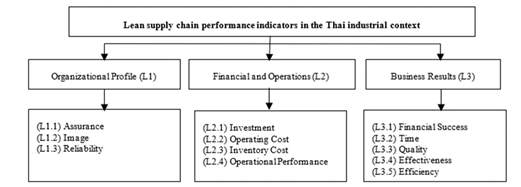
his research aims to systematically develop and prioritize performance indicators for Lean Supply Chain (LSC) practices that have not been widely adopted in Thai industries. The study included a comprehensive literature review of national and international industry publications. The literature review identified Lean Supply Chain (LSC) performance indicators align with the Thai industrial context. The three dimensions of the industry are (1) organizational profile, (2) finance and operations, and (3) business results. Different prioritizations and weights within each dimension are assigned to reflect their relative significance. These variations distinguish the Thai industry from industries in other countries. The research achieve its objective by applying the Fuzzy-AHP technique. This technique undertook expert evaluations from the Thai industry to assign weights to the significant indicators for LSC. This study demonstrates the development and prioritization of indicators for LSC tailored explicitly to the captivating context of the Thai industry. The indicators ranking across various dimensions can provide valuable guidance for business owners to comprehend their advantages and implement them within their organizations. Additionally, these findings can serve as a fundamental basis for future research and development, enabling the establishment of performance indicators for LSC within other countries' industries. However, further research development using techniques such as AHP, SAW, and TOPSIS is prioritized.
References
T. Mookamukul, “Importance of logistics and supply chain indicators for manufacturing industry”, Chulalongkorn Business Review, vol. 31, no. 119-120, pp. 149-164, 2009.
D. Dametew, F. Ebinger, and B. Beshah, “The Roles of Supply Chain Performance Measurement on Manufacturing Firms”, Global Journal of Technology & Optimization, vol. 9, no. 1, pp. 1000222, 2018. doi: 10.4172/2229-8711.100022
A. S. Khan, A. Chaabane, and F. Dweiri, “Supply chain performance measurement systems:
a qualitative review and proposed conceptual framework”, Int. J. Industrial and Systems Engineering, vol. 34, no. 1, pp. 43-64, 2020.
E. T. Erkan, and U. BAÇ, “ Supply chain performance measurement: a case study about applicability of SCOR model in a manufacturing industry firm”, International journal of business and management studies, vol. 3, no. 1, pp. 381-390, 2011.
N. Nurhasanah, N. W. Tanjung, E. Ripmiatin, A. S. Wulandari, M. Qibtiyah, and Meliantika, “Enhancing Competitiveness of Ready Made Garment Small-Medium Enterprises through Logistics Performance Measurement Using SCOR Method”, Proceedings of the 2nd International Conference of Industrial, Mechanical, Electrical, Chemical Engineering, pp. 123-126, 2016.
Yuniaristanto, N. Ikasari, W. Sutopo, and R. Zakaria, “Performance Measurement in Supply Chain Using SCOR Model in The Lithium Battery Factory”, Proceedings of the 2nd International Conference on Materials Technology and Energy, no. 943(012049), 2020. doi:10.1088/1757-899X/943/1/012049.
H. Sarjono, T. A. Suprapto, H. A. Setyorini, R. D. Nurjannah, and F. Fisabilla, (2021). “Supply Chain Performance Measurement with Method SCOR Model in Service Company”, Proceedings of the 2nd Asia Pacific International Conference on Industrial Engineering and Operations Management, Surakarta, Indonesia, September 14-16, pp. 2570-2581, 2021.
E. Kusrini, Subagyo, and A. N. Masruroh, “Designing Performance Measurement For Supply Chain’s Actors and Regulator Using Scale Balanced Scorecard And Data Envelopment Analysis”, IOP Conf. Series: Materials Science and Engineering, no. 105(012032), 2016. doi:10.1088/1757-899X/105/1/012032
F. G. Frederico, A. J. Garza-Reyes, and A. V. Kumar, Kumar, “ Performance measurement for supply chains in the Industry 4.0 era: a balanced scorecard approach”, International Journal of Productivity and Performance Management, vol. 70, no. 4, pp. 789-807, 2020.
A. Teeranupattana, and J. Tang, “The development of a model to measure supply chain performance by applying the measurement method of Chan and Qi (Fuzzy Set Theory) was applied to the framework working SCOR”, Business Administration Journal, vol. 32, no. 121, pp. 11-33, 2009.
C. Mio, A. Costantini, and S. Panfilo, “Performance measurement tools for sustainable business: A systematic literature review on the sustainability balanced scorecard use”, Corp Soc Responsib Environ Manag, vol. 2022, no. 29, pp. 367–384, 2021.
S. Thoucharee, “A Literature Review on Performance Measurement of Logistic Systems and Supply Chain”, UBU Engineering Journal, vol. 10, no. 2, pp. 95-106, 2017.
P. Sudchalee, N. Wanna, and P. Sirisaranlak, “The Study of Retail Supply Chain: A Case Study of Souvenir Shop”, Proceedings of the 6th KPRU National conference Kamphaengphet Rajabhat University, December 20, pp. 256-272, 2019.
S. Siangchin, “An application of supply chain operation reference model for a sample company”, A Thesis Submitted in Partial Fulfillment of the Requirements for Master of Engineering (Engineering management) Department of Industrial Engineering and Management Graduate School, Silpakorn University, 2020.
Logistics office Department of Primary Industries and Mines, “Logistics and Supply Chain Efficiency and Potential Assessment Guide”, 2017.
D. Rungklin, and S. Srimai, “Supply Chain Performance Measurement in the Manufacturing Industry”, WMS Journal of Management Walailak University, vol. 8, no. 1, pp. 98-109, 2019.
S. Boonyarith, and T. Lhaosirihongthong, “Dimensions of warehouse management performance indicators”, Research and development journal, vol. 24, no. 2, pp. 45-55, 2013.
T. Rachapila, and S. Jansirisak, “Supply chain primary production efficiency indicator: Sweet corn”, Prawarun Agricultural Journal, vol. 10,
no. 1, pp. 95-108, 2013.
B. Argiyantari, M. T. Simatupang, and H. M. Basri, “Pharmaceutical Supply Chain Transformation through Application of the Lean Principle: A Literature Review”, Journal of Industrial Engineering and Management, vol. 13, no. 3, pp. 475-494, 2020. http://doi.org/10.3926/jiem.3100.
L. G. Guilherme, R. Miorando, and G. Marodin, “Lean supply chain management: Empirical research on practices, contexts, and performance”, International Journal of Production Economics, vol. 193(2017), pp. 98–112, 2017.
H. O. Achieng, W. Githii, and T. O. Ombati, “Lean Supply Chain and Performance Enablers at Homa Lime Company”, American Journal of Industrial and Business Management, vol. 8, no. 5, pp. 1157-1171, 2018.
N. Garcia-Buendia, J. Moyano-Fuentes, and M. J. Maqueira-Marín, “Lean supply chain management and performance relationships: what has been done and what is left to do”, CIRP Journal of Manufacturing Science and Technology, vol. 32(2021), pp. 405–423, 2021.
V. Sharma, D. R. Raut, K. S. Mangla, E. B. Narkhede, S. Luthra, R. Gokhale, “A systematic literature review to integrate lean, agile, resilient, green and sustainable paradigms in the supply chain management”, Business Strategy and the Environment, vol. 30, no. 2, pp. 1191–1212, 2021.
P. Ugochukwu, J. Engstrom, J. Langstrand, “Lean in the supply chain: a literature review”, Management and Production Engineering Review, vol. 3, no. 4, pp. 87–96, 2012. doi: 10.2478/v10270-012-0037-6
A. M. Habib, R. Rizvan, and S. Ahmed, “Implementing lean manufacturing for improvement of operational performance in a labeling and packaging plant: A case study in Bangladesh”, Results in Engineering, vol. 17(100818), pp. 1-14, 2023.
F. R. Aziz, and M. S. Hafez, “Applying lean thinking in construction and performance improvement”, Alexandria Engineering Journal, vol. 52, no. 4, pp. 679–695, 2013.
I. Kulchitapong, and M. Lohatapanont, “An Application of Lean Technique in Trading Business”, Chulalongkorn Business Review, vol. 31, no. 119-120, pp. 81-96, 2009.
D. Adebanjo, T. Laosirihongthong, and P. Samaranayake, “Prioritizing lean supply chain management initiatives in healthcare service operations: a fuzzy AHP approach”, Production Planning & Control, vol. 27, no. 12, pp. 953-966, 2016. doi: 10.1080/09537287.2016.1164909
G. L. Tortorella, R. Miorando, and G. Marodin, “Lean supply chain management: Empirical research on practices, contexts, and performance”, International Journal of Production Economics, vol. 193(2017), pp. 98-112, 2017.
G. L. Tortorella, R. Miorando, and J. Limon-Romero, “Supply chain performance: how lean practices efficiently drive improvements”, Journal of Manufacturing Technology Management, vol. 29, no. 5, pp. 829-845, 2018.
D.C.A. Oliveira, O.D.W. Silva, and C. D. Moraisa, “Developing and prioritizing lean key performance indicators for plastering supply chains”, Production, vol. 32, no. e20220054, 2022. http://dx.doi.org/10.1590/0103-6513.20220054
J. Bhadu, P. Kumar, J. Bhamu, and D. Singh, “Lean production performance indicators for medium and small manufacturing enterprises: modelling through analytical hierarchy process”, Int J Syst Assur Eng Manag, vol. 13, pp. 978-997, 2021. https://doi.org/10.1007/s13198-021-01375-6
R. Ongpairao, and N. Suthikannarouenau, “Waste Reduction and Efficiency Enhancement in the Production Process: Case Study of Plastic Bag Factory”, Proceeding of the 16th RSU NATIONAL GRADUATE RESEARCH CONFERENCE. Paper presented at Rangsit University: Pathumthani, Thailand. Retrieved August 19th, 2021, from: https://rsujournals.rsu.ac.th/index.php/rgrc/article/view/2179/1937
S. Saetung, J. Thirasirikul, and W. Premchaiswadi, “A Study of Components of Total Quality Management and Lean Manufacturing System Affecting Management Efficiency of Hard-Disk-Drive Industry in Thailand”, Journal of Social Academic, vol. 11, no. 3, pp. 360-370. 2018.
A. Vatcharanurak, “An application of lean system to garment manufacturing: Polo shirt production line”, A thesis summitted in partial fulfillment of the requirement for the degree of master of engineering in textile engineering department of textile engineering, faculty of engineering, Rajamangala university of technology Thanyaburi, 2009.
S. Wattanaponprom, “Applying Lean Conceps to Improve Product Receiving Process Efficiency ABC Co., Ltd., Suphanburi Branch”, Graduate school University of the Thai Chamber of Commerc, 2013.
A. Muangwong, “Lean system to manage easy rot raw materials in make to order food production systems”, A thesis submitted in partial fulfillment of the requirements for master of engineering (Engineering Management) department of industrial engineering and management graduate school, Silpakorn University, 2020.
J. Kaewsud, “Production process improvement by using lean concept: The Case of Gloves Manufacturing in Songkhla”, A Minor Thesis Submitted in Partial Fulfillment of the Requirements for the Degree of Master of Business Administration Prince of Songkla University. 2019.
S. Ngamdee, and A. Sophadang, “Applying Lean concepts to reduce lead time in the strategic planning metric reporting process”, The 1st Academic Conference on Industrial Engineering and Industrial Management, 2017. (Extended Abstract)
K. Supakitanankun, “Effectiveness of lean management to manage medical material, fluid solution and antiseptic at Surgery Department, Udonthani Hospital”, Udonthani Hospital Medical Journal, vol. 24, no .3, pp.230-237, 2016.
K. Tinyanont, “Study work processes and apply lean concepts to eliminate wastes in the purchasing Process”, A Term Paper Submitted in Partial Fulfillment of the Requirements for the Degree of Master of Business Administration Program in Industrial Management Graduate School Thai-Nichi Institute of Technology, 2018.
E. Aeang-kan, E. Bunjoongkleng, P. Nusan, and M. Kaewmoracharoeng, “Improving the construction procurement process by applying lean techniques”, Proceeding of the 27th National Convention on Civil Engineering. Paper presented at Chiang Rai, Thailand. Retrieved August 24-26, 2022. https://conference.thaince.org/index.php/ncce27/article/view/1426/1038
S. Hongpiriyakul, “The application of lean thinking to supply chain management: a case study of rubber glove factory”, A thesis submitted in partial fulfillment of the requirements for the degree of Master of Engineering in industrial and systems engineering prince of Songkhla University, 2014.
S. Kaganski, J. Majak, and K. Karjust, “Fuzzy AHP as a tool for prioritization of key performance indicators”, Proceeding of The 51st CIRP Conference on Manufacturing Systems. Procedia CIRP, vol. 72, pp. 1227-1232, 2018.
M. Rossini, J. D. Powell, and K. Kundu, “Lean supply chain management and Industry 4.0: a systematic literature review”, International Journal of Lean Six Sigma, vol. 14, no. 2, pp. 253-276, 2022. doi:10.1108/IJLSS-05-2021-0092.
O.W. Widyarto, J. M. Shofa, and N. Djamal, “Key Performance Indicators on Supply Chain PerformanceMeasurement in An Electronic Commerce: A Literature Review”, International Journal of Engineering and Advanced Technology, vol. 8, no. 5C, pp. 137-141, 2019.
I. Kolos, “Formation of the key performance indicators system for lean management of enterprises”, Technology audit and production reserves, vol. 5/4, no. 43, pp. 15-19, 2018.
M. Vienazindiene, and R. Ciarniene, “Lean manufacturing implementation and progress measurement”, Economics and management, vol. 18, no. 2, pp. 366-373, 2013.
J. Owusu-Guha, l. P, Buschur, and A. Tyson, “Lean into Clinical Pharmacy: An Experience in Implementing Key Performance Indicators and Gemba Walks into Clinical Pharmacy Services”, Pharmacy practice & practice-based research,
vol. 12, no. 4, pp. 1-8, 2021. https://doi.org/10.24926/iip.v12i4.4316
M. A. Sánchez, and P. M. Pérez, “The use of lean indicators for operations management in services”, Int. J. Services Technology and Management, vol. 5, no. 5/6, pp. 465-478, 2004.
F. Behrouzi, and Y. K. Wong, “Lean performance evaluation of manufacturing systems: A dynamic and innovative approach”, Procedia computer science, vol. 3(2011), pp. 388-395, 2011.
G. Ante, F. Facchini, G. Mossa, and S. Digiesi, “Developing a key performance indicators tree for lean and smart production systems”, IFAC Papers Online, vol. 51, no. 11, pp. 13-18, 2018.
I. Rakhmanhuda, and D. P. Karningsih, “Development lean assessment indicator: A case study”, MATEC Web of Conferences, vol. 204, no. 03018, 2018. https://doi.org/10.1051/
matecconf/201820403018
M. Todorov, B. Jovanoski, and R. Minovski, “Key Performance Indicators for Lean: Literature Review and Recommendations”, International Journal of Modern Studies in Mechanical Engineering, vol. 5, no. 1, pp. 27-36, 2019.
D. De, S. Chowdhury, K. P. Dey, and K. S. Ghosh, “Impact of Lean and Sustainability Oriented Innovation on Sustainability Performance of Small and Medium Sized Enterprises: A Data Envelopment Analysis-based framework”, International Journal of Production Economics, vol. 219, pp. 416–430, 2020.
H. Aslam, M. Waseem, and M. Khurram, “Impact of supply chain management practices on corporate image: Mediating role of Green communications”, Pakistan journal of Commerce and Social science, vol. 13, no. 3, pp. 581-598, 2019.
A. Kaewngam, P. Chatwattana, and P. Piriyasurawong, “Supply Chain Management Model in Digital Quality Assurance for ASEAN University Network Quality Assurance (AUN QAQA)”. Higher Education Studies, Vol. 9, no. 4, pp. 12-20, 2019.
A. Cholewa-Wójcik, and A. Kawecka, “Packaging quality assurance in supply chain”, Proceeding of the 14th International Scientific Conference - Osijek, Croatia, Business Logistics in Modern Management, pp. 103-108, 2014.
R. I. Ginanjar, R. Hurriyati, L. Adiwibowo, V. Gaffar, and J.Saputra, “The Role of Supply Chain Management Consumer Attitude as Intervening between Brand Images, Perceived Value and Revisiting Intention”, International Journal of Supply Chain Management, vol. 8, no. 4, pp. 901-906, 2019.
K. C. Dissanayake, and A. J. Cross, “Systematic mechanism for identifying the relative impact of supply chain performance areas on the overall supply chain performance using SCOR model and SEM”, International Journal of Production Economics, vol. 201, pp. 102–115, 2018.
M. I. Ambe, “Key Indicators for Optimising Supply Chain Performance: The Case of Light Vehicle Manufacturers In South Africa”, The Journal of Applied Business Research, vol. 30, no. 1, pp. 277-290, 2014.
R. Sundara, N. A. Balaji, and M. R. SatheeshKumar, “A Review on Lean Manufacturing Implementation Techniques”, Proceeding of the 12th global congress on manufacturing and management, GCMM 2014, Procedia Engineering, vol. 97, pp. 1875 – 1885, 2014.
G. Papageorgiou, A. Efstathiades, and G. T. Dimitriadis, “Lean Supply Chain Management and its Impact on Organisational Competitiveness”, International Journal of Supply Chain Management, vol. 9, no. 4, pp.84-90, 2020.
H. Cortes, J. Daaboul, L. J. Duigou, and B. Eynard, “Strategic Lean Management: Integration of operational Performance Indicators for strategic Lean management”, IFAC-Papers OnLine, vol. 49, no. 12, pp. 065–070, 2016.
D. Rodrigues, R, Godina, and D. E. P. Cruz, “Key Performance Indicators Selection through an Analytic Network Process Model for Tooling and Die Industry”, Sustainability, vol. 13, no. 13777, 2021.https://doi.org/10.3390/su132413777.
S. S. N. Al-Mahrooqi, “Strategic Implementation on the Lean Management Approach in Human Resource Practices”, Advances in Social Sciences Research Journal, vol. 9, no. 3, pp. 383-392, 2022.
G. Peng, L. Han, Z. Liu, Y. Guo, J. Yan, and X. Jia, “An Application of Fuzzy Analytic Hierarchy Process in Risk Evaluation Model”, Frontiers in Psychology, vol. 12, no. 715003, 2021. doi: 10.3389/fpsyg.2021.715003
A. Belhadi, E. F. Touriki, and E. S. Fezazi, “Prioritizing the solutions of lean implementation in SMEs to overcome its barriers an integrated fuzzy AHP-TOPSIS approach”, Journal of Manufacturing Technology Management, vol. 28, no. 8, pp. 1115-1139, 2017.
K. Govindan, K. S. Mangla, and S. Luthra, “Prioritizing indicators in improving supply chain performance using fuzzy AHP: insights from the case example of four Indian manufacturing companies”,. Production Planning & Control, vol. 28, no. 6–8, pp. 552–573, 2017. https://doi.org/10.1080/09537287.2017.1309716
H. Abbas, A. A. Alawi, and A. K. Maktoumi, “Prioritizing Service Supply-Chain Performance Measures Using Multi-Criteria Decision-Making Methodologies”, Journal of Asian Finance, Economics and Business, vol. 7, no. 11, pp. 843–851, 2020.
S. E. Helmy, H. G. Eladl, and M. Eisa, “Fuzzy analytical hierarchy process (FAHP) using geometric mean method to select best processing framework adequate to big data”, Journal of Theoretical and Applied Information Technology, vol. 99, no. 1, pp. 206-226 2021.
S. Butdee, and P. Phuanghsalee, “Uncertain risk assessment modelling for bus body manufacturing supply chain using AHP and Fuzzy AHP”, Proceeding of the 14th Global Congress on Manufacturing and Management (GCMM-2018), Procedia Manufacturing, vol. 30, pp. 663-670, 2019.
N. Panyathanavanich, “Application of lean thinking to improve purchasing process: A case of automotive Industry”, An independent study submitted in partial fulfillment of the requirements for the degree of Master of Engineering in industrial development department of industrial engineering faculty of engineering Thammasat university, 2017.
M. H. Kimari, and S. Muli, “Influence of Lean Supply Chain Management Practices on the Performance of Manufacturing Firms in Kenya, a Case Study of Unilever Kenya Ltd. International”, Journal of Business and Social Research, vol. 12, no. 1, pp. 01-15, 2022.
P.R.C. Gopal, and J. Thakkar, “A review on supply chain performance measures and metrics: 2000-2011”,International Journal of Productivity and Performance Management, vol. 61, no. 5, pp. 518-547, 2012.
H. khairca, and M. d R. Cabrita, “Developing a lean supply chain performance framework in a SME: a perspective based on the balanced scorecard”, Procedia Engineering, vol. 131, pp. 270-279, 2015.
F. Khair, D. I. Wijaya, H. D. Yulianto, and K. E. N. Soebandrija, “Designing the performance measurement for sustainable supply chain of the crude palm oil (CPO) companies using lean & green supply chain management (LGSCM) approach (Case Study: Indonesia’s palm oil company)”, The 3rd International Conference on Eco Engineering Development, vol. 426, no. 012116, 2020.
L. Catellani, and E. Bottani, “Supply chain performance metrics in the lean, agile, resilient, green perspectives: a survey and model”, Proceedings of the 24th International Conference on Harbor, Maritime and Multimodal Logistics Modelling & Simulation (HMS), 2021. doi: 10.46354/i3m.2022.hms.004.
A. Sukkar, and M. M. G. Mvula, “Lean supply chain performance measurement in the manufacturing industry”, International Journal of Current Research, vol. 14, no. 11, pp. 22746-22749, 2022.
B. Dahinine. A. Laghouag, W. Bensahel,
M. Alsolamy, and T. Guendouz, “Evaluating performance measurement metrics for lean and agile supply chain strategies in large enterprise”, Sustainability, vol. 16, no. 2586, 2024. https://doi.org/10.3390/su16062586
A. Vanichchinchai, “The effect of lean manufacturing on a supply chain relationship and performance”, Sustainability, vol. 11, no. 5751, 2019. https://doi.org/10.3390/su11205751
I. Vinogradova-Zinkevic, “Comparative sensitivity analysis of some Fuzzy AHP methods”, Mathematics, vol.11, no. 4984, 2023. https://doi.org/10.3390/math11244984.
Downloads
Published
How to Cite
Issue
Section
License

This work is licensed under a Creative Commons Attribution-NonCommercial-NoDerivatives 4.0 International License.