Grading Invasive Ductal Carcinoma from Whole-Slide Histological Images using Deep Learning-Based Feature Encoding Techniques
Keywords:
slide grading, feature encoding, image-level classification, computer-aided diagnosisAbstract
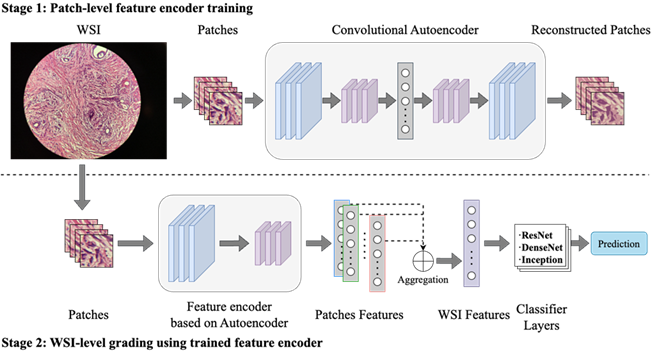
Invasive ductal carcinoma (IDC) grading is crucial for determining treatment and prognosis. However, the process of manual grading of whole-slide histological images (WSIs) is time-consuming and prone to variability. In this study, we propose a deep learning-based method aimed at automating the grading of breast cancer from WSIs. Unlike conventional approaches that directly process entire WSIs, our method divides them into smaller patches and employs an unsupervised autoencoder to extract pathological features from each patch. These features are then integrated into a comprehensive representation of the WSI. A classification model is subsequently utilized to assign one of three grades. The proposed approach effectively captures local pathological features while preserving spatial relationships between patches. This technique uniquely balances feature preservation with computational efficiency, addressing the challenges associated with the high resolution of WSIs. Experimental results on a breast cancer histological image dataset demonstrate that our method achieves an average accuracy of 71.43% while reducing training time by 50–67%. This performance outperforms the best results obtained using traditional feature extraction techniques. This highlights the robustness and reliability of our approach in reducing pathologists' workload and improving diagnostic consistency.
References
G. Campanella et al., "Clinical-grade computational pathology using weakly supervised deep learning on whole slide images," Nature Medicine, vol. 25, no. 8, pp. 1301-1309, 2019/08/01 2019, doi: 10.1038/s41591-019-0508-1.
C. van Dooijeweert, P. J. van Diest, and I. O. Ellis, "Grading of invasive breast carcinoma: the way forward," Virchows Archiv, vol. 480, no. 1, pp. 33-43, 2022/01/01 2022, doi: 10.1007/s00428-021-03141-2.
E. Gray, A. Donten, K. Payne, and P. S. Hall, "Survival estimates stratified by the Nottingham Prognostic Index for early breast cancer: a systematic review and meta-analysis of observational studies," Systematic Reviews, vol. 7, no. 1, p. 142, 2018/09/15 2018, doi: 10.1186/s13643-018-0803-9.
N. K. C. Pratiwi, Y. N. Fu’adah, N. Ibrahim, S. Rizal, and S. Saidah, "Invasive Ductal Carcinoma (IDC) Classification Based on Breast Histopathology Images Using Convolutional Neural Network," Singapore, 2021: Springer Singapore, in Proceedings of the 1st International Conference on Electronics, Biomedical Engineering, and Health Informatics, pp. 477-486.
C. L. Srinidhi, O. Ciga, and A. L. Martel, "Deep neural network models for computational histopathology: A survey," Medical Image Analysis, vol. 67, p. 101813, 2021/01/01/ 2021, doi: https://doi.org/10.1016/j.media.2020.101813.
A. Korzynska, L. Roszkowiak, J. Zak, and K. Siemion, "A review of current systems for annotation of cell and tissue images in digital pathology," Biocybernetics and Biomedical Engineering, vol. 41, no. 4, pp. 1436-1453, 2021/10/01/ 2021, doi: https://doi.org/10.1016/j.bbe.2021.04.012.
F. Aeffner et al., "Introduction to Digital Image Analysis in Whole-slide Imaging: A White Paper from the Digital Pathology Association," Journal of Pathology Informatics, vol. 10, no. 1, p. 9, 2019/01/01/ 2019, doi: https://doi.org/10.4103/jpi.jpi_82_18.
D. Komura and S. Ishikawa, "Machine Learning Methods for Histopathological Image Analysis," Computational and Structural Biotechnology Journal, vol. 16, pp. 34-42, 2018/01/01/ 2018, doi: https://doi.org/10.1016/j.csbj.2018.01.001.
I. Hirra et al., "Breast Cancer Classification From Histopathological Images Using Patch-Based Deep Learning Modeling," IEEE Access, vol. 9, pp. 24273-24287, 2021, doi: 10.1109/ACCESS.2021.3056516.
M. Shaban et al., "Context-Aware Convolutional Neural Network for Grading of Colorectal Cancer Histology Images," IEEE Transactions on Medical Imaging, vol. 39, no. 7, pp. 2395-2405, 2020, doi: 10.1109/TMI.2020.2971006.
A. Cruz-Roa et al., Automatic detection of invasive ductal carcinoma in whole slide images with convolutional neural networks (SPIE Medical Imaging). SPIE, 2014.
N. Bayramoglu and J. Heikkilä, "Transfer Learning for Cell Nuclei Classification in Histopathology Images," Cham, 2016: Springer International Publishing, in Computer Vision – ECCV 2016 Workshops, pp. 532-539.
S. Dash, S. Padhy, P. Suman, and R. Kumar Das, "Enhancing Lung Cancer Diagnosis through CT Scan Image Analysis using Mask-EffNet," Engineering Access, vol. 11, no. 1, pp. 92-107, 12/20 2024. [Online]. Available: https://ph02.tci-thaijo.org/index.php/mijet/article/view/254068.
H. U. Khan, B. Raza, A. Waheed, and H. Shah, "MSF-Model: Multi-Scale Feature Fusion-Based Domain Adaptive Model for Breast Cancer Classification of Histopathology Images," IEEE Access, vol. 10, pp. 122530-122547, 2022, doi: 10.1109/ACCESS.2022.3223870.
X. Wang et al., "Transformer-based unsupervised contrastive learning for histopathological image classification," Medical Image Analysis, vol. 81, p. 102559, 2022/10/01/ 2022, doi: https://doi.org/10.1016/j.media.2022.102559.
K. Sirinukunwattana, D. R. J. Snead, and N. M. Rajpoot, "A Stochastic Polygons Model for Glandular Structures in Colon Histology Images," IEEE Transactions on Medical Imaging, vol. 34, no. 11, pp. 2366-2378, 2015, doi: 10.1109/TMI.2015.2433900.
S. Calderaro, G. L. Bosco, F. Vella, and R. Rizzo, "Breast Cancer Histologic Grade Identification by Graph Neural Network Embeddings," Cham, 2023: Springer Nature Switzerland, in Bioinformatics and Biomedical Engineering, pp. 283-296.
Z. Gao, Z. Lu, J. Wang, S. Ying, and J. Shi, "A Convolutional Neural Network and Graph Convolutional Network Based Framework for Classification of Breast Histopathological Images," IEEE Journal of Biomedical and Health Informatics, vol. 26, no. 7, pp. 3163-3173, 2022, doi: 10.1109/JBHI.2022.3153671.
K. Wang, F. Zheng, L. Cheng, H. N. Dai, Q. Dou, and J. Qin, "Breast Cancer Classification From Digital Pathology Images via Connectivity-Aware Graph Transformer," IEEE Transactions on Medical Imaging, vol. 43, no. 8, pp. 2854-2865, 2024, doi: 10.1109/TMI.2024.3381239.
W. Voon et al., "Performance analysis of seven Convolutional Neural Networks (CNNs) with transfer learning for Invasive Ductal Carcinoma (IDC) grading in breast histopathological images," Scientific Reports, vol. 12, no. 1, p. 19200, 2022/11/10 2022, doi: 10.1038/s41598-022-21848-3.
M. Tan and Q. Le, "EfficientNet: Rethinking Model Scaling for Convolutional Neural Networks," presented at the Proceedings of the 36th International Conference on Machine Learning, Proceedings of Machine Learning Research, 2019. [Online]. Available: https://proceedings.mlr.press/v97/tan19a.html.
K. He, X. Zhang, S. Ren, and J. Sun, "Deep Residual Learning for Image Recognition," in 2016 IEEE Conference on Computer Vision and Pattern Recognition (CVPR), 27-30 June 2016 2016, pp. 770-778, doi: 10.1109/CVPR.2016.90.
M. Sandler, A. Howard, M. Zhu, A. Zhmoginov, and L. C. Chen, "MobileNetV2: Inverted Residuals and Linear Bottlenecks," in 2018 IEEE/CVF Conference on Computer Vision and Pattern Recognition, 18-23 June 2018 2018, pp. 4510-4520, doi: 10.1109/CVPR.2018.00474.
A. Abdelli, R. Saouli, K. Djemal, and I. Youkana, "Combined Datasets For Breast Cancer Grading Based On Multi-CNN Architectures," in 2020 Tenth International Conference on Image Processing Theory, Tools and Applications (IPTA), 9-12 Nov. 2020 2020, pp. 1-7, doi: 10.1109/IPTA50016.2020.9286653.
T. Hattiya, K. Dittakan, and S. Musikasuwan, "Diabetic Retinopathy Detection using Convolutional Neural Network: A Comparative Study on Different Architectures: doi: 10.14456/mijet.2021.8," Engineering Access, vol. 7, no. 1, pp. 50-60, 01/09 2021. [Online]. Available: https://ph02.tci-thaijo.org/index.php/mijet/article/view/10.14456.mijet.2021.8.
S. Sharma, S. Kumar, M. Sharma, and A. Kalkal, "An ensemble of deep CNNs for automatic grading of breast cancer in digital pathology images," Neural Computing and Applications, vol. 36, no. 11, pp. 5673-5693, 2024/04/01 2024, doi: 10.1007/s00521-023-09368-1.
G. Huang, Z. Liu, L. V. D. Maaten, and K. Q. Weinberger, "Densely Connected Convolutional Networks," in 2017 IEEE Conference on Computer Vision and Pattern Recognition (CVPR), 21-26 July 2017 2017, pp. 2261-2269, doi: 10.1109/CVPR.2017.243.
C. Szegedy, V. Vanhoucke, S. Ioffe, J. Shlens, and Z. Wojna, "Rethinking the Inception Architecture for Computer Vision," in 2016 IEEE Conference on Computer Vision and Pattern Recognition (CVPR), 27-30 June 2016 2016, pp. 2818-2826, doi: 10.1109/CVPR.2016.308.
K. Simonyan and A. Zisserman, "Very Deep Convolutional Networks for Large-Scale Image Recognition," p. arXiv:1409.1556doi: 10.48550/arXiv.1409.1556.
H. Bolhasani, E. Amjadi, M. Tabatabaeian, and S. J. Jassbi, "A histopathological image dataset for grading breast invasive ductal carcinomas," Informatics in Medicine Unlocked, vol. 19, p. 100341, 2020/01/01/ 2020, doi: https://doi.org/10.1016/j.imu.2020.100341.
E. Kumaraswamy, S. Kumar, and S. Sharma, "Performance Analysis of Feature Extraction and Deep Learning Approaches on Whole and Segmented Histopathological Images for Cancer Grade Classification," in 2024 IEEE International Conference on Interdisciplinary Approaches in Technology and Management for Social Innovation (IATMSI), 14-16 March 2024 2024, vol. 2, pp. 1-7, doi: 10.1109/IATMSI60426.2024.10502483.
A. Dosovitskiy et al., "An Image is Worth 16x16 Words: Transformers for Image Recognition at Scale," p. arXiv:2010.11929doi: 10.48550/arXiv.2010.11929.
Downloads
Published
How to Cite
Issue
Section
License

This work is licensed under a Creative Commons Attribution-NonCommercial-NoDerivatives 4.0 International License.