A New Predictive Algorithm for Enhancing Regression Performance Using Insights from Random Vine Anchorage Mechanisms
Keywords:
Biologically Inspired Computing, Regression Performance, Random Vine Anchorage MechanismsAbstract
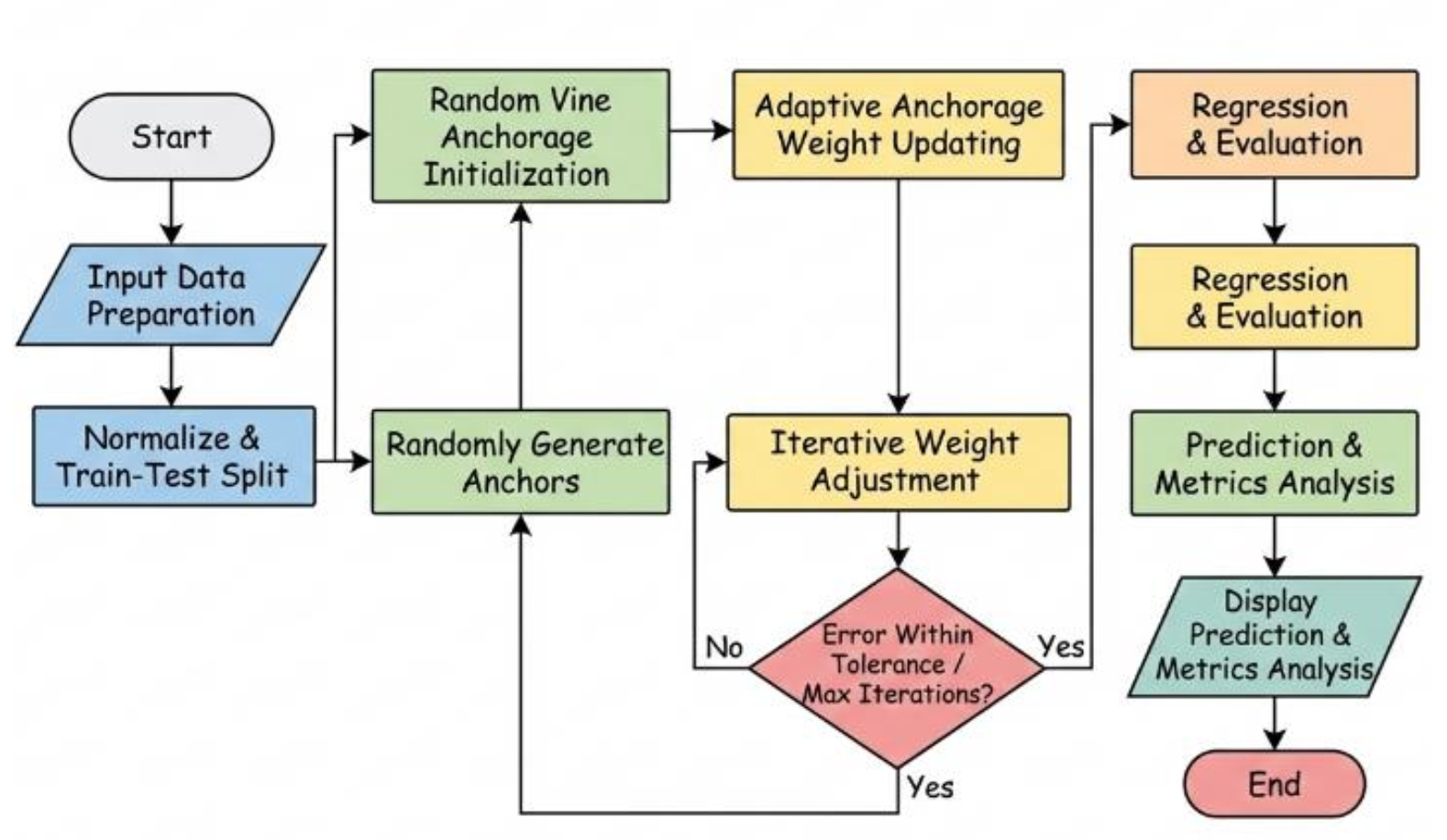
This study proposes a novel regression algorithm termed the Random Vine Anchorage Mechanism (RVAM), inspired by adaptive anchoring behaviors observed in climbing vines. Unlike conventional regression approaches that rely on fixed feature weighting or global optimization objectives, RVAM introduces an anchorage-based learning strategy that dynamically reinforces informative features while attenuating redundant or weakly relevant ones through a vine-structured dependency model.The primary objective of this research is to enhance regression performance under challenging data conditions, including high dimensionality, feature correlation, and noise perturbation. To achieve this, RVAM integrates three key mechanisms: adaptive feature anchorage initialization, random vine-based dependency modeling, and normalized anchorage weight updating. These components jointly enable the proposed algorithm to capture complex feature interactions while maintaining robustness and numerical stability.The effectiveness of RVAM is evaluated using multiple benchmark datasets specifically designed for regression analysis. Experimental results demonstrate that the proposed method consistently outperforms conventional regression models, including linear regression, LASSO, Elastic Net, Random Forest, and Gradient Boosting, across multiple evaluation metrics such as Mean Squared Error (MSE), Root Mean Squared Error (RMSE), Mean Absolute Error (MAE), coefficient of determination (R²), and Mean Absolute Percentage Error (MAPE). On average, RVAM achieves performance improvements ranging from 8% to 15% compared with baseline methods, particularly in datasets characterized by multicollinearity and complex feature dependencies. These findings highlight the potential of biologically inspired anchorage mechanisms as an effective and generalizable strategy for improving regression performance in complex engineering and data-driven applications.
References
] J. L. Sztepanacz and D. Houle, “Regularized regression can improve estimates of multivariate selection in the face of
multicollinearity and limited data,” in Evolution Letters, 2024..
F. Wen, Y. Su, D. Liu, Y. Wang, and M. Liu, “Automated sparse feature selection in high-dimensional proteomics data
via 1-bit compressed sensing and K-Medoids clustering,” in BMC Bioinformatics, 2025.
Z. Wang, F. Yuan, R. Li, M. Zhang and X. Luo, “Hidden AS link prediction based on random forest feature selection
and GWO-XGBoost model,” Computer Network, 2025.
J. Friedman, T. Hastie and R. Tibshirani, Lasso and elastic-net regularized generalized linear models,” Astrophysics, vol.
, 2023.
[ 5 ] O, Sahin and C. Czado, “High-dimensional sparse vine copula regression with application to genomic prediction,”
Biometrics, vol. 80, no. 2, pp. 511–530, 2024.
[ 6 ] Y. He, C. Zou and Y. Zhao, “Covariance Regression with High-Dimensional Predictors,” arXiv preprint
arXiv:2404.06701, 2024..
A. Zhao, C. Li, R. Li and Z. Zhang, “Testing high-dimensional regression coefficients in linear models,” The Annals of
Statistics, 2024.
Y. Zuo and H. Zuo, “Weighted least squares regression with the best robustness and high computability,” Axioms, vol.
, no. 5, Art. no. 295, 2024.
S. Chakraborty, K. Khare, and G. Michailidis, “A generalized Bayesian approach for high-dimensional robust regression
with serially correlated errors and predictors,” arXiv preprint, arXiv:2412.05673, 2024.
R. Ibragimov, J. Kim, and A. Skrobotov, “New robust inference for predictive regressions,” Econometric Theory, vol.
, no. 6, pp. 1364–1390, 2024.
M. Marchese, M. D. Martínez-Miranda, and J. P. Nielsen, “Robustifying and simplifying high-dimensional regression
with applications to stock return and telematics data,” Financial Innovation, vol. 10, Art. no. 138, 2024.
Y. Jin and D. Rothenhäuser, “Modular regression: Improving linear models by incorporating auxiliary data,” Journal of
Machine Learning Research, vol. 24, pp. 1–52, 2023.
[ 1 3 ] E. Kraev, B. Koseoglu, L. Traverso, and M. Topiwalla, “SHAP-Select: Lightweight feature selection using SHAP
values and regression,” arXiv preprint, arXiv:2410.06815, 2024.
H. Khoshvaght, R. R. Permala, A. Razmjou, and M. Khiadani, “A critical review on selecting performance evaluation
metrics for supervised machine learning models in wastewater quality prediction,” Journal of Environmental Chemical
Engineering, Art. no. 1196754, 2025.
[ 1 5 ] X. Wang, Y. Jin, S. Schmitt and M. Olhofer, “Recent advances in Bayesian optimization ACM computing surveys,
[ 1 6 ] SH. Masteali, M. Bayat, P. Bettinger and M. Ghorbanpour, “Uncertainty analysis of linear and non-linear regression
models in the modeling of water quality in the Caspian Sea basin: Application of Monte-Carlo method Ecological Indicators,
[ 1 7 ] P. Dumre and S Bhattarai, “Optimizing linear regression models: A comparative study of error metrics,” IEEE-
(ICTACS), 2024.
[ 1 8 ] A. Puppala, “A comprehensive review of linear regression models: Theory, applications, and advanced techniques,”
International Journal of Machine Learning and Cybernetics, vol. 3, no. 1, pp. 1–6, Apr. 2025.
NK. Kumar, “Autocorrelation and heteroscedasticity in regression analysis,” Journal of Business and Social Sciences,
[ 2 0 ] MM. Mundu, JI. Sempewo and A. Goparaju, “Comparative analysis of model evaluation metrics in energy systems,
environmental modeling, and sustainability science,” International Journal of Energy Research, 2026.
[ 2 1 ] AS. Marco, JD. Kirwan and A. Toumpa, “ Uncertainty Quantification for Deep Regression using Contextualised
Normalizing Flows,” arXiv preprint arXiv:2512.00835, 2025.
Downloads
Published
How to Cite
Issue
Section
License

This work is licensed under a Creative Commons Attribution-NonCommercial-NoDerivatives 4.0 International License.