Structural Equation Modeling for Successful Water Management in the Northeastern Mekong River Basin under the Royal Irrigation Department
Keywords:
Leadership, Learning Organization, Farmer Participation, Environmental Conditions, Water Management to SuccessAbstract
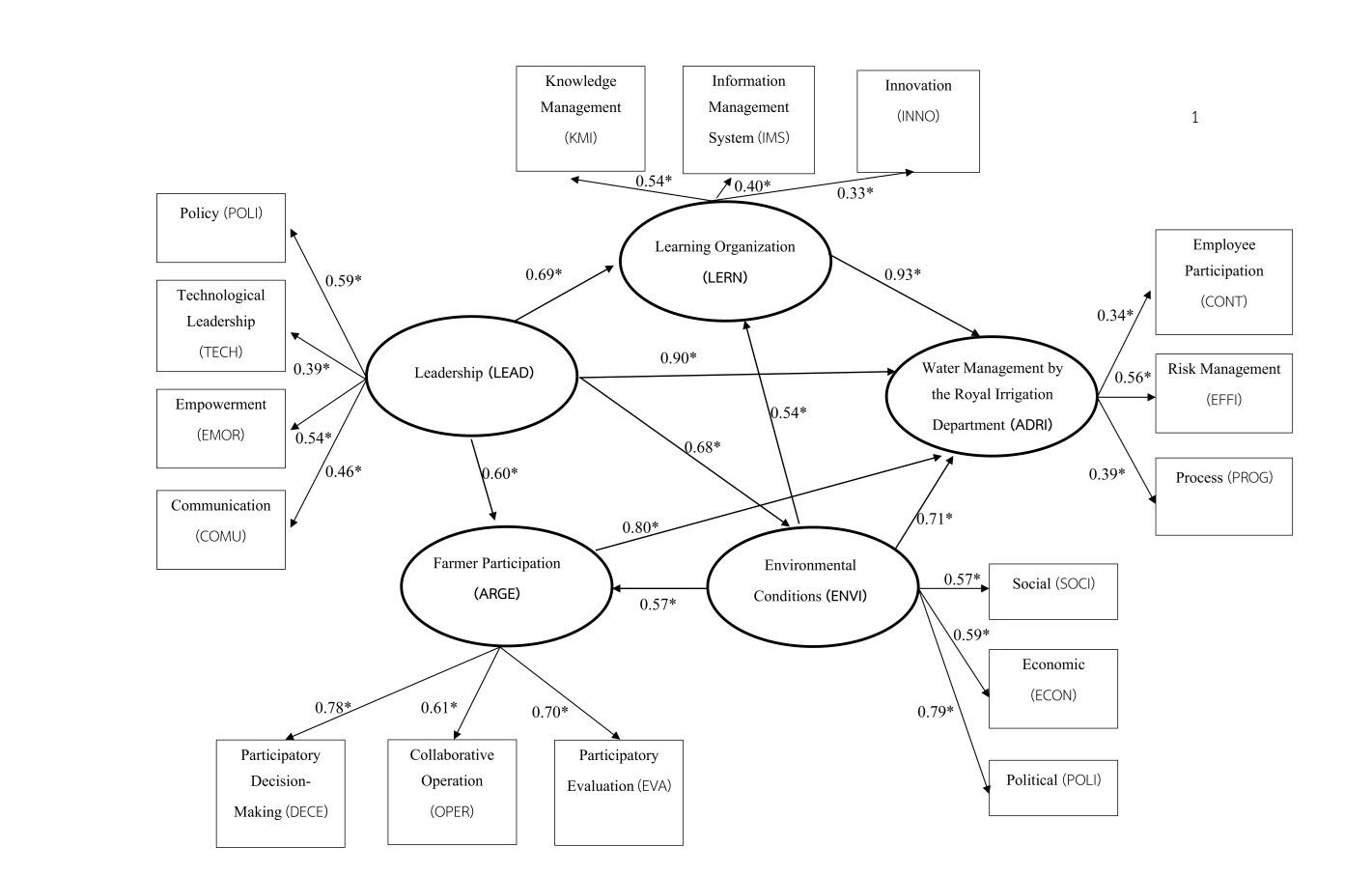
This study aims to: (1) examine the influence of causal factors that affect the success of water management, and (2) verify the consistency of the developed model with empirical data. This is a quantitative research study that employed questionnaires distributed to 375 staff members responsible for water management under the Royal Irrigation Department in the Northeastern Mekong River Basin. The participants were from 15 agencies and had at least one year of work experience. The data were analyzed using Structural Equation Modeling (SEM) techniques. The findings from the quantitative research were also analyzed qualitatively using the documentary analysis method. The results revealed that: (1) Continuous quality improvement, becoming a learning organization, leadership, farmer participation, and environmental conditions all had a statistically significant influence (at the 0.05 level) on the success of water management by the Royal Irrigation Department, with influence values of 0.93, 0.90, 0.80, and 0.71, respectively. Therefore, a key strategy for the Royal Irrigation Department to achieve successful water management involves the proper and timely management of a learning organization in response to changing circumstances. Furthermore, there is an urgent need to enhance the efficiency and effectiveness of leadership, farmer participation, and environmental management to ensure sustainable water management development in the future.
References
Royal Irrigation Department, January 2025. Available: https://www.rid.go.th/index.php/en/
vision-mission
Office of the National Economic and Social Development Council (NESDB), January 2025. Available: http://www.
nesdb.go.th/nesdb_en/more_news.php?cid=154&filename=index
National Statistic Office Ministry of Information and Communication Technology, January 2025. Available: http://web.
nso.go.th/index.htm
Department of Alternative Energy Development and Efficiency, January 2025. Available: http://www.dede.go.th/
ewtadmin/ewt/dede_web/ewt_news.php?nid=47140
P. Sutthichaimethee, “Forecasting Economic, Social and Environmental Growth in the Sanitary and Service Sector Based on
Thailand’s Sustainable Development Policy,” Journal of Ecological Engineering, vol.19, no.1, pp.205–210, 2018.
United Nations Framework Convention on Climate Change, “Global Progress in Environmental Law,” Environmental Policy
and Law, vol.46, no.1, pp.23–27, 2016.
United Nations, The World Population in 2014, New York, 2014.
United Nations. University of Oslo, “Walter Wallace Wheel,” January 2025. Available: http://www.uio.no/
studier/emner/matnat/ifi/INF5180/v10/undervisningsmateriale/handouts/09_WWHEEL315.
Pollution Control Department Ministry of Natural Resources and Environment, Enhancement and Conservation of National Environmental Quality Act, B.E. 2535, December 2023. Available: http://www.pcd.go.th/info_serv/reg_
envi.html
The World Bank, “Energy Use (Kg of Oil Equivalent Per Capita),” February 2025. Available: https://data.
worldbank.org/indicator/EG.USE.PCAP.KG.OE
DEPA Thailand, January 2025. Available: https://www.depa.or.th/en/digitalservice/smartcity/
smart%20city%20manaul
Thailand Greenhouse Gas Management Organization (Public Organization), “Net Zero GHG Emissions,” February 2025. Available: https://thaicarbonlabel.tgo.or.th/tools/files.php?mod=
YjNKbllXNXBlbUYwYVc5dVgyUnZkMjVzYjJGaw&type=WDBaSlRFVlQ&files=TkRrPQ
National Statistical Office Ministry of Information and Communication Technology, February 2025. Available: http:
//web.nso.go.th/index.htm
OECD, “Historical Crude Oil Import Prices (Indicator),” February 2025. Available: https://data.oecd.org/
energy/crude-oil-import-prices.htm
Office of Natural Resources and Environmental Policy and Planning (ONEP), “Thailand’s Fourth Biennial Update Report,”
February 2025. Available: https://www.onep.go.th
J. Fernandez, “Environmental implications of trade liberalization on North American transport services: the case of the
trucking sector,” Int Environ Agreements, vol.10, pp.133–145, 2010.
I.A. Quesada and H.P. Weikard, “International Environmental Agreements for biodiversity conservation: a game-theoretic
analysis,” Int Environ Agreements, vol.17, pp.731–754, 2017.
N. Busscher, C. Parra and F. Vanclay, “Environmental justice implications of land grabbing for industrial agriculture and
forestry in Argentina,” Journal of Environmental Planning and Management, vol.63, no.3, pp.500–522, 2020. Available:
https://doi.org/10.1080/09640568.2019.1595546
D.A. Dickey and W.A. Fuller, “Likelihood ratio statistics for autoregressive time series with a unit root,” Econometrica,
vol.49, pp.1057–1072, 1981.
S. Johansen and K. Juselius, “Maximum likelihood estimation and inference on cointegration with applications to the
demand for money,” Oxford Bulletin of Economics and Statistics, vol.52, pp.169–210, 1990.
S. Johansen, Likelihood-Based Inference in Cointegrated Vector Autoregressive Models, New York: Oxford University
Press, 1995.
W. Enders, Applied Econometrics Time Series; Wiley Series in Probability and Statistics, Tuscaloosa: University of Alabama, 2010.
A.C. Harvey, Forecasting, Structural Time Series Models and the Kalman Filter, Cambridge: Cambridge University Press,
C.A. Sims, “Macroeconomics and Reality,” Econometrica, vol.48, pp.1–48, 1980.
B.M. Byrne, Structural Equation Modeling with AMOS: Basic Concepts, Applications, and Programming, London: Routledge, 2009.
K. Dooley and A. Gupta, “Governing by expertise: the contested politics of (accounting for) land-based mitigation in a new
climate agreement,” Int Environ Agreements, vol.17, pp.483–500, 2017.
B. Sandler, “Grow or Die: Marxist Theories of Capitalism and the Environment,” Rethinking Marxism, vol.7, no.2,
pp.38–57, 1994.
D.E. van Norren, “The Sustainable Development Goals viewed through Gross National Happiness, Ubuntu, and Buen
Vivir,” Int Environ Agreements, vol.20, pp.431–458, 2020.
C.A. Senit, “Transforming our world? Discursive representation in the negotiations on the Sustainable Development Goals,” ´
Int Environ Agreements, vol.20, pp.411–429, 2020.
T.S. Faran and L. Olsson, “Geoengineering: neither economical, nor ethical—a risk–reward nexus analysis of carbon
dioxide removal,” Int Environ Agreements, vol.18, pp.63–77, 2018.
W. Bardi, S.E. Ayouni and M. Hamdaoui, “Are structural policies in countries bordering Mediterranean appropriate to
economic convergence: Panel ARDL Application,” Cogent Economics & Finance, vol.7, no.1, pp.2–20, 2019.
V. Mykhnenko and M. Wolff, “State rescaling and economic convergence,” Regional Studies, vol.53, no.4, pp.462–477,
A.M. Bocse, “Hybrid transnational advocacy networks in environmental protection: banning the use of cyanide in European
gold mining,” Int Environ Agreement, 2020. Available: https://doi.org/10.1007/s10784-020-09492-6
Y. Shen and M. Faure, “Green building in China,” Int Environ Agreements, 2020. Available: https://doi.org/10.
/s10784-020-09495-3
S. Switzer, L. Gerber and F. Sindico, “Access to Minerals: WTO Export Restrictions and Climate Change Considerations,”
Laws, vol.4, pp.617–637, 2015.
J. Handrlica and V. Sancin, “Earthquakes in nuclear liability conventions: a study in international disaster law,” Journal of
Energy & Natural Resources Law, 2020.
A. Gupta, T. Pistorius and M.J. Vijge, “Managing fragmentation in global environmental governance: the REDD+ Partnership as bridge organization,” Int Environ Agreements, vol.16, pp.355–374, 2016.
P. Sutthichaimethee, “Model of Environmental Problems Priority Arising from the Use of Environmental and Natural
Resources in Machinery Sectors of Thailand,” Environmental and Climate Technologies, vol.17, no.1, pp.18–29, 2016.
P. Sutthichaimethee, “Varimax Model to Forecast the Emission of Carbon Dioxide from Energy Consumption in Rubber
and Petroleum Industries Sectors in Thailand,” Journal of Ecological Engineering, vol.18, no.3, pp.112–117, 2017.
P. Sutthichaimethee and B. Dockthaisong, “A Relationship of Causal Factors in the Economic, Social, and Environmental
Aspects Affecting the Implementation of Sustainability Policy in Thailand: Enriching the Path Analysis Based on a GMM
Model,” Resources, vol.7, no.4, pp.87, 2018.
P. Sutthichaimethee and D. Ariyasajjakorn, “Forecasting Model of GHG Emission in Manufacturing Sectors of Thailand,”
Journal of Ecological Engineering, vol.18, no.1, pp.18–24, 2018.
P. Sutthichaimethee and D. Ariyasajjakorn, “Forecast of Carbon Dioxide Emissions from Energy Consumption in Industry
Sectors in Thailand,” Environmental and Climate Technologies, vol.22, no.1, pp.107–117, 2018.
P. Sutthichaimethee and K. Kubaha, “A Relational Analysis Model of the Causal Factors Influencing CO2 in Thailand’s
Industrial Sector under a Sustainability Policy Adapting the VARIMAX-ECM Model,” Energies, vol.11, no.7, 1704, 2018.
P. Sutthichaimethee and D. Ariyasajjakorn, “A Forecasting Model on Carrying Capacity for Government’s Controlling
Measure under Environmental Law in Thailand: Adapting Non-recursive Autoregression Based on the Var-X Model,” International Journal of Energy Economics and Policy, vol.10, no.6, pp.645–655, 2018.
P. Sutthichaimethee and D. Ariyasajjakorn, “The revised input-output table to determine total energy content and total
greenhouse gas emission factors in Thailand,” Journal of Ecological Engineering, vol.18, no.6, pp.166–170, 2017.
P. Sutthichaimethee, D. Tandamrong, S. Ouansrimeang and K. Kidrakarn, “A Model for Determining the Effectiveness of
Regulatory and Administrative Measures of Sustainability Policy in Thailand,” Engineering Access, vol.10, no.2, pp.103–113,
Downloads
Published
How to Cite
Issue
Section
License

This work is licensed under a Creative Commons Attribution-NonCommercial-NoDerivatives 4.0 International License.