SEM-SAM Model for Strategic Management Toward Efficient and Sustainable Emerging Industries for Sustainable Future
Keywords:
Industrial sector, management efficiency, sustainable development, development strategy, carbon neutralityAbstract
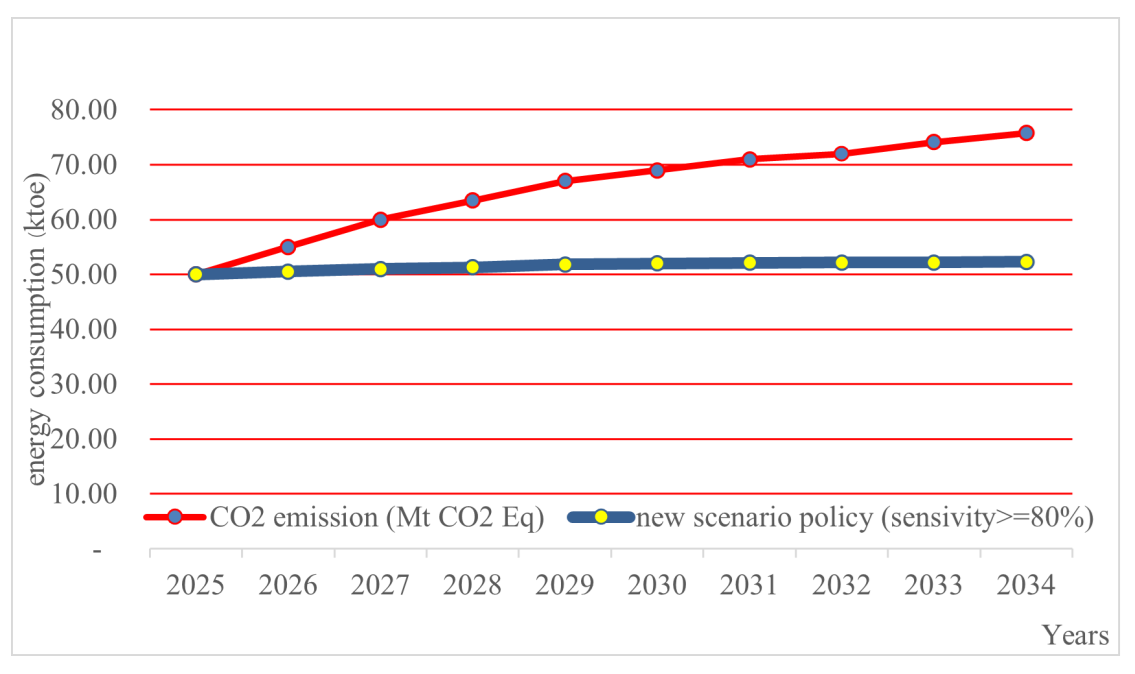
This research aims to develop a model to define the causal relationships of factors influencing future energy consumption in Thailand’s industrial sectors, aligned with the country’s sustainable development goals. The study proposes a Structural Equation Modeling based on the Social Accounting Matrix (SEM-SAM model) as a key tool for effective national management in line with the carbon neutrality target by 2050. The findings reveal that from 1992 to 2025, there has been consistent growth in both the economic and social sectors. However, this growth has simultaneously led to significant environmental degradation. The study indicates that CO2 emissions resulting from industrial energy consumption have surpassed the carrying capacity threshold of 65.05 Mt CO2 Eq. (2025-2034), with a growth rate (2034/2025) of 30.45%, reaching 75.01 Mt CO2 Eq. (2025-2034) during this period. As a solution, the research introduces a new scenario policy that incorporates increased use of biodiesel fuel and clean technologies, which helps reduce CO2 emissions to only 45.05 Mt CO2 Eq. (2025-2034). These findings highlight the potential of the proposed model as a decision-making tool for steering national policy toward a sustainable future.
References
P. Sutthichaimethee, W. Sa-Ngiamvibool, P. Thanarak, J. Luo, and S. Wattana, “A long-term CO2 emission forecasting
under sustainability policy using an advanced model complementing the paarimax framework,” Agriculture, vol. 14, no. 12,
p. 2342, 2024.
W. Bardi, S. Ayouni, and M. Hamdaoui, “Are structural policies in countries bordering mediterranean appropriate to economic convergence: Panel ardl application,” Cogent Economics & Finance, vol. 7, no. 1, pp. 2–20, 2019.
P. Sutthichaimethee, P. Saraphirom, and C. Junsiri, “An advanced model for greenhouse gas emission reduction in the
agricultural sector to achieve sustainability for thailand’s future,” Applied Sciences, vol. 15, no. 4, p. 2160, 2025.
P. Sutthichaimethee, W. Sa-Ngiamvibool, B. Wattana, J. Luo, and S. Wattana, “Enhancing sustainable strategic governance for energy-consumption reduction towards carbon neutrality in the energy and transportation sectors,” Sustainability,
vol. 17, no. 6, p. 2659, 2025.
Office of the National Economic and Social Development Council (NESDB), “March 2025,” http://www.nesdb.go.th/nesdb
en/more news.php?cid=154&filename=index, 2025, accessed March 2025.
National Statistic Office Ministry of Information and Communication Technology, “March 2025,” http://web.nso.go.th/i.
dex.htm, 2025, accessed March 2025.
P. Sutthichaimethee, G. Mentel, V. Voloshyn, H. Mishchuk, and Y. Bilan, “Modeling the efficiency of resource consumption
management in construction under sustainability policy: Enriching the dsem-arima model,” Sustainability, vol. 16, no. 24,
p. 10945, 2024.
P. Sutthichaimethee, P. Saraphirom, and C. Junsiri, “Long-term strategy for determining the potential of climate-smart
agriculture to maximize efficiency under sustainability in thailand,” Sustainability, vol. 17, no. 8, p. 3635, 2025.
Department of Alternative Energy Development and Efficiency, “January 2025,” http://www.dede.go.th/ewtadmin/ewt/
dede web/ewt news.php?nid=47140, 2025, accessed January 2025.
P. Sutthichaimethee, “Forecasting economic, social and environmental growth in the sanitary and service sector based on
thailand’s sustainable development policy,” Journal of Ecological Engineering, vol. 19, no. 1, pp. 205–210, 2018.
United Nations Framework Convention on Climate Change, UNFCCC, “Global progress in environmental law,” Environmental Policy and Law, vol. 46, no. 1, pp. 23–27, 2016.
P. Sutthichaimethee, P. Saraphirom, and C. Junsiri, “Efficiency of national governance in managing long-term greenhouse
gas emission reduction in the agricultural sector towards the thailand 5.0 goal,” Sustainability, vol. 17, no. 9, p. 3959, 2025.
United Nations. University of Oslo, “Walter wallace wheel,” http://www.uio.no/studier/emner/matnat/ifi/INF5180/v10/
undervisningsmateriale/handouts/09 WWHEEL315.pdf, 2015, accessed March 2025.
Pollution Control Department Ministry of Natural Resources and Environment, “Enhancement and conservation of national
environmental quality act, b.e. 2535,” http://www.pcd.go.th/info serv/reg envi.html, 2023, accessed December 2023.
The World Bank, “Energy use (kg of oil equivalent per capita),” https://data.worldbank.org/indicator/EG.USE.PCAP.KG.
OE, 2025, accessed March 2025.
DEPA Thailand, “Smart city manual,” https://www.depa.or.th/en/digitalservice/smartcity/smart%20city%20manaul, 2025,
accessed January 2025.
Thailand Greenhouse Gas Management Organization, “Net zero ghg emissions,” https://thaicarbonlabel.tgo.or.th/tools/files.
php?mod=YjNKbllXNXBlbUYwYVc5dVgyUnZkMjVzYjJGaw&type=WDBaSlRFVlQ&files=TkRrPQ, 2025, accessed
March 2025.
National Statistical Office Ministry of Information and Communication Technology, “March 2025,” http://web.nso.go.th/
index.htm, 2025.
C. Junsiri, P. Sutthichaimethee, and N. P. a ran, “Efficiency of national governance in managing long-term greenhouse gas
emission reduction in the agricultural sector towards the thailand 5.0 goal,” Forecasting, vol. 6, no. 3, pp. 485–501, 2024.
D. Dickey and W. Fuller, “Likelihood ratio statistics for autoregressive time series with a unit root,” Econometrica, vol. 49,
pp. 1057–1072, 1981.
S. Johansen and K. Juselius, “Maximum likelihood estimation and inference on cointegration with applications to the
demand for money,” Oxford Bulletin of Economics and Statistics, vol. 52, pp. 169–210, 1990.
P. Sutthichaimethee, P. Saraphirom, and C. Junsiri, “A path analysis—generalized method of moments based on a nearestneighbor with observed variable model for developing new scenario policies to reduce greenhouse gas emissions from
agricultural waste towards sustainability,” Applied Sciences, vol. 15, no. 4, p. 2160, 2025.
S. Johansen, Likelihood-Based Inference in Cointegrated Vector Autoregressive Models. New York: Oxford University
Press, 1995.
W. Enders, Applied Econometrics Time Series; Wiley Series in Probability and Statistics. Tuscaloosa: University of
Alabama, 2010.
A. Harvey, Forecasting, Structural Time Series Models and the Kalman Filter. Cambridge: Cambridge University Press,
C. A. Sims, “Macroeconomics and reality,” Econometrica, vol. 48, pp. 1–48, 1980.
B. Byrne, Structural Equation Modeling with AMOS: Basic Concepts, Applications, and Programming. London: Routledge, 2009.
P. Sutthichaimethee and B. Dockthaisong, “A relationship of causal factors in the economic, social, and environmental
aspects affecting the implementation of sustainability policy in Thailand: Enriching the path analysis based on a GMM
model,” Resources, vol. 7, no. 4, p. 87, 2018.
P. Sutthichaimethee and D. Ariyasajjakorn, “Forecasting model of GHG emission in manufacturing sectors of thailand,”
Journal of Ecological Engineering, vol. 18, no. 1, pp. 18–24, 2018.
——, “Forecast of carbon dioxide emissions from energy consumption in industry sectors in thailand,” Environmental and
Climate Technologies, vol. 22, no. 1, pp. 107–117, 2018.
Downloads
Published
How to Cite
Issue
Section
License

This work is licensed under a Creative Commons Attribution-NonCommercial-NoDerivatives 4.0 International License.