Optimization-Based Tuning of a Cascaded PDN–PI Controller for Frequency Regulation in Solar PV–Powered Thermal Systems
Keywords:
Load Frequency Control, PDN–PI Controller, Water Cycle Algorithm, Catch Fish Optimization Algorithm, Grey Wolf OptimizerAbstract
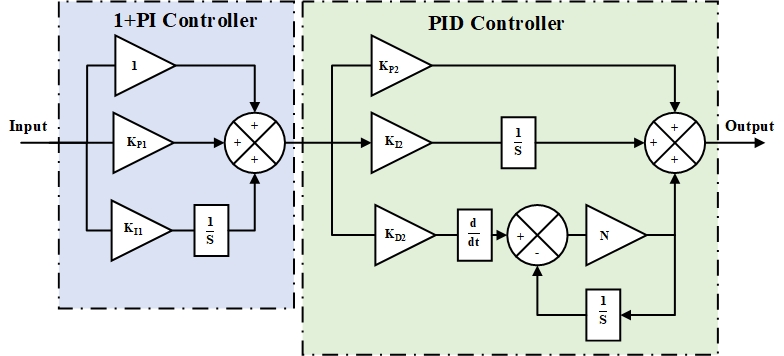
In modern power systems, Load Frequency Control (LFC) is crucial for maintaining system stability, especially in grids with substantial integration of variable renewable energy sources. This paper presents an innovative cascaded PDN–PI controller that hierarchically integrates a Proportional–Derivative with Filter (PDN) stage to mitigate rapid oscillations and a Proportional–Integral (PI) stage to eradicate steady-state faults. The suggested structure utilizes derivative filtering to reduce noise and preserve long-term accuracy, hence improving robustness in hybrid photovoltaic (PV)–thermal power systems, in contrast to traditional cascaded controllers. Five controller gains were optimized for optimal parameter tuning using three metaheuristic algorithms: Water Cycle Algorithm (WCA), Catch Fish Optimization Algorithm (CFOA), and Grey Wolf Optimizer (GWO), with the Integral of Time-weighted Absolute Error (ITAE) as the objective function. A two-area load frequency control (LFC) system was modeled, comprising a photovoltaic (PV) generation system and a reheat thermal power plant interconnected via a tie-line. The simulation findings for two load disturbance scenarios indicated that the suggested PDN–PI controller markedly surpassed conventional PI control, exhibiting enhanced damping, less overshoot, and expedited settling times. Among the optimization strategies, GWO demonstrated superior convergence and resilience, producing the lowest ITAE values and maintaining constant stability among parameter fluctuations. This study's contributions include (i) the development of an innovative cascaded PDN–PI controller specifically designed for renewable-integrated LFC systems, (ii) comparative metaheuristic optimization of its parameters, and (iii) robustness evaluation via sensitivity analysis. These findings offer novel insights into controller design for hybrid power systems and underscore prospective avenues for real-time and hardware-in-the-loop validation
References
C. Li et al., ”Continuous Under-Frequency Load Shedding Scheme for Power System Adaptive Frequency Control,” IEEE
Transactions on Power Systems, vol. 35, no. 2, pp. 950-961, 2020, doi: 10.1109/TPWRS.2019.2943150.
J. Hu, J. Cao, J. M. Guerrero, T. Yong, and J. Yu, ”Improving Frequency Stability Based on Distributed Control of Multiple
Load Aggregators,” IEEE Transactions on Smart Grid, vol. 8, no. 4, pp. 1553-1567, 2017, doi: 10.1109/TSG.2015.2491340.
W. Zhang et al., ”Photoelectric coupling enhanced absorbers for boosting thermoelectric generation,” Journal of Materials
Science and Technology, Article vol. 249, pp. 99-108, 2026, doi: 10.1016/j.jmst.2025.05.054.
J. T. Bialasiewicz, ”Renewable Energy Systems With Photovoltaic Power Generators: Operation and Modeling,” IEEE
Transactions on Industrial Electronics, vol. 55, no. 7, pp. 2752-2758, 2008, doi: 10.1109/TIE.2008.920583.
E. Du et al., ”The Role of Concentrating Solar Power Toward High Renewable Energy Penetrated Power Systems,” IEEE
Transactions on Power Systems, vol. 33, no. 6, pp. 6630-6641, 2018, doi: 10.1109/TPWRS.2018.2834461.
Z. Aminov, V. Noudeng, T. D. Xuan, E. Matjanov, and A. Kholbekov, ”A novel integrated sorption enhanced cogasification
combined cycle and blue hydrogen production,” Fuel, Article vol. 404, 2026, Art no. 136215, doi:
1016/j.fuel.2025.136215.
S. Saat, M. A. Ahmad, and M. R. Ghazali, ”Data-driven brain emotional learning-based intelligent controller-PID control
of MIMO systems based on a modified safe experimentation dynamics algorithm,” International Journal of Cognitive
Computing in Engineering, Article vol. 6, pp. 74-99, 2025, doi: 10.1016/j.ijcce.2024.11.005.
Z. Guo et al., ”Dual tracking model-free predictive control for three-level neutral-point clamped inverters,” Electric Power
Systems Research, Article vol. 249, 2025, Art no. 112054, doi: 10.1016/j.epsr.2025.112054.
H. M.Wu and M. Q. Zaman, ”Enhanced Hierarchical Fuzzy Formation Control with fuzzy collision avoidance behavior for
multiple Mecanum wheeled Mobile Robots,” Robotics and Autonomous Systems, Article vol. 194, 2025, Art no. 105124,
doi: 10.1016/j.robot.2025.105124.
S. Guler, ”Soliton inspired hybrid active vibration control method for shock-induced transient vibrations: Numerical
perspective,” International Journal of Non-Linear Mechanics, Article vol. 178, 2025, Art no. 105198, doi:
1016/j.ijnonlinmec.2025.105198.
J. Hussain, R. Zou, Z. Wu, P. K. Pathak, and S. Akhtar, ”Design and Performance Analysis of Walrus Optimization Algorithm
(WaOA)-Based Cascade Controller for Load Frequency Control of a Multi-Area Power System With Renewable
Sources,” International Journal of Numerical Modelling: Electronic Networks, Devices and Fields, Article vol. 38, no. 2,
, Art no. e70046, doi: 10.1002/jnm.70046.
D. Izci et al., ”Master–Slave Architecture Enhanced and Improved GBO Tuned Cascaded PI-PDN Controller for Speed
Regulation of DC Motors,” Optimal Control Applications and Methods, Article 2025, doi: 10.1002/oca.3313.
Z. Wang, J. Zhang, Z. Wang, H. Wang, and Z. Bai, ”Research on optimization strategy for steel strip temper rolling
elongation based on model predictive control,” Engineering Applications of Artificial Intelligence, Article vol. 159, 2025,
Art no. 111785, doi: 10.1016/j.engappai.2025.111785.
E. S¸ ahin and B. C¸ avdar, ”A novel fractional order delay-based PIR controller concept to enhance frequency regulation of a
PV-reheat thermal power system under non-linearity and cyber attack,” Computers and Electrical Engineering, Article vol.
, 2025, Art no. 110240, doi: 10.1016/j.compeleceng.2025.110240.
S. Ekinci, O. Can, M. S. Ayas, D. Izci, M. Salman, and M. Rashdan, ”Automatic Generation Control of a Hybrid PV-Reheat
Thermal Power System Using RIME Algorithm,” IEEE Access, Article vol. 12, pp. 26919-26930, 2024, doi: 10.1109/ACCESS.
3367011.
B. Cavdar, E. Sahin, E. Sesli, O. Akyazi, and F. M. Nuroglu, ”Cascaded fractional order automatic generation control of
a PV-reheat thermal power system under a comprehensive nonlinearity effect and cyber-attack,” Electrical Engineering,
Article vol. 105, no. 6, pp. 4339-4360, 2023, doi: 10.1007/s00202-023-01943-y.
S. K. Ojha and C. O. Maddela, ”Load frequency control of a two-area power system with renewable energy sources
using brown bear optimization technique,” Electrical Engineering, Article vol. 106, no. 3, pp. 3589-3613, 2024, doi:
1007/s00202-023-02143-4.
Y. Arya, ”AGC of two-area electric power systems using optimized fuzzy PID with filter plus double integral controller,”
Journal of the Franklin Institute, Article vol. 355, no. 11, pp. 4583-4617, 2018, doi: 10.1016/j.jfranklin.2018.05.001.
A. A. Abou El-Ela, R. A. El-Sehiemy, A. M. Shaheen, and A. E. G. Diab, ”Design of cascaded controller based on coyote
optimizer for load frequency control in multi-area power systems with renewable sources,” Control Engineering Practice,
Article vol. 121, 2022, Art no. 105058, doi: 10.1016/j.conengprac.2021.105058.
B. Dekaraja and L. C. Saikia, ”Combined Voltage and Frequency Control of Multiarea Multisource System Using
CPDN-PIDN Controller,” IETE Journal of Research, Article vol. 69, no. 9, pp. 6457-6472, 2023, doi:
1080/03772063.2021.2004456.
S. Ekinci, D. Izci, O. Can, M. Bajaj, and V. Blazek, ”Frequency regulation of PV-reheat thermal power system via a novel
hybrid educational competition optimizer with pattern search and cascaded PDN-PI controller,” Results in Engineering,
Article vol. 24, 2024, Art no. 102958, doi: 10.1016/j.rineng.2024.102958.
J. Zhang, L. Li, D. G. Dorrell, and Y. Guo, ”Modified PI controller with improved steady-state performance and comparison
with PR controller on direct matrix converters,” Chinese Journal of Electrical Engineering, vol. 5, no. 1, pp. 53-66, 2019,
doi: 10.23919/CJEE.2019.000006.
K. Orman, ”Design of a Memristor-Based 2-DOF PI Controller and Testing of Its Temperature Profile Tracking in a Heat
Flow System,” IEEE Access, vol. 10, pp. 98384-98390, 2022, doi: 10.1109/ACCESS.2022.3206022.
S. P. Simon, L. Dewan, and M. P. R. Prasad, ”Design and Analysis of ITAE Tuned Robust PID Controller for Brushed
DC Motor,” in 2022 IEEE Silchar Subsection Conference (SILCON), 4-6 Nov. 2022, pp. 1-6, doi: 10.1109/SILCON55242.2022.10028938.
W. Xu, X. Yue, S. Yin, H. Wang, and S. Zhang, ”Research on PID Parameter Tuning Method of Brushless DC Motor
with ITAE Index,” in 2023 IEEE 6th Information Technology, Networking, Electronic and Automation Control Conference
(ITNEC), 24-26 Feb. 2023, vol. 6, pp. 177-180, doi: 10.1109/ITNEC56291.2023.10082641.
S. Kakkar et al., ”Design and Control of Grid-Connected PWM Rectifiers by Optimizing Fractional Order PI Controller
Using Water Cycle Algorithm,” IEEE Access, vol. 9, pp. 125941-125954, 2021, doi: 10.1109/ACCESS.2021.3110431.
H. Eskandar, A. Sadollah, A. Bahreininejad, and M. Hamdi, ”Water cycle algorithm – A novel metaheuristic optimization
method for solving constrained engineering optimization problems,” Computers & Structures, vol. 110-111, pp. 151-166,
, doi: 10.1016/j.compstruc.2012.07.010.
C. Lv and G. Long, ”Energy-efficient cluster head selection in Internet of Things networks using an optimized evaporation
rate water-cycle algorithm,” Journal of Engineering and Applied Science, Article vol. 72, no. 1, 2025, Art no. 34, doi:
1186/s44147-025-00603-1.
G. Al-Rawashdeh, R. Mamat, and N. H. B. A. Rahim, ”Hybrid Water Cycle Optimization Algorithm With Simulated Annealing
for Spam E-mail Detection,” IEEE Access, vol. 7, pp. 143721-143734, 2019, doi: 10.1109/ACCESS.2019.2944089.
H. Jia, Q. Wen, Y. Wang, and S. Mirjalili, ”Catch fish optimization algorithm: a new human behavior algorithm for solving
clustering problems,” Cluster Computing, vol. 27, no. 9, pp. 13295-13332, 2024, doi: 10.1007/s10586-024-04618-w.
Z. Fu, Z. Li, Y. Li, and H. Chen, ”MICFOA: A Novel Improved Catch Fish Optimization Algorithm with Multi-Strategy
for Solving Global Problems,” Biomimetics, vol. 9, no. 9, p. 509, 2024. [Online]. Available: https://www.mdpi.com/2313-
/9/9/509.
S. Mirjalili, S. M. Mirjalili, and A. Lewis, ”Grey Wolf Optimizer,” Advances in Engineering Software, vol. 69, pp. 46-61,
, doi: 10.1016/j.advengsoft.2013.12.007.
Y. Liu, A. As’arry, M. K. Hassan, A. A. Hairuddin, and H. Mohamad, ”Review of the grey wolf optimization algorithm:
variants and applications,” Neural Computing and Applications, vol. 36, no. 6, pp. 2713-2735, 2024, doi: 10.1007/s00521-
-09202-8.
Downloads
Published
How to Cite
Issue
Section
License

This work is licensed under a Creative Commons Attribution-NonCommercial-NoDerivatives 4.0 International License.