Post-Quantum CRYSTALS-Kyber with Thai Text Seeds: Unicode Normalization and Performance Evaluation
Keywords:
CRYSTALS-Kyber, Post-quantum cryptography, Thai text seed, Unicode normalization, Performance evaluationAbstract
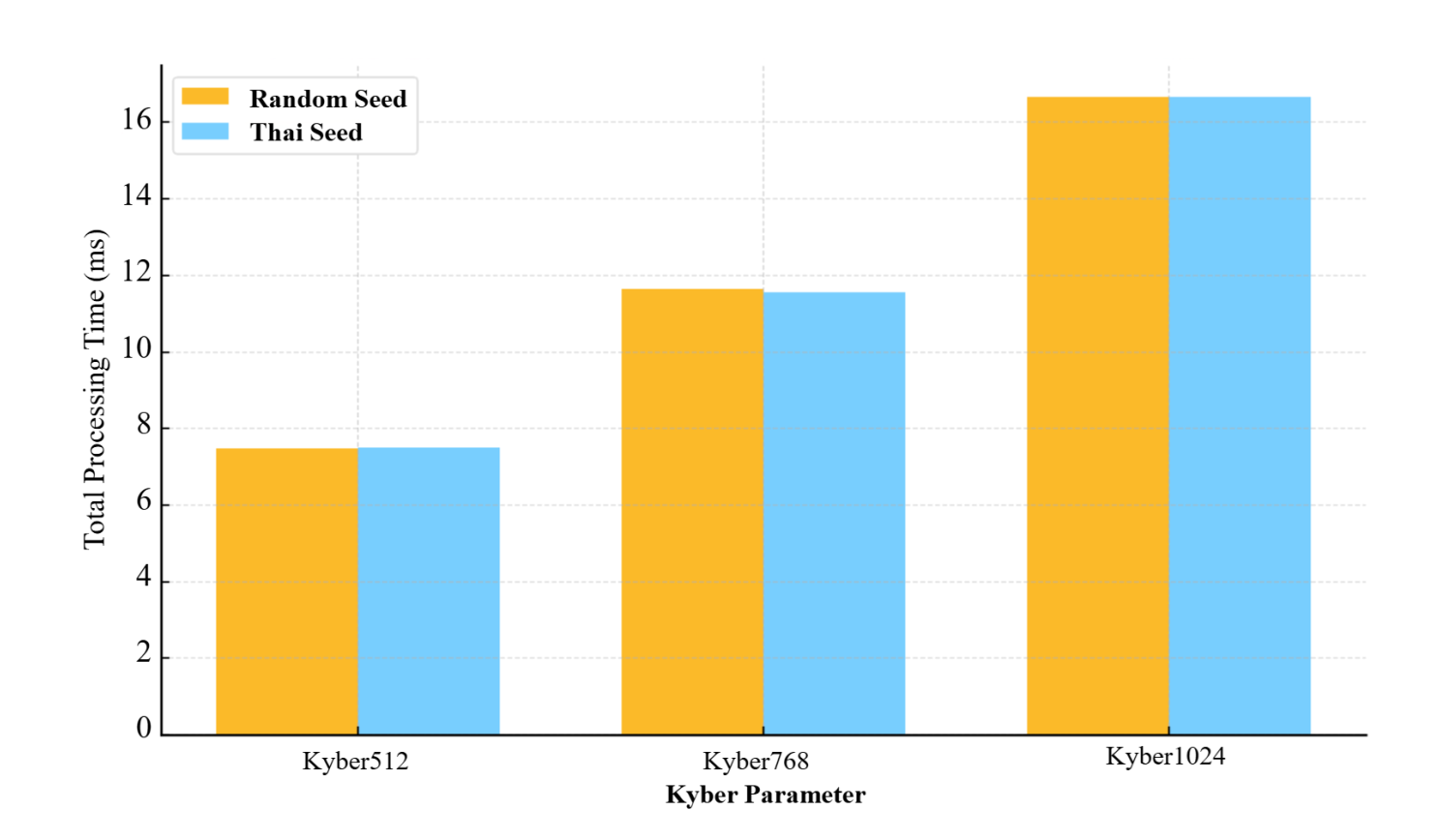
This research evaluates Post-Quantum CRYSTALS-Kyber through the generation of seeds from Thai text, highlighting Unicode normalization and performance analysis. This approach relies on user-specified seeds derived from Thai text rather than on random seeds. The proposed method includes Thai text normalization, UTF-8 encoding, and seed generation by using the SHAKE256 hash function for Deterministic Random Bit creation (DRBG) to generate key pairs, followed by system verification through encapsulation and decapsulation operations. Kyber512, Kyber768, and Kyber1024 have been chosen for three investigations. The experimental results demonstrate that Thai seeds consistently maintained 100% accuracy throughout the evaluation. Although the seed generation process requires additional durations of 0.0109ms, 0.0095ms, and 0.0108ms, the effect on total processing time remains small at ±0.6%. Furthermore, the examination of four Unicode normalization forms (NFC, NFD, NFKC, NFKD) verifies that visually indistinguishable Thai texts containing different byte sequences could be normalized to provide identical seed results when SHAKE256 is applied with complete consistency. In addition, these results indicate that Thai seeds not only improve user convenience and linguistic significance but also maintain the security and efficiency of Kyber without reducing performance relative to random seeds. Therefore, this study provides the essential foundation for the establishment of hybrid cryptosystems that accommodate the Thai language. Furthermore, it might be adapted for effective post-quantum security systems in the future. This work bridges linguistic usability and quantum-resistant cryptography, paving the way for culturally inclusive post-quantum systems.
References
National Institute of Standards and Technology (NIST), “Module-Lattice-Based Key-Encapsulation Mechanism Standard,”
Gaithersburg, MD, USA: NIST, Aug. 2024, FIPS PUB 203, doi: 10.6028/NIST.FIPS.203.
E. Alkim, L. Ducas, T. Poppelmann and P. Schwabe, “Post-quantum key exchange—A new hope,” in ¨ Proc. 25th USENIX
Security Symp., Austin, TX, USA, Aug. 2016, pp. 327–343.
J. Bos, L. Ducas, E. Kiltz, T. Lepoint, V. Lyubashevsky, J. M. Schanck, P. Schwabe, G. Seiler, and D. Stehle, “CRYSTALSKyber: A CCA-secure module-lattice-based KEM,” in Proc. IEEE European Symp. Security and Privacy, London, UK,
Apr. 2018, pp. 353–367, doi: 10.1109/EuroSP.2018.00032.
P. Schwabe, D. Stebila and T. Wiggers, “More efficient post-quantum KEMTLS with pre-distributed public keys,” in Proc.
European Symp. Research in Computer Security, Part I, Darmstadt, Germany, Oct. 2021, pp. 3–22, doi: 10.1007/978-3-
-88418-5 1.
C. A. Roma, C.-E. A. Tai and M. A. Hasan, “Energy efficiency analysis of post-quantum cryptographic algorithms,” IEEE
Access, vol. 9, pp. 71295–71317, 2021, doi: 10.1109/ACCESS.2021.3077843.
L. Botros, M. J. Kannwischer and P. Schwabe, “Memory-efficient high-speed implementation of Kyber on Cortex-M4,” in
Proc. AFRICACRYPT 2019, Rabat, Morocco, Jul. 2019, pp. 209–228, doi: 10.1007/978-3-030-23696-0 11.
E. Barker and J. Kelsey, “Recommendation for random number generation using deterministic random bit generators,”
NIST SP 800-90A Rev. 1, Gaithersburg, MD, USA, Jun. 2012, doi: 10.6028/NIST.SP.800-90Ar1.
S. Houy, P. Schmid and A. Bartel, “Security Aspects of Cryptocurrency Wallets—A Systematic Literature Review,” ACM
Computing Surveys, vol. 56, no. 1, pp. 1–31, August2023, doi: 10.1145/3596906.
A. Dionysiou and E. Athanasopoulos, “Unicode Evil: Evading NLP systems using visual similarities of text characters,” in Proc. 14th ACM Workshop on Artificial Intelligence and Security, Virtual Event, Nov. 2021, pp. 1–12, doi:
1145/3474369.3486871.
R. Chandramouli, M. Iorga, and S. Chokhani, “Cryptographic key management issues and challenges in cloud services,”
NISTIR 7956, 2013, pp. 1–36, doi: 10.6028/NIST.IR.7956.
N. Bindel, J. Brendel, M. Fischlin, B. Goncalves and D. Stebila, “Hybrid key encapsulation mechanisms and authenticated key exchange,” in Proc. Int. Conf. Post-Quantum Cryptography, Chongqing, China, May 2019, pp. 206–226, doi:
1007/978-3-030-25510-7 12.
S. Li, Y. Chen, L. Chen, J. Liao, C. Kuang, K. Li, W. Liang and N. Xiong, “Post-Quantum Security: Opportunities and
Challenges”,Sensors, vol. 23, pp. 8744, 2023, doi: 10.3390/s23218744
M. A. G. de la Torre, I. A. M. Sandoval, G. T. F. de Abreu and L. H. Encinas, “Post-quantum wireless-based key encapsulation mechanism via CRYSTALS-Kyber for resource-constrained devices,” IEEE Access, vol. 13, pp. 66714–66725, 2025,
doi: 10.1109/ACCESS.2024.3479215.
[14] J. Senor, J. Portilla and M. Portela-Garc ˜ ´ıa, “Performance analysis of postquantum cryptographic schemes for securing large-scale wireless sensor networks,” IEEE Trans. Ind. Informat., vol. 20, no. 10, pp. 12339–12349, Oct. 2024, doi:
1109/TII.2024.3423641.
G. Bertoni, J. Daemen, M. Peeters and G. Van Assche, “Keccak,” in Proc. EUROCRYPT, Athens, Greece, May 2013, pp.
–314, doi: 10.1007/978-3-642-38348-9 19.
J. Kelsey, S. Chang, and R. Perlner, “SHA-3 derived functions: cSHAKE, KMAC, TupleHash, and ParallelHash,” Gaithersburg, MD, USA, Dec. 2016, NIST SP 800-185, doi: 10.6028/NIST.SP.800-185.
M. Bisheh-Niasar, R. Azarderakhsh, and M. Mozaffari-Kermani, “Instruction-Set Accelerated Implementation of
CRYSTALS-Kyber”, IEEE Transactions on Circuits and Systems I: Regular Papers, vol. 68, no. 11, pp. 4648-4659, November 2021, doi: 10.1109/TCSI.2021.3106639.
National Institute of Standards and Technology (NIST), “SHA-3 standard: Permutation-based hash and extendable-output
functions,” Gaithersburg, MD, USA, Aug. 2015, FIPS PUB 202, doi: 10.6028/NIST.FIPS.202.
N. Ansary, Q. A. Rahman Adib, T. Reasat, A.S. Sushmit, A.I. Humayun, S. Mehnaz, K. Fatema, M. M. Or Rashid and
F.Sadeque, “Unicode Normalization and Grapheme Parsing of Indic Languages,” in Proc. 2024 Lang. Resources and Evaluation Conf. (LREC-COLING), pp. 17019–17030, May 2024.
H. Nguyen and S. Cavallari, “Neural multi-task text normalization and sanitization with pointer-generator,” in Proc. First
Workshop on Natural Language Interfaces, Jul. 2020, pp. 37–47, doi: 10.18653/v1/2020.nli-1.5.
J. Lang, A. Czeskis, D. Balfanz, M. Schilder, and S. Srinivas, “Security keys: Practical cryptographic second factors for the
modern web,” in Proc. Financial Cryptography and Data Security, Christ Church, Barbados, Feb. 2016, pp. 422–440, doi:
1007/978-3-662-54970-4 25.
D. Sikeridis, P. Kampanakis and M. Devetsikiotis, “Post-quantum authentication in TLS 1.3: A performance study,”
in Proc. The Network and Distributed System Security Symp., San Diego, CA, USA, Feb. 2020, pp. 1–16, doi:
14722/ndss.2020.24041.
T. M. Fernandez-Caram ´ es, “From pre-quantum to post-quantum IoT security: A survey on quantum-resistant cryptosystems ´
for the Internet of Things,” IEEE Internet of Things J., vol. 7, no. 7, pp. 6457–6480, 2020, doi: 10.1109/JIOT.2019.2956244.
A. Narayanan and V. Shmatikov, “Fast dictionary attacks on passwords using time-space tradeoff,” in Proc. 12th ACM Conf.
Comput. Commun. Security, Alexandria, VA, USA, Nov. 2005, pp. 364–372, doi: 10.1145/1102120.1102168.
E. Simion, “Entropy and Randomness: From Analogic to Quantum World,” IEEE Access, vol. 8, pp. 74553–74561, 2020,
doi: 10.1109/ACCESS.2020.2988658.
P. A. Grassi, M. E. Garcia, and J. L. Fenton, “Digital identity guidelines: Authentication and lifecycle management,” NIST
SP 800-63B, Gaithersburg, MD, USA, Jun. 2017, doi: 10.6028/NIST.SP.800-63b.
Downloads
Published
How to Cite
Issue
Section
License

This work is licensed under a Creative Commons Attribution-NonCommercial-NoDerivatives 4.0 International License.