The Accumulation of Radon Gas in Shophouses: Case Study of Using Concrete with Fly Ash and Phosphogypsum Additives as Building Materials
DOI:
https://doi.org/10.56261/built.v23.256808Keywords:
Radon, Phosphogypsum, Fly-ash, Building material, Indoor air qualityAbstract
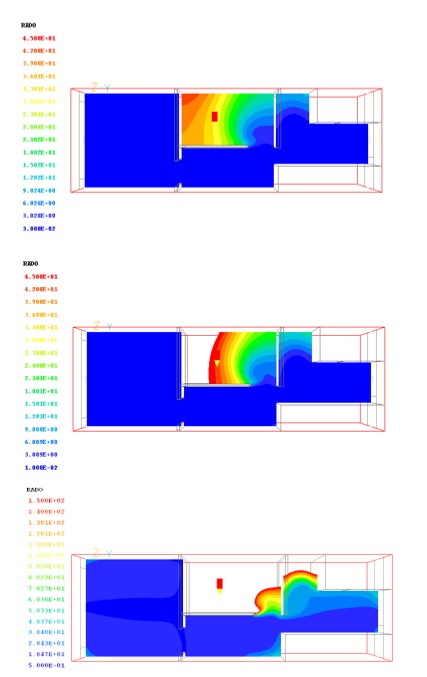
Radon is a ubiquitous radioactive noble gas which cannot be detected by any human senses. Moreover, it is known to be the leading cause of lung cancer among non-smokers. Soil is the main source of radon, although another major source of indoor radon is derived from building materials, particularly building materials which are by-products from industrial processes containing relatively high concentrations of radium (such as fly ash and phosphogypsum). These building materials produce more radon gas than the others. This research is divided into two parts. The first part focuses on radon-exhalation rates from cementitious materials which contain variations of fly ash (FA) and phosphogypsum (PG). The second part focuses on the study of the concentrations and distributions of radon in shophouses, one of the most popular residential building types in Thailand, which use fly ash and phosphogypsum as an additive in cement. From the first part, the results from measuring radon concentration in closed test chambers by using a pulse-counting ionization chamber radon gas monitor (Atmos 12 dpx) show that the radon exhalation rate is significantly increased when more fly ash is added (from 40 to 60% in concrete); whereas, a clearly exponential correlation is found between radon exhalation rate and phosphogypsum content. From the second part, the CFD simulations show that, in the case of using 50% PG additive, the interior partitions in shophouses affect the radon concentration level and this noble gas accumulates in areas of poor ventilation, which could reach 648.10 Bq/m3 (higher than the average world value of 39 Bq/m3), resulting in the exceedance of the annual effective dose of 16.33 mSv/y.
Downloads
References
Beck, T.R. (2024). Note on dose conversion for radon exposure. Radiation Environmental Biophysics, 63(3), 351 – 356.
Bulut, H.A. & Şahin, R. (2024). Radon, concrete, buildings and human health – A review study. Buildings, 14, 510.
Calin, M.R. & Calin, M.A. (2011). Investigations on the presence and distribution of radon in the Cacica Salt Mine, Romania. Journal of Radioanalytical and Nuclear Chemistry, 288, 203 – 206.
Chauhan, R.P., Kant, K., Sharma, S.K., & Chakarvarti, S.K. (2003). Measurement of alpha radioactive air pollutants in fly ash brick dwelling. Radiation Measurements, 36, 533-536.
Chung, E.K., Jang, J.K., Kim, J.K., Kim, J.B., & Kwon, J. (2018). Evaluation of effective dose and exposure level of radon in process handling NORM. Journal of Korean Society of Occupational and Environmental Hygiene, 28(3), 283 – 291.
Danaei, Z., Baghani, H.R., & Mowlavi, A.A. (2020). Absorbed dose assessment from short-lived radionuclides of radon (222Rn) Decay Chain in Ling Tissue: A Monte Carlo Study. Iranian Journal of Medical Physics, 17(1), 66-74.
Grygier, A., & Skubacz, K. (2024). Radon equilibrium factor and the assessment of the annual effective dose at underground workplaces. Atmosphere, 15(9), 1131.
International Commission on Radiological Protection. (1993). Protection against Radon-222 at home and at work. ICRP Publication 65. Ann ICRP, 23(2).
Jabar, R., Hasan, A.K., & Abojassim, A.A. (2023). Effective dose (ingestion and inhalation) due to radon from tap water samples in children at primary schools in Najaf City, Iraq. Water Supply, 23(3), 1234 – 1249.
Man, C.K., & Yeung, H.S. (1999). Modeling and measuring the indoor radon concentration in high rise buildings in Hong Kong. Applied Radiation and Isotopes, 50, 1131 – 1135.
Nazaroff, W.W., & Nero, Jr., A.V. (1998). Radon and its decay products in indoor air. John Wiley & Sons.
Roelofs, L.M.M., & Scholten, L.C. (1994). The effect of aging, humidity and fly-ash additive on the radon exhalation from concrete. Health Physics, 67(3), 266 – 271.
Sahota, H.S., Randhawa, K.S., Singh, M., & Singh, K. (2005). Temperature variation of indoor and outdoor radon progeny. Atmospheric Environment, 39, 2991 – 2994.
Samuelsson, C. (1990). The closed-can exhalation method for measuring radon. Journal of Research of the National Institute of Standards and Technology, 95(2), 167 – 169.
Srisuwan, T. (2006). Radon reduction in shop-houses: Case study of using concrete with fly ash and phosphogypsum additives as building materials [Master’s thesis, Faculty of Architecture and Planning, Thammasat University].
Turkish Atomic Energy Authority. (2017). Guide on radon in closed environments and radioactivity in building materials (RSGD-KLV-013).
United Nations Scientific Committee on the Effects of Atomic Radiation. (1982). Ionizing radiation sources and biological effects (Reports to General Assembly). United Nations.
United Nations Scientific Committee on the Effects of Atomic Radiation. (1992). Exposures from natural sources of radiation. A/Ac., 82/R. 511.
United Nations Scientific Committee on the Effects of Atomic Radiation. (1993). 1993 Report to the general assembly, with scientific annexes. United Nations.
United Nations Scientific Committee on the Effects of Atomic Radiation. (2000). Sources and effects of ionizing radiation Vol. I. United Nations.
United Nations Scientific Committee on the Effects of Atomic Radiation. (2008). Annex: E: sources-to-effects assessment for radon in homes and workplaces. Effects of ionizing radiation. United Nations.
Wanabonges, P., Tokonami, S., & Bovornkitti, S. (2005). Current studies on radon gas in Thailand. International Congress Series, 1276, 208 – 209.
World Health Organization. (2009). WHO: Handbook on indoor radon: A public health perspective.
Yamanishi, H., Obayashi, H., Tsuji, N., & Nakayoshi, H. (1998). Effect of humidity on radon exhalation rate from concrete. Tohwa University International Symposium (pp.429 – 434). World Scientific Publishing.
Zhu, S., Kato, S., Murakami, S., & Hayashi, T. (2005). Study on inhalation region by means of CFD analysis and experiment. Building and Environment, 40, 1329 – 1336.
Downloads
Published
How to Cite
Issue
Section
License
Copyright (c) 2025 International Journal of Building, Urban, Interior and Landscape Technology

This work is licensed under a Creative Commons Attribution-NonCommercial-NoDerivatives 4.0 International License.