The Philosophy of Space and Place in Geography: Analyzing the Historical Urban Development of Kerman City Through the Spatial Distribution of Mosques
DOI:
https://doi.org/10.56261/built.v23.259011Keywords:
Urban development, mosques of Kerman city, Geographic Information System, spatial analysis tools, Kerman cityAbstract
Abstract
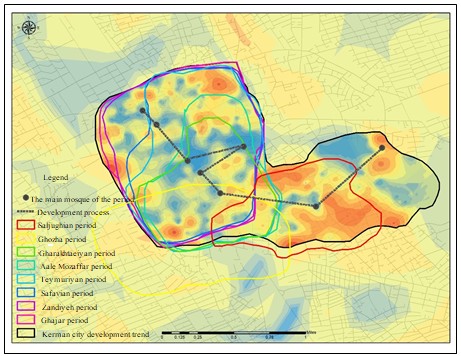
This article aims to examine the significance, status, and role of mosques in Kerman city, and the meaningful correlation between mosques during different urban periods and the identity of urban development. It seeks to demonstrate the potential identity of mosques in the city, showcasing the primary role they play in Kerman's development. Using various analytical methods and tools, the study will illustrate the role and standing of mosques in the urban development of Kerman. Therefore, this research is analytical and based on field surveys, which can also be categorized as applied methods in this field. The tools employed in the research process include Geographic Information Systems (GIS) and spatial analysis tools to demonstrate the spatial development trends of the city. The results indicate that mosques have had effective programs for urban development during the examined periods, and the spatial distribution of mosques serves as a close proxy for urban development. Therefore, locational data for places of worship, which is often readily available and accessible, can be utilized to extract historical urban development over a specific timeframe.
Downloads
References
References
Adamson, F.B. (2019). Sending states and the making of intra-diasporic politics: Turkey and its diaspora(s). International Migration Review, 53(1), 210–236. DOI: https://doi.org/10.1177/0197918318767665
Adraoui, M.-A. (2019). Exporting their religious doctrines? The cases of Saudi Arabia, Turkey and Morocco. In Mediterranean Yearbook 2019 (pp. 319-321). Instituto Europeo del Mediterráneo.
Afnarius, S., Akbar, F., & Yuliani, F. (2020). Developing web-based and mobile-based GIS for places of worship information to support halal tourism: A case study in Bukittinggi, Indonesia. ISPRS International Journal of Geo-Information, 9(1), 52. DOI: https://doi.org/10.3390/ijgi9010052
Agnew, J. (2011). Space and place. Handbook of geographical knowledge, 316-331. DOI: https://doi.org/10.4135/9781446201091.n24
Ahmad, A. (2020). Ethnic discrimination against second-generation immigrants in hiring: Empirical evi¬dence from a correspondence test. European Societies, 22(5), 659-681. https://doi.org/10.1080/14616696.2020.1822536 DOI: https://doi.org/10.1080/14616696.2020.1822536
Ahmad, S., Kokab, J., & Ali, H. (2024). Character-building pillars in society: Role of mosque in Muslim society. Al-Kashaf, 4(1), 57-63.
Ahmed, I. (2018, April 30). Mosque as public space in city and community. AlterInter. https://www.alterinter.org/?Mosque-as-Public-Space-in-City-and-Community
AiGlobal Media. (2021). Private sector investment in Islamic countries. AI Global Media Ltd.
Ajili, H., Shir Dastian, M., & Namaz Dost, F. (2017). The role of mosques in realizing the goals of resistance economy. Paper presented at the Fifth Iranian Islamic Conference on Progress, Tehran.
Akash, S. (2014). Cosmology and architecture in premodern Islam: An architectural reading of mystical themes (R. Muradpour, Trans.). Raman Sokhon, Iranian Translators. (Original work published in Arabic)
Alabodi, M. S. (2007, June 17). Between the Stone Age and the Bloody Age. Al Bayan. https://www.albayan.ae/opinions/2007-06-17-1.179506
Al Muhsin, M. A., & Ahmad, N. Z. (2020). The emergence of education 4.0 trends in teaching Arabic Islamic finance curriculum design: A case study. International Journal of Psychosocial Rehabilitation. 23(4), 1019-1031. DOI: https://doi.org/10.37200/IJPR/V23I4/PR190430
Al-Hakawati. (2022, March). Markets in the Rashidoun and Umayyads eras. http://al-hakawati.net/Art/ArtDetails/1465/
Albarazy, A. (2020). The effect of intelligent interactive installation in public spaces, the application of AR portal doors in Famagusta Walled City [Doctoral dissertation, Eastern Mediterranean University].
Albayan. (2020, April 25). Al-Ibrahimiyah Takiyeht: No one get hungry in Hebron. Albayan. https://www.albayan.ae/one-world/2020-04-25-1.3841262
Algaderjy, R. (2014). Dor Al Meamar Fe Hadaret Al Insan [Role of architecture in human civilization]. Markaz Derasat Al Wehda Al Arabia.
Alsammarae, R. (2019). Comment: Mosques are now expanding horizontally, offering renewed public spaces for their communities. Middle East Architect. https://www.middleeastarchitect.com/42125-comment-mosques-are-now-expanding-horizontally-offering-renewed-public-spaces-for-their-communities
Amirhajlo, S., Emami, S. M. A., Aghagli, D., & Riahian, R. (2019). Introduction and classification and structure of Zarin Fam tiles found in Dokhtar Castle, Kerman. Archaeological Research.
Amini, A., Jafarinia, G., Ghalehteimouri, K. J., & Gorgin, B. (2024). A Sustainable Social Development Model Based On Cultural Barriers. Indonesian Journal of Social Research (IJSR), 6(3), 266-285. DOI: https://doi.org/10.30997/ijsr.v6i3.436
Anderson, B. (2016). Taking-place: Non-representational theories and geography. Routledge.
Archnet. (2021). Citadel of Herat restoration. https://archive.archnet.org/sites/6834
Asahi Shimbun. (2020, May 20). The pain of not being able to gather at prayer sites: Christianity and Islam. Asahi Shimbun.
Ash-Shalabi, N. (2015). Sirah-review of events and analysis of events on the way of the life of the Prophet Muhammad. Insan Kamil.
Asif, N., Utaberta, N., Mohd Rasdi, M. T., Mohd Yunos, M. Y., Ismail, N. A., & Ismail, S. (2017). The concept of mosque based on Islamic philosophy: A review based on early Islamic texts and practices of the early generation of the Muslims. Advances in Environmental Biology, 9, 371-374.
Asim, G. M., & Ando, T. (2020). A study on cisterns in the Herat old city, Afghanistan. Journal of Architecture and Planning, 85, 781-789. DOI: https://doi.org/10.3130/aija.85.781
Awis Al Lababede, M., Blasi, A. H., & Alsuwaiket, M. A. (2020). Mosques smart domes system using machine learning algorithms. International Journal of Advanced Computer Science and Applications, 11(3), 373-378. https://doi.org/10.14569/IJACSA.2020.0110347 DOI: https://doi.org/10.14569/IJACSA.2020.0110347
Azmi, N. A., Arıcı, M., & Baharun, A. (2021). A review on the factors influencing energy efficiency of mosque buildings. Journal of Cleaner Production, 126010. DOI: https://doi.org/10.1016/j.jclepro.2021.126010
Azmi, N. A., & Kandar, M. Z. (2020). Thermal comfort and occupant satisfaction in a naturally ventilated mosque in Malaysia. Universiti Teknologi Malaysia.
Bastani Parisi. (1972). Preface. In The royal history of Karakhtaians (pp. 9-75). Farhang Iran Foundation. DOI: https://doi.org/10.1017/S1120962300024185
Beekers, D., & Tamimi Arab, P. (2016). Dreams of an iconic mosque: spatial and temporal entanglements of a converted church in Amsterdam. Material Religion, 12(2), 137-164. DOI: https://doi.org/10.1080/17432200.2016.1172760
Blair, S., & Bloom, J. (2012). Islamic art and architecture (A. Ashraghi, Trans.). Soroush.
Blaschke, T., Merschdorf, H., Cabrera-Barona, P., Gao, S., Papadakis, E., & Kovacs-Györi, A. (2018). Place versus space: From points, lines and polygons in GIS to place-based representations reflecting language and culture. ISPRS International Journal of Geo-Information, 7(11), 452. DOI: https://doi.org/10.3390/ijgi7110452
Britannica Encyclopedia. (2021). Mosque. https://www.britannica.com/topic/mosque
Burchardt, M., Martínez-Ariño, J., Griera, M., & Bramadat, P. (2023). Rite and stone: Religious belonging and urban space in global perspective. Space and Culture, 26(2), 148-154. DOI: https://doi.org/10.1177/12063312231161185
Cappelletti, A. (2020). Socio-economic development in Xinjiang Uyghur Autonomous Region: Disparities and dynamics. Mediterranean Yearbook, 131-154. DOI: https://doi.org/10.1007/978-981-15-1536-1
Carmona, M. (2021). Public places urban spaces: The dimensions of urban design (3rd ed.). Routledge. https://doi.org/10.4324/9781315158457 DOI: https://doi.org/10.4324/9781315158457
Collins-Kreiner, N. (2010). Researching pilgrimage: Continuity and transformations. Annals of tourism research, 37(2), 440-456. DOI: https://doi.org/10.1016/j.annals.2009.10.016
Course Hero. (2020, June 29). Women may participate in the prayers but in most cases they must occupy. https://www.coursehero.com/file/pjf2s/Women-may-participate-in-the-prayers-but-in-most-cases-they-must-occupy-a/
Curtis, S. (2016). Space, place and mental health. Routledge. DOI: https://doi.org/10.4324/9781315610160
Delaney, D. (2020). The lived experi¬ences of Muslims in Europe: Recog¬nition, power and intersubjective dilemmas. Rout¬ledge. DOI: https://doi.org/10.4324/9781351017756
Dikici, E., 2021. Integration, transnationalism and transnational Islam. Identities, 00(00), 1–20. DOI: https://doi.org/10.1007/978-3-030-74006-1_1
Duff, C. (2007). Towards a theory of drug use contexts: Space, embodiment and practice. Addiction Research & Theory, 15(5), 503-519. DOI: https://doi.org/10.1080/16066350601165448
Dyas, D. (2020). The dynamics of pilgrimage: Christianity, holy places, and sensory experience. Routledge. DOI: https://doi.org/10.4324/9781003094968
Emberses, N., & Melville, C. (1991). History of earthquakes in Iran (A. Rada, Trans.). Agah.
Eyles, J., & Williams, A. (Eds.). (2008). Sense of place, health and quality of life. Ashgate.
Foreign, Commonwealth & Development Office. (2022, May 24). China's human rights violations in Xinjiang: Foreign Secretary's statement. Gov.UK.
Frenkel, S., Isaac, M., & Mac, R. (2022, January 31). How Facebook is morphing into Meta. The New York Times. https://www.nytimes.com/2022/01/31/technology/facebook-meta-change.html
Freyer, J. D. (2021). Free ice water. Temporama. https://www.temporama.com/portfolio/free-ice-water
Gehrke, L. (2020, November 6). Austria shuts down mosque after Vienna terror attack. Politico.
George, A. (2017). The Quran, calligraphy, and the early civilization of Islam. In A companion to Islamic art and architecture (pp. 109-129). Wiley. DOI: https://doi.org/10.1002/9781119069218.ch4
Ghalehteimouri, K. J., Ros, F. C., & Rambat, S. (2024). Flood risk assessment through rapid urbanization LULC change with destruction of urban green infrastructures based on NASA Landsat time series data: A case of study Kuala Lumpur between 1990–2021. Ecological Frontiers, 44(2), 289-306. DOI: https://doi.org/10.1016/j.chnaes.2023.06.007
Glanville, J. L., & Shi, Q. (2020). The extension of particularized trust to generalized and out-group trust: The constraining role of collectivism. Social Forces, 98(4), 1801-1828. https://doi.org/10.1093/sf/soz114 DOI: https://doi.org/10.1093/sf/soz114
Golestani, Z., Borna, R., Khaliji, M. A., Mohammadi, H., Jafarpour Ghalehteimouri, K., & Asadian, F. (2024). Impact of urban expansion on the formation of urban heat islands in Isfahan, Iran: A satellite base analysis (1990–2019). Journal of Geovisualization and Spatial Analysis, 8(2), 32. DOI: https://doi.org/10.1007/s41651-024-00189-x
Granados-Sánchez, J., & Reid, A. (2025). Powerful knowledge as a new international trend in contemporary school geography. In Handbook of geography education (pp. 131-159). Springer Nature Switzerland. DOI: https://doi.org/10.1007/978-3-031-72366-7_7
Gravelle, T. B., Medeiros, M., & Nai, A. (2021). In the shadow of the tower: Spatial proximity to mosques, visible diversity, and support for the radical right. Political Geography, 91, 102499. DOI: https://doi.org/10.1016/j.polgeo.2021.102499
Grenni, S., Soini, K., & Horlings, L. G. (2020). The inner dimension of sustainability transformation: How sense of place and values can support sustainable place-shaping. Sustainability Science, 15, 411-422. DOI: https://doi.org/10.1007/s11625-019-00743-3
Guo, H., Aviv, D., Loyola, M., Teitelbaum, E., Houchois, N., & Meggers, F. (2020). On the understanding of the mean radiant temperature within both the indoor and outdoor environment, a critical review. Renewable and Sustainable Energy Reviews, 117, 109207. DOI: https://doi.org/10.1016/j.rser.2019.06.014
Haddad, M. (2020). Food production and food security management in Muslim civilization. Muslim Heritage.
Haddad, M. (2021, November 6). Islam's influences on people's pro-environmental practices. Muslim Heritage.
Hall, E. T. (2017). The hidden dimension (M. Tabibian, Trans.). University of Tehran Press.
Hammond, K. (2020). China's Muslims & Japan's empire: Centering Islam in World War II. University of North Carolina Press. DOI: https://doi.org/10.5149/northcarolina/9781469659657.001.0001
Hamzehnejad, M., & Rahroui Poodeh, S. (2019). Conceptual typology in the temples of Jews, Christians and Muslims in the Safavid period of Isfahan (based on the sacred characteristics of purification, simile, beauty and glory). Quarterly Journal of Islamic Architecture Research, 4(11), 17-38.
Hamilton, S., & Spicer, A. (2016). Defining the holy: The delineation of sacred space. In Defining the Holy (pp. 19-42). Routledge. DOI: https://doi.org/10.4324/9781315258294-9
Harsritanto, B. I. R., Nugroho, S., Ghafirin, M. D. A., & Prabowo, A. R. (2019). Did we need low energy campus mosque? E3S Web of Conferences, 125, 08001. DOI: https://doi.org/10.1051/e3sconf/201912508001
Hays, J. (2020). Mosques: Their features, architecture and customs. Facts and Details. http://factsanddetails.com/world/cat55/sub358/item1447.html
Hewidy, H., & Lilius, J. (2018, July). Housing affordability and Muslims overrepresentation in Helsinki, Finland [Conference presentation]. AESOP 2018.
Hewidy, H., & Lilius, J. (2021). The death and life of Malmi neighbourhood shopping street: Is ethnic retail a catalyst for public life recovery in Helsinki? European Planning Studies. https://doi.org/10.1080/09654313.2021.1956433 DOI: https://doi.org/10.1080/09654313.2021.1956433
Holud, Renata (2018). Mosque and the modern world: Architecture, private founders, government sponsors. Yazda Publications.
Holloway, L., & Hubbard, P. (2014). People and place: The extraordinary geographies of everyday life. Routledge. DOI: https://doi.org/10.4324/9781315838694
Hopkins, P., Kong, L., & Olson, E. (Eds.). (2012). Religion and place: Landscape, politics and piety. Springer Science & Business Media. DOI: https://doi.org/10.1007/978-94-007-4685-5
Ibn Balkhi. (1984). Farsnameh (G. Lesturanj, Ed.). Asatir.
Kamarudin, Z., Kassim, P. S. J., & Abdullah, A. (2020). The variants and meanings of Malay motif ornamentation in the urban context: A case study of Putrajaya. Planning Malaysia, 18, 12. DOI: https://doi.org/10.21837/pm.v18i12.756
Kamran, J. G., Musa, K. K., & Sadegh, G. F. (2020). An investigation into urban development patterns with sprawl and other corresponding changes: A case study of Babol City. Journal of Urban Culture Research, 20, 26-43. DOI: https://doi.org/10.58837/CHULA.JUCR.20.1.3
Karimi, Y. (2018). Social psychology: Theories, concepts, and applications (32nd ed.). Arasbaran Publications.
Karmic. (2019, October 17). What do you know about the most famous businessmen of the Islamic era? Al Jazeera.
Kelman, I. (2020). Disaster by choice: How our actions turn natural hazards into catastrophes. Oxford University Press.
Khanzadeh, M. (2024). Aesthetic and functional analysis of mosque entrance areas in Ottoman and Safavid Empires: A comparative study. Cogent Arts & Humanities, 11(1), 2313262. DOI: https://doi.org/10.1080/23311983.2024.2313262
Khodayi, J., & Khazaei, M. (2017). Evaluation of the location of Mahalhai Mosque in the direction of strengthening the identity structure of the neighborhoods as a place to live, a case study of Mashhad. Urban Studies Quarterly, 18.
Knott, K. (2010). Religion, space, and place: The spatial turn in research on religion. Religion and Society, 1(1), 29-43. DOI: https://doi.org/10.3167/arrs.2010.010103
Kuhn, W. (2012). Core concepts of spatial information for transdisciplinary research. International Journal of Geographical Information Science, 26(12), 2267-2276. DOI: https://doi.org/10.1080/13658816.2012.722637
Kühne, O. (2018). Landscape and power in geographical space as a social-aesthetic construct. Springer International Publishing. DOI: https://doi.org/10.1007/978-3-319-72902-2
Kuppinger P. (2019). Informal place-making: Mosques, Muslims, and urban innovation in Germany. In M. Arefi & C. Kickert (Eds), The Palgrave handbook of bottom-up urbanism (p. 149-162). Palgrave Mac¬millan. https://doi.org/10.1007/978-3- 319-90131-2_10 DOI: https://doi.org/10.1007/978-3-319-90131-2_10
Kwan, M. P., Richardson, D., Wang, D., & Zhou, C. (2015). Space-time integration in geography and GIScience. Springer. DOI: https://doi.org/10.1007/978-94-017-9205-9
Latief, H. (2016). Philanthropy and "Muslim citizenship" in post-Suharto Indonesia. Southeast Asian Studies, 5(2), 269-286.
Lilley, K. D. (2004). Cities of God? Medieval urban forms and their Christian symbolism. Transactions of the Institute of British Geographers, 29(3), 296-313. DOI: https://doi.org/10.1111/j.0020-2754.2004.00229.x
Murphy, L. T., Elimä, K., Mühlhoff, K., & Souli, D. (2021). Laundering cotton: How Xinjiang cotton is obscured in international supply chains. Sheffield Hallam University Helena Kennedy Centre.
Mack, J. (2019). An awkward technoc¬racy: Mosques, churches, and urban planners in neoliberal Sweden. American Ethnologist, 46(1), 89-104. https://doi.org/10.1111/amet.12736 DOI: https://doi.org/10.1111/amet.12736
Mahbubi, G., Mokhtabad Amrei, M., & Attar Abbasi, M. (2016). Recognition of the existence of coexistence inside and outside the architecture of Iranian mosques (with emphasis on the fuzzy method). Kimia-ye-Honar, 5(21), 57-75.
McDaniel, J. (Ed.). (2019). Religious experience in the Hindu Tradition. MDPI. DOI: https://doi.org/10.3390/rel10050329
Ministry of Culture, Information. (2021). A copy of Herat projects.
Mirhosseini, S. M., Ansari, M., & Bemanian, M. (2018). Spatial hierarchy in Iranian mosques (case study: Jame Mosque of Yazd). International Journal of Applied Arts Studies (IJAPAS), 3(4), 49-60.
Mitchell, K., & Sparke, M. (2020). Hotspot geopolitics versus geosocial solidarity: Contending constructions of safe space for migrants in Europe. Environment and Planning D: Society and Space, 38(6), 1046-1066. DOI: https://doi.org/10.1177/0263775818793647
Moghdisi, A. A. M. (1982). Ahsan al-Taqasim in the knowledge of the regions (A. Manzavi, Trans.). Authors Company.
Mohandees, A. (2016). Mafhoom Al Masjid Fel Quraan Al Kareem, Derasat Seyakia. Abaad.
Monica, M. R. (2020). Introduction: Historicism, modernity and religion in Islamic modernism and the re-enchantment of the sacred in the age of history. Edinburgh University Press. https://www.jstor.org/stable/10.3366/j.ctv182jr7v.4.
Moosavi, S. M. R. (2018, February). The importance of mosque in urban design. Paper presented at the Second National Conference of Architecture, Civil, and Urban Environment, Hamedan.
Mostofi, H. (2016). Selected history (A. H. Navaei, Ed., 6th ed.). Amir Kabir.
Movahed, A., & Jafarpour Ghalehteimouri, K. (2019). The importance of the concept and meaning of place in tourism geography. Journal of Tourism, Hospitality and Environment Management, 4(16), 1-9. DOI: https://doi.org/10.35631/JTHEM.416001
Muhammad Ayoub. (2022, January 25). Shaded and illuminated streets, hotels and commercial malls: Urbanization of the Islamic city. Al Jazeera.
World Population Review. (2021). Muslim population by country 2021. https://worldpopulationreview.com/country-rankings/muslim-population-by-country
Mustafa, A., Ebaid, A., Omrani, H., & McPhearson, T. (2021). A multi-objective Markov Chain Monte Carlo cellular automata model: Simulating multi-density urban expansion in NYC. Computers, Environment and Urban Systems, 87, 101602. https://doi.org/10.1016/j.compenvurbsys.2021.10160 DOI: https://doi.org/10.1016/j.compenvurbsys.2021.101602
Mustafa, A., Rienow, A., Saadi, I., Cools, M., & Teller, J. (2018). Comparing support vector machines with logistic regression for calibrating cellular automata land use change models. European Journal of Remote Sensing, 51(1), 391–401. DOI: https://doi.org/10.1080/22797254.2018.1442179
Niedermeyer, O. V. (1924). Afghanistan. Leipzig.
Nizar Al-Sayad. (2017). Modeling traditional Islamic cities (M. Ghayoumi, Trans.). Golestan Art, 14.
O'Grady, S. (2018, June 8). Austria shuts down seven mosques in what it says is 'just the beginning' of a crackdown. Washington Post.
Olson, E., & Sayer, A. (2009). Radical geography and its critical standpoints: Embracing the normative. Antipode, 41(1), 180-198. DOI: https://doi.org/10.1111/j.1467-8330.2008.00661.x
Pauha, T. & Konttori J. (2020). “There is freedom of religion in Finland, but …”. The Helsinki Mosque Debate. In T. Sakaranaho, T. Aarrevaara, & J. Kont¬tori (Eds.), The challenges of religious literacy. The case of Finland (p. 9-24). Springer International Publishing. https://doi.org/10.1007/978-3-030- 47576-5 DOI: https://doi.org/10.1007/978-3-030-47576-5_2
Peterson, J. A. (2017). Formwerkz Architects' Al-Islah mosque: "Changing with the world while keeping fundamental." Architectural Review.
Raden Risang Haryo, C. D., Mulyadi, L., & Iskandar, T. (2020). Delay factors in building construction project of state elementary school. Civil Engineering Journal, 6(3), 523-530. DOI: https://doi.org/10.28991/cej-2020-03091488
Radio Dabanga. (2020). Sudan's imams shorten Friday prayers as 'historic' coronavirus precaution. https://www.dabangasudan.org/en/all-news/article/sudan-s-imams-shorten-friday-prayers-as-historic-coronavirus-precaution
Ratnasari, C., Setiawan, D. W., & Harsritanto, B. I. (2020). The application of artificial lighting in hotel room. Malaysia Architecture Journal, 2(1), 25-32.
Reuters. (2020). EU eyes body to train imams against "ideology of hatred."
Rizvi, K. (2014). Transnational architecture, ethics, and the reification of history: Park51 Islamic Community Center in New York City. In In the wake of the global turn: Propositions for an 'exploded' art history without borders (pp. 40-60).
Ronald, L.-B., & Mark, W. (2021). Handbook of contemporary Islam and Muslim lives. Springer Nature.
Ruta Clair, Gordon, M., Kreutz, M., Munoz, C., & Rastogi, M. (2021). The effects of social isolation on well-being and life satisfaction during pandemic. Humanities and Social Sciences Communications, 8(1), 1-6. https://doi.org/10.1057/s41599-021-00710-3 DOI: https://doi.org/10.1057/s41599-021-00710-3
Scott, A. J., Carter, C., Reed, M. R., Larkham, P., Adams, D., Morton, N., Waters, R., Collier, D., Crean, C., Curzon, R., Forster, J., Gibbs, P., Grayson, N., Hardman, M., Hearle, A., Jarvis, D., Kennet, M., Leach, K., Middleton, M., Schiessel, N., Stonyer, B., & Coles, R. (2013). Disintegrated development at the rural–urban fringe: Re-connecting spatial planning theory and practice. Progress in Planning, 83, 1-52. DOI: https://doi.org/10.1016/j.progress.2012.09.001
Shaari, N., Abdullah Mohd Asmoni, M. N., Afiq Lokman, M. A., Abdul Hamid, H., & Mohammed, A. H. (2015). Practices for project quality management systems (PQMS) in construction project. Jurnal Teknologi, 77(26), 69-76. https://doi.org/10.11113/jt.v77.6862 DOI: https://doi.org/10.11113/jt.v77.6862
Shabankarei, M. (1984). Al-Ansab Assembly (M. Muhaddith, Ed.). Amir Kabir.
Sharbatly Foundation. (2020, August 11). Al Sharbatly Mosque in Cairo, the Arab Republic of Egypt in the fifth assembly. https://www.hasfound.org/en/programs/building-mosques-program/mosque19
Sheppard, E. (2002). The spaces and times of globalization: Place, scale, networks, and positionality. Economic geography, 78(3), 307-330. DOI: https://doi.org/10.1111/j.1944-8287.2002.tb00189.x
Simonsen, K., Neergaard, M. D., & Koefoed, L. M. (2019). A mosque event: The opening of a purpose-built mosque in Copenhagen. Social & Cultural Geography, 20(5), 649-670. https://doi.org/10.1080/14649365.2017.1373144 DOI: https://doi.org/10.1080/14649365.2017.1373144
Soltani Fard, H., & Seyed Moradi, Z. S. (2018). Transformation of Jame Mosque position in the spatial configuration of the studied Islamic city: Sabzevar Jame Mosque. Islamic Architecture Research Quarterly, 11.
Šuman, N., Marinič, M., & Kuhta, M. (2020). A methodological framework for sustainable office building renovation using green building rating systems and cost-benefit analysis. Sustainability, 12(15), 6156. https://doi.org/10.3390/su12156156 DOI: https://doi.org/10.3390/su12156156
Tally Jr, R. T. (2018). Topophrenia: Place, narrative, and the spatial imagination. Indiana University Press. DOI: https://doi.org/10.2307/j.ctv7r40df
Tamimi, N., Qahtan, A., & Abuelzein, O. (2020). Rear zone for energy efficiency in large mosques in Saudi Arabia. Energy and Buildings, 223, 110148. DOI: https://doi.org/10.1016/j.enbuild.2020.110148
Tartarini, F., Schiavon, S., Cheung, T., & Hoyt, T. (2020). CBE thermal comfort tool: Online tool for thermal comfort calculations and visualizations. Software, 12, 100563. DOI: https://doi.org/10.1016/j.softx.2020.100563
The Baitulfutuh Mosque in London. (2020). Ahmadiyya Muslim Community. http://baitulfutuh.org/worship/imosque.shtml
Tobin, D. (2020). Securing China's Northwest frontier: Identity and insecurity in Xinjiang. Cambridge University Press. DOI: https://doi.org/10.1017/9781108770408
Totonchi, A. (2020). Smart mosque based on IoT: Internet of things. LAP Lambert Academic Publishing.
UNESCO. (2004). City of Herat, Ministry of Information and Culture of Afghanistan. https://whc.unesco.org/en/tentativelists/1927/
UNESCO. (2010). UNESCO country programming document (UCPD): Afghanistan 2010–2011. http://unesdoc.unesco.org/images/0018/001875/187584e.pdf
Winchester, D., & Pagis, M. (2022). Sensing the sacred: Religious experience, somatic inversions, and the religious education of attention. Sociology of Religion, 83(1), 12-35. DOI: https://doi.org/10.1093/socrel/srab004
Shamaei, A., & Jafarpour Ghalehteimouri, K. (2024). Evaluating the impact of Zanjan city’s economic drivers on the quality of life in peri-urban villages: a case study of Do Asb and Payin Kouh villages. Frontiers of Urban and Rural Planning, 2(1), 10. DOI: https://doi.org/10.1007/s44243-024-00035-0
Ussin, A., Lim, C., Salleh, E., Ashhar, Z., & Mat, S. (2020). Using CFD to optimizing comfort and energy using different air temperatures and velocities for air conditioning (AC) in Penang State Mosque. In Proceedings of the 11th Windsor Conference on Thermal Comfort: Resilient Comfort. Windsor, UK.
Verkaaik, O. (2020). The anticipated mosque: The political affect of a planned building. City & Society, 32, 118-136. https://doi.org/10.1111/ciso.12241 DOI: https://doi.org/10.1111/ciso.12241
Ward, T. (2017). Istiqlal Mosque. AFAR. http://www.afar.com/places/istiqlal-mosque-daerah-khusus-ibukota-jakarta
Williams, J. M. (2020). Affecting migration: Public information campaigns and the intimate spatialities of border enforcement. Environment and Planning C: Politics and Space, 38(7-8), 1198-1215. DOI: https://doi.org/10.1177/2399654419833384
Yamamura, S., & Lassalle, P. (2019). Approximating entrepreneurial superdiversity: Reconceptualizing the superdiversity debate in ethnic minority entrepreneurship. Journal of Ethnic and Migration Studies, 1–22. DOI: https://doi.org/10.1080/1369183X.2019.1656058
Yanasmayan, Z., & Kaslı, Z. (2019). Reading diasporic engagements through the lens of citizenship: Turkey as a test case. Political Geography, 70, 24-33. DOI: https://doi.org/10.1016/j.polgeo.2019.01.004
Yener-Roderburg, İ. Ö. (2020). Party organizations across borders. Political Parties Abroad, 218-237. DOI: https://doi.org/10.4324/9781003015086-17
Downloads
Published
How to Cite
Issue
Section
License
Copyright (c) 2025 International Journal of Building, Urban, Interior and Landscape Technology

This work is licensed under a Creative Commons Attribution-NonCommercial-NoDerivatives 4.0 International License.