The Evolution and Development of Public Spaces in Mueang Chiang Mai, Thailand
DOI:
https://doi.org/10.56261/built.v23.259022Keywords:
Evolution, Empty Public Space, Development of Mueang Chiang MaiAbstract
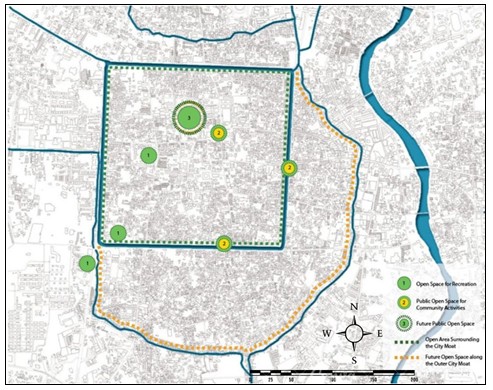
Chiang Mai is an old city with an important role as the center of the Lanna Kingdom. It has unique geographical and architectural features, especially the public space called “Khuang”, which serves as the center of politics, society, and culture. The changes in public spaces in Chiang Mai can be divided into major periods: 1884–1933, when the public spaces were mostly used for religious roles and community activities; 1933–1987, when the public spaces began to accommodate urban expansion, in addition to economic and social activities; and 1987–2024 (present), when public spaces were developed in line with the city growth in terms of economy, tourism, and modern culture. In particular, the Khuang Luang area remains an important gathering spot for both traditions and public activities at the city level. These changes reflect the relationship between power, culture, and the way of life of people in each era. This article aims to analyze the roles of public spaces and Khuang Luang in Chiang Mai and propose guidelines for the restoration and development of these historically and culturally valuable public spaces to allow sustainable use in the modern era, and meaning for the urban community in the future.
Downloads
References
Boonprakom, S., & Udphuay, S. (2023). Archaeological investigation and visualization by ground-penetrating radar at Wiang Kaew Palace site in Chiang Mai City Moat, Thailand. In Proceedings of the International Conference on Applied Geophysics 2023. Department of Geological Sciences, Chiang Mai University.
Charoenmuang, T. (1997). Urban expansion in Northern Thailand: A case study of Chiang Mai city administration. Faculty of Social Sciences, Chiang Mai University.
Crawford, M. (1995). Contesting the public realm: Struggles over urban space in Los Angeles. Journal of Architectural Education, 49(1), 4–9. https://doi.org/10.2307/1425256 DOI: https://doi.org/10.1080/10464883.1995.10734658
Damrikul, S. (2006). City spaces and Wat Hua Kuang: Key elements of Lanna cities. Chulalongkorn University Press.
Fraser, N. (1990). Rethinking the public sphere: A contribution to the critique of actually existing democracy. Social Text,(25/26),56–80. https://doi.org/10.2307/466240 DOI: https://doi.org/10.2307/466240
Habermas, J. (1989). The structural transformation of the public sphere: An inquiry into a category of bourgeois society (T. Burger, Trans.). MIT Press. (Original work published 1962)
Kongtaweesak, P. (2020). Chiang Mai city and diverse globalization. Social Sciences Academic Journal, Faculty of Social Sciences, Chiang Mai University, 32(1), 10–41.
Kraipakorn, D. (2014). The royal palace and Wiang Kaew of Chiang Mai rulers during the reign of King Rama V: Untold stories in Siamese chronicles and traces found in other evidence. NAJUA: History of Architecture and Thai Architecture,10, 10 –25.
Kranikara, P. (1996). Chiang Mai today at its 700th year. Chiang Mai: Chiang Mai Chamber of Commerce.
Lefebvre, H. (1996). Writings on cities. Blackwell.
Lim, W. S. W. (2008). Asian alterity: with special reference to architecture and urbanism through the lens of cultural studies. World Scientific. DOI: https://doi.org/10.1142/9789812708809
Lynch, K. (1994). The image of the city. MIT Press.
Meechoobot, W. (2008). A retrospective on Lanna: Key insights from maps of Chiang Mai city. Chulalongkorn University Press.
Ongsakul, S. (1986). The history of Lanna. Amarin Printing and Publishing.
Rakpan, K., & Oranratmanee, R. (2014a). A transformation of public spaces in Chiang Mai: Towards cultural economy and livable city. Journal of Architecture/Planning Research and Studies, 11(2), 69–80.
Rakpan, K., & Oranratmanee, R. (2014b). The continuity of Kad Luang Market district in the dynamics of change in Chiang Mai city. Journal of Mekong Societies, 10(2), 197–214.
Sangawong, S. (2009). Land-use dynamics in Chiang Mai city area and future urban prediction using the SLEUTH model. Social Sciences Academic Journal, Faculty of Social Sciences, Chiang Mai University, 21(1), 119–169.
Sodabunnaru, T. (2003). Beliefs in the construction of Chiang Mai city in Lanna culture (Master’s thesis, Faculty of Architecture, Silpakorn University).
Sukkan, P. (2008). Temporal dimensions through historical spaces: A case study of Chiang Mai's Kuang Luang (Master’s thesis, Faculty of Architecture, Silpakorn University).
Winichakul, T. (1994). Siam mapped: A history of the geo-body of a nation. University of Hawai’i Press.
Downloads
Published
How to Cite
Issue
Section
License
Copyright (c) 2025 International Journal of Building, Urban, Interior and Landscape Technology

This work is licensed under a Creative Commons Attribution-NonCommercial-NoDerivatives 4.0 International License.