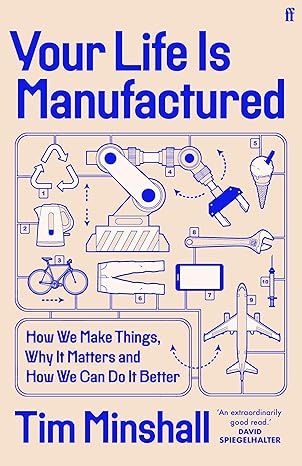
Your Life Is Manufactured: How We Make Things, Why It Matters and How We Can Do It Better
DOI:
https://doi.org/10.56261/built.v23.260903Keywords:
Manufacturing, Technology Management, Design Management, Sociomaterialism, Human-centred manufacturingAbstract
This book review highlights the pivotal role of manufacturing in modern society and the increasingly varied industrial landscapes shaped by digital transformation. This underscores the importance of adopting a human-centered approach to achieve sustainable manufacturing. From a sociomaterialist perspective, Cambridge University Professor Tim Minshall discusses the critical role of manufacturing within complex artificial systems that emerge from digital innovation, advocating sustainable practices rooted in human-centered values. By utilizing a sociotechnical systems innovation framework, this book offers valuable insights for those interested in exploring complex systems and technological trends, supported by the epistemic foundation of sociomaterialism that underpins Minshall's arguments. This review explores the vital contributions of manufacturing, considering its epistemological basis and addressing the often-overlooked practical agenda for latecomer manufacturers in the Global South, such as Thailand, to promote sustainable manufacturing-led innovation amid ongoing digital transformation.
Downloads
References
AAmann, E., & Cantwell, J. (2012). Innovative firms in emerging market countries. Oxford University Press. DOI: https://doi.org/10.1093/acprof:oso/9780199646005.001.0001
Baines, T., & Lightfoot, H. (2013). Made to serve." What it takes for a Manufacturer to Compete. John Wiley & Sons. DOI: https://doi.org/10.1002/9781119207955
Bannon, L. J., & Ehn, P. (2013). Design matters in participatory design. In J. Simonsen & T. Robertson (Eds.), Routledge international handbook of participatory design (pp. 37-63). Routledge.
Bettis, R. A., & Prahalad, C. K. (1995). The dominant logic: Retrospective and extension. Strategic Management Journal, 16(1), 5-14. DOI: https://doi.org/10.1002/smj.4250160104
Bocken, N. M., Pauw, I. D., Bakker, C., & Grinten, B. (2016). Product design and business model strategies for a circular economy. Journal of Industrial and Production Engineering, 33(5), 308-320. DOI: https://doi.org/10.1080/21681015.2016.1172124
Ceschin, F., & Gaziulusoy, I. (2016). Evolution of design for sustainability: From product design to design for system innovations and transitions. Design studies, 47, 118-163. DOI: https://doi.org/10.1016/j.destud.2016.09.002
Chang, H.-J. (2014). Economics: The user's guide. Bloomsbury Publishing.
Chesbrough, H. (2010). Business model innovation: Opportunities and barriers. Long Range Planning, 43, 354-363. DOI: https://doi.org/10.1016/j.lrp.2009.07.010
Govindarajan, V., Trimble, C., & Nooyi, I. K. (2012). Reverse innovation: Create far from home, win everywhere. Harvard Business Review Press.
Hendler, S. (2019). Digital-physical product development: A qualitative analysis. uropean Journal of Innovation Management, 22(2), 315-334. DOI: https://doi.org/10.1108/EJIM-01-2018-0026
Hobday, M. (1995). East Asian latecomer firms: Learning the technology of electronics. World Development, 23(7), 1171-1193. https://doi.org/10.1016/0305-750x(95)00035-b DOI: https://doi.org/10.1016/0305-750X(95)00035-B
Intarakumnerd, P. (2017). Mismanaging innovation systems: Thailand and the middle-income trap. Routledge. DOI: https://doi.org/10.4324/9781315150765
Kallinikos, J., Aaltonen, A., & Marton, A. (2013). The ambivalent ontology of digital artifacts. MIS quarterly, 357-370. DOI: https://doi.org/10.25300/MISQ/2013/37.2.02
Kuhn, T. S. (1997). The structure of scientific revolutions. University of Chicago press. DOI: https://doi.org/10.7208/chicago/9780226458106.001.0001
Lee, K., Wong, C.-Y., Intarakumnerd, P., & Limapornvanich, C. (2020). Is the Fourth Industrial Revolution a window of opportunity for upgrading or reinforcing the middle-income trap? Asian model of development in Southeast Asia. Journal of Economic Policy Reform, 23(4), 408-425. DOI: https://doi.org/10.1080/17487870.2019.1565411
Leonardi, P. M. (2012). Materiality, sociomateriality, and socio-technical systems: What do DOI: https://doi.org/10.2139/ssrn.2129878
these terms mean? How are they different? Do we need them? In P. M. Leonardi, B. A.
Nardi, & J. Kallinikos (Eds.), Materiality and organizing: Social interaction in a
technological world (pp. 25-48). Oxford University Press.
Mathews, J. A. (2002). Competitive advantages of the latecomer firm: A resource-based account
of industrial catch-up strategies. Asia Pacific Journal of Management, 19, 467-488.
https://doi.org/10.1023/a:1020586223665 DOI: https://doi.org/10.1023/A:1020586223665
Minshall, T. (2025). Your life is manufactured: How we make things, why it matters and how we can do it better. Faber & Faber.
Mortara, L., & Minshall, T. (2014). Patterns of implementation of OI in MNCs. In H. DOI: https://doi.org/10.1093/acprof:oso/9780199682461.003.0012
Chesbrough, W. Vanhaverbeke, & J. West (Eds.), New frontiers in open innovation (pp.
-241). Oxford University Press.
Orlikowski, W. J., & Scott, S. V. (2014). Exploring material-discursive practices. Journal of DOI: https://doi.org/10.1111/joms.12114
Management Studies, 52(5), 697-705.
SCG. (n.d.-a). Green innovation overview. https://www.scg.com/about-scg/business-
purpose/green-innovation
SCG. (n.d.-b). Product stewardship. https://www.scgsustainability.com/en/product-stewardship-
en/
Simon, H. (1996). The sciences of the artificial. MIT Press.
Suchman, L., Trigg, R., & Blomberg, J. (2002). Working artefacts: Ethnomethods of the DOI: https://doi.org/10.1080/00071310220133287
prototype. The British Journal of Sociology, 53(2), 163-179.
The Economist. (2023a, April 26). How to make low-carbon concrete from old cement.
https://www.economist.com/science-and-technology/2023/04/26/how-to-make-low-
carbon-concrete-from-old-cement
The Economist. (2023b, September 14). Electric two-wheelers are creating a buzz in Asia. https://www.economist.com/business/2023/09/14/electric-two-wheelers-are-creating-a-buzz-in-asia
The Economist. (2023c, February 2). China’s BYD is overtaking Tesla as the carmaker extraordinaire. https://www.economist.com/business/2023/02/02/chinas-byd-is-overtaking-tesla-as-the-carmaker-extraordinaire
The Economist. (2025, March 18). Where will be the next electric-vehicle superpower? Three Asian countries make their pitch. https://www.economist.com/finance-and-economics/2025/03/18/where-will-be-the-next-electric-vehicle-superpower
The World Bank. (2022). Research and development expenditure (% of GDP). https://data.worldbank.org/indicator/GB.XPD.RSDV.GD.ZS?locations=TH-KR
UN Sustainable Development Group. (2022). UN sustainable development cooperation framework for Thailand 2022 to 2026. United Nations Thailand.
Von Zedtwitz, M., Corsi, S., Søberg, P. V., & Frega, R. (2014). A typology of reverse innovation. Journal of Product Innovation Management, 32(1), 12-28. DOI: https://doi.org/10.1111/jpim.12181
Yoo, Y., Henfridsson, O., & Lyytinen, K. (2010). Research commentary—The new organizing logic of digital innovation: An agenda for information systems research. Information Systems Research, 21(4), 724-735. DOI: https://doi.org/10.1287/isre.1100.0322
Yoo, Y., Henfridsson, O., Kallinikos, J., Gregory, R., Burtch, G., Chatterjee, S., & Sarker, S. (2024). The next frontiers of digital innovation research. Information Systems Research, 35(4), 1507-1523. https://doi.org/10.1287/isre.2024.editorial.v35.n4 DOI: https://doi.org/10.1287/isre.2024.editorial.v35.n4
Yoo, Y., Boland, R. J., Jr., Lyytinen, K., & Majchrzak, A. (2012). Organizing for innovation in
the digitized world. Organization Science, 23(5), 1398-1408.
Downloads
Published
How to Cite
Issue
Section
License
Copyright (c) 2025 International Journal of Building, Urban, Interior and Landscape Technology

This work is licensed under a Creative Commons Attribution-NonCommercial-NoDerivatives 4.0 International License.