Adaptive Reuse of Historic Buildings for Museum Purposes: A Comprehensive Analytical Framework
DOI:
https://doi.org/10.56261/built.v23.262156Abstract
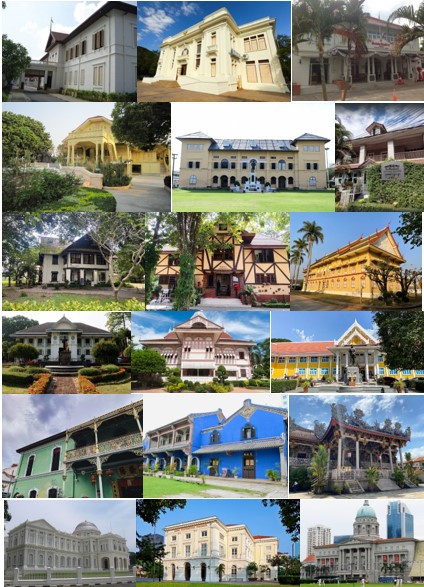
This research explores the conversion of historical buildings into museums, focusing on their original roles and architectural characteristics. This qualitative study employs a comparative analysis of selected adaptive-reuse museum cases across Southeast Asia and an extensive literature review to examine how original building typologies, spatial organization, ethical considerations, and community engagement shape museum outcomes. It examines case studies from Southeast Asia, such as Thailand, Malaysia, and Singapore, and how these buildings influence exhibition planning, spatial structuring, and public engagement. The study views reuse as a flexible strategy that connects with broader economic, social, and environmental issues. Economically, modifying existing structures is often more cost-effective than building new ones, reducing material costs, opening avenues for heritage tourism, and accessing diverse funding sources. Socially, it promotes cultural continuity, stimulates inclusivity, and strengthens relationships between institutions and communities. Environmentally, reuse fosters sustainable development by preserving embedded energy in existing materials, reducing construction waste, and aligning with climate-responsive design concepts. The research also addresses ethical issues, emphasizing the responsibility of carefully interpreting history, ensuring equal access, and maintaining transparency in funding and operational processes. It also addresses challenges such as integrating modern facilities without compromising heritage values, responding to safety and accessibility requirements, and engaging stakeholders at every stage. The study concludes that if guided by thoughtful design and collective conservation, repurposing historic buildings will be a more modern, culturally rooted, and sustainable choice than new construction.
Downloads
References
Australia ICOMOS. (2013). The Burra Charter: The Australia ICOMOS Charter for Places of Cultural Significance. https://australia.icomos.org/publications/charters/
Black, G. (2011). Transforming museums in the twenty-first century. Routledge.
Bullen, P. A., & Love, P. E. D. (2011). Adaptive reuse of heritage buildings. Structural Survey, 29(5), 411–421. https://doi.org/10.1108/02630801111182439
Crooke, E. (2007). Museums and community: Ideas, issues and challenges. Routledge.
Douglas, J. (2006). Building adaptation (2nd ed.). Butterworth-Heinemann.
Falk, J. H., & Dierking, L. D. (2013). The museum experience revisited. Routledge.
Feilden, B. M. (2007). Conservation of historic buildings (3rd ed.). Routledge.
Horayangkura, V. (2010). The creation of cultural heritage: Towards creating a modern Thai architectural identity. Manusya: Journal of Humanities, 13(1), 60-80.
Horayangkura, V. (2022). In search of sustainable paradigms for conservation and development based on underlying convergent/divergent conceptions. Journal of Architectural/Planning Research and Studies (JARS), 6(3), 1–22. https://doi.org/10.56261/jars.v6i3.168711
International Council on Monuments and Sites (ICOMOS). (1964). The Venice Charter: International Charter for the Conservation and Restoration of Monuments and Sites. https://www.icomos.org/images/DOCUMENTS/Charters/venice_e.pdf
International Council on Monuments and Sites (ICOMOS). (1999). International cultural tourism charter: Managing tourism at places of heritage significance.
Jokilehto, J. (2018). A history of architectural conservation (2nd ed.). Routledge.
Lim, S. W. Q. (2014). Heritage, hybridity, and the global city-state: Singapore’s Peranakan museum [Doctoral dissertation, University of British Columbia]. UBC Library. http://hdl.handle.net/2429/48450
Macdonald, S. (2011). Leveraging heritage: Museums and urban regeneration. In S.Macdonald (Ed.), A companion to museum studies (pp. 408–425). Wiley-Blackwell.
Orbasli, A. (2008). Architectural conservation: Principles and practice. Wiley-Blackwell.
Parry, R. (2007). Recoding the museum: Digital heritage and the technologies of change. Routledge.
Plevoets, B., & Van Cleempoel, K. (2019). Adaptive reuse of the built heritage: Concepts and cases of an emerging discipline. Routledge.
Shipley, R., Utz, S., & Parsons, M. (2006). Does adaptive reuse pay? A study of the business of building renovation in Ontario, Canada. International Journal of Heritage Studies, 12(6), 505–520. https://doi.org/10.1080/13527250600940181
Silva, K. D. (2015). The spirit of place of Bhaktapur, Nepal. International Journal of Heritage Studies, 21(8), 820–841. https://doi.org/10.1080/13527258.2015.1028962
Simon, N. (2010). The participatory museum. Museum 2.0. Smith, L., & Waterton, E. (2009). Heritage, communities and archaeology. Duckworth.
Throsby, D. (2010). The economics of cultural policy. Cambridge University Press.
Tilden, F. (1977). Interpreting our heritage. University of North Carolina Press.
Yung, E. H. K., & Chan, E. H. W. (2012). Implementation challenges to the adaptive reuse of heritage buildings: Towards the goals of sustainable, low carbon cities. Habitat International, 36(3), 352–361. https://doi.org/10.1016/j.habitatint.2011.11.001
Downloads
Published
How to Cite
Issue
Section
License
Copyright (c) 2025 International Journal of Building, Urban, Interior and Landscape Technology

This work is licensed under a Creative Commons Attribution-NonCommercial-NoDerivatives 4.0 International License.