Patterns of Intergenerational Interaction in Community-Based Welfare Facilities: Group Size, Generational Richness, and Generation-Based Participation
DOI:
https://doi.org/10.56261/built.v24.263218Keywords:
Intergenerational interaction, Community-based welfare facilities, Generational richness, Spatial behavior analysis, Generation-based participationAbstract
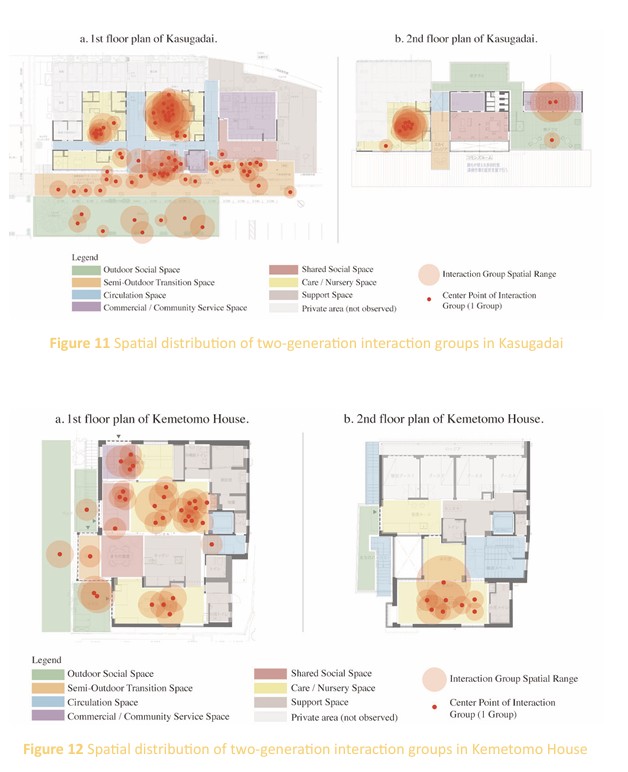
This study investigates patterns of intergenerational interaction in community-based welfare facilities in Japan by quantitatively examining group size, generational richness, and generation-based participation. Based on systematic observations of two facilities—the Kasugadai Community Center in Aikawa Town, Kanagawa Prefecture, and the Kemetomo House Kids Nishi-Oi in Shinagawa Ward, Tokyo—users were classified by age group and role, and interactions were analyzed as group-based social configurations. The results show that most intergenerational interactions occurred in small groups of two to five participants, with single-generation and two-generation groups accounting for the majority of cases, while interactions involving three or more generations were rare. These findings indicate that mere generational co-presence does not necessarily lead to diverse intergenerational exchange, as older adults primarily engaged through structured or staff-mediated interactions rather than spontaneous multigenerational gatherings. Overall, the study provides empirical insight into how intergenerational engagement is organized within welfare settings and highlights the influence of spatial and institutional contexts on interaction patterns, offering implications for the design of more inclusive, interaction-supportive community spaces.
Downloads
References
Cabinet Office, Government of Japan. (2022). Annual report on the ageing society: Chapter 1 ageing situation (Section 1-1-1). https://www8.cao.go.jp/kourei/whitepaper/w-2022/html/zenbun/s1_1_1.html (in Japanese)
Wang, P. (2024, January 18). Population declined slightly while quality development achieved progress. National Bureau of Statistics of China. https://www.stats.gov.cn/xxgk/jd/sjjd2020/202401/t20240118_1946711.html (in Chinese)
Yamada, A., & Koga, T. (2017). Architectural textbook on older adults’ care facilities. (in Japanese)
Cabinet Secretariat, Government of Japan. (n.d.). Japanese version of CCRC (draft). https://www.chisou.go.jp/sousei/meeting/ccrc/ccrc_soan.pdf (in Japanese)
Suzuki, H., Murakawa, M., & Yamada, A. (2022). Shared spaces and support functions in intergenerational co-housing communities. Journal of Architecture and Planning (Transactions of AIJ), 87(802), 2298–2308. (in Japanese)
Asahi, N., Katayama, M., & Yamada, A. (2021). Possibilities of intergenerational co-housing based on community management and resident interactions. AIJ Journal of Technology and Design, 27(66), 931–936. (in Japanese)
Okuda, K., & Yamaguchi, K. (2014). A study of use and interaction patterns in multi-functional welfare facilities. Journal of Architecture and Planning (Transactions of AIJ), 79(705), 2375–2385. (in Japanese)
Watanabe, A., & Takizawa, Y. (1998). Evaluation of spatial liveliness and calmness in special nursing homes: Study on spatial qualities for older adults’ care (Part 2). Journal of Architecture and Planning (Transactions of AIJ), 63(513), 101–109. (in Japanese)
Gualano, M. R., Voglino, G., Bert, F., Thomas, R., Camussi, E., & Siliquini, R. (2018). The impact of intergenerational programs on children and older adults: A review. International Psychogeriatrics, 30(4), 451–468. https://doi.org/10.1017/S104161021700182X
French, S., Wood, L., Foster, S. A., Giles-Corti, B., Frank, L., & Learnihan, V. (2014). Sense of community and its association with the neighborhood built environment. Environment and Behavior, 46(6), 677–697. https://doi.org/10.1177/0013916512469098
Shinkenchiku. (2022). Kasugadai Center. Shinkenchiku, April, 100–109. (in Japanese)
Shinkenchiku. (2019). Hall for children, older adults, and dining. Shinkenchiku, February, 100–107. (in Japanese)
Downloads
Published
How to Cite
Issue
Section
License
Copyright (c) 2026 International Journal of Building, Urban, Interior and Landscape Technology

This work is licensed under a Creative Commons Attribution-NonCommercial-NoDerivatives 4.0 International License.