Ambidextrous Management of Design in the Age of Artificial Intelligence - Driven Digital Innovation
A Narrative Review
DOI:
https://doi.org/10.56261/built.v24.263368Keywords:
Digital materiality, Generativity, Design Management, Sociomaterial practice, Degital innovation, Artificial Intelligence (AI), Generative AI (GenAI) , Human-centered designAbstract
Design is increasingly understood as a sociomaterial practice in which human actors and material agencies co-produce problem solving and meaning in evolving sociotechnical systems. This narrative review synthesizes fragmented work on generativity and generative design and traces how organizational design languages have shifted from control- and governance-oriented approaches toward enabling, open, and collaborative forms of organizing. Drawing on classic cases from Xerox PARC and Frank O. Gehry’s technology enabled architectural practice, and on theories of digital materiality and layered modular architecture (LMA), the paper shows how digital artifacts remain incomplete and recombinable while generative AI amplifies both generative capacity and sociotechnical risk (e.g., overload, homogenization, privacy, and accountability challenges). This paper
advances an ambidextrous view of design management for AI-driven digital innovation: organizations should enable generativity while deploying nuanced, human-centered controls - including governance, formalization, and interdisciplinary oversight—to steer evolving design practices toward accountable and ethically defensible outcomes.
Downloads
References
Adler, P. S., & Borys, B. (1996). Two types of bureaucracy: Enabling and coercive. Administrative Science Quarterly, 41(1), 61–89. https://www.jstor.org/stable/2393986 DOI: https://doi.org/10.2307/2393986
Adler, P. S., & Winograd, T. (1992). The usability challenge. In P. S. Adler & T. Winograd (Eds.), Usability: Turning technologies into tools (pp. 3–14). Oxford University Press. DOI: https://doi.org/10.1093/oso/9780195075106.003.0004
Avital, M., & Te’eni, D. (2009). From generative fit to generative capacity: Exploring an emerging dimension of information systems design and task performance. Information Systems Journal, 19(4), 345–367. https://doi.org/10.1111/j.1365-2575.2007.00291.x DOI: https://doi.org/10.1111/j.1365-2575.2007.00291.x
Baldwin, C. Y., & Clark, K. B. (2000). Design rules: The power of modularity. MIT Press. DOI: https://doi.org/10.7551/mitpress/2366.001.0001
Bannon, L. J., & Ehn, P. (2012). Design: Design matters in participatory design. In J. Simonsen & T. Robertson (Eds.), Routledge international handbook of participatory design (pp. 37–63). Routledge.
BBC News. (2025, December 6). From leaning glass tower to golden fish sculpture—Frank Gehry’s most iconic work. https://www.bbc.com/news/articles/c0qlgx275jqo
Blomberg, J., & Burrel, M. (2009). An ethnographic approach to design. In A. Sears & J. A. Jacko (Eds.), Human-computer interaction: Development process (pp. 71–94). CRC Press. DOI: https://doi.org/10.1201/9781420088892.ch5
Boland, R. J., Lyytinen, K., & Yoo, Y. (2007). Wakes of innovation in project networks: The case of digital 3D representations in architecture, engineering, and construction. Organization Science, 18(4), 631–647. https://doi.org/10.1287/orsc.1070.0304 DOI: https://doi.org/10.1287/orsc.1070.0304
Boland, R. J., Jr., Collopy, F., Lyytinen, K., & Yoo, Y. (2008). Managing as designing: Lessons for organization leaders from the design practice of Frank O. Gehry. Design Issues, 24(1), 10–25. https://doi.org/10.1162/desi.2008.24.1.10 DOI: https://doi.org/10.1162/desi.2008.24.1.10
Bordas, A., Le Masson, P., Thomas, M., & Weil, B. (2024). What is generative in generative artificial intelligence? A design-based perspective. Research in Engineering Design. Advance online publication. https://doi.org/10.1007/s00163-024-00441-x DOI: https://doi.org/10.1007/978-3-031-71922-6_8
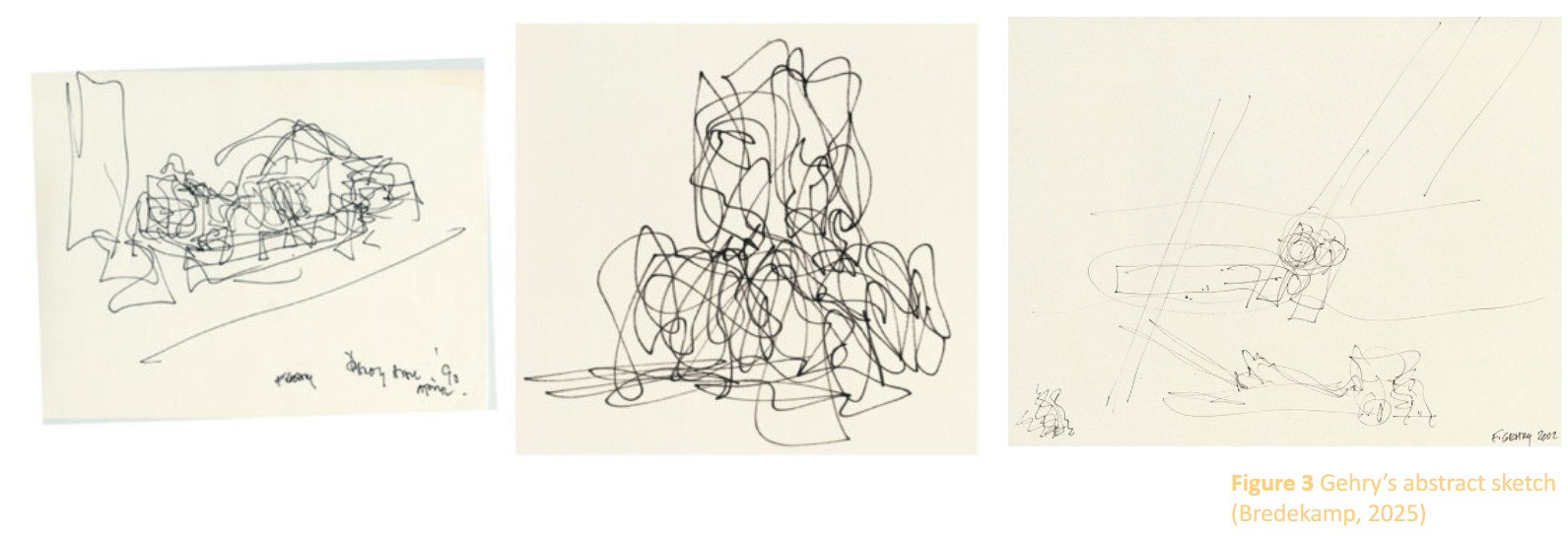
Bredekamp, H. (2025, December 6). Frank Gehry and the art of drawing. The MIT Press Reader. https://thereader.mitpress.mit.edu/frank-gehry-and-the-art-of-drawing/
Cai, Y., Xin, X., Li, L., Shang, Y., & Chen, L. (2026). Bridging human and machine intelligence: How design thinking and generative AI capabilities drive exploratory and exploitative innovation. Technological Forecasting and Social Change, 228, 124662. https://doi.org/10.1016/j.techfore.2026.124662 DOI: https://doi.org/10.1016/j.techfore.2026.124662
Cain, G. (2020). Samsung rising: Inside the secretive company conquering tech. Random House.
CSU Center for Public History and Digital Humanities. (2010, September 18). Peter B. Lewis Building: Frank Gehry designs a home for the Case Weatherhead School. https://clevelandhistorical.org/items/show/39
Eaton, B., Elaluf-Calderwood, S., Sorensen, C., & Yoo, Y. (2011). Dynamic structures of control and generativity in digital ecosystem service innovation: the cases of the Apple and Google mobile app stores (Working paper series 183). London School of Economics and Political Science. https://researchonline.lse.ac.uk/id/eprint/47436
Elsbach, K. D., & Stigliani, I. (2018). Design thinking and organizational culture: A review and framework for future research. Journal of Management, 44(6), 2274-2306. https://doi.org/10.1177/0149206317744252 DOI: https://doi.org/10.1177/0149206317744252
Farjoun, M. (2010). Beyond dualism: Stability and change as a duality. Academy of Management Review, 35(2), 202–225. https://doi.org/10.5465/amr.35.2.zok202 DOI: https://doi.org/10.5465/amr.35.2.zok202
Garud, R., Jain, S., & Tuertscher, P. (2008). Incomplete by design and designing for incompleteness. Organization Studies, 29(3), 351–371. https://doi.org/10.1177/0170840607088018 DOI: https://doi.org/10.1177/0170840607088018
Hriday, M. S. H., & Rehman, A. (2025). Artificial intelligence and machine learning applications in construction project management: Enhancing scheduling, cost estimation, and risk mitigation. International Journal of Business and Economics Insights, 5(3), 30–64. https://doi.org/10.63125/jrpjje59 DOI: https://doi.org/10.63125/jrpjje59
Hutter, K., Rupp, J., & Füller, J. (2026). From divergence to convergence: GenAI's role in collaborative design thinking. Business Horizons. Advance online publication. https://doi.org/10.1016/j.bushor.2026.04.001 DOI: https://doi.org/10.1016/j.bushor.2026.04.001
Kallinikos, J., Aaltonen, A., & Marton, A. (2013). The ambivalent ontology of digital artifacts. MIS Quarterly, 37(2), 357–370. https://doi.org/10.25300/MISQ/2013/37.2.02 DOI: https://doi.org/10.25300/MISQ/2013/37.2.02
Krippendorff, K. (2011). Principles of design and a trajectory of artificiality. Journal of Product Innovation Management, 28(3), 411–418. https://doi.org/10.1111/j.1540-5885.2011.00814.x DOI: https://doi.org/10.1111/j.1540-5885.2011.00814.x
Leonardi, P. M. (2012). Materiality, sociomateriality, and socio-technical systems: What do these terms mean? How are they different? Do we need them? In P. M. Leonardi, B. A. Nardi, & J. Kallinikos (Eds.), Materiality and organizing: Social interaction in a technological world (pp. 25–48). Oxford University Press. DOI: https://doi.org/10.1093/acprof:oso/9780199664054.003.0002
Leonardi, P. M., Nardi, B. A., & Kallinikos, J. (Eds.). (2012). Materiality and organizing: Social interaction in a technological world. Oxford University Press. DOI: https://doi.org/10.1093/acprof:oso/9780199664054.001.0001
Leonardi, P. M., & Rodriguez-Lluesma, C. (2012). Sociomateriality as a lens for design: Imbrication and the constitution of technology and organization. Scandinavian Journal of Information Systems, 24(2), 79–88. https://aisel.aisnet.org/sjis/vol24/iss2/4
Merschbrock, C., & Munkvold, B. E. (2012). A research review on building information modeling in construction—An area ripe for IS research. Communications of the Association for Information Systems, 31(10), 207–228. https://doi.org/10.17705/1CAIS.03110 DOI: https://doi.org/10.17705/1CAIS.03110
Mintzberg, H. (1979). The structuring of organizations: A synthesis of the research. Prentice-Hall.
Nylén, D., & Holmström, J. (2015). Digital innovation strategy: A framework for diagnosing and improving digital product and service innovation. Business Horizons, 58(1), 57–67. https://doi.org/10.1016/j.bushor.2014.09.001 DOI: https://doi.org/10.1016/j.bushor.2014.09.001
Orlikowski, W. J., & Scott, S. V. (2008). Sociomateriality: Challenging the separation of technology, work, and organization. Academy of Management Annals, 2(1), 433–474. https://doi.org/10.5465/19416520802211644 DOI: https://doi.org/10.5465/19416520802211644
Orlikowski, W. J., & Scott, S. V. (2016). Digital work: A research agenda. In B. Czarniawska (Ed.), A research agenda for management and organization studies (pp. 88–95). Edward Elgar Publishing. DOI: https://doi.org/10.4337/9781784717025.00014
Orlikowski, W. J., & Scott, S. V. (2023). The digital undertow and institutional displacement: A sociomaterial approach. Organization Theory, 4(2), 26317877231180898. https://doi.org/10.1177/26317877231180898 DOI: https://doi.org/10.1177/26317877231180898
Sanchez, R., & Mahoney, J. T. (1996). Modularity, flexibility, and knowledge management in product and organization design. Strategic Management Journal, 17(S2), 63–76. https://doi.org/10.1002/smj.4250171107 DOI: https://doi.org/10.1002/smj.4250171107
Savard Architecte. (n.d.). Frank Gehry in Seattle. https://savardarchitecte.ca/en/frank-gehry-in-seattle/
Schrage, M. (1996). Cultures of prototyping. Bringing design to software, 4(1), 191-213. https://doi.org/10.1145/229868.230045 DOI: https://doi.org/10.1145/229868.230045
Scott, W. R. (1998). Organizations and organizing: Rational, natural, and open systems (4th ed.). Prentice Hall.
Simon, H. A. (1996). The Sciences of the Artificial. The MIT press.
Sreenivasan, A., & Suresh, M. (2024). Design thinking and artificial intelligence: A systematic literature review exploring synergies. International Journal of Innovation Studies, 8(3), 297–312. https://doi.org/10.1016/j.ijis.2024.05.001 DOI: https://doi.org/10.1016/j.ijis.2024.05.001
Suchman, L., Trigg, R., & Blomberg, J. (2002). Working artefacts: Ethnomethods of the prototype. The British Journal of Sociology, 53(2), 163–179. https://doi.org/10.1080/00071310220133287 DOI: https://doi.org/10.1080/00071310220133287
Thomas, L. D. W., & Tee, R. (2019). Generativity: A systematic review and conceptual framework. International Journal of Management Reviews, 21(3), 255–278. https://doi.org/10.1111/ijmr.12277 DOI: https://doi.org/10.1111/ijmr.12277
Verganti, R. (2008). Design, meanings, and radical innovation: A metamodel and a research agenda. Journal of Product Innovation Management, 25(5), 436–456. https://doi.org/10.1111/j.1540-5885.2008.00313.x DOI: https://doi.org/10.1111/j.1540-5885.2008.00313.x
Verganti, R., Vendraminelli, L., & Iansiti, M. (2020). Innovation and design in the age of artificial intelligence. Journal of Product Innovation Management, 37(3), 212–227. https://doi.org/10.1111/jpim.12523 DOI: https://doi.org/10.1111/jpim.12523
Verganti, R., Dell’Era, C., & Swan, K. S. (2021). Design thinking: Critical analysis and future evolution. Journal of Product Innovation Management, 38(6), 603-622. https://doi.org/10.1111/jpim.12610 DOI: https://doi.org/10.1111/jpim.12610
Wilson, M. (2015, February 17). Why Samsung design stinks: Blame Steve Jobs syndrome. Fast Company. https://www.fastcompany.com/3042408/why-samsung-design-stinks
Yoo, Y. (2012). Digital materiality and the emergence of an evolutionary science of the artificial. In P. M. Leonardi, B. A. Nardi, & J. Kallinikos (Eds.), Materiality and organizing: Social interaction in a technological world (pp. 134–156). Oxford University Press. DOI: https://doi.org/10.1093/acprof:oso/9780199664054.003.0007
Yoo, Y., Boland, R. J., Jr., & Lyytinen, K. (2006). From organization design to organization designing. Organization Science, 17(2), 215–229. https://doi.org/10.1287/orsc.1050.0168 DOI: https://doi.org/10.1287/orsc.1050.0168
Yoo, Y., Henfridsson, O., Kallinikos, J., Gregory, R., Burtch, G., Chatterjee, S., & Sarker, S. (2024). The next frontiers of digital innovation research. Information Systems Research, 35(4), 1507–1523. https://doi.org/10.1287/isre.2024.editorial.v35.n4 DOI: https://doi.org/10.1287/isre.2024.editorial.v35.n4
Yoo, Y., Henfridsson, O., & Lyytinen, K. (2010). Research Commentary — The new organizing logic of digital innovation: An agenda for information systems research. Information Systems Research, 21(4), 724–735. https://doi.org/10.1287/isre.1100.0322 DOI: https://doi.org/10.1287/isre.1100.0322
Downloads
Published
How to Cite
Issue
Section
License
Copyright (c) 2026 International Journal of Building, Urban, Interior and Landscape Technology

This work is licensed under a Creative Commons Attribution-NonCommercial-NoDerivatives 4.0 International License.