Pathway to Carbon Neutral Campus: Strategic Solar Energy Assessment of Khon Kaen University
DOI:
https://doi.org/10.56261/built.v24.264965Keywords:
Carbon neutrality, Strategic energy management, Solar photovoltaic, Net Zero University, Campus-as-city, Self-consumption ratioAbstract
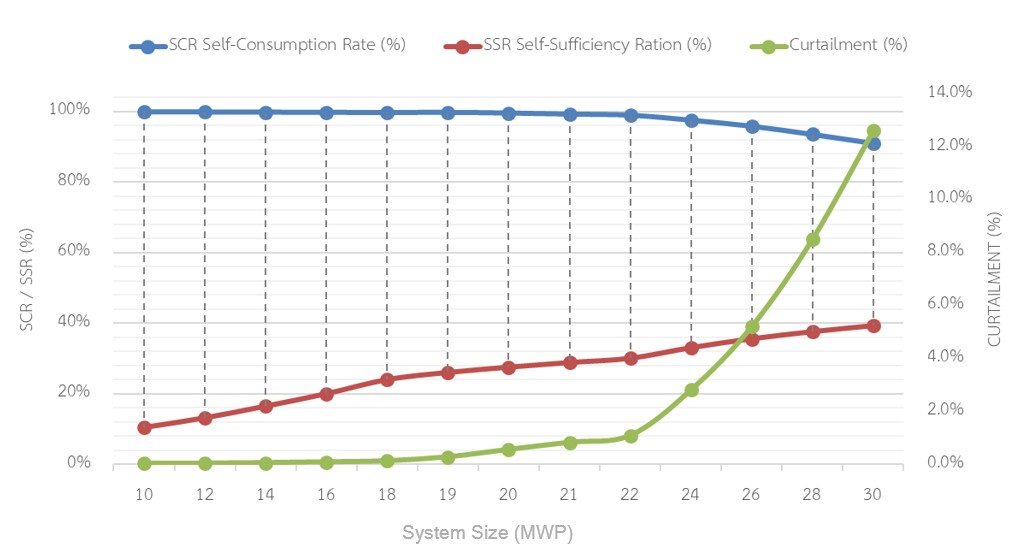
The transition of universities toward carbon neutrality requires not only strategic planning but also a feasibility assessment. In the case of the energy sector, the largest GHG source in large higher-education institutions. This study integrates strategic planning analysis with technical evaluation for Khon Kaen University (KKU), which targets carbon neutrality by 2040 and positions solar photovoltaic (PV) deployment as the flagship Scope 2 measure within that pathway. Using 8,760-hour electricity load data, spatial suitability analysis, and hourly PV simulation, the study evaluates the self-consumption ratio (SCR), self-sufficiency ratio (SSR), and curtailment rate across PV capacities of 10–30 MWp, and quantifies the resulting direct GHG reduction and 2040 load-projection performance. Purchased electricity accounts for 60–65% of KKU's emissions, equivalent to a baseline of approximately 81,600 tCO2e/yr. The optimal capacity range of 19–22 MWp yields an SCR of 98.9–99.7%, an SSR of 26–30%, and a curtailment rate of 0.27–1.08%, achievable without battery storage. This range corresponds to a direct GHG reduction of approximately 13,300–15,300 tCO2e/yr, or approximately 26–30% of Scope 2 and 16–19% of total institutional emissions. Under a projected 2040 load scenario, the same capacity range remains technically valid, confirming it as a robust, no-regret near-term measure. These findings demonstrate a strategic balance among direct emissions reduction, load compatibility, and operational feasibility and can guide other Thai universities in linking emissions diagnostics to practical, evidence-based, and monitorable energy strategies.
Downloads
References
Aghamolaei, R., & Fallahpour, M. (2023). Strategies towards reducing carbon emission in university campuses: A comprehensive review of both global and local scales. Journal of Building Engineering, 76, Article 107183. https://doi.org/10.1016/j.jobe.2023.107183
Ali, A., Muqeet, H. A., Khan, T., Hussain, A., Waseem, M., & Niazi, K. A. K. (2023). IoT-enabled campus prosumer microgrid energy management: A comprehensive study. Energies, 16(4), Article 1863. https://doi.org/10.3390/en16041863
Amin, M. M., & Kocher, I. S. (2023). Floating photovoltaic performance evaluation using novel cooling system case study. NTU Journal of Renewable Energy, 5(1), 86–92. https://doi.org/10.56286/ntujre.v5i1.624
Bertsch, V., Geldermann, J., & Lühn, T. (2017). What drives the profitability of household PV investments, self-consumption and self-sufficiency? Applied Energy, 204, 1–15. https://doi.org/10.1016/j.apenergy.2017.06.055
Cao, S., Hasan, A., & Sirén, K. (2016). Nearly zero-energy building in Finland—energy performance and net zero-energy concept. Energy, 116, 734–752. https://doi.org/10.1016/j.energy.2016.09.143
Castillo-Cagigal, M., Caamaño-Martín, E., Matallanas, E., Masa-Bote, D., Gutiérrez, A., Monasterio-Huelin, F., & Jiménez-Leube, J. (2011). PV self-consumption optimization with storage and active DSM for the residential sector. Solar Energy, 85(9), 2338–2348. https://doi.org/10.1016/j.solener.2011.06.028
Del Borghi, A., Spiegelhalter, T., Moreschi, L., & Gallo, M. (2021). Carbon-neutral-campus building: Design versus retrofitting of two university zero energy buildings in Europe and in the United States. Sustainability, 13(16), Article 9023. https://doi.org/10.3390/su13169023
Denholm, P., & Margolis, R. M. (2007). Evaluating the limits of solar photovoltaics (PV) in electric power systems utilizing energy storage and other enabling technologies. Energy Policy, 35(9), 4424–4433. https://doi.org/10.1016/j.enpol.2007.03.004
Depietri, Y., & McPhearson, T. (2017). Integrating the grey, green, and blue in cities: Nature-based solutions for climate change adaptation and risk reduction. In N. Kabisch, H. Korn, J. Stadler, & A. Bonn (Eds.), Nature-based solutions to climate change adaptation in urban areas: Linkages between science, policy and practice (pp. 91–109). Springer. https://doi.org/10.1007/978-3-319-56091-5_6
Eltawil, M. A., & Zhao, Z. (2010). Grid-connected photovoltaic power systems: Technical and potential problems—A review. Renewable and Sustainable Energy Reviews, 14(1), 112–129. https://doi.org/10.1016/j.rser.2009.07.015
Evans, J., Jones, R., Karvonen, A., Millard, L., & Wendler, J. (2015). Living labs and co-production: University campuses as platforms for sustainability science. Current Opinion in Environmental Sustainability, 16, 1–6. https://doi.org/10.1016/j.cosust.2015.06.005
Filho, W. L., Salvia, A. L., Frankenberger, F., Akib, N. A. M., & Pallant, E. (2021). Sustainability and renewable energy at universities: Experiences from North America. International Journal of Sustainable Development & World Ecology, 28(4), 331–341. https://doi.org/10.1080/13504509.2020.1860315
Filho, W. L., Weissenberger, S., Luetz, J. M., Sierra, J., Rampasso, I. S., Sharifi, A., et al. (2023). Towards a greater engagement of universities in addressing climate change challenges. Scientific Reports, 13, Article 19030. https://doi.org/10.1038/s41598-023-45866-x
Fox, W., Dwivedi, P., Lowe, R. C., III, Welch, S., & Fuller, M. (2020). Estimating carbon stock of live trees located on the main campus of the University of Georgia. Journal of Forestry, 118(5), 457–465. https://doi.org/10.1093/jofore/fvaa025
Gacu, J. G., Garcia, J. D., Fetalvero, E. G., Catajay-Mani, M. P., & Monjardin, C. E. F. (2023). Suitability analysis using GIS-based analytic hierarchy process for solar power exploration. Energies, 16(18), Article 6724. https://doi.org/10.3390/en16186724
Gao, L., Wang, S., Mao, M., Liu, C., & Li, T. (2024). Study on the energy consumption characteristics and the self-sufficiency rate of rooftop photovoltaic of university campus buildings. Energies, 17(14), Article 3535. https://doi.org/10.3390/en17143535
Guerrieri, M., La Gennusa, M., Peri, G., Rizzo, G., & Scaccianoce, G. (2019). University campuses as small-scale models of cities: Quantitative assessment of a low carbon transition path. Renewable and Sustainable Energy Reviews, 113, Article 109263. https://doi.org/10.1016/j.rser.2019.109263
Halder, B., Banik, P., Almohamad, H., Al Dughairi, A. A., Al-Mutiry, M., Al Shahrani, H. F., & Abdo, H. G. (2022). Land suitability investigation for solar power plant using GIS, AHP and multi-criteria decision approach: A case of megacity Kolkata, West Bengal, India. Sustainability, 14(18), Article 11276. https://doi.org/10.3390/su141811276
Helmers, E., Chang, C.-C., & Dauwels, J. (2021). Carbon footprinting of universities worldwide: Part I—Objective comparison by standardized metrics. Environmental Sciences Europe, 33(1), Article 30. https://doi.org/10.1186/s12302-021-00454-6
International Renewable Energy Agency. (2020). Electricity storage and renewables: Costs and markets to 2030. IRENA.
Islam, M. S., Liu, G., Xu, D., Chen, Y., Li, H., & Chen, C. (2023). University-campus-based zero-carbon action plans for accelerating the zero-carbon city transition. Sustainability, 15(18), Article 13504. https://doi.org/10.3390/su151813504
Kohl, K., Hopkins, C., Barth, M., Michelsen, G., Dlouha, J., Razak, D. A., Sanusi, Z. A. B., & Toman, I. (2022). A whole-institution approach towards sustainability: A crucial aspect of higher education's individual and collective engagement with the SDGs and beyond. International Journal of Sustainability in Higher Education, 23(2), 218–236. https://doi.org/10.1108/IJSHE-10-2020-0398
Li, Y., & Jia, Q. S. (2022). On the feasibility to achieve carbon neutrality in university campus: A case study. IFAC-PapersOnLine, 55(5), 78–83. https://doi.org/10.1016/j.ifacol.2022.07.643
Lin, X., Cai, H., & Zhao, S. (2024). An empirical analysis of carbon emissions in higher education institutions: A case study of Zhejiang Ocean University using emission factor methodology. Sustainability, 16(21), Article 9412. https://doi.org/10.3390/su16219412
Luthander, R., Widén, J., Nilsson, D., & Palm, J. (2015). Photovoltaic self-consumption in buildings: A review. Applied Energy, 142, 80–94. https://doi.org/10.1016/j.apenergy.2014.12.028
Nottrott, A., Kleissl, J., & Washom, B. (2013). Energy dispatch schedule optimization and cost benefit analysis for grid-connected, photovoltaic-battery storage systems. Renewable Energy, 55, 230–240. https://doi.org/10.1016/j.renene.2012.12.036
Office of Natural Resources and Environmental Policy and Planning. (2021). Thailand's long-term low greenhouse gas emission development strategy. ONEP.
Paredes-Canencio, K. N., Lasso, A., Castrillon, R., Vidal-Medina, J. R., & Quispe, E. C. (2024). Carbon footprint of higher education institutions: A review. Environment, Development and Sustainability, 26, 30239–30272. https://doi.org/10.1007/s10668-024-04596-4
Paspatis, A., Fiorentzis, K., Katsigiannis, Y., & Karapidakis, E. (2022). Smart campus microgrids towards a sustainable energy transition—The case study of the Hellenic Mediterranean University. Mathematics, 10(7), Article 1065. https://doi.org/10.3390/math10071065
Quoilin, S., Kavvadias, K., Mercier, A., Pappone, I., & Zucker, A. (2016). Quantifying self-consumption linked to solar home battery systems: Statistical analysis and economic assessment. Applied Energy, 182, 58–67. https://doi.org/10.1016/j.apenergy.2016.08.077
Sachs, J., Schmidt-Traub, G., Mazzucato, M., Messner, D., Nakicenovic, N., & Rockström, J. (2019). Six transformations to achieve the sustainable development goals. Nature Sustainability, 2(9), 805–814. https://doi.org/10.1038/s41893-019-0352-9
Salpakari, J., & Lund, P. (2016). Optimal and rule-based control strategies for energy flexibility in buildings with PV. Applied Energy, 161, 425–436. https://doi.org/10.1016/j.apenergy.2015.10.111
Salom, J., Marszal, A. J., Widén, J., Candanedo, J., & Lindberg, K. B. (2014). Analysis of load match and grid interaction indicators in net zero energy buildings. Applied Energy, 136, 119–131. https://doi.org/10.1016/j.apenergy.2014.09.018
Sarasa-Maestro, C. J., Dufo-López, R., & Bernal-Agustín, J. L. (2016). Analysis of photovoltaic self-consumption systems. Energies, 9(9), Article 681. https://doi.org/10.3390/en9090681
Suganthi, D., & Jamuna, K. (2025). Optimizing campus microgrid energy systems: Economic, environmental, and sensitivity insights. Energy Conversion and Management: X, 27, Article 101046. https://doi.org/10.1016/j.ecmx.2025.101046
Thailand Greenhouse Gas Management Organization. (2024). Emission factors for carbon footprint assessment of organizations. TGO.
Vieira, F. M., Moura, P. S., & Almeida, A. T. (2017). Energy storage system for self-consumption of photovoltaic energy in residential zero energy buildings. Renewable Energy, 103, 308–320. https://doi.org/10.1016/j.renene.2016.11.048
Wang, L., Yan, X., Fang, M., Song, H., & Hu, J. (2023). A systematic design framework for zero carbon campuses: Investigating the Shanghai Jiao Tong University Fahua Campus case. Sustainability, 15(10), Article 7975. https://doi.org/10.3390/su15107975
Weniger, J., Tjaden, T., & Quaschning, V. (2014). Sizing of residential PV battery systems. Energy Procedia, 46, 78–87. https://doi.org/10.1016/j.egypro.2014.01.160
Yang, P., Chua, L. H. C., Irvine, K. N., & Su, S. L. (2022). Impacts of a floating photovoltaic system on temperature and water quality in a shallow tropical reservoir. Limnology, 23, 441–454. https://doi.org/10.1007/s10201-022-00698-y
Downloads
Published
How to Cite
Issue
Section
License
Copyright (c) 2026 International Journal of Building, Urban, Interior and Landscape Technology

This work is licensed under a Creative Commons Attribution-NonCommercial-NoDerivatives 4.0 International License.