Environmental Health Risk and Spatial Distribution of PM2.5 in The Cement Industry 10.32526/ennrj/23/20240182
Article Sidebar
Main Article Content
Abstract
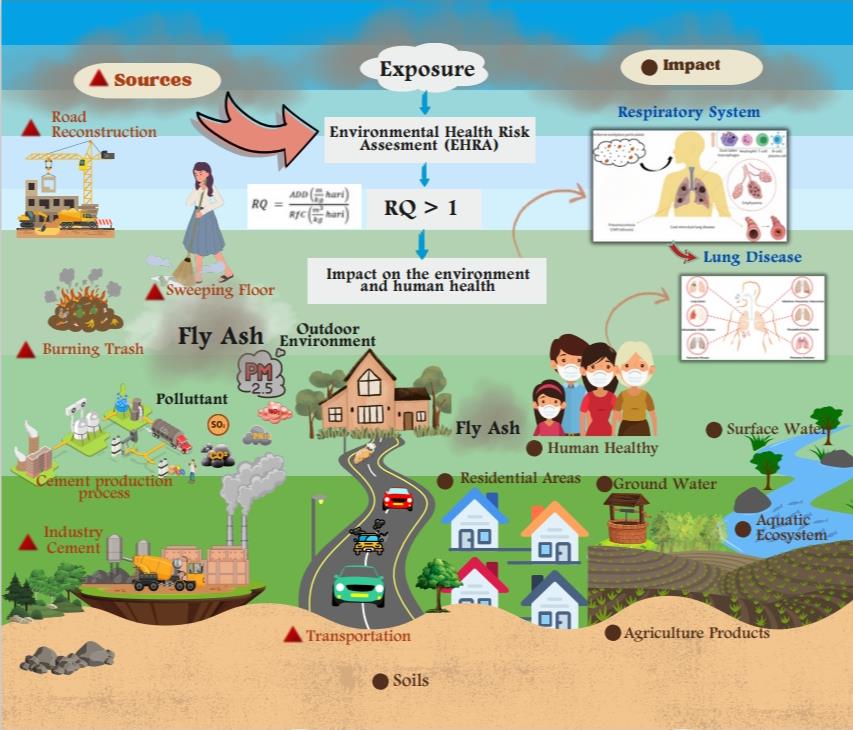
The proximity of cement factories to residential areas raises concerns about air pollution and health risks associated with particulate matter (PM) emissions, particularly PM2.5. This study aims to assess environmental health risks and spatial PM2.5 exposure around the cement industry in South Sulawesi, Indonesia. Methods involved descriptive quantitative techniques, with data collected from eight sampling locations using purposive sampling, encompassing 160 individuals. Data analysis included intake calculations and risk quotient assessments. Hazard identification, dose-response analysis, exposure evaluation, and risk characterization were conducted to assess the health risks of PM2.5 exposure. Results indicate that PM2.5 levels in areas near the cement plant often exceed acceptable safety limits, posing notable health risks, especially among sensitive populations such as children and the elderly. The spatial analysis identifies Taraweang and Mangilu Villages as moderately exposed, Mangilu village is 1.6 km away from the cement factory, while Taraweang village is 1.55 km away, underscoring the necessity for targeted mitigation strategies and policies to safeguard public health in similar industrial settings.
Article Details

This work is licensed under a Creative Commons Attribution-NonCommercial 4.0 International License.
Published articles are under the copyright of the Environment and Natural Resources Journal effective when the article is accepted for publication thus granting Environment and Natural Resources Journal all rights for the work so that both parties may be protected from the consequences of unauthorized use. Partially or totally publication of an article elsewhere is possible only after the consent from the editors.
References
Abbasi SA, Ponni G, Tauseef SM. Potential of joyweed Alternanthera sessilis for rapid treatment of domestic sewage in SHEFROL® bioreactor. International Journal of Phytoremediation 2019;21(2):160-9.
Abubakar IR, Maniruzzaman KM, Dano UL, AlShihri FS, AlShammari MS, Ahmed SMS, et al. Environmental sustainability impacts of solid waste management practices in the global South. International Journal of Environmental Research and Public Health 2022;19(19):Article No. 12717.
Chanda F, Lin Kai-Xuan, Chaurembo AI, Huang Jian-Yuan, Zhang Hui-Juan, Deng Wen-Hui, et al. PM2.5-mediated cardiovascular disease in aging: Cardiometabolic risks, molecular mechanisms and potential interventions. Science of The Total Environment 2024;954:Article No. 176255.
Devi MLS WP. Distribution of Tsp (Total Suspended Particulate) dust to public health in Pt Semen Padang Industrial Area. Buana 2020;4(6):1245-61 (in Indonesian).
Duppa A, Daud A, Bahar B. Ambient air quality around Bosowa Cement Industry in Maros Regency. Journal of Maritime Public Health 2020;3(1):86-92 (in Indonesian).
Dwi Safira M, Syafiuddin A, Hakim A, Fasya Z, Setianto B, S1 PS, et al. Literature review: Air quality in industrial estates in various locations in Indonesia. Jurnal Public Health 2022;9(2):38-47 (in Indonesian).
Fitra M, Awaluddin S, Sejati, Elanda Fikri. Environmental Health Risk Analysis Revised Edition. Miladil Fitra; 2022 (in Indonesian).
Fitriyanti R, Fatimura M. Cleaner production applications in the cement industry. Jurnal Redoks 2019;3(1):10-5 (in Indonesian).
He B. A risk and decision analysis framework to evaluate future PM2.5 risk: A case study in Los Angeles-Long Beach Metro Area. International Journal of Environmental Research and Public Health. 2021;18(9):Article No. 4905.
Istiqomah Q, Irsan R, Satria A. Analysis of distribution of NO2 pollutants in PT. X Sanggau Regency, West Kalimantan. Journal of Civil Engineering 2023;23(3):359-62.
Kasim S, Daud A, Birawida AB, Mallongi A, Arundhana AI, Rasul A, et al. Analysis of environmental health risks from exposure to polyethylene terephthalate microplastics in refilled drinking. Global Journal of Environmental Science and Management 2023;9:301-18.
Keyvani S, Mohammadyan M, Chimehi E. Effect of the meteorological parameters on the indoor PM2.5 and PM10 concentrations in a hospital. Scientific Research Publishing House 2020;2(4):1-7.
Kholodov A, Zakharenko A, Drozd V, Chernyshev V, Kirichenko K, Seryodkin I, et al. Identification of cement in atmospheric particulate matter using the hybrid method of laser diffraction analysis and Raman spectroscopy. Heliyon 2020;6(2):e03299.
Liang Y, Sengupta D, Campmier MJ, Lunderberg DM, Apte JS, Goldstein AH. Wildfire smoke impacts on indoor air quality assessed using crowdsourced data in California. Proceedings of the National Academy of Sciences 2021;118(36): e2106478118.
Lin C, Huang RJ, Ceburnis D, Buckley P, Preissler J, Wenger J, et al. Extreme air pollution from residential solid fuel burning. Nature Sustainability 2018;1(9):512-7.
Novirsa R, Achmadi UF. Risk analysis of exposure to PM2.5 in daytime ambient air to people in the cement industry area. Public Health: National Public Health Journal 2012;7(4):Article No. 173 (in Indonesian).
World Health Organization (WHO). WHO Ambient Air Quality Database, 2022 Update: Status Report. World Health Organization; 2023.
Ouyang H, Tang X, Kumar R, Zhang R, Brasseur G, Churchill B, et al. Toward better and healthier air quality: Implementation of WHO 2021 global air quality guidelines in Asia. Bulletin of the American Meteorological Society 2022;103(7):1696-703.
Palacio LC, Durango-Giraldo G, Zapata-Hernandez C, Santa-González GA, Uribe D, Saiz J, et al. Characterization of airborne particulate matter and its toxic and proarrhythmic effects: A case study in Aburrá Valley, Colombia. Environmental Pollution 2023;336:Article No. 122475.
Paustenbach DJ, Madl AK, Massarsky A. Exposure assessment. Human and Ecological Risk Assessment: Theory and Practice 2024;1:157-261.
Rasmi SAB, Türkay M. Sustainability analysis of cement supply chains considering economic, environmental and social effects. Cleaner Logistics and Supply Chain 2023;8:Article No. 100112.
Regia RA, Bachtiar VS, Solihin R. Analysis of health risks due to exposure to particulate Matter 2.5 (PM2.5) in residential homes in housing X Cement Industrial Area. Journal of Environmental Science 2021;19(3):531-40 (in Indonesian).
Roser M. Data Review: How Many People Die from Air Pollution? Our World in Data; 2021.
Saroyo H, Saputri NFM. Cytotoxicity of mangrove leaves (rhizophora) ethanolic extract on cancer cells. Journal of Nutraceuticals and Herbal Medicine 2021;4(1):43-52.
Sun J, Yu J, Niu X, Zhang X, Zhou L, Liu X, et al. Solid fuel derived PM2.5 induced oxidative stress and according cytotoxicity in A549 cells: The evidence and potential neutralization by green tea. Environment International 2023;171:Article No. 107674.
United States Environmental Protection Agency. Applying or Implementing Particulate Matter (PM) Standards. USEPA; 2022.
Wan Mahiyuddin WR, Ismail R, Mohammad Sham N, Ahmad NI, Nik Hassan NMN. Cardiovascular and respiratory health effects of fine particulate matters (PM2.5): A review on time series studies. Atmosphere 2023;14(5):Article No. 856.
Xu H, Léon JF, Liousse C, Guinot B, Yoboué V, Akpo AB, et al. Personal exposure to PM2.5 emitted from typical anthropogenic sources in southern West Africa: Chemical characteristics and associated health risks. Atmospheric Chemistry and Physics 2019;19(10):6637-57.
Yun X, Shen G, Shen H, Meng W, Chen Y, Xu H, et al. Residential solid fuel emissions contribute significantly to air pollution and associated health impacts in China. Science Advances 2020;6(44):eaba7621.
