Controlling Small Particles for Two-Step Density Sorting of Simulated Microplastics: Overcoming Surface Tension Effects with Surfactants 10.32526/ennrj/23/20240264
Article Sidebar
Main Article Content
Abstract
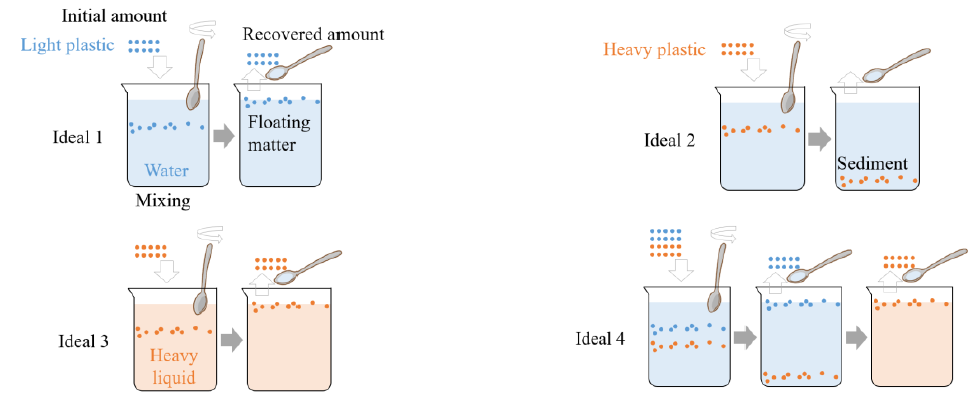
Infrared spectrometers are commonly recommended for analyzing microplastics (MPs) in sediment samples. However, these instruments are costly and time consuming, limiting the scope of surveys and our understanding of the distribution and long-term variation of MPs. Although it is challenging to determine MPs by floatation sorting, it is possible to estimate the ratio of MPs that float and sink in seawater. The study employed floatation sorting to confirm whether MPs with densities lower than the liquid float and those with densities higher sink, even for MPs smaller than 1 mm. As expected, large MPs (1 to 4.75 mm in size) with densities higher than that of the liquid sank. Unexpectedly, small MPs (212 μm to 1 mm) with densities higher than the liquid’s density also floated. Assuming the unexpected floating was due to surface tension, we added a surfactant to lower it, causing MPs with densities higher than the liquid’s to either sink as expected or accelerate sinking. Thus, with the use of a surfactant, even small MPs can be sorted by density if a heavy liquid is used after water.
Article Details

This work is licensed under a Creative Commons Attribution-NonCommercial 4.0 International License.
Published articles are under the copyright of the Environment and Natural Resources Journal effective when the article is accepted for publication thus granting Environment and Natural Resources Journal all rights for the work so that both parties may be protected from the consequences of unauthorized use. Partially or totally publication of an article elsewhere is possible only after the consent from the editors.
References
Akdogan Z, Guven B. Microplastics in the environment: A critical review of current understanding and identification of future research needs. Environmental Pollution 2019;254:Article No. 113011.
Alimba CG, Faggio C. Microplastics in the marine environment: Current trends in environmental pollution and mechanisms of toxicological profile. Environmental Toxicology and Pharmacology 2019;68:61-74.
Ang AL, Jose CM, Del Rosario CI, Uy OL, Garcia J. Recent advances on density separation techniques for microplastic recovery from sediments. Sinaya: A Philippine Journal for Senior High School Teachers and Students 2022;1(2):1-23.
Asakura H. Plastic bottles for sorting floating microplastics in sediment. Journal of Marine Science and Engineering 2022;10(3):Article No. 390.
Banik P, Hossain MB, Nur AA, Choudhury TR, Liba SI, Yu J, et al. Microplastics in sediment of Kuakata beach, Bangladesh: Occurrence, spatial distribution, and risk assessment. Frontiers in Marine Science 2022;9:Article No. 860989.
Beckwith VK, Fuentes MMPB. Microplastic at nesting grounds used by the northern Gulf of Mexico loggerhead recovery unit. Marine Pollution Bulletin 2018;131:32-7.
Chang M, Zhang C, Li M, Dong J, Li C, Liu J, et al. Warming, temperature fluctuations and thermal evolution change the effects of microplastics at an environmentally relevant concentration. Environmental Pollution 2022;292:Article No. 118363.
Coppock RL, Cole M, Lindeque PK, Queirós AM, Galloway TS. A small-scale, portable method for extracting microplastics from marine sediments. Environmental Pollution 2017; 230:829-37.
Crutchett TW, Bornt KR. A simple overflow density separation method that recovers >95% of dense microplastics from sediment. Methods X 2024;12:Article No. 102638.
Cutroneo L, Reboa A, Geneselli I, Capello M. Considerations on salts used for density separation in the extraction of microplastics from sediments. Marine Pollution Bulletin 2021;166:Article No. 112216.
Debraj D, Lavanya M. Microplastics everywhere: A review on existing methods of extraction. Science of the Total Environment 2023;893:Article No. 164878.
Huang D, Tao J, Cheng M, Deng R, Chen S, Yin L, et al. Microplastics and nanoplastics in the environment: Macroscopic transport and effects on creatures. Journal of Hazardous Materials 2021;407:Article No. 124399.
Huang D, Wang X, Yin L, Chen S, Tao J, Zhou W, et al. Research progress of microplastics in soil-plant system: Ecological effects and potential risks. Science of the Total Environment 2022;812:Article No. 151487.
Joint Group of Experts on the Scientific Aspects of Marine Environmental Protection (GESAMP). Guidelines for the Monitoring and Assessment of Plastic Litter in the Ocean, Series: GESAMP Reports and Studies 99. London, UK: GESAMP Joint Group of Experts on the Scientific Aspects of Marine Environmental Protection; 2019.
Li J, Liu H, Chen JP. Microplastics in freshwater systems: A review on occurrence, environmental effects, and methods for microplastics detection. Water Research 2018;137:362-74.
Luo H, Liu C, He D, Xu J, Sun J, Li J, et al. Environmental behaviors of microplastics in aquatic systems: A systematic review on degradation, adsorption, toxicity and biofilm under aging conditions. Journal of Hazardous Materials 2022; 423:Article No. 126915.
Masura J, Baker J, Foster G, Arthur C. Laboratory Methods for the Analysis of Microplastics in the Marine Environment: Recommendations for Quantifying Synthetic Particles in Waters and Sediments. NOAA Technical Memorandum NOS-OR&R-48; 2015.
Nabi I, Bacha AUR, Zhang L. A review on microplastics separation techniques from environmental media. Journal of Cleaner Production 2022;337:Article No. 130458.
Nuelle MT, Dekiff JH, Remy D, Fries E. A new analytical approach for monitoring microplastics in marine sediments. Environmental Pollution 2014;184:161-9.
Olsen LMB, Knutsen H, Mahat S, Wade EJ, Arp HPH. Facilitating microplastic quantification through the introduction of a cellulose dissolution step prior to oxidation: proof-of-concept and demonstration using diverse samples from the Inner Oslofjord, Norway. Marine Environmental Research 2020;161:Article No. 105080.
Plee TA, Pomory CM. Microplastics in sandy environments in the Florida Keys and the panhandle of Florida, and the ingestion by sea cucumbers (Echinodermata: Holothuroidea) and sand dollars (Echinodermata: Echinoidea). Marine Pollution Bulletin 2020;158:Article No. 111437.
Prata JC, Da Costa JP, Duarte AC, Rocha-Santos T. Methods for sampling and detection of microplastics in water and sediment: A critical review. TrAC Trends in Analytical Chemistry 2019;110:150-9.
Quinn B, Murphy F, Ewins C. Validation of density separation for the rapid recovery of microplastics from sediment. Analytical Methods 2017;9(9):1491-8.
Shukla S, Pei Y, Li WG, Pei DS. Toxicological research on nano and microplastics in environmental pollution: Current advances and future directions. Aquatic Toxicology 2024;270:Article No. 106894.
Soursou V, Campo J, Picó Y. A critical review of the novel analytical methods for the determination of microplastics in sand and sediment samples. TrAC Trends in Analytical Chemistry 2023;166:Article No. 117190.
Tirkey A, Upadhyay LS. Microplastics: An overview on separation, identification and characterization of microplastics. Marine Pollution Bulletin 2021;170:Article No. 112604.
Tiwari M, Rathod TD, Ajmal PY, Bhangare RC, Sahu SK. Distribution and characterization of microplastics in beach sand from three different Indian coastal environments. Marine Pollution Bulletin 2019;140:262-73.
Tiwari M, Sahu SK, Rathod T, Bhangare RC, Ajmal PY, Pulhani V, et al. Comprehensive review on sampling, characterization and distribution of microplastics in beach sand and sediments. Trends in Environmental Analytical Chemistry 2023; 40:e00221.
Van Cauwenberghe L, Devriese L, Galgani F, Robbens J, Janssen CR. Microplastics in sediments: A review of techniques, occurrence and effects. Marine Environmental Research 2015;111:5-17.
Vermeiren P, Muñoz C, Ikejima K. Microplastic identification and quantification from organic rich sediments: A validated laboratory protocol. Environmental Pollution 2020; 262:Article No. 114298.
Wang F, Wang Q, Adams CA, Sun Y, Zhang S. Effects of microplastics on soil properties: Current knowledge and future perspectives. Journal of Hazardous Materials 2022;424:Article No. 127531.
Wu P, Huang J, Zheng Y, Yang Y, Zhang Y, He F, et al. Environmental occurrences, fate, and impacts of micro-plastics. Ecotoxicology and Environmental Safety 2019; 184:Article No. 109612.
Xiang Y, Jiang L, Zhou Y, Luo Z, Zhi D, Yang J, et al. Microplastics and environmental pollutants: Key interaction and toxicology in aquatic and soil environments. Journal of Hazardous Materials 2022;422:Article No. 126843.
Yang H, Dong H, Huang Y, Chen G, Wang J. Interactions of microplastics and main pollutants and environmental behavior in soils. Science of the Total Environment 2022;821:Article No. 153511.
Yoganandham ST, Hamid N, Junaid M, Duan JJ, Pei DS. Micro (nano) plastics in commercial foods: A review of their characterization and potential hazards to human health. Environmental Research 2023;236:Article No. 116858.
Zhang L, Zhang S, Wang Y, Yu K, Li R. The spatial distribution of microplastic in the sands of a coral reef island in the South China Sea: Comparisons of the fringing reef and atoll. Science of the Total Environment 2019;688:780-6.
Zhang Y, Jiang H, Bian K, Wang H, Wang C. A critical review of control and removal strategies for microplastics from aquatic environments. Journal of Environmental Chemical Engineering 2021;9(4):Article No. 105463.
