Nutrient and Coliform Levels in the Surface Waters of a Protected Upland Lake in Ormoc City Philippines 10.32526/ennrj/23/20240281
Article Sidebar
Main Article Content
Abstract
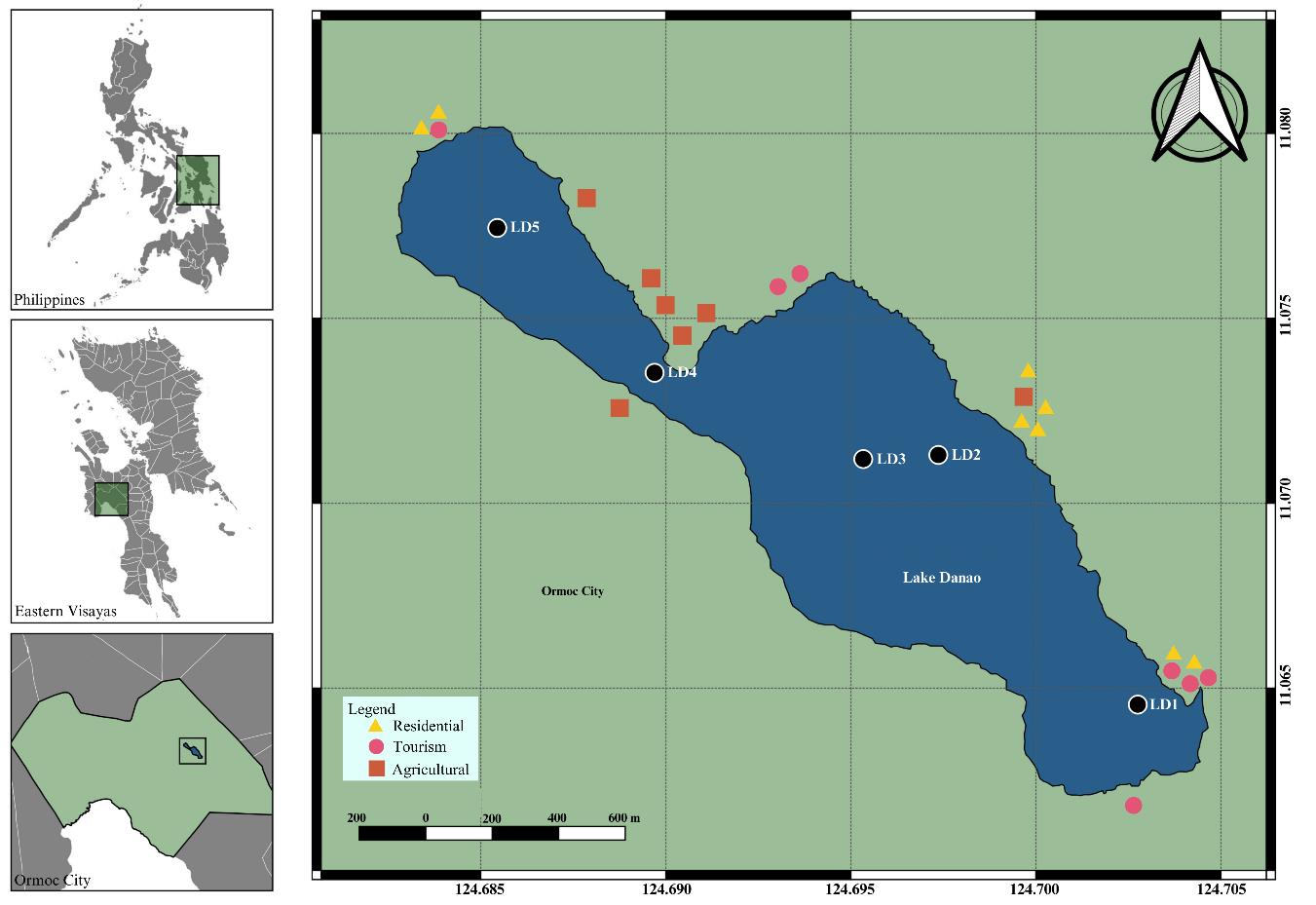
Lake Danao in Ormoc City, Philippines, is a legally protected freshwater ecosystem classified as a Class A water body by the government. However, its ecosystem services and biological stability are continuously threatened by untreated runoff from human activities in the upland regions surrounding the lake. A study was thus conducted to evaluate the water quality of Lake Danao using water quality indices and microbiological assessments. Water samples were collected in five sampling stations from April 2021 to June 2022. Results ranged between 0 and 20.53 mg/L for nitrates, 0 and 1.06 mg/L for nitrites, 0.07 and 2.5 mg/L for phosphates, 2.86 and 7.73 mg/L for dissolved oxygen, and 2.83 and 1,600 MPN/100 mL for total coliform. On average, the readings of these parameters were above the Philippines’ Department of Environment and Natural Resources maximum allowable limits for Class A waters. In addition, fecal coliform (0-849.67 MPN/100 mL, x̄=40.17 MPN/100 mL) consistently exceeded the limit. Mean readings in fecal coliform and phosphate levels were drawing near Class B levels. The results may impose possible threats to human health, as high levels of coliform suggest that the lake is already an unsafe source of potable water. In addition, fluctuations across sampling periods were observed for all parameters measured, except for total and fecal coliforms. Lastly, heavy precipitation resulted in a very low N/P ratio (<1) which suggests that the possible source of the phosphate is anthropogenic, and runoff from the surrounding land has carried significant concentrations of phosphates and coliform into the water body. The nutrient pollution index shows that Lake Danao is “moderately polluted,” while its trophic state index states that it is “mesotrophic.” It is recommended that strategies in runoff treatment should be advanced, be it by nature-based solutions, such as ensuring thick vegetation cover along the buffer zone, or via man-made interventions like no-till farming. Regular monitoring of the lake water quality should therefore be continued, particularly for nutrients and coliform, to ensure the maintenance, protection, and responsible use of the protected upland lake.
Article Details

This work is licensed under a Creative Commons Attribution-NonCommercial 4.0 International License.
Published articles are under the copyright of the Environment and Natural Resources Journal effective when the article is accepted for publication thus granting Environment and Natural Resources Journal all rights for the work so that both parties may be protected from the consequences of unauthorized use. Partially or totally publication of an article elsewhere is possible only after the consent from the editors.
References
Al-Afify ADG, Abdo MH, Othman AA, Abdel-Satar AM. Water quality and microbiological assessment of Burullus Lake and its Surrounding Drains. Water, Air, and Soil Pollution Journal 2023;234(6):Article No. 385.
American Public Health Association (APHA). Standards Methods for the Examination of Water and Wastewater. 20th ed. Washington, D.C.: American Public Health Association; 1998.
Bera D. Total coliform and fecal coliform bacterial estimation assessing water quality of Lake Saheb Bandh. International Journal of Aquatic Science 2022;13(1):77-90.
Bhateria R, Jain D. Water quality assessment of lake water: A review. Sustainable Water Resources Management 2016; 2(2):161-73.
Carlson RE. A trophic state index for lakes. Limnology and Oceanography 1977;2(22):361-9.
Cooper NA, Monroe MC. Water Quality in the Floridan Aquifer Region [Internet]. 2024 [cited 2021 Jul 4]. Available from: https://edis.ifas.ufl.edu/publication/FR440.
Dan T, Stone L. The distribution of fecal pollution indicator bacteria in Lake Kinneret. Water Research 1991;25(3):263-70.
De la Cruz JO, Romero JB, Amistoso AFGN, Romero II VM, Lama MT, Dañal RMS, et al. Basic morphology and morphometry of Lake Danao in Ormoc City, Leyte, the Philippines. Philippine Journal of Science 2024;153(2):693-702.
Department of Environment and Natural Resources (DENR). Water Quality Guidelines and General Effluent Standards of 2016. DENR; 2016.
Department of Environment and Natural Resources-Environmental Management Bureau (DENR-EMB). Water Quality Monitoring Manual Volume 1: Manual on Ambient Water Quality Monitoring. DENR-EMB; 2008.
Dillon PJ, Rigler FH. A test of a simple nutrient budget model predicting the phosphorus concentration in lake water. Journal of the Fisheries Board of Canada 1974;31(11):1771-8.
Dodds WK. Eutrophication and trophic state in rivers and streams. Limnology and Oceanography 2006;51(1-2):671-80.
Dodson SI, Arnott SE, Cottingham KL. The relationship in lake communities between primary productivity and species richness. Ecology 2000;81(10):2662-79.
Downing JA, Mccauley E. The nitrogen: Phosphorus relationship in lakes. Limnology and Oceanography 1992;37(5):936-45.
Fink G, Alcamo J, Flörke M, Reder K. Phosphorus Loadings to the World’s Largest Lakes: Sources and Trends. Global Biogeochemical Cycles 2018;32(4):617-34.
Frei R, Lawson G, Norris AJ, Cano G, Vargas M, Kujanpää E, et al. Limited progress in nutrient pollution in the US caused by spatially persistent nutrient sources. PLOS One 2021; 16(11):e0258952.
García-Avila F, Loja-Suco P, Siguenza-Jeton C, Jiménez-Ordoñez M, Valdiviezo-Gonzales L, Cabello-Torres R, et al. Evaluation of the water quality of a high Andean Lake using different quantitative approaches. Ecological Indicators 2023;154: Article No. 110924.
Isiuku BO, Enyoh CE. Pollution and health risks assessment of nitrate and phosphate concentrations in water bodies in South Eastern, Nigeria. Environmental Advances 2020;2:Aticle No. 100018.
Lewis WM. Global primary production of lakes: 19th Baldi Memorial Lecture. Inland Waters 2011;1(1):1-28.
Liu W, Zhang Q, Liu G. Lake eutrophication associated with geographic location, lake morphology and climate in China. Hydrobiologia 2010;644(1):289-99.
Liu F, Zhang H, Wang Y, Yu J, He Y, Wang D. Hysteresis analysis reveals how phytoplankton assemblage shifts with the nutrient dynamics during and between precipitation patterns. Water Research 2024;251:Article No. 121099.
Liu L, Zheng X, Wei X, Kai Z, Xu Y. Excessive application of chemical fertilizer and organophosphorus pesticides induced total phosphorus loss from planting causing surface water eutrophication. Scientific Reports 2021;11(1):Article No. 23015.
Niyoyitungiye L, Giri A, Ndayisenga M. Assessment of coliforms bacteria contamination in Lake Tanganyika as bioindicators of recreational and drinking water quality. South Asian Journal of Research in Microbiology 2020;6(3):9-16.
Olstadt J, Schauer JJ, Standridge J, Kluender S. A comparison of ten USEPA approved total coliform/E. coli tests. Journal of Water and Health 2007;5(2):267-82.
Philippine Atmospheric Geophysical and Astronomical Services Administration (PAGASA). Daily Rainfall and Temperature [Internet]. 2004 [cited 2022 Jul 1]. Available from: https://www.pagasa.dost.gov.ph/climate/climate-monitoring.
Romero JB, de la Cruz JO, Gerona-Daga MEB, Tabornal RU, Dañal RMS, Neis LMV. Diversity, abundance, and local use of fishes in Lake Danao, Ormoc City, Philippines. Philippine Journal of Fisheries 2023;30(2):277-88.
Sarpong L, Li Y, Cheng Y, Nooni IK. Temporal characteristics and trends of nitrogen loadings in Lake Taihu, China and its influencing mechanism at multiple timescales. Journal of Environmental Management 2003;344:Article No. 118406.
Schindler DW. Recent advances in the understanding and management of eutrophication. Limnology and Oceanography 2006;51(1-2):356-63.
Shaw B, Mechenich C, Klessig L. Understanding Lake Data. USA: University of Wisconsin-Extension; 2004.
Smith VH. Eutrophication of freshwater and coastal marine ecosystems: A global problem. Environmental Science and Pollution Research 2003;10(2):126-39.
Sotomayor G, Alvarado A, Romero J, López C, Aguilar M, Forio MAE, et al. Limnological characteristics and relationships with primary productivity in two high andean hydroelectric reservoirs in Ecuador. Water 2024;16(14):Article No. 2012.
Staley C, Reckhow K, Lukasik J, Harwood V. Assessment of sources of human pathogens and fecal contamination in a Florida freshwater lake. Water Research 2012;46(17):5799-812.
Spalinger K, Bouwens K. The Roles of Phosphorus and Nitrogen in Lake Ecosystems. Alaska, USA: Department of Fish and Game Division of Commercial Fisheries; 2003.
Tumanda MI JR, Roa EC, Gorospe JG, Daitia MT, Dejarme SM, Gaid RD. Limnological and Water Quality Assessment of Lake Mainit [Internet]. 2016 [cited 2021 Jul 4]. Available from: https://www.academia.edu/70191912/Limnological_and_Water_Quality_Assessment_of_Lake_Mainit.
United Nations Educational, Scientific and Cultural Organization (UNESCO). The United Nations World Water Development Report. UNESCO; 2021.
United States Environmental Protection Agency (USEPA). Final water quality guidance for the great lakes system. Federal Register 1995;60(56):15366-425.
United States Environmental Protection Agency (USEPA). Nitrification. Federal Register 2002;29(9):2352-6.
Vasistha P, Ganguly R. Water quality assessment of natural lakes and its importance: An overview. Materials Today: Proceedings 2020;32(4):544-52.
Withers PJ, Neal C, Jarvie HP, Doody DG. Agriculture and eutrophication: Where do we go from here? Sustainability 2014;6(9):5853-75.
Wurtsbaugh WA, Paerl HW, Dodds WK. Nutrients, eutrophication and harmful algal blooms along the freshwater to marine continuum. Wiley Interdisciplinary Reviews: Water 2019; 6(5):Article No. 1373.
Zhang Y, Song C, Ji L, Liu Y, Xiao J, Cao X, et al. Cause and effect of N/P ratio decline with eutrophication aggravation in shallow lakes. Science of the Total Environment 2018;627:1294-302.
