Heavy Metal Contamination in Taft River Sediments Affected by Bagacay Mine Post-Operation in Hinabangan, Samar, Philippines 10.32526/ennrj/23/20250026
Article Sidebar
Main Article Content
Abstract
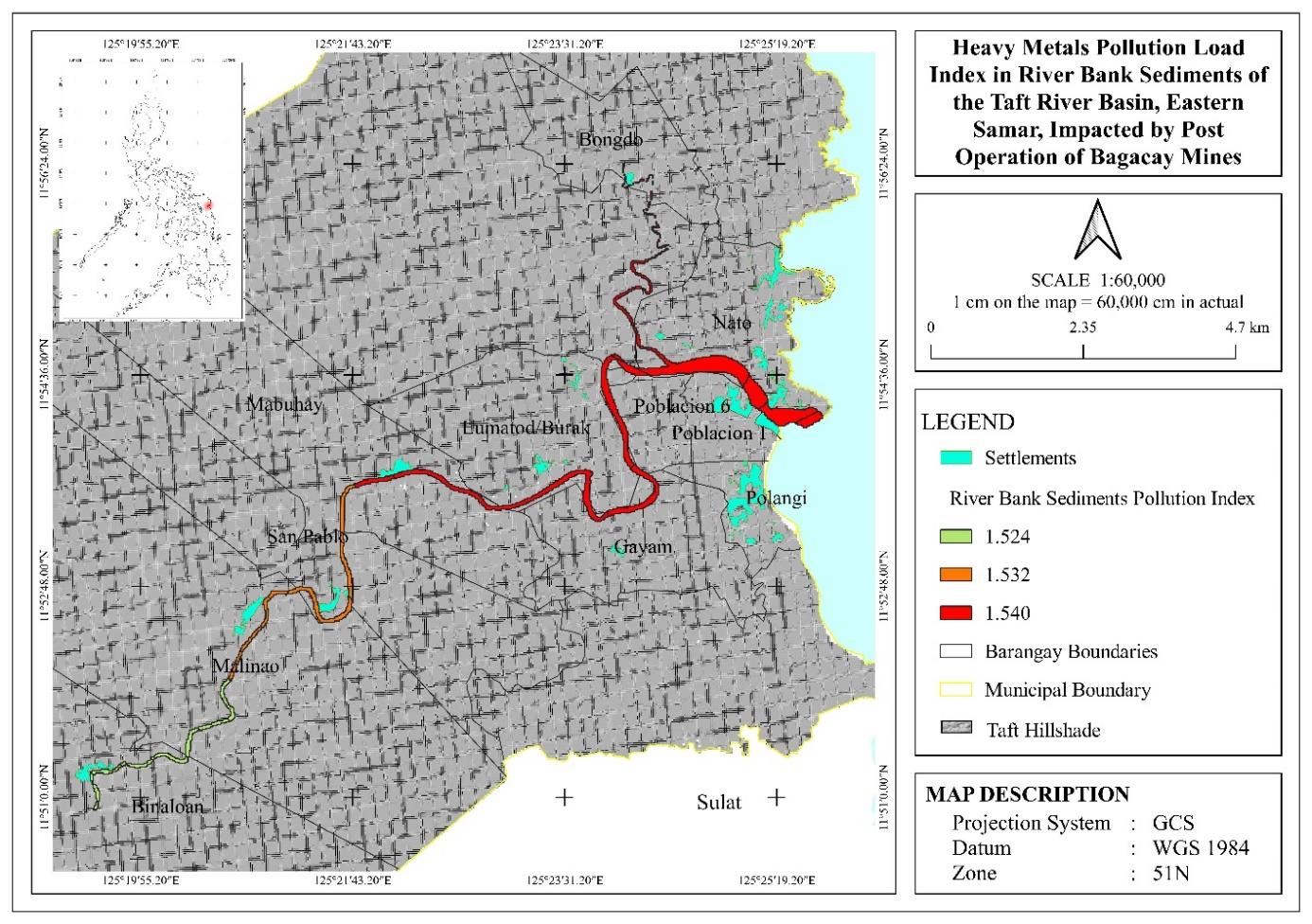
The purpose of this study was to assess the level of heavy metal contamination in the sediments of the Taft River Basin in Taft Eastern Samar, Philippines. The concentrations and levels of heavy metal contamination in sediments were assessed using the Pollution Load index (PLi), the Contamination Factor (Cfi), and the Geoaccumulation Index (Igeo). Our findings revealed moderate to high levels of potentially toxic elements (PTEs) such as Ti, Cr, Mn, Ni, Cu, Zn, As, Mo, Cd, and Pb. The CF and Igeo values indicated significant pollution, with Igeo values ranging from class 2 to class 6. The CFi indicated moderate to high contamination in river bank sediments following the order of Pb>As>Zn>Mo>Mn>Cu>Ni>Cr>Ti>Cd, and Pb>Cu>Zn>As>Mn>Cr>Ni>Mo> Ti>Cd in river bottom sediments. The PLi values exceeded the critical threshold of 1, confirming severe contamination, especially in the upper reaches of the river near the Bagacay mining site. The contamination showed a consistent presence of heavy metals, with Pb, As, Zn, and Mo being dominant in river bank sediments, and Cu, Pb, Zn, and As in river bottom sediments. Downstream attenuation of PTE levels was observed and is attributed to dilution and sedimentation processes. Overall, the study confirmed the contamination of these heavy metals in the sediments and underscored the need for rehabilitating the Bagacay mine to prevent the buildup of these contaminated sediments in the basin. It is recommended to expand monitoring to include groundwater and biotic components to better assess long-term ecological risks. Regular sediment quality assessments, and multi-stakeholder watershed management are essential for the sustainable health of the Taft River and its surrounding communities.
Article Details

This work is licensed under a Creative Commons Attribution-NonCommercial 4.0 International License.
Published articles are under the copyright of the Environment and Natural Resources Journal effective when the article is accepted for publication thus granting Environment and Natural Resources Journal all rights for the work so that both parties may be protected from the consequences of unauthorized use. Partially or totally publication of an article elsewhere is possible only after the consent from the editors.
References
Agency for Toxic Substances and Disease Registry (ATSDR). Toxicological Profile for Arsenic. Atlanta, GA: US Department of Health and Human Services, Public Health Service; 2007.
Arifin YI, Sakakibara M, Sera K. Impacts of artisanal and small-scale gold mining (ASGM) on environment and human health of Gorontalo Utara Regency, Gorontalo Province, Indonesia. Geosciences 2015;5(2):160-76.
Asio VB, Cabunos Jr CC, Chen ZS. Morphology, physiochemical characteristics, and fertility of soils from quaternary limestone in Leyte, Philippines. Soil Science 2006;171(8):648-61.
Belyaeva OA. Impact of mining enterprises of the city of Kapan on adjacent agroecosystems. Natural Science 2012; 2(19):26-30.
Basir, Kimijima S, Sakakibara M, Pateda SM, Sera K. Contamination level in geo-accumulation index of river sediments at artisanal and small-scale gold mining area in Gorontalo Province, Indonesia. International Journal of Environmental Research and Public Health 2022; 19(10):Article No. 6094.
Cabahug M, Ultra V, Morallos S, Lanuza N, Espejon E, Tan ZN, et al. Heavy metal concentrations in Mollusks and Crustaceans harvested from Eastern Samar’s Taft River in the Philippine and the health risks posed to consumers. Philippine Journal of Science 2023;152(4):1349-62.
Cayanan EA, Estudillo CE. Characterization of the Climate of the Philippines based on the Latest 30-Year Normal (1981-2010) Data. Philippine Atmospheric, Geophysical, and Astronomical Services Administration (PAGASA); 2018.
Chen J, Lu J, Zhang Z, Zhao R. Assessment of heavy metal pollution and human health risk in urban river sediments: A case study of Fenhe River, China. Environmental Science and Pollution Research International 2020;27(26):26949-63.
da Silva Y, Cantalice J, do Nascimento C, Singh V, da Silva Y, Silva C, et al. Bedload as an indicator of heavy metal contamination in a Brazilian anthropized watershed. Catena 2017;153:106-13.
Dayang JR. Revegetating Bagacay Mining Site: A review of potential tropical species for phytoremediation of non-essential heavy metals. Journal of Degraded and Mining Lands Management 2017;4(3):807-14.
Decena C, Sanita M, Liporada R. Assessing heavy metal contamination in surface sediments in an urban river in the Philippines. Polish Journal of Environmental Studies 2018;27(5):1983-95.
Duncan AE, de Vries N, Nyarko KB. Assessment of heavy metal pollution in the sediments of the River Pra and its tributaries. Water, Air, and Soil Pollution 2018;229(1):Article No. 272.
Edokpayi J, Nkhumeleni M, Enitan-Folami A, Olaniyi F. Water quality assessment and potential ecological risk of trace metals in sediments of some selected rivers in Vhembe District, South Africa. Physics and Chemistry of the Earth, Parts A/B/C 2022;126:Article No. 103111.
United States Environmental Protection Agency (US EPA). Method 3050B: Acid Digestion of Sediments, Sludges, and Soils. Report No:SW-846. Washington (DC): US EPA; 1996.
Eze PN, Zhang Y, Wang L. Using geostatistics and GIS techniques to assess heavy metal contamination in soils around a coal mine area in South Africa. Environmental Earth Science 2018;77(6):Article No. 230.
World Health Organization (WHO). Environmental Health Criteria 24-Titanium. International Programme on Chemical Safety; 1982.
Feng W, Tao Y, Liu M, Deng Y, Yang F, Liao H, et al. Distribution and risk assessment of nutrients and heavy metals from sediments in the world-class water transfer projects. Environmental Sciences Europe 2024;36(1):Article No. 140.
Gabrielyan A, Shahnazaryan G, Minasyan S. Distribution and identification of sources of heavy metals in the Voghji River basin impacted by mining activities (Armenia). Journal of Chemistry 2018;1:Article No. 7172426.
Islam MS, Ahmed MK, Habibullah-Al-Mamun M, Islam KN, Ibrahim M, Masunaga S. Arsenic and lead in foods: A potential threat to human health in Bangladesh. Food Additives and Contaminants: Part A 2014;31(12):1982-92.
Kabata-Pendias A. Trace Elements in Soils and Plants. 2nd ed. CRC Press; 2001.
Kang M, Tian Y, Zhang H, Lan Q. Distribution, ecological risk assessment, and source identification of heavy metals in river sediments from Hai River and its tributaries, Tianjin, China. Water, Air, and Soil Pollution 2020;231:Arcticle No. 38.
Lei P, Zhang H, Shan BQ. Analysis of heavy metals pollution and ecological risk assessment in the sediments from the representative river mouths and tributaries of the Danjiangkou Reservoir. Resources and Environment in the Yangtze Basin 2013;22(1):110-7.
Luo C, Routh J, Dario M, Sarkar S, Wei L, Luo D, et al. Distribution and mobilization of heavy metals at an acid mine drainage affected region in South China, a post-remediation study. Science of the Total Environment 2020;724:Article No. 138122.
Manullang CY, Lestari TY, Arifin Z. Assessment of Fe, Cu, Zn, Pb, Cd, and Hg in Ambon Bay surface sediments. Marine Research in Indonesia 2017;42(2):77-86.
Mineral Resources and Geosciences Bureau (MGB). Environmental Impact Assessment of Mining Operations in the Philippines. Manila: Department of Environment and Natural Resources; 2005.
Müller G. Heavy metals in the sediments of the Rhine - changes since 1979. Review in Science and Technology 1981; 81(24):778-83.
Sabijon J, Ultra Jr V, Bollido M, Openiano M, Poliquit D, Aquino R, et al. Nutrients and heavy metal contents on surface of agricultural soils in the flood-plains of Taft River Basin impacted by Bagacay Mines, Philippines. Philippine Journal of Science 2024;153(1):375-90.
Salomons W, Forstner U. Metals in the Hydrocycle. Berlin, Heidelberg, New York: Springer-Verlag; 1984. p. 349.
Samaniego JO, Gibaga CR, Tanciongco AM, Quierrez RN. Abandoned and inactive mines in the Philippines: Current environmental conditions, ongoing rehabilitation efforts and future opportunities. In: Derelict Mines. CRC Press; 2024. p. 189-207.
Shen F, Mao L, Sun R, Du J, Tan Z, Ding M. Contamination evaluation and source identification of heavy metals in the sediments from the Lishui River Watershed, Southern China. International Journal of Environmental Research and Public Health 2019;16(3):Article No. 336.
Sun Z, Xie X, Wang P, Hu Y, Cheng H. Heavy metal pollution caused by small-scale metal ore mining activities: A case study from a polymetallic mine in South China. Science of the Total Environment 2018;639:217-27.
Tomlinson D, Wilson J, Harris C, Jeffrey D. Problems in the assessment of heavy-metal levels in estuaries and the formation of a pollution index. Helgoländer Meeresuntersuchungen 1980;33:566-75.
Tupan C, Herawati EY, Arfiati D. Detection of phytochelatin and glutathione in seagrass Thalassia hemprichii as a detoxification mechanism due to lead heavy metal exposure. Aquatic Science and Technology 2014;2(1):67-78.
Ultra Jr VU. Fly ash and compost amendments and Mycorrhizal inoculation enhanced the survival and growth of Delonix regia in Cu-Ni mine tailings. Philippine Journal of Science 2020;149(3):479-89.
Vodyanitskii YN. Standards for the contents of heavy metals in soils of some states. Annals of Agrarian Science 2016; 14(3):257-63.
Wang J, Liu R, Zhang P, Yu W, Shen Z, Feng C. Spatial variation, environmental assessment and source identification of heavy metals in sediments of the Yangtze River Estuary. Marine Pollution Bulletin 2014;87(1-2):364-73.
Weber CJ, Opp C. Spatial patterns of mesoplastics and coarse microplastics in floodplain soils as resulting from land use and fluvial processes. Environmental Pollution 2020;267:Article No. 115390.
Yang Y, Chen F, Zhang L, Liu J, Wu S, Kang M. Comprehensive assessment of heavy metal contamination in sediment of the Pearl River Estuary and adjacent shelf. Marine Pollution Bulletin 2012;64(9):1947-55.
Zahra A, Hashmi MZ, Malik RN, Ahmed Z. Enrichment and geo-accumulation of heavy metals and risk assessment of sediments of the Kurang Nallah-feeding tributary of the Rawal Lake Reservoir, Pakistan. Science of the Total Environment 2014;470:925-33.
Zhang M, He P, Qiao G, Huang J, Yuan X, Li Q. Heavy metal contamination assessment of surface sediments of the Subei Shoal, China: Spatial distribution, source apportionment and ecological risk. Chemosphere 2019;223:211-22.
Zhang C, Selinus O, Sjövall K. Geostatistical interpolation of heavy metals in soils using the OK and IDW methods in a coal mining area. Environmental Monitoring Assessment 2011;176(1-4):361-77.
Zhao D, Wan S, Yu Z, Huang J. Distribution, enrichment and sources of heavy metals in surface sediments of Hainan Island rivers, China. Environmental Earth Sciences 2015;74:5097-110.
Zheng NA, Wang Q, Liang Z, Zheng D. Characterization of heavy metal concentrations in the sediments of three freshwater rivers in Huludao City, Northeast China. Environmental Pollution 2008;154(1):135-42.
Zhou F, Li P, Xing XL, Weng MZ, Liu L, Zhang Y, et al. Distribution characteristics and ecological risk assessment of heavy metals in sediments of Longyang Lake and Moshui Lake in Wuhan. China Environmental Science 2023;43:5433-43.
Zhu D, Wu S, Han J, Wang L, Qi M. Evaluation of nutrients and heavy metals in the sediments of the Heer River, Shenzhen, China. Environmental Monitoring and Assessment 2018;190(7):Article No. 380.
