Modelling Air Pollution in Thailand: Insights from Community Mobility Data 10.32526/ennrj/23/20240334
Article Sidebar
Main Article Content
Abstract
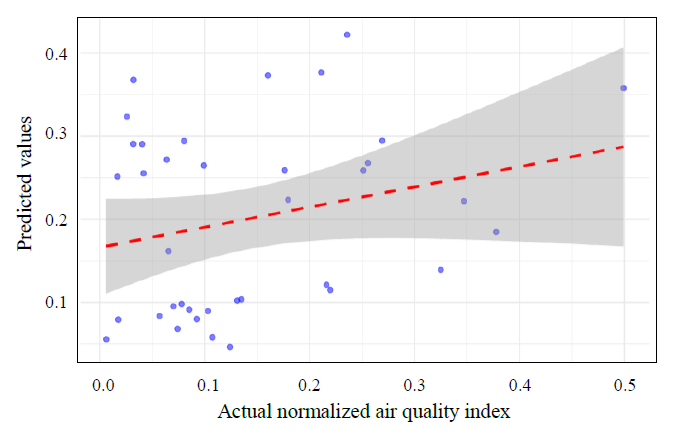
This research investigates the relationship between community mobility and air pollution in Thailand, utilizing econometric and machine learning approaches to provide useful insights for policymakers to counter this issue. Data was sourced from the pollution database provided by the Ministry of Natural Resources and Environment and the community mobility database from a Google Trend search. The methodology of the research includes data extracting and pre-processing. The data analysis used an econometric model utilized Generalized Method of Moments, and a Machine Learning employed Support Vector Machines Results of the econometric analysis reveal that residential mobility, workplace mobility, and park mobility have a significant positive relationship with changes in air pollution. The support vector machine results show that community mobility explains 58.50% of air pollution variation and has a prediction accuracy of 94.47% on the training set. The results also suggest that pollution problems should be monitored closely when air pollution changes by 20%. These findings enhance the understanding of the complex factors influencing air pollution and offer valuable insights for developing effective mitigation strategies.
Article Details

This work is licensed under a Creative Commons Attribution-NonCommercial 4.0 International License.
Published articles are under the copyright of the Environment and Natural Resources Journal effective when the article is accepted for publication thus granting Environment and Natural Resources Journal all rights for the work so that both parties may be protected from the consequences of unauthorized use. Partially or totally publication of an article elsewhere is possible only after the consent from the editors.
References
Archer CL, Cervone G, Golbazi M, Al Fahel N, Hultquist C. Changes in air quality and human mobility in the USA during the COVID-19 pandemic. Bulletin of Atmospheric Science and Technology 2020;1(3):491-514.
Badr HS, Du H, Marshall M, Dong E, Squire MM, Gardner LM. Association between mobility patterns and COVID-19 transmission in the USA: A mathematical modelling study. The Lancet Infectious Diseases 2020;20(11):1247-54.
Bahadur FT, Shah SR, Nidamanuri RR. Air-pollution monitoring and modelling: An overview. Environmental Forensics 2024;25(5):309-36.
Bahadur FT, Shah SR, Nidamanuri RR. A brief outline of indoor air quality: Monitoring, modelling, and impacts. Journal of Environmental Engineering 2025;151(5):Article No. 03125001.
Bahadur FT, Shah SR, Nidamanuri RR. Applications of remote sensing vis-à-vis machine learning in air-quality monitoring and modelling: A review. Environmental Monitoring and Assessment 2023;195(12):Article No. 1502.
Barua S, Nath SD. The impact of COVID-19 on air pollution: Evidence from global data. Journal of Cleaner Production 2021;298:Article No. 126755.
Beigh FA, Shah SR, Ahmad K. A perspective on indoor air-quality monitoring, guidelines, and the use of various sensors. Environmental Forensics 2025;26(3):350-67.
Borkin D, Némethová A, Michaľčonok G, Maiorov K. Impact of data normalisation on classification-model accuracy. Research Papers Faculty of Materials Science and Technology Slovak University of Technology 2019;27(45):79-84.
Chen GJ. A simple way to deal with multicollinearity. Journal of Applied Statistics 2012;39(9):1893-909.
Cui C, Wang Z, He P, Yuan S, Niu B, Kang P, et al. Escaping from pollution: The effect of air quality on inter-city population mobility in China. Environmental Research Letters 2019;14:Article No. 124025.
Dang HH, Dang HH, Trinh T. Does the COVID-19 lockdown improve global air quality? New cross-national evidence on its unintended consequences. Journal of Environmental Economics and Management 2020;105:Article No. 102401.
Das M, Das A, Sarkar R, Mandal P, Saha S, Ghosh S. Exploring short-term spatio-temporal pattern of PM2.5 and PM10 and their relationship with meteorological parameters during COVID-19 in Delhi. Urban Clim 2021;39:Article No. 100944.
Davis DR, Weinstein DE. Economic geography and regional production structure: An empirical investigation. European Economic Review 1999;43(2):379-407.
Emsia E, Coskuner C. Economic-growth prediction using optimised support-vector machines. Computer Economics 2016;48(3):453-62.
Escanciano JC, Lobato IN. An automatic portmanteau test for serial correlation. Journal of Economics 2009;151(2):140-9.
Freitas ED, Ibarra-Espinosa SA, Gavidia-Calderón ME, Rehbein A, Rafee SA, Martins JA, et al. Mobility restrictions and air quality under COVID-19 pandemic in São Paulo, Brazil. Preprints 2020. DOI: 10.20944/preprints202004.0515.v1
Gujarati DN, Porter DC. Basic Econometrics. 5th ed. New York, USA: McGraw-Hill/Irwin; 2008.
Harnkijroong T, Panich N. Influence of meteorological factors on PM10 at roadside of Bangkok. Proceedings of the 10th National Kasetsart University Kamphaeng Saen Conference; 2013 Dec 6-7. Nakhon Pathom, Thailand; 2013.
Hua V, Nguyen T, Dao M, Nguyen HD, Nguyen BT. The impact of data imputation on the air-quality-prediction problem. PLoS One 2024;19(9):e0306303
Inthisorn P, Puttanapong N. Associations between mobility indices and the COVID-19 pandemic in Thailand. Nakhara: Journal of Environmental Design and Planning 2022;21(2):Article No. 215.
Kondo MC, Mizes C, Lee J, McGady-Saier J, O’Malley L, Diliberto A, et al. Towards participatory air-pollution exposure assessment in a goods-movement community. Progress in Community Health Partnerships: Research, Education, and Action 2014;8(3):291-304.
Li J, Ding T, He W. Socio-economic driving forces of PM2.5 emissions in China: A global meta-frontier-production-theoretical decomposition analysis. Environmental Science and Pollution Research 2022;29(51):77565-79.
Li J, Tartarini F. Changes in air quality during the COVID-19 lockdown in Singapore and associations with human-mobility trends. Aerosol and Air Quality Research 2020;20(8):1748-58.
Liu S, Kong G, Kong D. Effects of COVID-19 on air quality: Human mobility, spillover effects, and city connections. Environmental and Resource Economics 2020;76(4):635-53.
Lo K, Tung NT, Wu C-D, Thao HN X, Dung HB, Thuy TPC, et al. Air pollution mediates the association between human mobility and COVID-19 infection. Aerosol and Air Quality Research 2022;22(1):Article No. 210249.
Molinaro AM, Simon R, Pfeiffer RM. Prediction-error estimation: A comparison of resampling methods. Bioinformatics 2005;21(15):3301-7.
Murad SMW, Rahman A, Mohsin AKM. From policy to progress: Environmental taxation to mitigate air pollution in OECD countries. Journal of Environmental Management 2025;374: Article No. 124143.
Nowak D, Heisler G. Air-quality effects of urban trees and parks. National Recreation and Park Association; 2010. p. 44
Nyhan MM, Kloog I, Britter R, Ratti C, Koutrakis P. Quantifying population exposure to air pollution using individual mobility patterns inferred from mobile-phone data. Journal of Exposure Science and Environmental Epidemiology 2019;29(2):238-47.
Othman M, Latif MT. Air-pollution impacts from COVID-19 pandemic-control strategies in Malaysia. Journal of Cleaner Production 2021;291:Article No. 125992.
Othman M, Latif MT, Hamid HHA, Uning R, Khumsaeng T, Phairuang W, et al. Spatial-temporal variability and health impact of particulate matter during a 2019-2020 biomass-burning event in Southeast Asia. Scientific Reports 2022;12:Article No. 7630.
Oudin A, Forsberg B, Strömgren M, Beelen R, Modig L. Impact of residential mobility on exposure assessment in longitudinal air-pollution studies: A sensitivity analysis within the ESCAPE project. The Scientific World Journal 2012;2012(1): Article No. 125818.
Paoin K, Ueda K, Vathesatogkit P, Ingviya T, Buya S, Phosri A, et al. Effects of long-term air-pollution exposure on ankle-brachial index and cardio-ankle vascular index: A longitudinal cohort study using data from the electricity generating authority of Thailand study. International Journal of Hygiene and Environmental Health 2021;236:Article No. 113790.
Plaia A, Ruggieri M. Air-quality indices: A review. Reviews in Environmental Science and Bio/Technology 2011;10(2):165-79.
Rajakumari K, Priyanka V. Air-pollution prediction in smart cities by using machine-learning techniques. International Journal of Innovative Technology and Exploring 2020;9(5):1272-9.
Reis S, Liška T, Vieno M, Carnell EJ, Beck R, Clemens T, et al. The influence of residential and work-day population mobility on exposure to air pollution in the UK. Environment International 2018;121:803-13.
Royston P. Approximating the Shapiro-Wilk W-test for non-normality. Statistics and Computing 1992;2(3):117-9.
Shafeeque M, Arshad A, Elbeltagi A, Sarwar A, Pham QB, Khan S, et al. Understanding temporary reduction in atmospheric pollution and its impacts on coastal aquatic systems during the COVID-19 lockdown: A case study of South Asia. Geomatics, Natural Hazards and Risk 2021;12:560-80.
Sharma M, Pandey R, Maheshwari M, Sengupta B, Shukla BP, Gupta NK, et al. Interpretation of air-quality data using an air-quality index for the city of Kanpur, India. Journal of Environmental Engineering and Science 2003;2(6):453-62.
Srikamdee S, Onpans J. Forecasting daily air quality in Northern Thailand using machine-learning techniques. Proceedings of the 4th International Conference on Information Technology (InCIT); 2019 Oct 24-25. Bangkok, Thailand; 2019.
Srivastava S, Kumar A, Bauddh K, Gautam AS, Kumar S. 21-day lockdown in India dramatically reduced air-pollution indices in Lucknow and New Delhi, India. Bulletin of Environmental Contamination and Toxicology 2020;105(1):9-17.
Suriyawong P, Chuetor S, Samae H, Piriyakarnsakul S, Amin M, Furuuchi M, et al. Airborne particulate matter from biomass burning in Thailand: Recent issues, challenges, and options. Heliyon 2023;9(3):e14261.
Tee Lewis PG, Chen T-Y, Chan W, Symanski E. Predictors of residential mobility and its impact on air-pollution exposure among children diagnosed with early-childhood leukaemia. Journal of Exposure Science and Environmental Epidemiology 2019;29(4):510-9.
Wu Y, Song G. The impact of activity-based mobility pattern on assessing fine-grained traffic-induced air-pollution exposure. International Journal of Environmental Research and Public Health 2019;16:Article No. 3291.
Yasumoto S, Jones AP, Oyoshi K, Kanasugi H, Sekimoto Y, Shibasaki R, et al. Heat-exposure assessment based on individual daily-mobility patterns in Dhaka, Bangladesh. Computers, Environment and Urban Systems 2019;77:Article No. 101367.
Zhu Y, Xie J, Huang F, Cao L. The mediating effect of air quality on the association between human mobility and COVID-19 infection in China. Environmental Research 2020;189:Article No. 109911.
