Landslide Disaster Risk for Small and Medium Agricultural Enterprises (SMAEs) 10.32526/ennrj/23/20240340
Article Sidebar
Main Article Content
Abstract
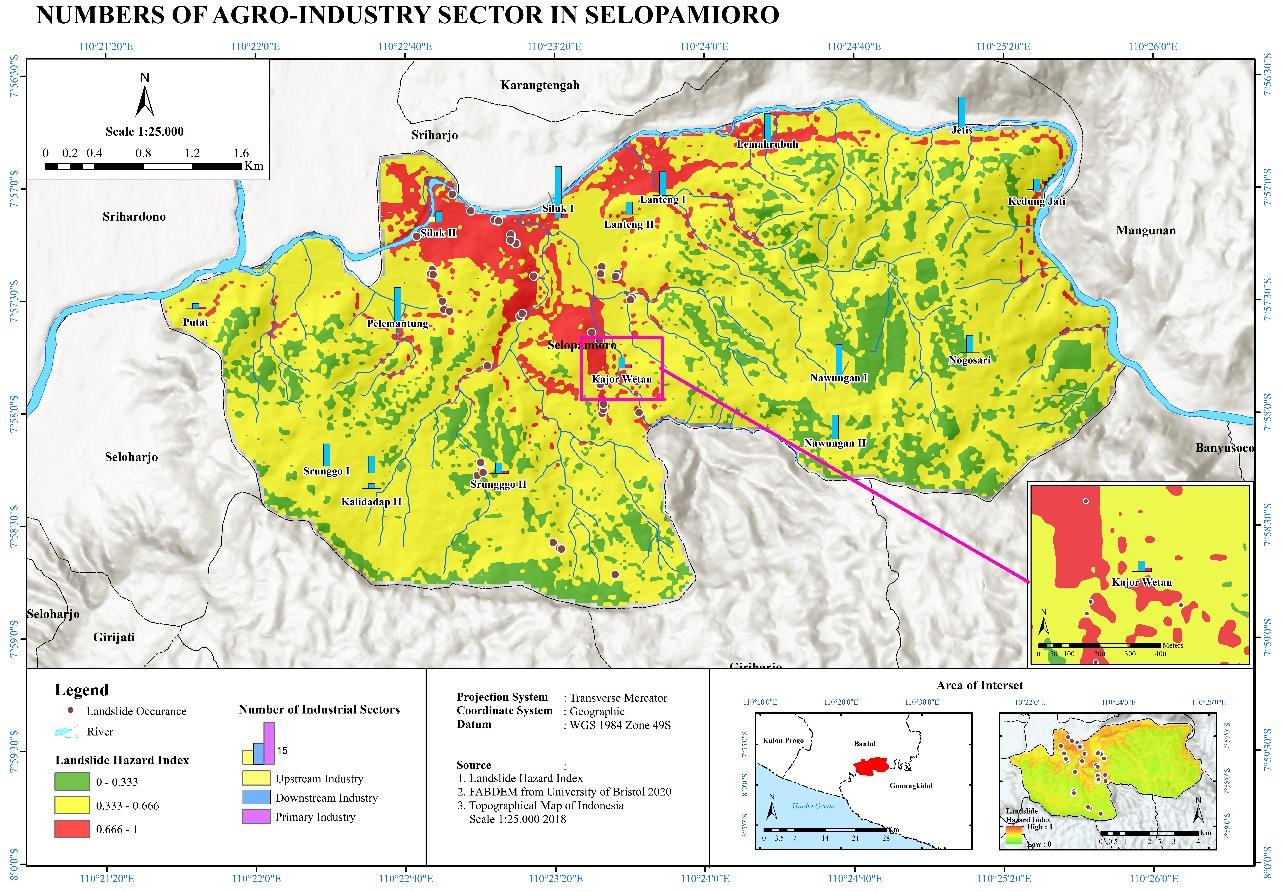
Small and Medium Agricultural Enterprises (SMAEs) are crucial for economic development in many developing countries, particularly in rural areas. Following a disaster, SMAEs experience the most profound impacts on their capital, logistics, workforce, and marketing operations. This study examines the impact of landslides on SMAEs in Selopamioro village, Bantul Regency of Special Region Yogyakarta. The study focused on the economic sensitivity of SMAEs and assessed their spatial distribution and classifications using drone aerial imagery and a village landslide database from 2010 to 2024. A total of 120 SMAEs were identified and classified by type in accordance with Indonesian laws. A representative sample of 60 SMAEs was validated using the Slovin formula. The study employed a hybrid survey methodology, combining interviews with village and hamlet leaders and on-site surveys using standardized questionnaires. The results showed that SMAEs in all hamlets of Selopamioro village have relatively low sensitivity, indicating that recent landslides have had limited effects on their sustainability. The village’s disaster response capacity was moderate, but the study identified deficiencies in planning for potential future landslides. This study provides valuable insights for SMAEs and local governments regarding proactive risk mitigation strategies.
Article Details

This work is licensed under a Creative Commons Attribution-NonCommercial 4.0 International License.
Published articles are under the copyright of the Environment and Natural Resources Journal effective when the article is accepted for publication thus granting Environment and Natural Resources Journal all rights for the work so that both parties may be protected from the consequences of unauthorized use. Partially or totally publication of an article elsewhere is possible only after the consent from the editors.
References
Al’Afif M, Sartohadi J, Samodra G. Impact of landslide on geoheritage: Opportunities through integration, geo-morphological classification and machine learning. International Journal of Geoheritage and Parks 2024; 12(2):333-51.
Alstadt B, Weisbrod G, Cutler D. Relationship of transportation access and connectivity to local economic outcomes: Statistical analysis. Transportation Research Record 2012;2297(1):154-62.
Anggreini RR, Asyikin N. Protection of MSMEs in the agriculture and plantation sector in anticipating the global recession. National Law Magazine 2023;53(2):262-95 (in Indonesian).
Budha PB, Rai P, Katel P, Khadka A. Landslide hazard mapping in panchase mountain of central Nepal. Environment and Natural Resources Journal 2020;18(4):387-99.
Cheung RWM. Landslide risk management in Hong Kong. Landslides 2021;18(1):3457-73.
Damayanti F, Sabri L, Wahyuddin Y. Implementation of geographic information system for identification of landslide prone areas (case study: Kapanewon Dlingo and Kapanewon Imogiri, Bantul Regency). Journal of Geodesy, Diponegoro University 2023;12(2):101-10 (in Indonesian).
Ebrahim EA, Toy A, Kassim YH. The factors that influence the growth and performance of micro and small-scale enterprises in dessie town administration. Frontiers in Sustainable Cities 2023;5:Article No.1296605.
Eskesen A, Agrawal R, Desai N. Small and Medium Enterprises in Agriculture Value Chain: Opportunities and Recommendations. United Kingdom: Oxfam International; 2014.
Fadilah N, Arsyad U, Soma AS. Analysis of landslide vulnerability level analysis using frequency ratio method in Bialo river basin. Perennial Journal 2019;15(1):42-50.
Food and Agriculture Organization (FAO). Cost-Effective Management Tools for Ensuring Food Quality and Safety for Small and Medium Agro-Industrial Enterprises. Rome: Food and Agriculture Organization; 2011.
Febriani FNI. Analysis of Social and Economic Vulnerability of Landslide Disasters in Imogiri District, Bantul Regency [dissertation]. Yogyakarta, Universitas Muhammadiyah Surakarta; 2020.
Gallage C, Abeykoon T, Uchimura T. Instrumented model slopes to investigate the effects of slope inclination on rainfall-induced landslides. Soils and Foundations 2021;61(1):160-74.
Garcia-Chevesich P, Wei X, Ticona J, Martínez G, Zea J, García V, et al. The impact of agricultural irrigation on landslide triggering: A review from Chinese, English, and Spanish literature. Water 2021;13(10):1-17.
Gariano SL, Guzzetti F. Mass-movements and climate change. In: Shroder JF, editor. Treatise on Geomorphology. Amsterdam: Elsevier; 2022. p. 1-13.
Guzzetti F, Gariano SL, Peruccacci S, Brunetti MT, Melillo M. Rainfall and Landslide Initiation. Rainfall: Modeling, Measurement and Applications. Amsterdam: Elsevier; 2022. p. 427-50.
Heryawan A, Fauzi A, Hidayat A. Economic analysis and natural resources policy of West Java Province. Journal of Agriculture, Resource and Environmental Economics 2016;1(2):1-11 (in Indonesian).
Holcombe E, Anderson M, Holm-Nielsen N. Community-based landslide risk reduction: Managing disasters in small steps. In: Margottini C, Canuti P, Sassa, editors. Learning by Doing: Community Based Landslide Risk Reduction. Berlin: Springer; 2013.
Hong H, Liu J, Zhu AZ. Modeling landslide susceptibility using LogitBoost alternating decision trees and forest by penalizing attributes with the bagging ensemble. Science of The Total Environment 2020;718:Article No.137231.
Intarat K, Yoomee P, Hussadin A, Lamprom W. Assessment of landslide susceptibility in the intermontane basin area of northern Thailand. Environment and Natural Resources Journal 2024;22(2):158-70.
Jakob M. Landslides in a Changing Climate. In: Davi, editor. Landslide Hazards, Risks, and Disasters. 2nd ed. Amsterdam: Elsevier; 2022. p. 505-79.
Jemec AM, Bezak N, Šegina E, Frantar P, Gariano SL, Medved A, et al. Climate change increases the number of landslides at the juncture of the Alpine, Pannonian and Mediterranean regions. Scientific Reports 2023;13(1):Article No. 23085.
Kainthola A, Sharma V, Pandey VHR, Jayal T, Singh M, Srivastav A, et al. Hill slope stability examination along Lower Tons valley, Garhwal Himalayas, India. Geomatics, Natural Hazards and Risk 2021;12(1):900-21.
Lau PHM, Zawawi AA. Analysis of landslide occurrence using DTM-based weighted overlay: A case study in tropical mountainous forest of cameron highlands, Malaysia. Environment and Natural Resources Journal 2021;19(5):358-70.
Lin Q, Wang Y, Glade T, Zhang J, Zhang Y. Assessing the spatiotemporal impact of climate change on event rainfall characteristics influencing landslide occurrences based on multiple GCM projections in China. Climatic Change 2020;162:761-79.
Luo HY, Zhang LM, Zhang LL, He J, Yin KS. Vulnerability of buildings to landslides: The state of the art and future needs. Earth Science Review 2023;238:Article No. 104329.
Manurung R, Surjandari NS, Djarwati N. Slope stability analysis based on 3 consecutive days of rain in Tirtomoyo watershed (case study of Damon village, Hargorejo, Wonogiri). Civil Engineering Matrix 2016;4(1):97-105 (in Indonesian).
Radović-Marković M, Farooq MS, Marković D. Strengthening the resilience of small and medium-sized enterprises. Management, Enterprise and Benchmarking in the 21st Century; Budapest: Óbuda University; 2017. p. 345-56.
Mersha T, Meten M. GIS-based landslide susceptibility mapping and assessment using bivariate statistical methods in Simada Area, Northwestern Ethiopia. Geoenvironmental Disasters 2020;7(1):1-22.
Morrish SC, Jones R. Post-disaster business recovery: An entrepreneurial marketing perspective. Journal of Business Research 2020;113(1):83-92.
Mujiyo M, Pratingkas TM, Cahyono O, Ariyanto DP. Landslides hazard assessment using soil physics approaches as a determinant factor on agricultural land in Hilly Area. Journal of Natural Resources and Environmental Management 2024;14(3):566-73 (in Indonesian).
Nagara RP, Wibowo A. The influence of slope on the development of built-up land in Serang Regency, Banten Province. Journal of Regional and Rural Development Planning 2024;8(2):116-31 (in Indonesian).
Nasution RHA, Deswindi L, Indrajaya D. Identification of factors affecting the productivity of medium small micro enterprises (MSMEs). International Journal Of Economics Development Research 2022;3(3):227-35 (In Indonesian).
Ngadisih, Samodra G, Bhandary NP, Yatabe R. Landslide Inventory: Challenge for Landslide Hazard Assessment in Indonesia. Berlin: Springer; 2017. p. 135-59.
Putra AN, Nita I, Jauhary MRA, Nurhutami SR, Ismail MH. Landslide risk analysis on agriculture area in pacitan regency in east Java Indonesia using geospatial techniques. Environment and Natural Resources Journal 2021;19(2):141-52.
Nurhaedah N. Development of MSMEs in the development of industrial agriculture in Makassar City. Bata Ilyas Educational Management Review 2022;2(2):79-84.
Pratiwi NA, Harianto H, Daryanto A. The role of upstream and downstream agroindustry in the economy and income distribution in Indonesia. Journal of Management and Agribusiness 2017;14(2):127-37 (in Indonesian).
Pratiwi LHK. Landslide Vulnerability Mapping Using Frequency Ratio Method in Tlogosono Village and Surrounding Area, Gebang District, Purworejo Regency, Central Java Province [dissertation]. Yogyakarta, Gadjah Mada University; 2018.
Purnamasari ANC, Hartantyo E, Junun S, Hafahzah H. Mapping subsurface and surface characteristics of the recent Pesanggrahan landslide, Central Java, Indonesia, for landslide hazard management. Environment and Natural Resources Journal 2024;23(1):1-13.
Radjah VYG, Suryatmojo H, Ngadisih. Landslide susceptibility zone using frequency ratio method in Karangkobar catchment, Merawu watershed, Banjarnegara District, Central Java Province. IOP Conference Series: Earth and Environmental Science 2020;451:Article No. 012087.
Raza A, Safdar M, Zhong M, Hunt JD. Analyzing spatial location preference of urban activities with mode-dependent accessibility using integrated land use-transport models. Land 2022;11(8):Article No. 1139.
Samodra G, Chen G, Sartohadi J. Comparing data-driven landslide susceptibility models based on participatory landslide inventory mapping in Purwosari area, Yogyakarta, Java. Environmental Earth Science 2017;76:Article No. 184.
Satpathy AS, Sahoo SK, Mohanty A, Mohanty PP. Strategies for enhancements of MSME resilience and sustainability in the post-COVID-19 era. Social Sciences and Humanities Open 2024;11:Article No. 101223.
Sharif BA. The impact of natural disasters on small and medium enterprises (SME) in Bangladesh. Open Access Library Journal 2021;8(6):1-15.
Sugiyono. Quantitative and Qualitative Research Methods R&D. Bandung: Alfabeta; 2017. p. 50.
Sukristiyanti S, Wikantika K, Sadisun IA, Yayusman LF, Jevon A, Telaumbanua JA. Polygon-based landslide inventory for Bandung basin using google earth. Indonesian Journal of Geography 2021;53(2):285-94.
Thongley T, Vansarochana C. Spatial zonation of landslide prone area using information value in the geologically fragile region of Samdrup Jongkhar-Tashigang National Highway in Bhutan. Environment and Natural Resources Journal 2021;19(2):121-31.
Tian Y, Chen J, Xu C, Lingling S. Geometrical characteristics of earthquake-induced landslides and correlations with control factors: A case study of the 2013 Minxian, Gansu, China, Mw 5.9 event. Landslides 2017;14(6):1915-27.
Utami, Dyah I, Santosa I, Vidya LMR. Priority resilience strategy for micro, small, and medium enterprises for dealing with natural disasters. International Journal of Disaster Risk Reduction 2021;55:Article No. 102074.
Wibawanti E, Sartohadi J, Ngadisih, Setiawan MA, Mardianto D. The effectiveness of “ProKlim” in controlling landslide by vegetative method in the Sambak village, Kajoran, Magelang. AgriTech 2023;43(2):105-15.
Wubalem A. Modeling of landslide susceptibility in a part of Abay Basin, Northwestern Ethiopia. Open Geosciences 2020; 12(1):1440-67.
Yi Yaning, Zhang Z, Zhang W, Jia H, Zhang J. Landslide susceptibility mapping using multiscale sampling strategy and convolutional neural network: A case study in Jiuzhaigou Region. Catena 2020;195:Article No. 104851.
Youssef B, Bouskri I, Brahim B, Kader S, Brahim I, Abdelkrim B, et al. The contribution of the frequency ratio model and the prediction rate for the analysis of landslide risk in the Tizi N’tichka area on the national road (RN9) linking Marrakech and Ouarzazate. Catena 2023;232:Article No. 107464.
