Groundwater Studies for Sustaining Peatlands against Fire Disasters and Supporting Water Resources 10.32526/ennrj/23/20250002
Article Sidebar
Main Article Content
Abstract
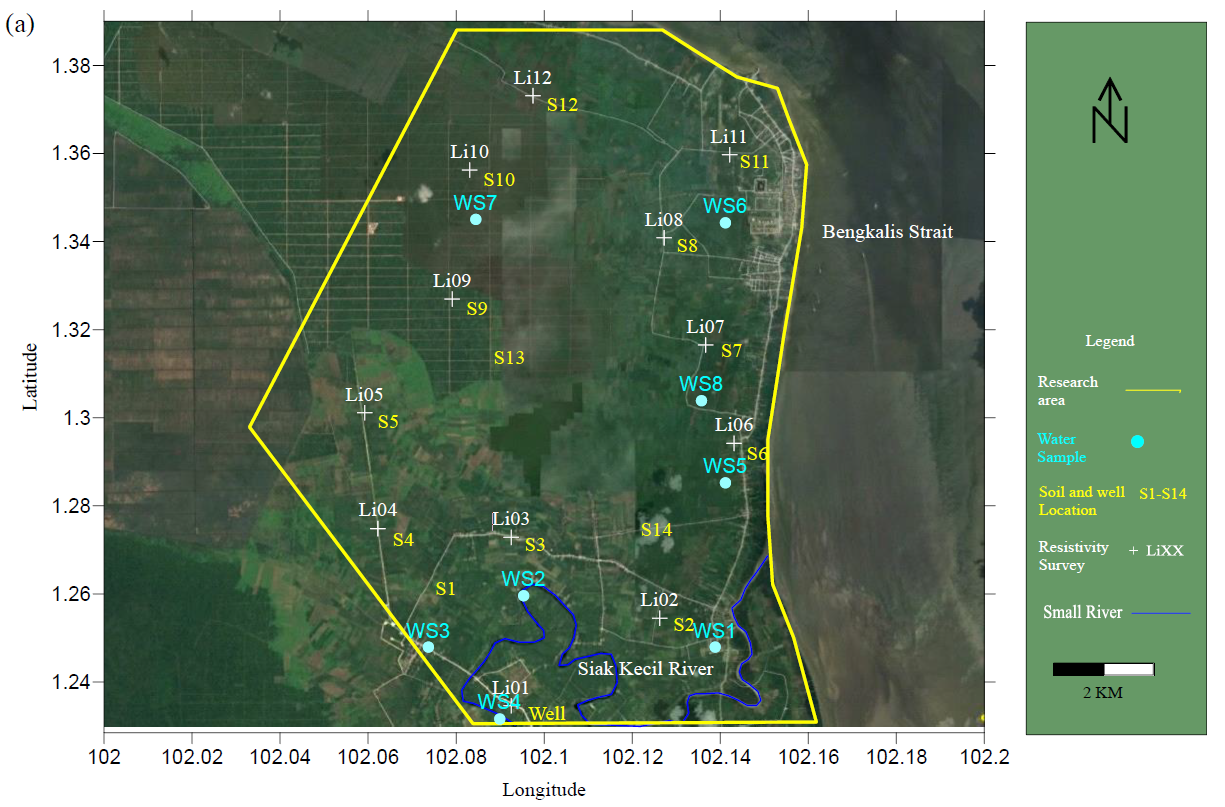
There are two main issues related to water resources in coastal areas covered by peat soil. The first problem is peat fires, which occur during the dry season and are difficult to extinguish because the characteristics of peat make it very flammable. The second problem is a lack of clean water resources for the needs of the surrounding community. This study investigates the feasibility of groundwater potential for prevention of peat fire tragedies, and groundwater resources for community use. This study employed an integrated approach that combined geoelectrical resistivity surveys with physical and chemical analyses of soil and groundwater to assess groundwater potential both as a water resource and as a preventive measure against peatland fires. The results of this study indicated that all groundwater samples were contaminated with seawater and exceeded the permissible limits set by the World Health Organization (WHO), making them unsuitable for human consumption. Except for the central and eastern parts of the study area, peat soil exhibited resistivity values ranging from 30 to 210 Ω·m, largely influenced by its fluid and clay content. Through interpretation of resistivity data, variations in sand and gravel content at different depths were identified. Shallow aquifers were present at a depth of 10 meters in the south and 12 meters in the north, and the peat soil had a thickness that varied up to 4 meters. Thus while the groundwater reserves in the study area are not fit for community use or consumption, they do appear sufficient to significantly reduce the risk of widespread peat fire disasters.
Article Details

This work is licensed under a Creative Commons Attribution-NonCommercial 4.0 International License.
Published articles are under the copyright of the Environment and Natural Resources Journal effective when the article is accepted for publication thus granting Environment and Natural Resources Journal all rights for the work so that both parties may be protected from the consequences of unauthorized use. Partially or totally publication of an article elsewhere is possible only after the consent from the editors.
References
Anda M, Ritung S, Suryani E, Hikmat M, Yatno E, Mulyani A, et al. Revisiting tropical peatlands in Indonesia: Semi-detailed mapping, extent and depth distribution assessment. Geoderma 2021;402:Article No. 115235.
Appelo CA, Postma D. Geochemistry, Groundwater and Pollution. London: CRC press; 2004.
Ayed B, Jmal I, Sahal S, Bouri S. The seawater intrusion assessment in coastal aquifers using GALDIT method and groundwater quality index: The Djeffara of Medenine coastal aquifer (Southeastern Tunisia). Arabian Journal of Geosciences 2018;11(20):Article No. 609.
Basri K, Wahab N, Talib MK, Zainorabidin A. Sub-surface profiling using electrical resistivity tomography (ERT) with complement from peat sampler. Civil Engineering and Architecture 2019;7(6A):7-18.
Braja MD. Advanced Soil Mechanics. 4th ed. London: CRC Press; 2019.
Chasmer LE, Hopkinson CD, Petrone RM, Sitar M. Using multitemporal and multispectral airborne lidar to assess depth of peat loss and correspondence with a new active normalized burn ratio for wildfires. Geophysical Research Letters 2017;44(23):11,851-9.
Clesceri LS, Greenberg AE, Eaton AD. Standard Methods for the Examination of Water and Wastewater. Washington DC: APHA; 1999.
Crezee B, Dargie GC, Ewango CE, Mitchard ET, Emba BO, Kanyama TJ, et al. Mapping peat thickness and carbon stocks of the central Congo Basin using field data. Nature Geoscience 2022;15(8):639-44.
Crowson M, Warren‐Thomas E, Hill JK, Hariyadi B, Agus F, Saad A, et al. A comparison of satellite remote sensing data fusion methods to map peat swamp forest loss in Sumatra, Indonesia. Remote Sensing in Ecology and Conservation 2019;5(3):247-58.
Dettmann U, Kraft NN, Rech R, Heidkamp A, Tiemeyer B. Analysis of peat soil organic carbon, total nitrogen, soil water content and basal respiration: Is there a ‘best’ drying temperature? Geoderma 2021;403:Article No. 115231.
Farrell CA, Connolly J, Morley TR. Charting a course for peatland restoration in Ireland: A case study to support restoration frameworks in other regions. Restoration Ecology 2024;32(7):e14216.
Ghit K, Muller S, Bélair GD, Belouahem Abed D, Daoud-Bouattour A, Benslama M. Palaeoecological significance and conservation of peat-forming wetlands of Algeria. Revue d'Écologie (La Terre et La Vie) 2018;73(4):414-30.
Guo M. Soil sampling and methods of analysis. Journal of Environmental Quality 2009;38(1):Article No. 375.
Hounslow A. Water Quality Data: Analysis and Interpretation. Boca Raton: CRC Press; 2018.
Islami N, Irianti M, Fakhruddin F, Zulirfan Z. A preliminary study of geothermal resources in the Rokan Hulu Regency, Riau, Indonesia. Journal of Physics: Conference Series 2019;1185(1):Article No. 012003.
Islami N, Irianti M, Yusoff I. An effective method for quantitative interpretation of seawater intrusion in shallow aquifers from electrical resistivity data. Current Applied Science and Technology 2025;25(1):1-14.
Islami N, Irianti M. A quantitative interpretation of salt water mixture in the shallow aquifer through the geoelectrical resistivity data. Journal of Physics: Conference Series 2023;2582(1):Article No. 012001.
Islami N, Irianti M. Resistivity characteristics of soil saturated with variation of salt water-fresh water mixture. Journal of Physics: Conference Series 2021;2049(1):Article No. 012029.
Islami N. Groundwater exploration in the bedrock area using geoelectrical resistivity survey. IOP Conference Series: Earth and Environmental Science 2018;186(3):Article No. 012016.
Juniyanti L, Purnomo H, Kartodihardjo H, Prasetyo LB. Understanding the driving forces and actors of land change due to forestry and agricultural practices in sumatra and kalimantan: A systematic review. Land 2021;10(5):Article No. 463.
Karunanidhi D, Aravinthasamy P, Deepali M, Subramani T, Shankar K. Groundwater pollution and human health risks in an industrialized region of southern India: Impacts of the COVID-19 lockdown and the monsoon seasonal cycles. Archives of Environmental Contamination and Toxicology 2021;80(1):259-76.
Kim Y, Lee KS, Koh DC, Lee DH, Lee SG, Park WB, et al. Hydrogeochemical and isotopic evidence of groundwater salinization in a coastal aquifer: A case study in Jeju volcanic island, Korea. Journal of Hydrology 2003;270(3-4):282-94.
Kurniawan A, Graham LB, Applegate G, Arifanti VB, Akbar A, Hadi EE, et al. Impacts of rainfall on peat fire during the dry season and wet dry season on degraded tropical peatland in South Sumatra, Indonesia. IOP Conference Series: Earth and Environmental Science 2024;1315(1):Article No. 012060.
Li S, Huang Z, Zhao K, Xu H, Fang Q. Comparative analysis of pit deformation characteristics in typical region soft soil deposits of China. Arabian Journal of Geosciences 2019;12:1-11.
Loke MH. Tutorial: 2-D and 3-D Electrical Imaging Surveys [internet]. 2001 [cited 2024 March 10]. Available from: http://www.geoelectrical.com.
Nelson K, Thompson D, Hopkinson C, Petrone R, Chasmer L. Peatland-fire interactions: A review of wildland fire feedbacks and interactions in Canadian boreal peatlands. Science of the Total Environment 2021;769:Article No. 145212.
Purwanto E, Santoso H, Jelsma I, Widayati A, Nugroho HY, van Noordwijk M. Agroforestry as policy option for forest-zone oil palm production in Indonesia. Land 2020;9(12):Article No. 531.
Rezanezhad F, Price JS, Quinton WL, Lennartz B, Milojevic T, Van Cappellen P. Structure of peat soils and implications for water storage, flow and solute transport: A review update for geochemists. Chemical Geology 2016;429:75-84.
Silvestri S, Knight R, Viezzoli A, Richardson CJ, Anshari GZ, Dewar N, et al. Quantification of peat thickness and stored carbon at the landscape scale in tropical peatlands: A comparison of airborne geophysics and an empirical topographic method. Journal of Geophysical Research: Earth Surface 2019;124(12):3107-23.
Sutejoa Y, Dewi R, Hastuti Y, Rustam RK. Engineering properties of peat in Ogan ilir regency. Jurnal Teknologi (Sciences & Engineering) 2016;78(7-3):61-9.
Szczepański M, Szajdak LW, Meysner T. Impact of shelterbelt and peatland barriers on agricultural landscape groundwater: Carbon and nitrogen compounds removal efficiency. Agronomy 2021;11(10):Article No. 1972.
Tajul Baharuddin MF, Taib S, Hashim R, Abidin MH, Rahman NI. Assessment of seawater intrusion to the agricultural sustainability at the coastal area of Carey Island, Selangor, Malaysia. Arabian Journal of Geosciences 2013;6(1):3909-28.
Tanneberger F, Appulo L, Ewert S, Lakner S, Ó Brolcháin N, Peters J, et al. The power of nature‐based solutions: How peatlands can help us to achieve key EU sustainability objectives. Advanced Sustainable Systems 2021;5(1):Article No. 2000146.
Taufik M, Widyastuti MT, Sulaiman A, Murdiyarso D, Santikayasa IP, Minasny B. An improved drought-fire assessment for managing fire risks in tropical peatlands. Agricultural and Forest Meteorology 2022;312:Article No. 108738.
Telahigue F, Agoubi B, Souid F, Kharroubi A. Assessment of seawater intrusion in an arid coastal aquifer, south-eastern Tunisia, using multivariate statistical analysis and chloride mass balance. Physics and Chemistry of the Earth, Parts A/B/C 2018;106:37-46.
Telford WM, Geldart LP, Sheriff RE. Applied Geophysics. Cambridge University Press; 1990.
World Health Organisation (WHO). WHO Guidelines for Drinking-Water Quality. 3rd ed. Geneva: WHO; 2008.
Zak D, McInnes RJ. A call for refining the peatland restoration strategy in Europe. Journal of Applied Ecology 2022;59(11):2698-704.
Zhao J, Lee JS, Elmore AJ, Fatimah YA, Numata I, Zhang X, et al. Spatial patterns and drivers of smallholder oil palm expansion within peat swamp forests of Riau, Indonesia. Environmental Research Letters 2022;17(4):Article No. 044015.
Zhuo L, Han D, Dai Q. Exploration of empirical relationship between surface soil temperature and surface soil moisture over two catchments of contrasting climates and land covers. Arabian Journal of Geosciences 2017;10:1-11.
