Soil Carbon Sequestration in Rice-Based Cropping Systems in Batac, Philippines 10.32526/ennrj/23/20250035
Article Sidebar
Main Article Content
Abstract
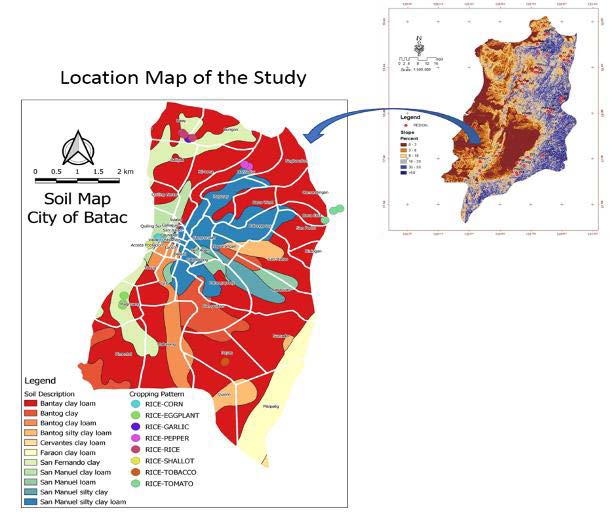
This study focused on the assessment of capacity of farm soils to sequester carbon under different rice-based cropping patterns. The results of this study may be valuable for the formulation of soil and crop management for climate change mitigation in the agriculture sector in Ilocos Norte, Philippines. This study was conducted in major cultivated areas in the City of Batac, characterized by intensified and diversified cropping patterns centered around rice cultivation. A quantitative research design was employed to determine the different cropping patterns and their influence on soil organic carbon (SOC). The dominant cropping patterns observed in Batac City was rice, followed by any of the following crops; corn, shallot, eggplant, rice, tomato, pepper, garlic and tobacco. These cropping patterns are assumed to have an influence in soil pH, organic matter (OM), % carbon, phosphorus (P), potassium (K), bulk density, soil texture, moisture content, and soil carbon stock (SOC). Results showed that soil organic matter content in various cropping patterns was proportional to the soil carbon stock in the soil. The analysis of variance between cropping patterns exhibited high variability in OM and SOC with an F-value >1. Rice-tobacco exhibited the highest carbon stock (1.80%), while rice-garlic (0.63%) and rice-corn (0.60%) had the lowest. Understanding the influence of crop biomass and management through this study can be beneficial in the design of informed decision-making strategies and advocacy on cropping pattern management, which can be disseminated to farmers to enhance the carbon sequestration potential of agricultural lands.
Article Details

This work is licensed under a Creative Commons Attribution-NonCommercial 4.0 International License.
Published articles are under the copyright of the Environment and Natural Resources Journal effective when the article is accepted for publication thus granting Environment and Natural Resources Journal all rights for the work so that both parties may be protected from the consequences of unauthorized use. Partially or totally publication of an article elsewhere is possible only after the consent from the editors.
References
Adekiya A, Alori E, Ogunbode T, Sangoyomi T, Oriade O. Enhancing organic carbon content in tropical soils: Strategies for sustainable agriculture and climate change mitigation. The Open Agriculture Journal 2023;17:e18743315282476.
Ahad T, Kanth TA, Nabi S. Soil bulk density as related to texture, organic matter content and porosity in Kandi soils of District Kupwara (Kashmir Valley), India. Geography 2015; 4(1):198-200.
Angers D, Mehuys G. Barley and alfalfa cropping effects on carbohydrate contents of a clay soil and its size fractions. Soil Biology and Biochemistry 1990;22(3):285-8.
Brar B, Singh J, Singh G, Kaur G. Effects of long-term application of inorganic and organic fertilizers on soil organic carbon and physical properties in maize-wheat rotation. Agronomy 2015;5(2):220-38.
Blanco-Canqui H, Stone L, Schlegel A, Lyon D, Vigil M, Mikha M, et al. No-till induced increase in organic carbon reduces maximum bulk density of soils. Soil Science Society of America Journal 2009;73(6):1871-9.
Buyanovsky G, Wagner G. Carbon cycling in cultivate land and its global significance. Global Change Biology 2002;4(2):131-41.
Chaudhari PR, Ahire DV, Ahire VD, Chkravarty M, Maity S. Soil bulk density as related to soil texture, organic matter content and available total nutrients of coimbatore soil. International Journal of Scientific and Research 2013;3(2):1-8.
Dikitanan R, Grosjean G, Nowak A, Leyte J. Climate-Resilient Agriculture in Philippines. Climate-Smart Agriculture Country Profile for Asia series. Manila, Philippines: International Center for Tropical Agriculture (CIAT), Government of the Philippines; 2017. p. 1-24.
Francaviglia R, Almagro M, Vicente-Vicente L. Conservation agriculture and soil organic carbon: Principles, processes, practices and policy options. Soil Systems 2023;7(1):Article No. 17.
Food and Agriculture Organization of the United Nations (FAO). Standard Operating Procedure for Soil Bulk Density: Cylinder Method. Global Soil Laboratory Network, FAO; 2023.
Food and Agriculture Organization of the United Nations (FAO). Standard Operating Procedure for Soil Organic Carbon: Walkey-Black Method, Titration and Colorimetric Method. Global Soil Laboratory Network, FAO; 2019.
Gikonyo FN, Dong X, Mosongo PS, Guo K, Liu X. Long-term impacts of different cropping patterns on soil physico-chemical properties and enzyme activities in the low land plain of North China. Agronomy 2022;12(2):Article No. 471.
Haddaway NR, Hedlund K, Jackson LE, Katterer T, Lugato E, Thomsen IK, et al. How does tillage intensity affect soil organic carbon? A systematic review. Environmental Evidence 2017;6:Article No. 30.
Hoyle FC, Murphy. Soil Quality: Soil organic carbon Australia [Internet]. 2018 [cited 2025 June 12]. Available from: https://soilqualityknowledgebase.org.au/measuring-soil-organic-carbon/.
Kumarti N, Mohan C. Basics of clay minerals and their characteristics properties. In: Do Nascimento GMM, editor. Clay and Clay Minerals. IntechOpen; 2021.
Lal R. Soil carbon sequestration impact on global climate change and food security. Science 2004;304,1623-7.
Niu Z, An F, Suu Y, Li J, Liu T. Effects of cropping patterns on the distribution, carbon contents, and nitrogen contents of aeolian san soil aggregates in Northwest China. Scientific Reports 2024;14:Article No. 1498.
Pribyl DW. A critical review of the conventional SOC to SOM conversion factor. Geoderma 2010;156(3-4):75-83.
Pohanková P, Hlavinka KC, Kersebaum C, Nendel A, RodrÃguez J, Balek M, et al. Expected effects of climate change on the soil organic matter content related to contrasting agricultural management practices based on a crop model ensemble for locations in Czechia. European Journal of Agronomy 2024;156:Article No. 127165.
Qui NV, Khoa LV, Phuong NM, Vien DM, Dung TV, Linh TB, et al. Effects of rotating rice with upland crops and adding organic amendments, and of related soil quality on rice yield in the Vietnamese Mekong Delta. Agronomy 2024;14(6):Article No. 1185.
Truog E. Determination of readily available phosphorus in soil. Agronomy Journal 1930;(22)10:874-82.
Valenzuela-Balcázar IG, Visconti-Moreno EF, Faz Á, Acosta JA. Soil organic carbon dynamics in two rice cultivation systems compared to an agroforestry cultivation system. Agronomy 2022;12(1):Article No. 17.
Zhou D, Rui M, Lihua W, Jingru L, Yuanxiang T, Ji C, et al. Fertilization effects on soil organic matter chemistry. Soil and Tillage Research 2025;246:Article No. 106346.
Zhang C, Zhao Z, Li F, Zhang J. Effects of organic and inorganic fertilization on soil organic carbon and enzymatic activities. Agronomy 2022;12(12):Article No. 3125.
