Physico-Mechanical Properties of Two Native Tree Species in the Philippines and Their Potential as Alternatives to Exotic Industrial Tree Plantation Species 10.32526/ennrj/23/20250038
Article Sidebar
Main Article Content
Abstract
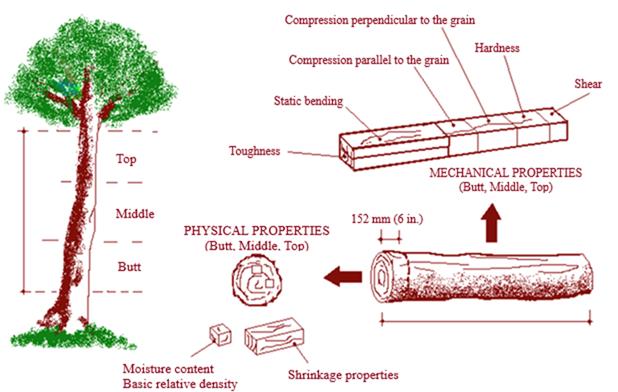
The potential of Bagalunga (Melia azedarach L.) and Kalumpit (Terminalia microcarpa Decne) as alternatives to Falcata [Falcataria falcata (L.) Greuter & R. Rankin], Gmelina (Gmelina arborea Roxb. ex Sm.), and Mahogany (Swietenia macrophylla King) were evaluated by assessing their physico-mechanical properties in accordance with ASTM D143-52: 2019 standards. Results showed that Mahogany had the lowest green moisture content (MC) at 90.60% and the highest basic relative density (RDb) at 0.52, while Falcata exhibited the highest green MC (193.98%) and the lowest RDb (0.29). Bagalunga displayed the highest shrinkage values [tangential shrinkage (TS): 6.63%, radial shrinkage (RS): 4.48%, volumetric shrinkage (VS): 10.81%], whereas Mahogany showed the lowest shrinkage (TS: 3.59%, RS: 3.11%, VS: 6.81%) but the highest longitudinal shrinkage (LS) (0.42%). Mahogany recorded the highest modulus of rupture (MOR) (63.65 MPa and 66.96 MPa at green and 12% MC, respectively), and excelled in compression [parallel (27.28 MPa and 35.62 MPa), perpendicular (7.14 MPa and 7.89 MPa)], hardness [side (4.67 kN and 4.20 kN), end (5.48 kN and 5.49 kN)], and shear strength (8.37 MPa and 10.37 MPa). Kalumpit exhibited the highest toughness in both green and 12% MC conditions (48.51 J/Spec and 42.62 J/Spec), along with the highest SPL (33.42 MPa) and MOE (8.58 GPa) at 12% MC. Gmelina had the highest MOE (7.12 GPa), while Mahogany showed the highest SPL (25.50 MPa) in the green condition. Height levels significantly affected TS and VS, while mechanical properties showed minimal variation. Farmers may consider Bagalunga and Kalumpit as alternative species. The application of silvicultural practices is essential for improving growth, optimizing rotation cycles, and ensuring sustainability for native tree species.
Article Details

This work is licensed under a Creative Commons Attribution-NonCommercial 4.0 International License.
Published articles are under the copyright of the Environment and Natural Resources Journal effective when the article is accepted for publication thus granting Environment and Natural Resources Journal all rights for the work so that both parties may be protected from the consequences of unauthorized use. Partially or totally publication of an article elsewhere is possible only after the consent from the editors.
References
Aguilos R, Marquez C, Adornado H, Aguilos M. Domesticating commercially important native tree species in the Philippines: Early growth performance level. Forests 2020;11(8):Article No. 885.
Alipon MA, Bondad EO, Alcachupas PL, Cortiguerra EC. Properties and utilization of young-age yemane (Gmelina arborea Roxb.) for lumber production. Philippine Journal of Science 2019;148(2):237-48.
Alipon MA, Bondad EO, Cayabyab PC. Relative Density of Philippine Woods. College, Laguna, Philippines: Forest Products Research and Development Institute; 2005.
Alipon MA, Bondad EO. Strength Grouping of Philippine Timbers for Various Uses. College, Laguna, Philippines: Forest Product Research and Development Institute; 2008.
American Society for Testing Materials (ASTM). Methods of testing small clear specimens of timber (ASTM Designation: D143-52). In: Book of ASTM Standards, Part 16. Philadelphia, PA: ASTM International; 2019. p. 1-30.
Amini MHM, Rasat MSM, Mohamed M, Wahab R, Ramle NH, Khalid I, et al. Chemical composition of small diameter wild Acacia mangium species. ARPN Journal of Engineering and Applied Sciences 2017;12(8):2698-702.
Ban DV. Utilization-Relevant Physical and Mechanical Wood Properties of Melia azedarach L. from Cultivation Areas in Northern Vietnam [dissertation]. Germany: Institute of Wood Biology and Wood Technology, University of Göttingen; 1997.
Bergman R. Drying and control of moisture content and dimensional changes. In: Madison WI, editor. Wood Handbook: Wood as an Engineering Material. United States: U.S. Department of Agriculture, Forest Service, Forest Products Laboratory; 2021.
Botero FA. Test methods adopted at IPT for the study of national woods: Tables and results obtained for national woods. São Paulo, Brazil: Institute of Technological Research; 1956.
Bullecer RC, Socorin L. Growth performance of planted indigenous trees 12 years from establishment. International Journal of Environment and Rural Development 2013; 4(1):118-23.
Department of Environment and Natural Resources-Forest Management Bureau (DENR-FMB). Diliman, Quezon City; Philippine Forestry Statistics; 2022.
Desch HE, Dinwoodie JM. Timber: Structure, Properties, Conversion, and Use. 7th ed. London: Red Globe Press; 1996.
Drozdzek M, Horodenski J, Jankowska A, Sarnowski P. Effect of extractives on the equilibrium moisture content and shrinkage of selected tropical wood species. BioResources 2017; 12(1):597-607.
Engay-Gutierez KG, Espaldon MO, Villanueva-Peyraube JD, Sobremisana MJ, Macandog DM, Tiburan Jr. CL. The sustainability of native tree in the greening initiative of the Philippines. UP Los Banos Journal 2023;21(2):65-104.
Hamdan H, Nordahlia AS, Anwar UMK, Mohd Iskandar M, Mohamad Omar MK, Tumirah K. Anatomical, physical, and mechanical properties of four pioneer species in Malaysia. Journal of Wood Science 2020;66:Article No. 59.
Hussin MC, Kasim J, Yusoff NF, Jasmi NF, Misfar SN. Effect of tree portion and distance from pith on the relative density, fiber properties, and chemical composition of Albizia falcataria wood. International Journal of Latest Research in Science and Technology 2014;3(6):187-91.
Kerdraon D, Drewer J, Castro B, Wallwork A, Hall JS, Sayer EJ. Litter traits of native and non-native tropical trees influence soil carbon dynamics in timber plantations in Panama. Forests 2019;10(3):Article No. 209.
Lundqvist SO, Grahn T, Olsson L, Seifert T. Comparison of wood, fiber, and vessel properties of drought-tolerant eucalypts in South Africa. Southern Forests: A Journal of Forest Science 2017;79(3):215-25.
Marasigan OS, Razal RA, Carandang WM, Alipon MA. Physical and mechanical properties of stems and branches of falcata [Falcataria moluccana (Miq.) Barneby and J.W. Grimes] grown in Caraga, Philippines. Philippine Journal of Science 2022;151(2):575-86.
Marquez C, Aguilos R, Bacsal R, Adornado H, Aguilos M. Early growth of 11 native and three alien tree species in northeastern Mindanao, Philippines. Forests 2021;12(7):Article No. 909.
Moya R, Tenorio C, Meyer I. Influence of wood anatomy on moisture content, shrinkage, and during defects in Vochysia guatemalensis Donn Sm. Scientia Forestalis 2012;40(94):249-58.
Nasser R, Al-Meffarrej H, Abdel-Aal M, Hegazy S. Chemical and mechanical properties of Melia azedarach mature wood as affected by primary treated sewage-effluent irrigation. American-Eurasian Journal of Agriculture and Environmental Sciences 2010;7(6):697-704.
Nath CD, Schroth G, Burslem DFRP. Why do farmers plant more exotic than native trees? A case study from the Western Ghats, India. Agriculture, Ecosystems and Environment 2016;230:315-28.
Natividad RA. Pioneer tree species: Their potential uses and harvesting constraints. Ecosystems and Development Journal 2016;6(1):32-6.
Nordahlia AS, Anwar UMK, Hamdan H, Zaidon A, Mohd Omar MK. Mechanical properties of 10-year-old sentang (Azadirachta excelsa) grown from vegetative propagation. Journal of Tropical Forest Science 2014;26(2):240-8.
Pun CY. Some basic strength properties of 22 timbers from Christmas Island. The Malayan Forester 1969;23(2):201-2.
R Core Team. R: A language and environment for statistical computing (Version 4.2.1) [Internet]. 2022 [cited 2024 Sep 13]. Available from: https://www.R-project.org/.
Ratsirarson H, Robertson HG, Picker MD, Noort SV. Indigenous forests versus exotic eucalypt and pine plantations: A comparison of leaf-litter invertebrate communities. African Entomology 2002;10(1):93-9.
Reyes G, Brown S, Chapman J, Lugo AE. Wood Densities of Tropical Tree Species. New Orleans, Louisiana: U.S. Department of Agriculture, Forest Service, Southern Forest Experiment Station; 1992.
Shmulsky R, Jones PD. Forest Products and Wood Science: An Introduction. 7th ed. Hoboken, New Jersey: Wiley-Blackwell; 2019.
Tomas-Carig E. Field Guidebook on Native Trees within the Quirino Forest Landscape. Plaridel, Bulacan, Philippines: St. Andrew Publishing House; 2020.
Van Duong D, Hesagawa M, Matsumura J. The relation of fiber length, wood density, and compressive strength to ultrasonic wave velocity within stem of Melia azedarach. Journal of the Indian Academy of Wood Science 2018;16(1):1-8.
Van Duong D, Matsumura J. Transverse shrinkage variations within tree stems of Melia azedarach planted in Northern Vietnam. Journal of Wood Science 2018;64(6):720-9.
Van Duong D, Schimleck L, Tai Tien D, Chu Van T. Radial variation in cell morphology of Melia azedarach planted in Northern Vietnam. Maderas: Ciencia y Tecnologia 2021;23(7):1-10.
Venson I, Silva Guzman A, Fuentes Talavera FJ, Richter HG. Biological, physical, and mechanical wood properties of Paraiso (Melia azedarach) from a roadside planting at Huaxtla, Jalisco, Mexico. Journal of Tropical Forest Science 2008;20(1):38-47.
Wessels CB, Crafford PL, Du Toit B, Grahn T, Johansson M, Lundqvist S-O, et al. Variation in physical and lumber properties from three drought tolerant Eucalyptus species grown on the dry west coast of Southern Africa. European Journal of Wood and Wood Products 2016;74(4):563-75.
