Dynamic Integrated Model for Sustainable Solid Waste Management in Bengkulu City 10.32526/ennrj/23/20250048
Article Sidebar
Main Article Content
Abstract
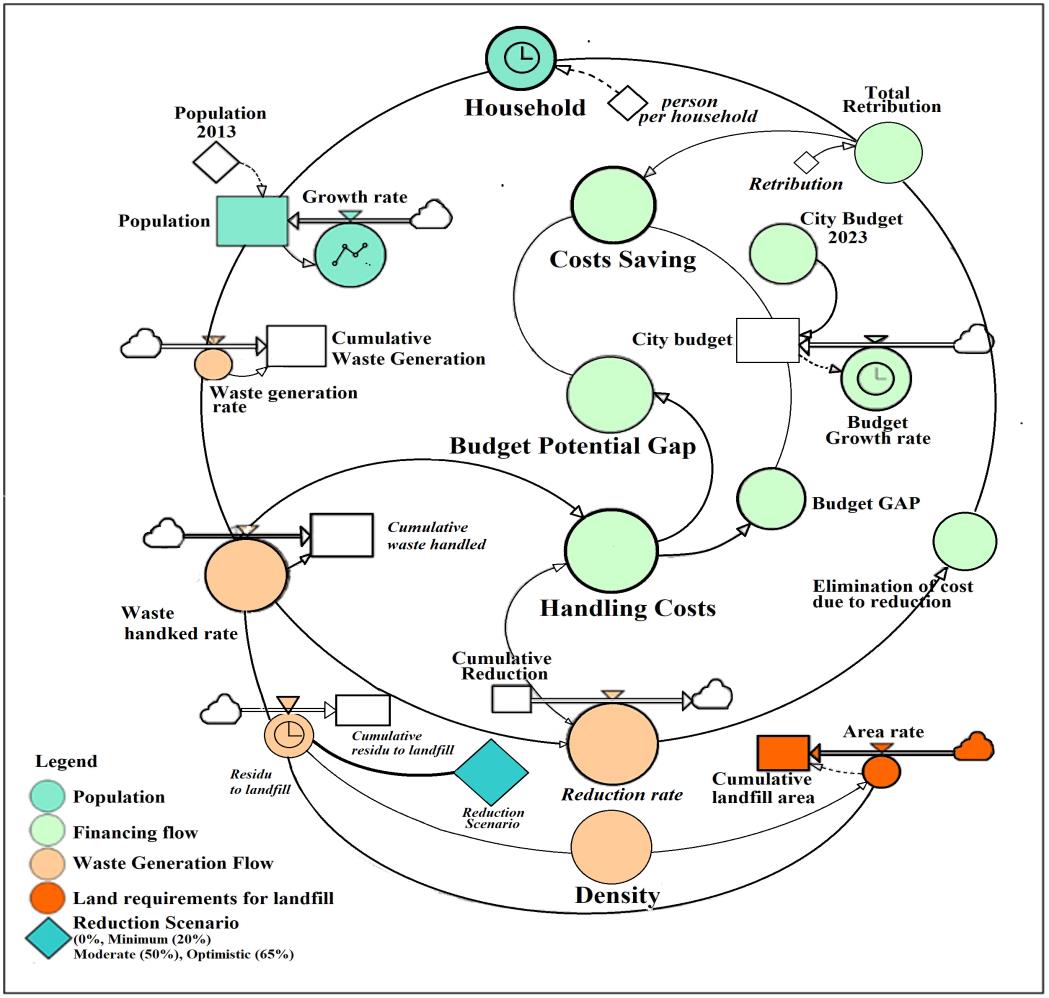
Rapid urbanization and increased consumption patterns have intensified municipal solid waste (MSW) challenges in developing cities. This study applies a system dynamics model to project waste generation, management costs, and landfill requirements in Bengkulu City, Indonesia, over a 20-year period. Four scenarios were simulated: business-as-usual, minimum (25%), moderate (50%), and optimistic (65%) waste reduction. The model integrates critical parameters including population growth, waste generation rates, recycling capacity, and community participation. Results indicate that without intervention, cumulative waste volume will overwhelm landfill capacity and escalate operational costs. Conversely, implementing waste reduction strategies—such as strengthening source separation, expanding composting and waste banks, adopting advanced technologies, and enforcing supportive policies—substantially reduces landfill dependency and operational expenses. The optimistic scenario demonstrates the highest efficiency, reducing required landfill land by over 85% and significantly lowering management costs. This study highlights the importance of multi-stakeholder collaboration, digital monitoring integration, and circular economy principles in urban waste governance. The model offers a practical decision-support framework for policymakers aiming to develop resilient, inclusive, and sustainable waste management systems in similar urban contexts.
Article Details

This work is licensed under a Creative Commons Attribution-NonCommercial 4.0 International License.
Published articles are under the copyright of the Environment and Natural Resources Journal effective when the article is accepted for publication thus granting Environment and Natural Resources Journal all rights for the work so that both parties may be protected from the consequences of unauthorized use. Partially or totally publication of an article elsewhere is possible only after the consent from the editors.
References
Abubakar IR, Maniruzzaman KM, Dano UL, AlShihri FS, AlShammari MS, Ahmed SMS, et al. Environmental sustainability impacts of solid waste management practices in the global south. International Journal of Environmental Research and Public Health 2022;19(19):Article No. 12717.
Artika I, Chaerul M. Dynamic system model for waste management scenario evaluation in Depok City. Jurnal Wilayah dan Lingkungan 2020;8(3):261-79 (in Indonesian).
Banerjee S, Chakraborty S, Banerjee S, Dutta A. Decision making and economical optimization of a city scale solid waste management system: An integrated model simulation on Kolkata, India. Materials Today: Proceedings 2023. DOI: 10.1016/j.matpr.2023.07.238.
Behera S, Samal K. Sustainable approach to manage solid waste through biochar assisted composting. Energy Nexus 2022;7:Article No. 100121.
Blakeslee J, Kothari BH, McBeath B, Sorenson P, Bank L. Network indicators of the social ecology of adolescents in relative and non-relative Foster households. Children and Youth Services Review 2017;73:173-81.
Boateng S, Boakye-Ansah D, Baah A, Aboagye B, Kyeremeh PAG. Solid waste management practices and challenges in rural and urban senior high schools in Ashanti Region, Ghana. Journal of Environmental and Public Health 2023; 2023:Article No. 9694467.
Bornstein MH. Dynamic Systems Theory. In: The SAGE Encyclopedia of Lifespan Human Development. SAGE Publications, Inc.; 2018.
Bruno M, Abis M, Kuchta K, Simon FG, Grönholm R, Hoppe M, et al. Material flow, economic and environmental assessment of municipal solid waste incineration bottom ash recycling potential in Europe. Journal of Cleaner Production 2021;317:Article No. 128511.
Del Carmen-Niño V, Herrera-Navarrete R, Juárez-López AL, Sampedro-Rosas ML, Reyes-Umaña M. Municipal solid waste collection: Challenges, strategies and perspectives in the optimization of a municipal route in a Southern Mexican Town. Sustainability 2023;15(2):Article No. 1083.
Devi RU, Gangaraju G, Kumar KS, Balakrishna K. A sustainable approach for an integrated municipal solid waste management. In: Recent Trends in Solid Waste Management. Elsevier; 2023. p. 55-74.
do Carmo Precci Lopes A, Ebner C, Gerke F, Wehner M, Robra S, Hupfauf S, et al. Residual municipal solid waste as co-substrate at wastewater treatment plants: An assessment of methane yield, dewatering potential and microbial diversity. Science of the Total Environment 2022;804:Article No. 149936.
Dyson B, Chang N Bin. Forecasting municipal solid waste generation in a fast-growing urban region with system dynamics modeling. Waste Management 2005;25(7):669-79.
Environmental Services of Bengkulu City. Basic Information on the Air Sebakul Landfill, Bengkulu City. Bengkulu City Government; 2022.
Ferronato N, Torretta V. Waste mismanagement in developing countries: A review of global issues. International Journal of Environmental Research and Public Health 2019;16(6):Article No. 1060.
Forrester JW. Industrial Dynamics. MIT Press; 1961.
Fragkoulis D, Roux G, Dahhou B. Detection, isolation and identification of multiple actuator and sensor faults in nonlinear dynamic systems: Application to a waste water treatment process. Applied Mathematical Modelling 2011;35(1):522-43.
Free CM, Bellquist LF, Forney KA, Humberstone J, Kauer K, Lee Q, et al. Static management presents a simple solution to a dynamic fishery and conservation challenge. Biological Conservation 2023;285:Article No. 110249.
Friederich J, Lugaresi G, Lazarova-Molnar S, Matta A. Process mining for dynamic modeling of smart manufacturing systems: Data requirements. Procedia CIRP 2022;107:546-51.
Govani J, Singh E, Kumar A, Zacharia M, Rena, Kumar S. New generation technologies for solid waste management. In: Current Developments in Biotechnology and Bioengineering. Elsevier; 2021. p. 77-106.
Guerrero LA, Maas G, Hogland W. Solid waste management challenges for cities in developing countries. Waste Management 2013;33(1):220-32.
Guo D, Zhang S, Hou H, Zhang Y, Xu H. Synergistic evaluation methodology for pollution and carbon reduction in the field of solid waste resource utilization. Environmental Impact Assessment Review 2024;108:Article No. 107604.
Habibah E, Novianti F, Saputra H. Analysis of Factors Influencing the Implementation of Waste Management Policies in Yogyakarta Using Dynamic System Modeling. Jurnal Analisa Sociology 2020;9:124-36 (in Indinesia).
Hla SS, Roberts D. Characterisation of chemical composition and energy content of green waste and municipal solid waste from Greater Brisbane, Australia. Waste Management 2015;41:12-9.
Ibarra Vega D, Bautista-Rodriguez S. The impact of circular economy strategies on municipal waste management: A system dynamics approach. Cleaner Engineering and Technology 2024;21:Article No. 100761.
Kala K, Bolia NB, Sushil. Analysis of informal waste management using system dynamic modelling. Heliyon 2022;8(8):e09993.
Knickmeyer D. Social factors influencing household waste separation: A literature review on good practices to improve the recycling performance of urban areas. Journal of Cleaner Production 2020;245:Article No. 118605.
Kumar A, Samadder SR. A review on technological options of waste to energy for effective management of municipal solid waste. Waste Management 2017;69:407-22.
Lam CM, Yu IKM, Medel F, Tsang DCW, Hsu SC, Poon CS. Life-cycle cost-benefit analysis on sustainable food waste management: The case of Hong Kong International Airport. Journal of Cleaner Production 2018;187:751-62.
Lee U, Han J, Wang M. Evaluation of landfill gas emissions from municipal solid waste landfills for the life-cycle analysis of waste-to-energy pathways. Journal of Cleaner Production 2017;166:335-42.
Li G, Wang W-Jing, You X-Yi. Social-economic assessment of integrated waste pickers in municipal solid waste management system: A case of Tianjin in China. Journal of Cleaner Production 2024;434:Article No. 140302.
Lim SL, Lee LH, Wu TY. Sustainability of using composting and vermicomposting technologies for organic solid waste biotransformation: Recent overview, greenhouse gases emissions and economic analysis. Journal of Cleaner Production 2016;111:262-78.
Mai L, Bao LJ, Wong CS, Zeng EY. Microplastics in the terrestrial environment. In: Microplastic Contamination in Aquatic Environments. Elsevier; 2018. p. 365-78.
Meena MD, Dotaniya ML, Meena BL, Rai PK, Antil RS, Meena HS, et al. Municipal solid waste: Opportunities, challenges and management policies in India: A review. Waste Management Bulletin 2023;1(1):4-18.
Moya D, Aldás C, López G, Kaparaju P. Municipal solid waste as a valuable renewable energy resource: A worldwide opportunity of energy recovery by using waste-to-energy technologies. Energy Procedia 2017;134:286-95.
Nepal M, Karki Nepal A, Khadayat MS, Rai RK, Shyamsundar P, Somanathan E. Low-cost strategies to improve municipal solid waste management in developing countries: Experimental evidence from Nepal. Environmental and Resource Economics 2023;84(3):729-52.
Pfister F, Bader HP, Scheidegger R, Baccini P. Dynamic modelling of resource management for farming systems. Agricultural Systems 2005;86(1):1-28.
Pinha ACH, Sagawa JK. A system dynamics modelling approach for municipal solid waste management and financial analysis. Journal of Cleaner Production 2020;269:Article No. 122350.
Radosavljevic S, Banitz T, Grimm V, Johansson LG, Lindkvist E, Schlüter M, et al. Dynamical systems modeling for structural understanding of social-ecological systems: A primer. Ecological Complexity 2023;56:Article No. 101052.
Rahman MN, Shozib SH, Akter MY, Islam ARMT, Islam MS, Sohel MS, et al. Microplastic as an invisible threat to the coral reefs: Sources, toxicity mechanisms, policy intervention, and the way forward. Journal of Hazardous Materials 2023;454:Article No. 131522.
Smith LB, Thelen E. Development as a dynamic system. Trends in Cognitive Sciences 2003;7(8):343-8.
Sołowski G, Konkol I, Cenian A. Production of hydrogen and methane from lignocellulose waste by fermentation: A review of chemical pretreatment for enhancing the efficiency of the digestion process Journal of Cleaner Production 2020;267:Article No. 121721
Sondh S, Upadhyay DS, Patel S, Patel RN. Strategic approach towards sustainability by promoting circular economy-based municipal solid waste management system: A review. Sustainable Chemistry and Pharmacy 2024;37:Article No. 101337.
Sterman JD. Systems dynamics modeling: Tools for learning in a complex world. IEEE Engineering Management Review 2002;30(1):8-25.
Thatcher A, Biyela P, Field TL, Hildebrandt D, Kidd M, Nadan S, et al. Contextualising urban sanitation solutions through complex systems thinking: A case study of the South African sanitation system. Journal of Cleaner Production 2024;451:Article No. 142084.
Ugwu CO, Ozoegwu CG, Ozor PA, Agwu N, Mbohwa C. Waste reduction and utilization strategies to improve municipal solid waste management on Nigerian Campuses. Fuel Communications 2021;9:Article No. 100025.
Wilson DC, Velis C, Cheeseman C. Role of informal sector recycling in waste management in developing countries. Habitat International 2006;30(4):797-808.
Zhang X, Feng D, Wang J, Sui A. Integrating renewable energy systems: Assessing financial innovation, renewable energy generation intensity, energy transition and environmental regulation with renewable energy sources. Energy Strategy Reviews 2024;56:Article No. 101567.
Zulkipli F, Nopiah ZM, Basri NEA, Kie CJ, Zulkepli J, Khalid KI. Integrated dynamical model for Malaysian solid waste management using system dynamics. International Journal of Engineering and Technology 2018;7(3):131-5.
