Predicting Habitat Suitability for the Endangered Green Peafowl (Pavo muticus L., 1766) in Thailand’s Western Stronghold under Future Climate Scenarios 10.32526/ennrj/23/20250081
Article Sidebar
Main Article Content
Abstract
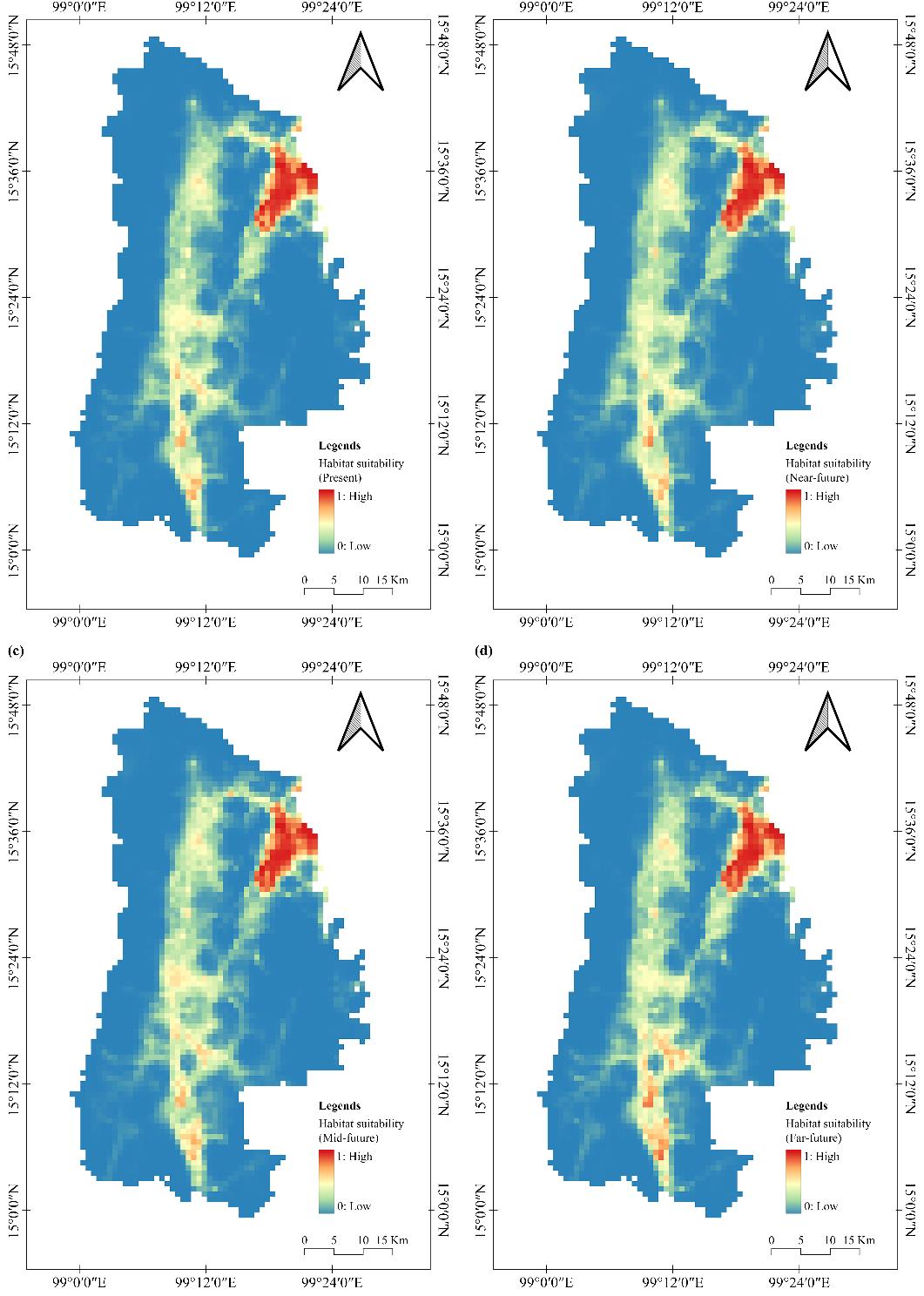
The green peafowl (Pavo muticus L., 1766) is endangered globally. This study evaluates environmental factors shaping its habitat in key Thai strongholds to identify current habitat suitability and predict future changes under climate scenarios. Current and projected climate data from 2020 to 2100 were analyzed under four scenarios of 20 years each: at present, in the near future, mid future and far future, using species distribution modelling with MaxEnt and SSP2-4.5 to assess potential impacts. The results show that the key green peafowl habitat factors included elevation, slope, streams, isothermality and annual precipitation. Mixed deciduous forests were the most critical forest types for the species. Moderately and highly suitable habitats for the green peafowl covered approximately 5% of the sanctuary. However, well suitable habitat is projected to decrease markedly, representing a 21.25% decline. Strict management of these crucial areas is essential. Moreover, expanding protected areas, networks, and conservation strategies are vital for addressing challenges arising from rapid global environmental change.
Article Details

This work is licensed under a Creative Commons Attribution-NonCommercial 4.0 International License.
Published articles are under the copyright of the Environment and Natural Resources Journal effective when the article is accepted for publication thus granting Environment and Natural Resources Journal all rights for the work so that both parties may be protected from the consequences of unauthorized use. Partially or totally publication of an article elsewhere is possible only after the consent from the editors.
References
Abdelaal M, Fois M, Fenu G, Bacchetta G. Using MaxEnt modeling to predict the potential distribution of the endemic plant Rosa arabica Crép. in Egypt. Ecological Informatics 2019;50:68-75.
Ab Lah NZ, Yusop Z, Hashim M, Mohd Salim J, Numata S. Predicting the habitat suitability of Melaleuca cajuputi based on the MaxEnt species distribution model. Forests 2021;12(11):Article No. 1449.
Akinwande MO, Dikko HG, Samson A. Variance inflation factor: As a condition for the inclusion of suppressor variable(s) in regression analysis. Open Journal of Statistics 2015;5(7):754-67.
Bai DF, Chen PJ, Atzeni L, Cering L, Li Q, Shi K. Assessment of habitat suitability of the snow leopard (Panthera uncia) in Qomolangma National Nature Reserve based on MaxEnt modeling. Zoological Research 2018;39(6):373-86.
Bernath-Plaisted JS, Correll MD, Somershoe SG, Dwyer AM, Bankert A, Beh A, et al. Review of conservation challenges and possible solutions for grassland birds of the North American Great Plains. Rangeland Ecology and Management 2023;90:165-85.
Bhagarathi LK, Da Silva PNB, Maharaj G, Pestano F, Cossiah C, Kalika-Singh S, et al. Comprehensive review on the impact of climate change on the ecology, breeding seasonality, abundance and distribution of birds and possible approaches to address and conserve bird populations. International Journal of Science and Technology Research Archive 2024;6(2):21-44.
Bhasin A, Ghosal S, Raina P, Hore U. Climate change impacts on high altitude wildlife distribution: Predicting range shifts for four ungulates in Changthang, Eastern Ladakh. Ecological Frontiers 2024;44(2):365-80.
Boucher O, Servonnat J, Albright AL, Aumont O, Balkanski Y, Bastrikov V, et al. Presentation and evaluation of the IPSL-CM6A-LR climate model. Journal of Advances in Modeling Earth Systems 2020;12(7):e2019MS002010.
Charaspet K, Sukmasuang R, Khoewsree N, Pla-Ard M, Paansri P, Keawdee B, et al. Spatial and temporal overlaps of top predators: Dhole, tiger and leopard, and their potential prey in Huai Kha Khaeng Wildlife Sanctuary, Thailand. Biodiversitas 2021;22(2):580-92.
Charaspet K, Duengkae P, Khiowsree N, Simchareon S, Sukmasuang R, Songsasen N. Some ecological aspects of dhole (Cuon alpinus) in the Huai Kha Khaeng Wildlife Sanctuary, Uthai Thani Province, Thailand. Folia Oecologica 2019a;46(2):91-100.
Charaspet K, Sukmasuang R, Khoewsree N, Pla-ard M, Songsaen N, Simchareon S. Movement, home range size and activity pattern of the golden jackal (Canis aureus, Linneaus, 1758) in Huai Kha Khaeng Wildlife Sanctuary, Thailand. Biodiversitas 2019b;20(11):3430-8.
Charaspet K, Sukmasuang R, Khoewsree N, Pla-ard M, Chanachai Y. Prey species and prey selection of dholes at three different sites in Thailand. Biodiversitas 2020;21(11):5248-62.
Chatterjee S, Hadi AS. Regression Analysis by Example. Hoboken, New Jersey: Jonh Wiley and Sons; 2006.
Choo YR, Kudavidanage EP, Amarasinghe TR, Nimalrathna T, Chua MAH, Webb EL. Best practices for reporting individual identification using camera trap photographs. Global Ecology and Conservation 2020;24:e01294.
Coreau A, Guillet F, Rabaud S. The influence of ecological knowledge on biodiversity conservation policies: A strategic challenge for knowledge producers. Journal for Nature Conservation 2018;46:97-105.
Dormann CF, Elith J, Bacher S, Buchmann C, Carl G, Carré G, et al. Collinearity: A review of methods to deal with it and a simulation study evaluating their performance. Ecography 2013;36(1):27-46.
Elith J, Phillips SJ, Hastie T, Dudík M, Chee YE, Yates CJ. A statistical explanation of MaxEnt for ecologists. Diversity and Distributions 2011;17(1):43-57.
Halupka L, Debora Arlt, Tolvanen J, Millon A, Bize P, Adamík P, et al. The effect of climate change on avian offspring production: A global meta-analysis. Proceedings of the National Academy of Sciences 2023;120(19):e2208389120.
Hernowo JB. Determinant factors of the Javan green peafowl (Pavo muticus muticus Linnaeus 1758) habitat in Baluran and Alas Purwo National Parks, East Java, Indonesia. Tropical Drylands 2017;1(1):50-6.
Holbrook JD, Squires JR, Olson LE, DeCesare NJ, Lawrence RL. Understanding and predicting habitat for wildlife conservation: The case of Canada lynx at the range periphery. Ecosphere 2017;8(9):e01939.
Fontúrbel FE, Rodríguez-Gómez GB, Fernández N, García B, Orellana JI, Castaño-Villa GJ. Sampling understory birds in different habitat types using point counts and camera traps. Ecological Indicators 2020;119:Article No. 106863.
International Union for Conservation of Nature (IUCN). The IUCN Red List of Threatened Species. Version 2024-2 [Internet]. 2025 [cited 2025 Jan 9]. Available from: http://iucnredlist.org.
Jiang D, Chen S, Hao M, Fu J, Ding F. Mapping the potential global codling moth (Cydia pomonella L.) distribution based on a machine learning method. Scientific Reports 2018; 8(1):Article No. 13093.
Kamworapan S, Thao PTB, Gheewala SH, Pimonsree S, Prueksakorn K. Evaluation of CMIP6 GCMs for simulations of temperature over Thailand and nearby areas in the early 21st century. Heliyon 2021;27:7(11):e08263.
Kanka P, Sukmasuang R, Duengkae P, Siripattaranugul K. Abundance and physical factors affecting the appearance of selected terrestrial birds in Khao Yai National Park using camera trapping. Biodiversitas 2023;24(1):222-32.
Khan AM, Li Q, Saqib Z, Khan N, Habib T, Khalid N, et al. MaxEnt modelling and impact of climate change on habitat suitability variations of economically important chilgoza pine (Pinus gerardiana Wall.) in South Asia. Forests 2022; 13(5):Article No. 715.
Kong D, Wu F, Shan P, Gao J, Yan D, Luo W, et al. Status and distribution changes of the endangered Green Peafowl (Pavo muticus) in China over the past three decades (1990s-2017). Avian Research 2018;9:Article No. 18.
Lawer EA. Predicting the impact of climate change on the potential distribution of a critically endangered avian scavenger, Hooded Vulture Necrosyrtes monachus, in Ghana. Global Ecology and Conservation 2024;49:e02804.
Leo S, Izz Q, Finley NL, Sumardi I, Andiani J. Wildlife species recorded by camera traps in reforested lowland rainforest and peat swamp forest of Gunung Palung National Park, Indonesia. Tropical Natural History 2024;24(1):8-19.
Lovino MA, Pierrestegui MJ, Müller OV, Berbery EH, Müller GV, Pasten M. Evaluation of historical CMIP6 model simulations and future projections of temperature and precipitation in Paraguay. Climatic Change 2021;164:Article No. 46.
Luo Y, Yang J, Liu L, Zhang K. MaxEnt modeling and effects of climate change on shifts in habitat suitability for Sorbus alnifolia in China. Plants 2025;14(5):Article No. 677.
Lu Q, Rao J, Shi C, Guo D, Fu G, Wang J, et al. Possible influence of sudden stratospheric warmings on the atmospheric environment in the Beijing-Tianjin-Hebei Region. Atmospheric Chemistry and Physics; Katlenburg-Lindau 2022;22(19):13087-102.
McGarvey DJ, Brown AL, Chen EB, Viverette CB, Tuley PA, Latham OC, et al. Do fishes enjoy the view? A MaxEnt assessment of fish habitat suitability within scenic rivers. Biological Conservation 2021;263:Article No. 109357.
Mota FMM, Kittelberger KD, Florez-Pa´ı C, Sekercioglu CH. Climate-driven distributional shifts in Choco´ endemic birds of southwest Colombia. Frontiers in Conservation Science 2024;5:Article No. 1412440.
Naimi B, Hamm ASS, Groen TA, Skidmore AK, Toxopeus AG. Where is positional uncertainty a problem for species distribution modelling? Ecography 2014;37(2):191-203.
Naimi B, Araújo MB. sdm: A reproducible and extensible R platform for species distribution modelling. Ecography 2016;39(4):368-75.
Nameer PO. The expanding distribution of the Indian peafowl (Pavo cristatus) as an indicator of changing climate in Kerala, southern India: A modelling study using MaxEnt. Ecological Indicators 2020;110:Article No. 105930.
Nasoongnern J, Suksavate W, Noowong J, Kaewdee B, Pisarn N, Sukmasuang R. Abundance, activity pattern and habitat suitability of the selected wildlife species in Ob Khan National Park, Northern Thailand. Journal of Wildlife and Biodiversity 2024;8(2):81-102.
Odeny D, Karanja F, Mwachala G, Pellikka P, Marchant R. Impact of climate change on species distribution and carbon storage of agroforestry trees on isolated east African mountains. American Journal of Climate Change 2019;8(3):364-86.
O’Donnell MS, Ignizio DA. Bioclimatic Predictors for Supporting Ecological Applications in the Conterminous United States: U.S. Geological Survey Data Series 691 [Internet]. 2012 [cited 2024 Dec 2]. Available from: https://pubs.usgs.gov/ publication/ds691.
Pacifici M, Visconti P, Butchart SHM, Watson JEM, Cassola FM, Rondinini C. Species’ traits influenced their response to recent climate change. Nature Climate Change 2017;7:205-8.
Phillips SJ, Anderson RP, Dudík M, Schapire RE, Blair ME. Opening the black box: An open-source release of Maxent. Ecography 2017;40(7):887-93.
Phillips SJ, Anderson RP, Schapire RE. Maximum entropy modeling of species geographic distributions. Ecological Modelling 2006;190(3-4):231-59
Phipps WL, Diekmann M, MacTavish LM, Mendelsohn JM, Naidoo V, Wolter K, et al. Due South: A first assessment of the potential impacts of climate change on Cape vulture occurrence. Biological Conservation 2017;210:16-25.
Penjor U, Kaszta Z, Macdonald DW, Cushman SA. Prioritizing areas for conservation outside the existing protected area network in Bhutan: The use of multi-species, multi-scale habitat suitability models. Landscape Ecology 2021;36:1281-309.
Patil AB, Vijay N. Conservation implications of diverse demographic histories: The case study of green peafowl (Pavo muticus Linnaeus 1766). Conservation Genetics 2024;25:455-68.
R Core Team. R: A Language and Environment for Statistical Computing. Vienna, Austria: Foundation for Statistical Computing [Internet]. 2018 [cited 2024 Dec 2]. Available from: https://cran.r-project.org/doc/manuals/r-release /fullrefman.pdf .
Rehman S, Iqbal Z, Qureshi R, Khan AM, Qaseem MF, Siddiqui MH. Bioclimatic and remote sensing factors are better key indicators than local topography and soil: Vegetation composition variability in forests of Pakistan’s Spin Ghar Mountain range. Ecological Indicators 2024;163:Article No. 112111.
Ren Z, Wang D, Ma A, Hwang J, Bennett A, Sturrock HJWB. Predicting malaria vector distribution under climate change scenarios in China: Challenges for malaria elimination. Scientific Reports 2016;6:Article No. 20604.
Saisamorn A, Duangchantrasiri S, Sornsa M, Suksavate W, Pattanavibool A, Duengkae P. Recovery of globally threatened ungulate species in Huai Kha Khaeng Wildlife Sanctuary, Thailand. Global Ecology and Conservation 2024;53:e03012.
Saridnirun G, Sukumal N, Grainger MJ, Savini T. Low-intensive agricultural landscapes could help to sustain Green Peafowl Pavo muticus inhabiting surrounding forest patches in Northern Thailand. Global Ecology and Conservation 2023;44:e02487.
Shrestha SL. Quantifying effects of meteorological parameters on air pollution in Kathmandu valley through regression models. Environmental Monitoring and Assessment 2022; 194(10):Article No. 684.
Shwe NM, Sukumal N, Oo KM, Dowell S, Browne S, Savini T. Importance of isolated forest fragments and low intensity agriculture for the long-term conservation of the green peafowl Pavo muticus. Oryx 2021;55(2):311-7.
Simcharoen A, Savini T, Gale GA, Simcharoen S, Duangchantrasiri S, Pakpien S, et al. Female tiger Panthera tigris home range size and prey abundance: Important metrics for management. Oryx 2014;48(3):370-7.
Singh C, Solomon D, Rao N. How does climate change adaptation policy in India consider gender? An analysis of 28 state action plans. Climate Policy 2021;21(7):958-75.
Sukumal N, Dowell SD, Savini T. Micro-habitat selection and population recovery of the Endangered Green Peafowl Pavo muticus in western Thailand: Implications for conservation guidance. Bird Conservation International 2017;27(3):414-30.
Sukumal N, Dowell SD, Savini T. Modelling occurrence probability of the endangered green peafowl Pavo muticus in mainland South-East Asia: Applications for landscape conservation and management. Oryx 2020;54(1):30-9.
Sukumal N, Thunhikorn S, Savini T. Assessing the status of the Green Peafowl’s expected stronghold in dry forests along the Salawin River, North-West Thailand. Bird Conservation International 2022;33:e32.
Suwanrat S, Ngoprasert D, Sutherland C, Suwanwaree P, Savini T. Estimating density of secretive terrestrial birds (Siamese fireback) in pristine and degraded forest using camera traps and distance sampling. Global Ecology and Conservation 2015;3:596-606.
Sukmasuang R, Chaisomboon P, Paansri P, Trisurat Y, Kanka P, Khiowsree N, et al. A. Abundance and factors affecting the appearance of Siamese fireback and red junglefowl in the lowland forest of Thailand. Biodiversitas 2023;24(10): 5718-30.
Trisurat Y, Kanchanasaka B, Kreft H. Assessing potential effects of land use and climate change on mammal distributions in northern Thailand. Wildlife Research 2014;41(6):522-36.
Williams DR, Rondinini C, Tilman D. Global protected areas seem insufficient to safeguard half of the world’s mammals from human-induced extinction. Proceedings of the National Academy of Sciences of the United States of America 2022;119(24):e2200118119.
Vimal R, Navarro LM, Jones Y, Wolf F, Moguédec GL, Réjou-Méchain M. The global distribution of protected areas management strategies and their complementarity for biodiversity conservation. Biological Conservation 2021;256:Article No. 109014.
Weinhäupl C, Devenish-Nelson ES. Potential impacts of climate change on terrestrial Aotearoa New Zealand’s birds reveal high risk for endemic species. Biological Conservation 2024;296:Article No. 110668.
Weiskopf SR, Rubenstein MA, Crozier LG, Gaichas S, Griffis R, Halofsky JE, et al. Climate change effects on biodiversity, ecosystems, ecosystem services, and natural resource management in the United States. Science of the Total Environment 2020;733:Article No. 137782.
Xie C, Chen L, Li M, Jim CY, Liu D. BIOCLIM modeling for predicting suitable habitat for endangered tree Tapiscia sinensis (Tapisciaceae) in China. Forests 2023;14:Article No. 2275.
Yan M, Gu B, Zhang M, Wang W, Quan RC, Li J, et al. The Range Contraction and Future Conservation of Green Peafowl (Pavo muticus) in China. Sustainability 2021;13:Article No. 11723.
Yi YJ, Cheng X, Yang ZF, Zhang SH. Maxent modeling for predicting the potential distribution of endangered medicinal plant (H. riparia Lour) in Yunnan, China. Ecological Engineering 2016;92:260-9.
Yu Y, He G, Li DY, Zhao XM, Chang J, Liu XC, et al. Climate change challenge, extinction risk, and successful conservation experiences for a threatened primate species in China: Golden snub-nosed monkey (Rhinopithecus roxellana). Zoological Research 2022;43(6):940-4.
Zaragozí B, Belda A, Giménez P, Navarro JT, Bonet A. Advances in camera trap data management tools: Towards collaborative development and integration with GIS. Ecological Informatics 2015;30:6-11.
Zhao G, Yang H, Gong Y, Xie B, Ge J, Feng L. Spatio-temporal coexistence of sympatric mesocarnivores with a single apex carnivore in a fine-scale landscape. Global Ecology and Conservation 2020;21(3):e00897.
