Population Density Estimation of Hornbills in the Eastern Part of Huai Kha Khaeng Wildlife Sanctuary, Thailand 10.32526/ennrj/24/20250091
Article Sidebar
Main Article Content
Abstract
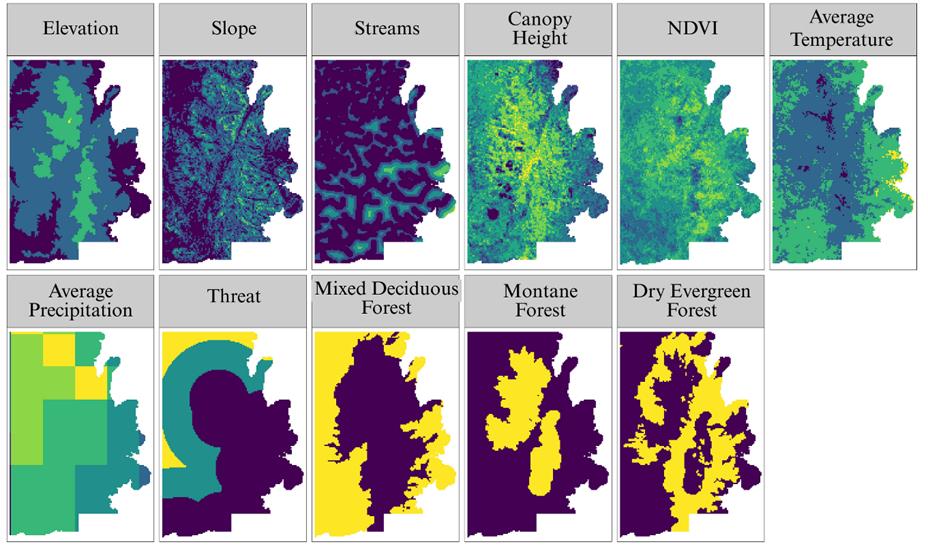
Hornbills belong to the Bucerotidae Family, and almost all species within this family are vulnerable to extinction. This study examined the population density of four hornbill species in the eastern part of the rainforest of the Huai Kha Khaeng Wildlife Sanctuary. The species studied were the Great Hornbill (Buceros bicornis Linnaeus 1758), Rufous-necked Hornbill (Aceros nipalensis Hodgson 1829), Wreathed Hornbill (Rhyticeros undulates Shaw 1811), and Tickell’s Brown Hornbill (Anorrhinus tickelli Blyth 1855). Moreover, the study investigated factors influencing hornbill density using distance sampling with point transect methods, as well as the unmarked package in R. The survey was conducted along four 9-km survey lines, covering a total of 36 km, using 45 survey points with 200-m spacing between points. In total, 180 points were surveyed, with each point observed for 10 min. The study was replicated twice, covering an area of approximately 600 km2, with surveys conducted from November 2023 to January 2024, and again from March 2024 to October 2024. The results showed the following hornbill population densities (individuals/km2): Great Hornbill 10.16±0.07 (n=108), Rufous-necked Hornbill 5.95±0.07 (n=74), Tickell’s Brown Hornbill 4.42±0.03 (n=61), and Wreathed Hornbill 1.52±0.01 (n=22). Factors that significantly influenced hornbill density included elevation, slope, average precipitation, average temperature, and montane forest. These findings contribute to the understanding of hornbill ecology and population dynamics. The results can guide management strategies and promote public awareness of habitat conservation.
Article Details

This work is licensed under a Creative Commons Attribution-NonCommercial 4.0 International License.
Published articles are under the copyright of the Environment and Natural Resources Journal effective when the article is accepted for publication thus granting Environment and Natural Resources Journal all rights for the work so that both parties may be protected from the consequences of unauthorized use. Partially or totally publication of an article elsewhere is possible only after the consent from the editors.
References
Anggraini K, Kinnaird M, O’Brien T. The effects of fruit availability and habitat disturbance on an assemblage of Sumatran hornbills. Bird Conservation International 2000; 10(3):189-202.
Annorbah NND, Collar NJ, Marsden SJ. Trade and habitat change virtually eliminate the Grey Parrot Psittacus erithacus from Ghana. International Journal of Avian Science 2016; 158(1):82-91.
Ardiantiono A, Karyadi, Isa M, Hasibuan AK, Kusara I, Arwin, et al. Hornbill density estimates and fruit availability in a lowland tropical rainforest site of Leuser Landscape, Indonesia: preliminary data towards long-term monitoring. Hornbill Natural History and Conservation 2020;1(1):2-11.
BirdLife International. Aceros nipalensis. The IUCN Red List of Threatened Species 2020: e.T22682510A176267243 [Internet]. 2020 [cited 2025 Sep 22]. Available from: https://www.iucnredlist.org/species/22682510/176267243.
BirdLife International. Rhyticeros undulatus. The IUCN Red List of Threatened Species 2018: e.T22682528A132400385 [Internet]. 2018 [cited 2025 Sep 22]. Available from: https://www.iucnredlist.org/species/22682528/132400385.
Callaghan CT, Santini L, Spake R, Bowler DE. Population abundance estimates in conservation and biodiversity research. Trends in Ecology and Evolution 2024;39(6):515-23.
Chaitanya R, Naniwadekar R, Meiri S. Why did the hornbill not cross the river? Upland habitats rather than a physical barrier limit the distribution of the Brown Hornbill. Journal of Biogeography 2024;51(11):2156-69.
Chandler R. Distance Sampling Analysis in Unmarked [Internet]. 2020 [cited 2025 Jan 5]. Available from: https://cran.r-project.org/web/packages/unmarked/vignettes/distsamp.html.
Cheng Y, Wen Z, He X, Dong Z, Zhangshang M, Li D, et al. Ecological traits affect the seasonal migration patterns of breeding birds along a subtropical altitudinal gradient. Avian Research 2022;13:Article No. 100066.
Cook M, Schott JR, Mandel J, Raqueno N. Development of an operational calibration methodology for the land sat thermal data archive and initial testing of the atmospheric compensation component of a land surface temperature (LST) product from the archive. Remote Sensing 2014;6(11):11244-66.
Dahal D, Nepal A, Rai CM, Sapkota S. Understanding the impact of climate change on the habitat of the rufous-necked hornbill (Aceros nipalensis) (Hodgson, 1829) using MaxEnt modeling in Bhutan. Ornithology Research 2023;31:182-92.
Datta A, Rawat GS. Nest-site selection and nesting success of three hornbill species in Arunachal Pradesh, north-east India: Great Hornbill Buceros bicornis, Wreathed Hornbill Aceros undulatus, and Oriental Pied Hornbill Anthracoceros albirostris. Bird Conservation International 2004;14:35-92.
Department of National Parks, Wildlife and Plant Conservation (DNP). Huai Kha Khaeng Wildlife Sanctuary [Internet]. 2024 [cited 2024 Dec 6]. Available from: www.dnp.go.th.
Department of Water Resources (DWR). National maps [Internet]. 2024 [cited 2024 Nov 8]. Available from: www.opendata.onde.go.th/en/dataset/9-national-maps.
Earth Resources Observation and Science (EROS) Center. USGS EROS Archive - Digital Elevation - Shuttle Radar Topography Mission (SRTM) 1 Arc-Second Global [Internet]. 2018 [cited 2024 Nov 10]. Available from: https://usgs.gov/centers/ eros/science/usgs-eros-archive-digital-elevation-shuttle-radar-topography-mission-srtm-1.
Farr TG, Rosen PA, Caro E, Crippen R, Duren R, Hensley S, et al. The Shuttle radar topography mission. Reviews of Geophysics 2007;45(2):Article No. 2005RG00018.
Funk C, Peterson P, Landsfeld M, Pedreros D, Verdin J, Shukla S, et al. The climate hazards infrared precipitation with stations: A new environmental record for monitoring extremes. Scientific Data 2015;2:Article No. 150066.
GRASS Development Team. r.grow - Generates a raster map layer with contiguous areas grown by one cell [Internet]. 2024 [cited 2024 Oct 20]. Available from: https://grass.osgeo.org/grass-stable/manuals/r.grow.html.
Hadiprakarsa YY, Kinnaird MF. Foraging characteristics of an assemblage of four Sumatran hornbill species. Bird Conservation International 2004;14(1):53-62.
International Union for Conservation of Nature (IUCN). The IUCN Red List of threatened species. Version 2025-1 [Internet]. 2025 [cited 2025 Jan 20]. Available from: https://iucnredlist.org.
International Union for Conservation of Nature (IUCN) Hornbill Specialist Group. Hornbills of the world [Internet]. 2025 [cited 2025 Sep 22]. Available from: https://iucnhornbills.org/ hornbills-of-the-world/.
Jinamoy S, Poonswad P, Pattanavibool A, Chimchome V, Thongsikem S. Estimating density of rufous-necked hornbill (Aceros nipalensis) using distance sampling in Thung Yai Naresuan (East) Wildlife Sanctuary. Journal of Wildlife in Thailand 2013;20(1):1-14 (in Thai).
Jinamoy S, Trisurat Y, Pattanavibool A, Pisdamkham C, Thongsikem S, Veerasamphan V, et al. Predictive distribution modelling for rufous-necked hornbill Aceros nipalensis (Hodgson, 1829) in the core area of the Western Forest Complex, Thailand. Raffles Bulletin of Zoology 2014;62:12-20.
Jornburom P, Chimchome V, Pattnavibool A, Poonswad P. Density estimation of hornbills in Huai Kha Khaeng Wildlife Sanctuary, Uthai Thani Province. Thai Journal of Forestry 2010;29(1):1-11 (in Thai).
Kellner KF, Smith AD, Royle JA, Kéry M, Belant JL, Chandler RB. The unmarked R package: Twelve years of advances in occurrence and abundance modelling in ecology. Methods in Ecology and Evolution 2023;14(6):1408-15.
Kemp AC, Kirwan GM. Rufous-necked Hornbill (Aceros nipalensis), version 1.0. In birds of the world, Cornell Lab of Ornithology, Ithaca, NY, USA [Internet]. 2020 [cited 2025 Sep 25]. Available from: https://birdsoftheworld.org/bow/ species/runhor1/1.0/introduction.
Kitamura S. Frugivory and seed dispersal by hornbills (Bucerotidae) in tropical forests. Acta Oecologica 2011; 37(6):531-41.
Marthy W, Clough Y, Tscharntke T. Assessing the biodiversity value of degraded lowland forest in Sumatra, Indonesia. Kukila 2016;19:1-20.
Mohd-Azlan J, Pengiran P, Maiwald MJ, Chas NBJ, Robert LA, Noske RA. Diversity and relative abundance of hornbills in selectively-logged production forests in Central Sarawak, Malaysian Borneo. Kukila 2023;24(1):1-10.
Monchaithanaphat N, Trisurat Y, Chimchome V. Non-breeding season population density of hornbills in the core area of Khao Yai National Park, Thailand. Hornbill Natural History and Conservation 2024;5:1-14.
Mynott HI, Lee DC, Santillan RA, Schwarz CJ, Tacud B, Fernandez AD, et al. Population assessment and habitat associations of the Visayan Hornbill (Penelopides panini) in Northwest Panay, Philippines. Avian Research 2021; 12:Article No. 67.
Naniwadekar R, Datta A. Spatial and temporal variation in hornbill densities in Namdapha Tiger Reserve, Arunachal Pradesh, North-East India. Tropical Conservation Science 2013;6(6):734-48.
Naniwadekar R, Ghuman S, Gopal A, Page N, Ramachandran V. Characteristics of Narcondam Hornbill Rhyticeros narcondami nest trees. Hornbill Natural History and Conservation 2020;1(2):1-9.
Nepal TK. Distribution and threats of Rufous-necked Hornbill (Aceros nipalensis) in Bhutan. International Journal of Science and Research 2020;9(11):797-800.
Ouithavon K, Poonswad P, Bhumbhakpan N, Laohajinda V. A comparative study of the feeding ecology of two sympatric hornbill species (Aves: Bucerotidae) during their breeding season in Huai Kha Khaeng Wildlife Sanctuary, Thailand. Proceedings of the Third Hornbill Workshop, The Ecology of Hornbills: Reproduction and Populations; 2005; Mahidol University, Bangkok: Thailand; 2005.
Paguntalan LJ, Reintar ART, Jakosalem PGC. Population density of Visayan Tarictic hornbill Penelopides panini on Negros Island, Philippines. Journal of Asian Ornithology 2021; 37:93-8.
Patel B, Sivaraman S, Balakrishnan P. Nesting ecology of Malabar Grey Hornbill Ocyceros griseus in a mosaic landscape in the Southern Western Ghats, India. Proceedings of the Zoological Society 2022;75:337-48.
Pawar P, Naniwadekar R, Raman T, Mudappa D. Seasonal variation in hornbill densities in coffee plantations in the Anaimalai Hills, Western Ghats, India. Sarawak Museum [Internet]. 2018 [cited 2024 Oct 12]. Available from: https://museum.sarawak.gov.my/web/subpage/webpage_view/314.
Pawar PY, Mudappa D, Raman TRS. Hornbill abundance and breeding incidence in relation to habitat modification and fig fruit availability. IBIS-International Journal of Avian Science 2021;163(2):473-85.
Poonswad P. Nest site characteristics of four sympatric species of hornbills in Khao Yai National Park, Thailand. IBIS-International Journal of Avian Science 1995;137(2):183-91.
Poonswad P, Chimchome V, Mahannop N, Mudsri S. Conservation of hornbills in Thailand. In: Sodhi NS, Gibson L, Raven PH, editors. Conservation Biology: Voices from the Tropics. 1st ed. John Wiley and Sons, Ltd.; 2013. p. 157-66.
Poonswad P, Kemp AC. Manual to the Conservation of Asian Hornbills. Bangkok, Thailand: Sirvatana Interprint; 1993.
Pradhan K, Datta A, Ganguly D, Naniwadekar R, Mahato S, Dukpa K, et al. Hornbill abundance and habitat relationships in a human-impacted protected area in the Indian Eastern Himalaya. Global Ecology and Conservation 2024;5:e02868.
QGIS Project. QGIS Desktop 3.28 User guide [Internet]. 2024 [cited 2024 Jun 20]. Available from: https://docs.qgis.org/ 3.28/pdf/en/QGIS-3.28-DesktopUserGuide-en.pdf.
Ridho M. Analyzing land surface temperature (LST) with Landsat 8 data in Google Earth Engine [Internet]. 2023 [cited 2025 Jan 5]. Available from: https://medium.com/@ridhomuh002/ analyzing-land-surface-temperature-lst-with-landsat-8-data-in-google-earth-engine-f4dd7ca28e70.
Royal Forest Department (RFD). Forest type database [Internet]. 2018 [cited 2024 Feb 17]. Available from: https://data.forest.go.th/.
RStudio Builds. RStudio desktop [Internet]. 2024 [cited 2024 Dec 15]. Available from: http://dailies.rstudio.com/version/ 2024.09.1+394/.
Saisamorn A, Duangchantrasiri S, Sornsa M, Suksavate W, Pattanavibool A, Duengkae P. Recovery of globally threatened ungulate species in Huai Kha Khaeng Wildlife Sanctuary, Thailand. Global Ecology and Conservation 2024;53:e03012.
Saputra RA. Prediction of bird habitat suitability: Determination and use of environmental parameters. Journal of Geographical Sciences and Education 2024;2(1):1-8.
Sibarani MC, Utoyo L, Pratama RD, Danus MA, Sudrajat R, Surahmat F, et al. Long-term monitoring of nesting behavior and nesting habitat of four sympatric hornbill species in a Sumatran lowland tropical rainforest of Bukit Barisan Selatan National Park. Hornbill Natural History and Conservation 2020;1(1):17-29.
Setiawana T, Prasetyob LB, Mulyanib YA, Jarulisc. The habitat suitability modelling of Rhinoceros Hornbills (Buceros rhinoceros) in Java Island, Indonesia. Journal of Natural Resources and Environmental Management 2023;14(2): Article No. 253.
Sriprasertsil V, Da-ouli N, Chootongkhum C, Strange BC, Khamcha D, Jinamoy S, et al. Changes in endangered hornbill populations over space and time and potential ecological impacts in peninsular Thailand. Global Ecology and Conservation 2024;53:e03006.
Thailand Hornbill Research Foundation. Hornbill species: Rufous-necked Hornbill [Internet]. 2024a [cited 2024 Feb 17]. Available from: www.hornbill.or.th/about-hornbills/hornbill-species/rufous-necked-hornbill.
Thailand Hornbill Research Foundation. Hornbill species [Internet]. 2024b [cited 2024 Oct 10]. Available from: http://hornbill.or.th.
Tifong J, Chimchome V, Poonswad P, Pattnavibool A. Home range and habitat use of rufous-necked hornbill (Aceros nipalensis) by radio tracking in Huai Kha Khaeng Wildlife Sanctuary, Uthai Thani Province. Thailand Journal of Forestry 2007;26:28-39 (in Thai).
Tiwari G, Pandey P, Kaul R, Lee H, Singh R. Comparison of point and roadside transect methods to evaluate the abundance and richness of diurnal raptors in the arid region of Rajasthan. Public Library of Science ONE 2021;16(12):e0259805.
Tolan J, Yang H-I, Nosarzewski B, Couairon G, Vo H, Brandt J, et al. Sub-meter resolution canopy height maps using self-supervised learning and a vision transformer trained on Aerial and GEDI Lidar [Internet]. 2023 [cited 2024 Feb 9]. Available from: http://arxiv.org/pdf/2304.07213.
Trisurat Y. GIS Database and Its Applications for Ecosystem Management. Bangkok, Thailand: Western Forest Complex, Ecosystem Management Project (WEFCOM), Kasetsart University; 2004.
Trisurat Y, Chimchome V, Pattanavibool A, Jinamoy S, Thongaree S, Kanchanasakha B, et al. An assessment of the distribution and conservation status of hornbill species in Thailand. Oryx 2013;47(3):441-50.
US Geological Survey (USGS). CHIRPS, version 2.0 Final [Internet]. 2024 [cited 2024 Feb 9]. Available from: https://www.chc.ucsb.edu/data/chirps.
US Geological Survey (USGS). USGS Landsat 9 level 2, collection 2, tier 1 [Internet]. 2025 [cited 2025 Feb 20]. Available from: https://developers.google.com/earth-engine/datasets/catalog/LANDSAT_LC09_C02_T1_L2.
Valderrama-Zafra JM, Rubio-Paramio MA, Garcia-Molina DF, Mercado-Colmenero JM, Oya A, Carrasco R, et al. Impact of topographic factors on animal field pathings: Analysis and prediction of deer movement patterns. Ecological Informatics 2024;80:Article No. 102487.
Wijerathne I, Wickramasinghe S. Behavioral pattern of endemic Sri Lanka Grey Hornbill (Ocyceros gingalensis) within the breeding and nonbreeding seasons. International Journal of Biodiversity 2018;2018:Article No. 509785.
Wijerathne IL, Vidanapathirana DR, Panduwawala PP, Nirath T, Kirambakanda K, Sarathchandra C, et al. Distribution status and influence of climate change on patterns of distribution of hornbills in Sri Lanka. Global Ecology and Conservation 2024;51:e02903.
