Life Cycle Assessment of Sugarcane Bagasse Takeout Containers: A Case Study in Laibin, Guangxi, China 10.32526/ennrj/24/20250100
Article Sidebar
Main Article Content
Abstract
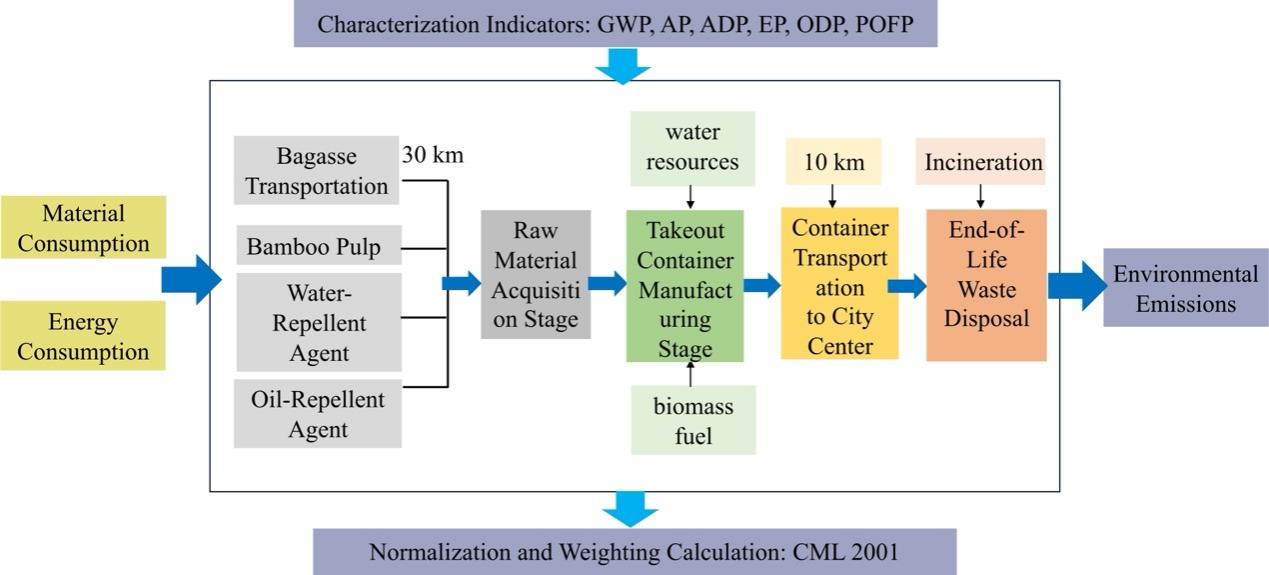
With growing global concerns over climate change, resource depletion, and environmental degradation, the packaging industry is under increasing pressure to shift toward low-carbon and sustainable alternatives. This study applies a Life Cycle Assessment (LCA) framework to evaluate the environmental impacts of sugarcane bagasse-based takeout containers using a representative enterprise in Laibin, Guangxi, China—a major sugarcane production hub. The system boundary spans from raw material acquisition to end-of-life disposal. Six environmental impact categories—Global Warming Potential (GWP), Acidification Potential (AP), Eutrophication Potential (EP), Abiotic Depletion Potential (ADP), Ozone Depletion Potential (ODP), and Photochemical Ozone Formation Potential (POFP)—were assessed using the CML 2001 method and compared with plastic, starch, and composite starch containers. The results show that bagasse containers significantly outperform conventional materials, especially in GWP and ADP, reducing total environmental burden by over 70%. Sensitivity analysis identifies bamboo pulp input, additives, and boiler fuel as key contributors. Optimization strategies include adopting cleaner pulping technologies, using green additives, and improving low-carbon logistics. The integrated “sugar mill-pulp mill-container factory” model in Laibin demonstrates high replicability in other agricultural regions of southern China and Southeast Asia. This study provides theoretical insights for promoting biomass packaging as part of the circular economy and sustainable material innovation.
Article Details

This work is licensed under a Creative Commons Attribution-NonCommercial 4.0 International License.
Published articles are under the copyright of the Environment and Natural Resources Journal effective when the article is accepted for publication thus granting Environment and Natural Resources Journal all rights for the work so that both parties may be protected from the consequences of unauthorized use. Partially or totally publication of an article elsewhere is possible only after the consent from the editors.
References
Arfelli F, Roguszewska M, Torta G, Iurlo M, Cespi D, Ciacci L, et al. Environmental impacts of food packaging: Is it all a matter of raw materials? Sustainable Production and Consumption 2024;49:318-28.
Barasa Kabeyi M, Olanrewaju O. Sugarcane bagasse and cane trash as a fuel. In: Proceedings of the 4th Asia Pacific International Conference on Industrial Engineering and Operations Management. Ho Chi Minh City, Vietnam: IEOM Society International; 2023.
Cruz RMS, Krauter V, Krauter S, Agriopoulou S, Weinrich R, Herbes C, et al. Bioplastics for food packaging: Environmental impact, trends and regulatory aspects. Foods 2022; 11(19):Article No. 3087.
Debnath M, Sarder R, Pal L, Hubbe MA. Molded pulp products for sustainable packaging: Production rate challenges and product opportunities. BioResources 2022;17(2):3810-70.
El Haouat Z, Essalih S, Bennouna F, Amegouz D. Development of a global framework for an integrated life cycle assessment (LCA) model in quality, safety and environmental (QSE) management systems: Improving environmental, social and economic sustainability performance. Sustainability 2025; 17(8):Article No. 3521.
Fan M, Bussracumpakorn C. The influence path of industry collaboration network and policy support on the optimization of sugarcane bagasse packaging value chain: An empirical study based on structural equation modeling. International Journal of Sustainable Development and Planning 2025;20(6):2409-24.
Fürst K, Feng Y. China’s regulatory respond to plastic pollution: Trends and trajectories. Frontiers in Marine Science 2022;9:Article No. 982546.
Grand View Research. Biodegradable Tableware Market (2024-2030). San Francisco (CA): Grand View Research, Inc.; 2024.
Hauschild M, Rosenbaum R, Olsen S. Life Cycle Assessment: Theory and Practice. Cham: Springer; 2018.
Heijungs R, Huijbregts M. A review of approaches to treat uncertainty in LCA. In: Proceedings of the 2nd International Congress on Environmental Modelling and Software; 2004 June 14-17; University of Osnabrück, Germany: 2004.
Hossam Y, Fahim IS. Towards a circular economy: Fabrication and characterization of biodegradable plates from sugarcane waste. Frontiers in Sustainable Food Systems 2023;7:Article No. 1220324
Janika AS, Afrrin M, Rahul R, Thirumoorthy S, Karthik P. Valorization of sugarcane bagasse in food packaging. In: Agro-wastes for Packaging Applications. 1st ed. Boca Raton: CRC Press; 2024.
Liu C, Luan P, Li Q, Cheng Z, Sun X, Cao D, et al. Biodegradable, hygienic, and compostable tableware from hybrid sugarcane and bamboo fibers as plastic alternative. Matter 2020;3(6):2066-79.
Liu J, Zheng L. Structure characteristics and development sustainability of municipal solid waste treatment in China. Ecological Indicators 2023;152:Article No. 110391.
Lu P, Zhou Y, Liu Q, Guan A, Yang Z. A high resolution gridded dataset for takeaway packaging waste in China. Scientific Data 2025;12(1):Article No. 600.
Pizzol M, Laurent A, Sala S, Weidema B, Verones F, Koffler C. Normalisation and weighting in life cycle assessment: Quo vadis? International Journal of Life Cycle Assessment 2017;22(6):853-66.
Semple KE, Zhou C, Rojas OJ, Nkeuwa WN, Dai C. Moulded pulp fibers for disposable food packaging: A state-of-the-art review. Food Packaging and Shelf Life 2022;33:Article No. 100908.
Singh RV, Sharma P, Sambyal K. Application of sugarcane bagasse in chemicals and food packaging industry: Potential and challenges. Circular Economy and Sustainability 2022;2(4):1479-500.
Stroescu M, Marc AR, Mureșan CC. A comprehensive review on sugarcane bagasse in food packaging: Properties, applications, and future prospects. Hop and Medicinal Plants 2024;32(1-2):169-84.
Thongsomboon W, Baimark Y, Srihanam P. Valorization of cellulose-based materials from agricultural waste: Comparison between sugarcane bagasse and rice straw. Polymers 2023;15(15):Article No. 3190.
Varghese SA, Pulikkalparambil H, Promhuad K, Srisa A, Laorenza Y, Jarupan L, et al. Renovation of agro-waste for sustainable food packaging: A review. Polymers 2023; 15(3):Article No. 648.
Zhang Y, Wen Z. Mapping the environmental impacts and policy effectiveness of takeaway food industry in China. Science of the Total Environment 2022;808:Article No. 152023.
