Selective Adsorption of Cationic Dyes by Hydrochar Derived from Spirogyra sp. Algae via Temperature-Varying Hydrothermal Carbonization 10.32526/ennrj/23/20250138
Article Sidebar
Main Article Content
Abstract
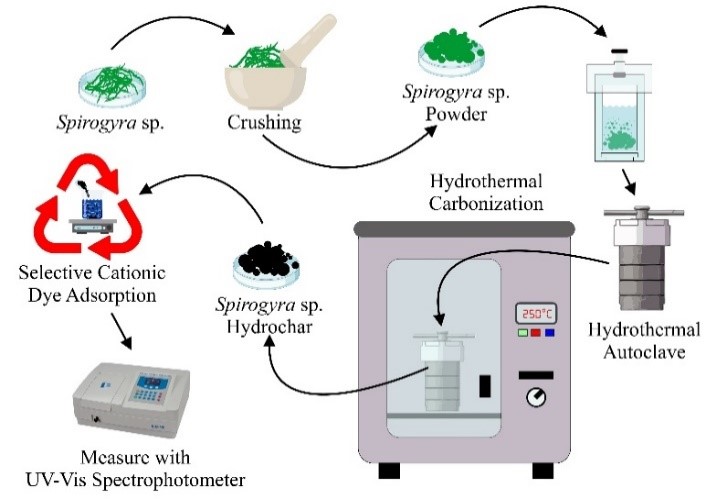
This study synthesized hydrochar adsorbents at varying temperatures 150°C (HC150) and 250°C (HC250), using the hydrothermal carbonization (HTC) method from Spirogyra sp. (SPG) and characterized them using XRD, FTIR, SEM, and BET analyze. XRD results confirmed a dominant CaCO₃ phase (JCPDS 01-086-2334) in all samples, with new peaks and shifts in HC150 and HC250 indicating structural changes from hydrochar formation. FTIR spectra revealed functional groups such as O-H, C=O, C-O, and C-N-S in SPG, with notable reductions in O-H and phenolic signals in HC150 and HC250, suggesting chemical transformations. SEM analysis revealed that SPG exhibits a smooth, sheet-like morphology, while HC150 formed uniform particles and HC250 developed a rough, porous surface, indicating increased carbonization, surface heterogeneity, and enhanced adsorption potential. BET analysis showed a marked increase in surface area and a transition from macroporous to mesoporous structures in HC150 and HC250, enhancing their adsorption capabilities. Adsorbents exhibited selective adsorption toward methylene blue (MB). Surface charge analysis revealed similar pHpzc values slightly below neutral, promoting favorable electrostatic interactions with cationic MB. Adsorption followed pseudo second order (PSO) kinetics compared to pseudo first order (PFO), indicating chemisorption, while isotherm modeling highlighted HC250 strong fit to the Freundlich model. Thermodynamic assessments confirmed HC250 superior performance, exhibiting more negative ∆G, lower ∆H, and higher ∆S values, signifying spontaneous, energy-efficient, and affinity-driven adsorption. Regeneration tests further underscored HC250 stability, with removal efficiency maintaining above 50% after four cycles (90.14% to 53.55%). In comparison, HC150 showed good reusability (80.56% to 51.88%), while SPG declined significantly (56.23% to 50.20%) after two cycles.
Article Details

This work is licensed under a Creative Commons Attribution-NonCommercial 4.0 International License.
Published articles are under the copyright of the Environment and Natural Resources Journal effective when the article is accepted for publication thus granting Environment and Natural Resources Journal all rights for the work so that both parties may be protected from the consequences of unauthorized use. Partially or totally publication of an article elsewhere is possible only after the consent from the editors.
References
Ahmad N, Kameda T, Rahman MT, Rahman F, Lesbani A. Preparation of a new hybrid MgAlLDH@Magnetite activated charcoal by hydrothermal method for stability and adsorption mechanism of congo red. Results in Surfaces and Interfaces 2025;18:Article No. 100440.
Al-Ghouti MA, Da’ana DA. Guidelines for the use and interpretation of adsorption isotherm models: A review. Journal of Hazardous Materials 2020;393:Article No. 122383.
Arora N, Tripathi S, Bhatnagar P, Gururani P, Philippidis GP, Kumar V, et al. Algal-based biochar and hydrochar: A holistic and sustainable approach to wastewater treatment. Chemical Engineering Journal 2024;496:Article No. 53953.
Ayawei N, Ebelegi AN, Wankasi D. Modelling and interpretation of adsorption isotherms. Journal of Chemistry 2017;1:Article No. 3039817.
Badaruddin M, Hanum L, Melwita E, Wibiyan S, Lesbani A. Hydrothermal сarbonization of Spirogyra sp. algae for adsorption and regeneration of malachite green dye. Chimica Techno Acta 2025;12(1):Article No. 12113
Chand V, Vanavana I. Evaluation of Spirogyra Sp. as a bioindicator of heavymetal pollution in a tropical aquatic environment. Pollution Research 2022;41(2):445-50.
Cui C, Qiao W, Li D, Wang L-J. Dual cross-linked magnetic gelatin/carboxymethyl cellulose cryogels for enhanced Congo red adsorption: Experimental studies and machine learning modelling. Journal of Colloid and Interface Science 2025;678:619-35.
Djezzar Z, Aidi A, Rehali H, Ziad S, Othmane T. Characterization of activated carbon produced from the green algae Spirogyra used as a cost-effective adsorbent for enhanced removal of copper(ii): Application in industrial wastewater treatment. RSC Advances 2024;14(8):5276-89.
Doondani P, Panda D, Gomase V, Peta KR, Jugade R. Novel chitosan-ZnO nanocomposites derived from Nymphaeaceae fronds for highly efficient removal of Reactive Blue 19, Reactive Orange 16, and Congo Red dyes. Environmental Research 2024;247:Article No. 118228.
Elhassan M, Kooh MRR, Chou Chau YF, Abdullah R. Hydrochar from Shorea spp.: A dual-purpose approach for sustainable biofuel and efficient methylene blue adsorbent. Biomass Conversion and Biorefinery 2025;15(4):5779-93.
Eltaweil AS, Ali Mohamed H, Abd El-Monaem EM, El-Subruiti GM. Mesoporous magnetic biochar composite for enhanced adsorption of malachite green dye: Characterization, adsorption kinetics, thermodynamics and isotherms. Advanced Powder Technology 2020;31(3):1253-63.
Ganash A, Othman S, Al-Moubaraki A, Ganash E. An electrodeposition of Cu-MOF on platinum electrode for efficient electrochemical degradation of tartrazine dye with parameter control and degradation mechanisms: Experimental and theoretical findings. Applied Surface Science Advances 2024;19:Article No. 100577.
Gibson N, Kuchenbecker P, Rasmussen K, Hodoroaba VD, Rauscher H. Chapter 4.1 - Volume-specific surface area by gas adsorption analysis with the BET method. In: Characterization of Nanoparticles: Measurement Processes for Nanoparticles. Elsevier; 2019. p. 265-94.
González-Fernández LA, Medellín-Castillo NA, Navarro-Frómeta AE, Castillo-Ramos V, Sánchez-Polo M, Carrasco-Marín F. Optimization of hydrochar synthesis conditions for enhanced Cd(II) and Pb(II) adsorption in mono and multimetallic systems. Environmental Research 2024;261:Article No. 119651.
Hamad N, Galhoum AA, Saad A, Wageh S. Efficient adsorption of cationic and anionic dyes using hydrochar nanoparticles prepared from orange peel. Journal of Molecular Liquids 2024;409:Article No. 125349.
Jefri J, Fithri NA, Ramadhan N. Enhanced selectivity of Ni/Al LDH for cationic dye adsorption via Gambier Leaf Extract Modification. Indonesian Journal of Material Research 2025;3(1):1-7.
Kala K, Vasumathi V, Sivalingam S, Kapali BSC. Optimization of organic dyes photodegradation and investigation of the anticancer performance by copper oxide/graphene oxide nanocomposite. Surfaces and Interfaces 2024;50:Article No. 104482.
Karadeniz F, Güzel F. Adsorptive performance of Melia azedarach fruit-derived biochar in removing methylene blue, diclofenac, and copper(II) from aqueous solution. Biomass Conversion and Biorefinery 2023;13(3):2429-47.
Khan I, Saeed K, Zekker I, Zhang B, Hendi AH, Ahmad A, et al. Review on methylene blue: Its properties, uses, toxicity and photodegradation. Water (Switzerland) 2022;14(2):Article No. 242.
Krishna Murthy TP, Gowrishankar BS, Krishna RH, Chandraprabha MN, Mathew BB. Magnetic modification of coffee husk hydrochar for adsorptive removal of methylene blue: Isotherms, kinetics and thermodynamic studies. Environmental Chemistry and Ecotoxicology 2020;2:205-12.
Kumar A, Singh R, Upadhyay SK, Sanjay Kumar S, Charaya MU. Biosorption: The removal of toxic dyes from industrial effluent using phytobiomass: A review. Plant Archives 2021;21(Supplement 1): 1320-5.
Laggoun Z, Khalfaoui A, Derbal K, Ghomrani AF, Benalia A, Pizzi A. Experimental study of selective batch bio-adsorption for the removal of dyes in industrial textile effluents. Journal of Renewable Materials 2025;13(1):127-46.
Le TTU, Ngo TG, Hoang NA, Nguyen VH, Nguyen VD, Hoang LP, et al. Adsorption characteristics of single and binary mixture of methylene blue and rhodamine B of novel hydrochar derived from lemongrass essential oil distillation residue. Journal of Molecular Liquids 2025;425:Article No. 127205.
Lesbani A, Ahmad N, Mohadi R, Royani I, Wibiyan S, Amri, et al. Selective adsorption of cationic dyes by layered double hydroxide with assist algae (Spirulina platensis) to enrich functional groups. JCIS Open 2024;15:Article No. 100118.
Li C, Zhong F, Liang X, Xu W, Yuan Q, Niu W, et al. Microwave-assisted hydrothermal conversion of crop straw: Enhancing the properties of liquid product and hydrochar by varying temperature and medium. Energy Conversion and Management 2023;290:Article No. 117192.
Li W, Tao E, Hao X, Li N, Li Y, Yang S. MMT and ZrO2 jointly regulate the pore size of graphene oxide-based composite aerogel materials to improve the selective removal ability of Cu(II). Separation and Purification Technology 2024; 331:Article No. 125506.
Lu YC, Kooh MRR, Lim LBL, Priyantha N. Effective and simple NaOH-modification method to remove methyl violet dye via Ipomoea aquatica Roots. Adsorption Science and Technology 2021;2021:Article No. 5932222.
Luo M, Wang L, Li H, Bu Y, Zhao Y, Cai J. Hierarchical porous biochar from kelp: Insight into self-template effect and highly efficient removal of methylene blue from water. Bioresource Technology 2023;372:Article No. 128676.
Mohadi R, Ahmad N, Wibiyan S, Zahara ZA, Fitri ES, Mardiyanto, et al. Synthesis of Zn/Al-ZnO composite using Zn/Al-layered double hydroxide for oxidative desulfurization of 4-methyldibenzothiophene. Science and Technology Indonesia 2023;8(4):701-9.
Mohadi R, Palapa NR, Wibiyan S, Mardiyanto, Rohmatullaili, Fitri ES, et al. Catalytic oxidative desulfurization of 4-methyldibenzothiophene by Ni/Al modified titanium dioxide and zinc oxide. Science and Technology Indonesia 2023;8(3):414-21.
Mon PP, Cho PP, Chandana L, Srikanth VVSS, Madras G, Ch S. Biowaste-derived Ni/NiO decorated-2D biochar for adsorption of methyl orange. Journal of Environmental Management 2023;344:Article No. 118418.
Morgan HM, Jiang TJ, Tsai WT, Yen TB. Initial physiochemical characterization of Djulis (Chenopodium formosanum) spent mushroom substrate biochar and its application for methylene blue dye adsorption, isotherm, kinetics, and parameters. Biomass Conversion and Biorefinery 2025;15:19947-61.
Neme I, Gonfa G, Masi C. Activated carbon from biomass precursors using phosphoric acid: A review. Heliyon 2022;8(12):e11940.
Normah N, Juleanti N, Palapa NR, Taher T, Siregar PMSBN, Wijaya A, et al. Hydrothermal carbonization of rambutan peel (Nephelium lappaceum L.) as a green and low-cost adsorbent for Fe(II) removal from aqueous solutions. Chemistry and Ecology 2022;38(3):284-300.
Normah N, Juleanti N, Siregar PMSBN, Wijaya A, Palapa NR, Taher T, et al. Size selectivity of anionic and cationic dyes using LDH modified adsorbent with low-cost rambutan peel to hydrochar. Bulletin of Chemical Reaction Engineering and Catalysis 2021;16(4):869-80.
Norrahma SSA, Hamid NHA, Hairom NHH, Jasmani L, Sidik DAB. Industrial textile wastewater treatment using Neolamarckia cadamba NFC filter paper via cross-flow filtration system. Journal of Water Process Engineering 2023;55:Article No. 104188.
Palapa NR, Putra MBK, Musifa E, Yuliasari N, Adawiyah R. Preparation and application of biochar from Areca catechu L. peel for malachite green and reactive blue dyes removal. Indonesian Journal of Environmental Management and Sustainability 2025;9(1):28-35.
Palapa NR, Wijaya A, Ahmad N, Amri A, Mohadi R, Lesbani A. Activated hydrochar prepared from Longan Fruit (Dimocarpus longan Lour.) peel via hydrothermal carbonization-NaOH activation for cationic dyes removal. Science and Technology Indonesia 2023;8(3):461-70.
Permann C, Gierlinger N, Holzinger A. Zygospores of the green alga Spirogyra: New insights from structural and chemical imaging. Frontiers in Plant Science 2022;13:Article No. 1080111.
Priatna SJ, Hakim YM, Wibyan S, Sailah S, Mohadi R. Interlayer modification of west java natural bentonite as hazardous dye rhodamine B adsorption. Science and Technology Indonesia 2023;8(2):160-9.
Ren Y, Liu S, Tan Y, Liu Y, Yuan T, Shen Z, et al. Application of QSAR for investigation on coagulation mechanisms of textile wastewater. Ecotoxicology and Environmental Safety 2022;244:Article No. 114035.
Saini R, Pandey M, Mishra RK, Kumar P. Adsorption potential of hydrochar derived from hydrothermal carbonization of waste biomass towards the removal of methylene blue dye from wastewater. Biomass Conversion and Biorefinery 2025;15(6):9229-49.
Shi Y, Chang Q, Zhang T, Song G, Sun Y, Ding G. A review on selective dye adsorption by different mechanisms. Journal of Environmental Chemical Engineering 2022;10(6)Article No. 108639.
Singh S, Verma N, Umar A, Kansal SK. ZnCdS nanoparticles decorated three-dimensional MoO3 polygonal structure: A novel photocatalyst for enhanced solar light-driven degradation of methyl orange dye. Journal of Alloys and Compounds 2024;997:Article No. 174714.
Siri-anusornsak W, Kolawole O, Soiklom S, Petchpoung K, Keawkim K, Chuaysrinule C, et al. Innovative use of Spirogyra sp. biomass for the sustainable adsorption of Aflatoxin B1 and Ochratoxin A in aqueous solutions. Molecules 2024;29(21):Article No. 5038.
Sornaly HH, Ahmed S, Titin KF, Islam MN, Parvin A, Islam MA, et al. The utility of bioremediation approach over physicochemical methods to detoxify dyes discharges from textile effluents: A comprehensive review study. Sustainable Chemistry and Pharmacy 2024;39:Article No. 101538.
Spagnuolo D, Iannazzo D, Len T, Balu AM, Morabito M, Genovese G, et al. Hydrochar from Sargassum muticum: A sustainable approach for high-capacity removal of Rhodamine B dye. RSC Sustainability 2023;1(6):1404-15.
Susanti E, Ristanti Widoretno M, Oktaviyani D, Sumi Lestari F, Muit N, Kurniawan R, et al. Sorption kinetics of heavy metals from aqueous solution using Spirogyra sp.: A microcosm study. LIMNOTEK Perairan Darat Tropis di Indonesia. 2023;29(1):Article No. 1190.
Tipnee S, Unpaprom Y, Ramaraj R, Tipnee S, Ramaraj R, Unpaprom Y. Nutritional evaluation of edible freshwater green macroalga Spirogyra varians. Emerging Topics in Life Sciences 2015;1(2):1-7.
Tones ARM, Eyng E, Zeferino CL, Ferreira S de O, Alves AA de A, Fagundes-Klen MR, et al. Spectral deconvolution associated to the Gaussian fit as a tool for the optimization of photovoltaic electrocoagulation applied in the treatment of textile dyes. Science of the Total Environment 2020;713:Article No. 136301.
Tsarpali M, Kuhn JN, Philippidis GP. Hydrothermal carbonization of residual algal biomass for production of hydrochar as a biobased metal adsorbent. Sustainability (Switzerland) 2022;14(1):Article No. 455.
Ullah F, Ji G, Irfan M, Gao Y, Shafiq F, Sun Y, et al. Adsorption performance and mechanism of cationic and anionic dyes by KOH activated biochar derived from medical waste pyrolysis. Environmental Pollution 2022;314:Article No. 120271.
Umesh AS, Puttaiahgowda YM, Thottathil S. Enhanced adsorption: Reviewing the potential of reinforcing polymers and hydrogels with nanomaterials for methylene blue dye removal. Surfaces and Interfaces 2024;51:Article No. 104670.
Vetrivel SA, Diptanghu M, Ebhin MR, Sydavalli S, Gaurav N, Tiger KP. Green algae of the genus Spirogyra: A potential absorbent for heavy metal from coal mine water. Remediation 2017;27(3):81-90.
Wang H, Chen C, Dai K, Xiang H, Kou J, Guo H, et al. Selective adsorption of anionic dyes by a macropore magnetic lignin-chitosan adsorbent. International Journal of Biological Macromolecules 2024;269(2):Article No. 131955.
Wibiyan S, Royani I, Ahmad N, Lesbani A. Assessing the efficiency, selectivity, and reusability of ZnAl-layered double hydroxide and Eucheuma cottonii composite in removing anionic dyes from wastewater. Inorganic Chemistry Communications 2024a;170:Article No. 113347.
Wibiyan S, Royani I, Lesbani A. Selective adsorption of cationic and anionic dyes using Ni/Al layered double hydroxide modified with Eucheuma cottonii. Indonesian Journal of Material Research 2024b;2(1):1-6.
Wibiyan S, Royani I, Lesbani A. Synthesis and performance of ZnAl@ layered double hydroxide composites with Eucheuma cottonii for adsorption and regeneration of Congo red dye. Indonesian Journal of Environmental Management and Sustainability 2024c;8(3):126-34.
Wibiyan S, Wijaya A, Siregar PMSBN. Adsorption of phenol using cellulose and hydrochar: Kinetic, isotherm, and regeneration studies. Indonesian Journal of Material Research 2023;1(2):61-7.
Wibowo YG, Syahnur MT, Al-Azizah PS, Arantha Gintha D, Lululangi BRG, Sudibyo. Phytoremediation of high concentration of ionic dyes using aquatic plant (Lemna minor): A potential eco-friendly solution for wastewater treatment. Environmental Nanotechnology, Monitoring and Management 2023;20:Article No. 100849.
Wierzbicka E, Kuśmierek K, Świątkowski A, Legocka I. Efficient rhodamine B dye removal from water by acid- and organo-modified halloysites. Minerals 2022;12(3):Article No. 350.
Wijaya A, Ahmad N, Hanum L, Melwita E, Lesbani A. Spirogyra sp. macro-algae-supported NiCr-LDH adsorbent for enhanced remazol red dye removal. Results in Surfaces and Interfaces 2025;18:Article No. 100427.
Wu J, Wang T, Li S, Tang W, Yu S, Zhao Z, et al. A green method to improve adsorption capacity of hydrochar by ball-milling: Enhanced norfloxacin adsorption performance and mechanistic insight. Carbon Research 2024;3(1):Article No. 60.
Yihunu EW, Minale M, Abebe S, Limin M. Preparation, characterization and cost analysis of activated biochar and hydrochar derived from agricultural waste: A comparative study. SN Applied Sciences 2019;1(8):Article No. 873.
Zhao Y, Qi K, Pan J. Efficient corn straw and poplar leaf biochar-based adsorbents for the eradication of methylene blue from aqueous solutions. Desalination and Water Treatment 2023;303:236-44.
