Differential Protein and Morphological Responses of Mosses to Heavy Metal Exposure: Insights from SDS-PAGE Analysis and Microscopic Examination 10.32526/ennrj/24/20250190
Article Sidebar
Main Article Content
Abstract
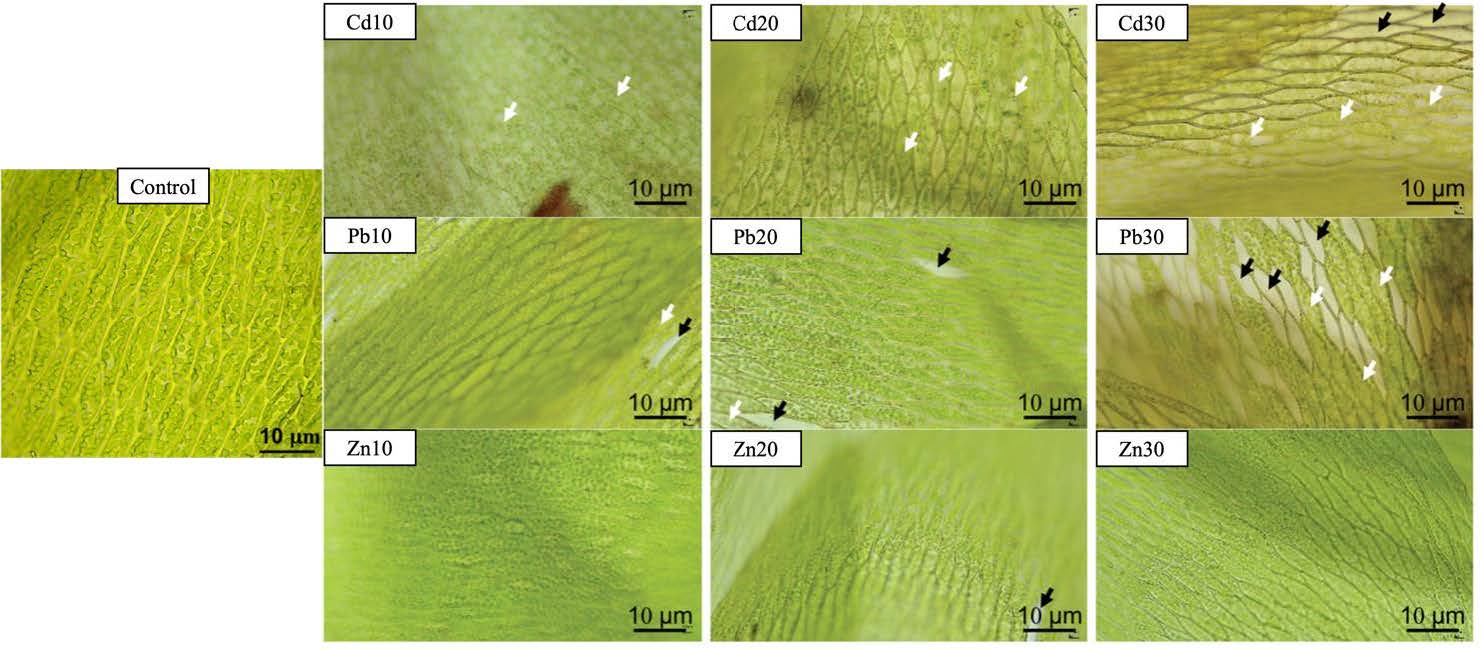
Heavy-metal pollution poses significant risks to ecosystems and human health. We evaluated acute proteomic and cytological responses of two mosses, Ectropothecium dealbatum and Hyophila involuta, to cadmium (Cd), lead (Pb), and zinc (Zn). Gametophores were immersed for 72 h to single-metal solutions (10, 20, or 30 mg/L; controls in distilled water), ensuring observed effects reflected single-metal toxicity. Protein profiles were resolved by SDS-PAGE, and light microscopy quantified chloroplasts per lamina cell and the proportion of dead cells. Cd elicited the strongest responses in both species, with intensified high-molecular-weight bands (~90, ~100, ~121 kDa) and pronounced cytological injury; Pb produced qualitatively similar but weaker changes. In contrast, Zn primarily modulated band intensity without generating new bands and caused limited injury at the tested doses. Concordant shifts across methods—reduced chloroplast counts and elevated lamina cell death co-occurring with Cd/Pb-associated bands—support a molecular–physiological linkage of acute metal stress. However, these high-molecular-weight bands (including the ~121 kDa signal) are size-based, putative markers only; independent identification (e.g., LC-MS/MS or immunodetection) and functional validation are still required. Within this 72-h window and concentration range, sensitivity followed Cd > Pb ≫ Zn. The findings nominate candidate proteins for rapid discrimination of damaging (Cd, Pb) versus comparatively tolerated (Zn) exposures and motivate targeted protein identification plus longer, field-calibrated studies to establish biomonitoring thresholds.
Article Details

This work is licensed under a Creative Commons Attribution-NonCommercial 4.0 International License.
Published articles are under the copyright of the Environment and Natural Resources Journal effective when the article is accepted for publication thus granting Environment and Natural Resources Journal all rights for the work so that both parties may be protected from the consequences of unauthorized use. Partially or totally publication of an article elsewhere is possible only after the consent from the editors.
References
Akram MW, Sajid M, Ahmad A, Waqar M, Kusar S, Iqbal A, et al. Effect of foliar spray of ascorbic acid on nodulation, gas exchange attributes and mineral ion contents of Pisum sativum under zinc stress. Plant Protection 2022;6(2):101-11.
Barbara C, Braglia R, Basile A, Cobianchi RC, Forni C. Proteomics and bryophytes: A comparison between different methods of protein extraction to study protein synthesis in the aquatic moss Leptodictyum riparium (Hedw.). Caryologia 2007;60(1-2):102-5.
Basile A, di Nuzzo RA, Capasso C, Sorbo S, Capasso A, Carginale V. Effect of cadmium on gene expression in the liverwort Lunularia cruciata. Gene 2005;356:153-9.
Basile A, Sorbo S, Conte B, Cardi M, Esposito S. Ultrastructural changes and Heat Shock Proteins 70 induced by atmospheric pollution are similar to the effects observed under in vitro heavy metals stress in Conocephalum conicum (Marchantiales-Bryophyta). Environmental Pollution 2013; 182:209-16.
Bellini E, Betti C, Sanità di Toppi L. Responses to cadmium in early-diverging Streptophytes (Charophytes and Bryophytes): Current views and potential applications. Plants 2021; 10(4):Article No. 770.
Bradford MM. A rapid and sensitive method for the quantitation of microgram quantities of protein using the principle of protein dye binding. Analytical Biochemistry 1976;72(1-2):248-54.
Cârdei P, Tudora C, Vlăduț V, Pruteanu MA, Găgeanu I, Cujbescu D, et al. Mathematical model to simulate the transfer of heavy metals from soil to plant. Sustainability 2021;13(11):Article No. 6157.
Chaudhuri S, Roy M. Global ambient air quality monitoring: Can mosses help? A systematic meta-analysis of literature about passive moss biomonitoring. Environment, Development and Sustainability 2024;26:5735-73.
Dang K, Mu J, Tian H, Gao D, Zhou H, Guo L, et al. Zinc regulation of chlorophyll fluorescence and carbohydrate metabolism in saline-sodic stressed rice seedlings. BMC Plant Biology 2024;24(1):Article No. 464.
Eddy A. A Handbook of Malesian Mosses. Vol. 2 Leucobryaceae to Buxbaumiacea. London, UK: Natural History Museum Publications; 1991.
Elliott DD, Velasquez PM. Non-vascular plants [Internet]. 2024 [cited 2024 July 23]. Available from: https://bio.libretexts.org/Bookshelves/Botany/Botany_in_Hawaii_(Daniela_Dutra_Elliott_and_Paula_Mejia_Velasquez)/06%3A_Plant_evolution_and_non-vascular_plants/6.03%3A_ Non-vascular_plants.
Esposito S, Cobianchi RC, Sorbo S, Conte B, Basile B. Ultrastructural alterations and HSP70 induction in Elodea canadensis Michx. exposed to heavy metals. Caryologia 2007;60(1-2):115-20.
Esposito S, Sorbo S, Conte B, Basile A. Effects of heavy metals on ultra- structure and HSP70s induction in the aquatic moss Leptodictyum riparium Hedw. International Journal of Phytoremediation 2012;14(4):1-13.
Gallo V, Serianni VM, Imperiale D, Zappettini A, Villani M, Marmiroli M, et al. Protein analysis of A. halleri and N. caerulescens hyperaccumulators when exposed to nano and ionic forms of Cd and Zn. Nanomaterials 2022;12(23):Article No. 4236.
Kuziemska B, Klej P, Wysokiński A, Jaremko D, Pakuła K. Yielding and bioaccumulation of zinc by cocksfoot under conditions of different doses of this metal and organic fertilization. Agronomy 2022;12(3):Article No. 686.
Laemmli UK. Cleavage of structural proteins during the assembly of the head of bacteriophage T4. Nature 1970;227:680-5.
Leon-Mediavilla J, Senovilla M, Montiel J, Gil-Diez P, Saez A, Kryvoruchko IS, et al. MtMTP2-facilitated zinc transport into intracellular compartments is essential for nodule development in Medicago truncatula. Frontiers in Plant Science 2018;9:Article No. 990.
Li GK, Gao J, Peng H, Shen Y, Ding H, Zhang ZM, et al. Proteomic changes in maize as a response to heavy metal (lead) stress revealed by iTRAQ quantitative proteomics. Genetics and Molecular Research 2016;15(1):1-14.
Mlecnik B, Scheideler M, Hackl H, Hartler J, Sánchez-Cabo F, Trajanoski Z. PathwayExplorer: web service for visualizing high-throughput expression data on biological pathways. Nucleic Acids Research 2005;33:633-7.
Nayar G, Altman R. Heterogeneous network approaches to protein pathway prediction. Compuational and Structural Biotechnology Journal 2024;23:2727-39.
Oishi Y, Hiura T. Bryophytes as bioindicators of the atmospheric environment in urban-forest landscapes. Landscape and Urban Planning 2017;167:348-55.
Parrish J, Yu J, Liu G, Hines J, Chan J, Mangiola B, et al. A proteome-wide protein interaction map for Campylobacter jejuni. Genome Biology 2007;8:Article No. R130.
Phaenark C, Niamsuthi A, Paejaroen P, Chunchob S, Cronberg N, Sawangproh W. Comparative toxicity of heavy metals Cd, Zn, and Pb to three acrocarpous moss species using chlorophyll contents. Trends in Sciences 2022;20(2):Article No. 4287.
Phaenark C, Seechanhoi P, Sawangproh W. Metal toxicity in Bryum coronatum Schwaegrichen: Impact on chlorophyll content, lamina cell structure, and metal accumulation. International Journal of Phytoremediation 2024;26(8):1336-47.
Printarakul N, Meeinkuirt W. The bryophyte community as bioindicator of heavy metals in a waterfall outflow. Scientific Reports 2022;12(1):Article No. 6942.
Rachna P, Vashistha BD. Effects of heavy metals on protonemal growth and bud formation in the moss Hydrogonium arcuatum. Agricultural Science Digest 2017;37(2):117-21.
Rehman K, Ashraf S, Rashid U, Ibrahim M, Hina S, Iftikhar T, et al. Comparison of proximate and heavy metal contents of vegetables grown with fresh and wastewater. Pakistan Journal of Botany 2013;45(2):391-400.
Rizvi A, Ahmed B, Khan MS, Rajput VD, Umar S, Minkina T, et al. Maize associated bacterial microbiome linked mitigation of heavy metal stress: A multidimensional detoxification approach. Environmental and Experimental Botany 2022; 200:Article No. 104911.
Sardar R, Zulfiqar A, Ahmed S, Shah AA, Iqbal RK, Hussain S, et al. Proteomic changes in various plant tissues associated with chromium stress in sunflower. Saudi Journal of Biological Sciences 2022;29(4):2604-12.
Shafiq S, Zeb Q, Ali A, Sajjad Y, Nazir R, Widemann E, et al. Lead, cadmium and znc phytotoxicity alter DNA methylation levels to confer heavy metal tolerance in wheat. International Journal of Molecular Sciences 2019;20(19):Article No. 4676.
Shaheen S, Majeed Z, Mahmood Q. The assessment of metal resistance through the expression of hsp-70 and ho-1 proteins in giant reed. International Journal of Plant Biology 2023;14(3):687-700.
Shlomi T, Segal D, Ruppin E, Sharan R. QPath: A method for querying pathways in a protein-protein interaction network. BMC Bioinformatics 2006;7:Article No. 199.
Shukla SR, Rao RV, Sharma SK, Kumar P, Sudheendra R, Shashikala S. Physical and mechanical properties of plantation-grown Acacia auriculiformis of three different ages. Australian Forestry 2007;70(2):86-92.
Sorrentino MC, Capozzi F, Giordano S, Spagnuolo V. Genotoxic effect of Pb and Cd on in vitro cultures of Sphagnum palustre: An evaluation by ISSR markers. Chemosphere 2017;181: 208-15.
Stanković J, Sabovljević A, Sabovljević MS. Bryophytes and heavy metals: A review. Acta Botanica Croatica 2018; 77(2):109-18.
Suman J, Uhlik O, Viktorova J, Macek T. Phytoextraction of heavy metals: A promising tool for clean-up of polluted environment? Frontiers in Plant Science 2018;9:Article No. 1476.
Sun S-Q, He M, Cao T, Zhang Y-C, Han W. Response mechanisms of antioxidants in Bryophyte (Hypnum plumaeforme) under the stress of single or combined Pb and/or Ni. Environmental Monitoring and Assessment 2009;149(1-4):291-302.
Sun SQ, He M, Wang GX, Cao T.Heavy metal‐induced physiological alterations and oxidative stress in the moss Brachythecium piligerum chad. Environmental Toxicology 2011;26(5):453-8.
Świsłowski P, Nowak A, Rajfur M. The influence of environmental conditions on the lifespan of mosses under long-term active biomonitoring. Atmospheric Pollution Research 2021;12(10):Article No. 101203.
Tremper AH, Agneta M, Burton S, Higgs DEB. Field and laboratory exposures of two moss species to low level metal pollution. Journal of Atmospheric Chemistry 2004;49:111-20.
Usman K, Souchelnytskyi S, Zouari N, Abu-Dieyeh MH. Proteomic analysis of T. qataranse exposed to lead (Pb) stress reveal new proteins with potential roles in Pb tolerance and detoxification mechanism. Frontiers in Plant Science 2022;13:Article No. 1009756.
Vijayarengan P, Mahalakshmi G. Zinc toxicity in tomato plants. World Applied Sciences Journal 2013;24(5):649-53.
Wei C, Jiao Q, Agathokleous E, Liu H, Li G, Zhang J, et al. Hormetic effects of zinc on growth and antioxidant defense system of wheat plants. Science of the Total Environment 2022;807(Part 2):Article No. 150992.
Wuana RA, Okieimen FE. Heavy metals in contaminated soils: A review of sources, chemistry, risks and best available strategies for remediation. International Scholarly Research Notices 2011;2011(1):Article No. 402647.