The Phytoremediation Potential of Lemna minor L. on Heavy Metal Accumulation, Biochemical Responses, and Growth Tolerance 10.32526/ennrj/24/20250197
Article Sidebar
Main Article Content
Abstract
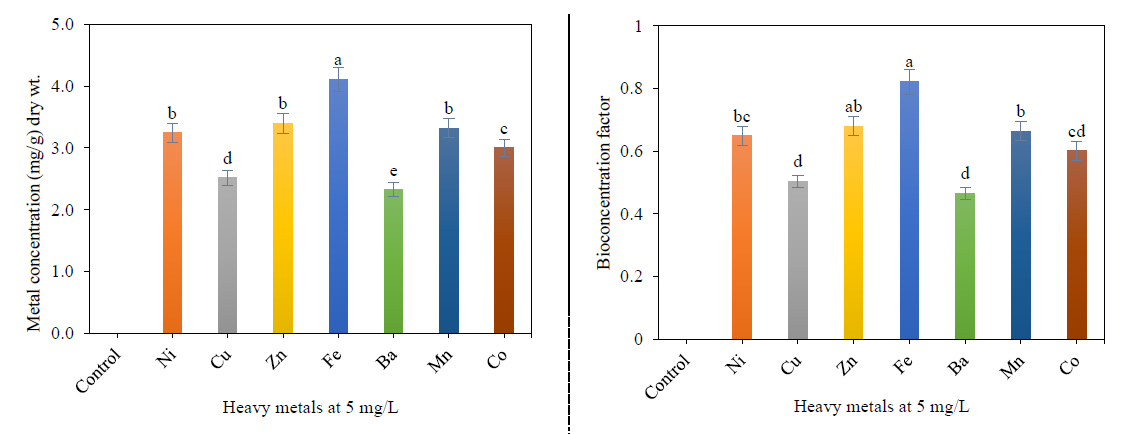
Duckweed (Lemna minor L.) is an efficient aquatic plant that accumulates heavy metals. This study aimed to investigate the ability of duckweed. To accumulate selected heavy metals (Ni, Cu, Zn, Fe, Ba, Mn, and Co) at 5 mg/L concentrations of each metal, and to study the effects of metals on plant growth and biochemical changes in the plant. This study was conducted for 14 days to control the environmental conditions. The accumulation of metal inside the plant tissue, bioconcentration factor (BCF), and relative growth rate (RGR) were measured at the end of the experiments, while plant fresh and dry weight, total chlorophyll, and protein and proline contents were measured at the beginning and end of the experiments. The results showed that the highest metal accumulation in plant tissue and BCF were 4.112 and 0.822, respectively, in the iron treatment, while the lowest values were 2.334 and 0.466, respectively, in the Ba treatment. The highest reduction in fresh weight and growth percentage was in the Ba treatment, the highest reduction in chlorophyll content was in the Ba treatment, and the lowest protein content was in the Cu treatment. Therefore, the results indicate that Duckweed can tolerate selected heavy metals and can be used in phytoremediation technology.
Article Details

This work is licensed under a Creative Commons Attribution-NonCommercial 4.0 International License.
Published articles are under the copyright of the Environment and Natural Resources Journal effective when the article is accepted for publication thus granting Environment and Natural Resources Journal all rights for the work so that both parties may be protected from the consequences of unauthorized use. Partially or totally publication of an article elsewhere is possible only after the consent from the editors.
References
Al-Abbawy DAH, Al-Thahaibawi BMH, Al-Mayaly IKA, Younis KH. Assessment of some heavy metals in various aquatic plants of Al-Hawizeh Marsh, southern of Iraq. Biodiversitas: Journal of Biological Diversity 2021;22(1):338-45.
Ali S, Abbas Z, Rizwan M, Zaheer IE, Yavaş İ, Ünay A, et al. Application of floating aquatic plants in phytoremediation of heavy metals-polluted water: A review. Sustainability 2020;12(5):Article No. 1927.
Al-Nabhan EAM, Al-Abbawy DAH. Improving wastewater treatment performance using ecological approaches. IOP Conference Series: Earth and Environmental Science 2021;910(1):Article No. 012086.
Al-Nabhan EAM. Removal efficiency, accumulation and biochemical response of Lemna minor L. exposed to some heavy metals. IOP Conference Series: Earth and Environmental Science 2022;1060(1):Article No. 012037.
Al-Nabhan EAM. Water hyssop as bioaccumulator for remediation of lead, nickel and iron. Marsh Bulletin 2023;18(1):26-37.
An M, Wang H, Fan H, Ippolito JA, Meng C, Yulian E, et al. Effects of modifiers on the growth, photosynthesis, and antioxidant enzymes of cotton under cadmium toxicity. Journal of Plant Growth Regulation 2019;38:1196-205.
Association of Official Analytical Chemists (AOAC). Official Methods of Analysis. 17th ed. Vol. 2. Gaithersburg (MD): Association of Official Analytical Chemists; 2000.
Arnon DI. Copper enzymes in isolated chloroplasts: polyphenoloxidase in Beta vulgaris. Plant Physiology 1949;24(1):1-15.
Aslanzadeh M, Saboora A, Moradlou O. Phytoremediation potential of duckweed (Lemna minor L.) for hexavalent chromium removal in synthetic wastewater: Unveiling physiological response and defense mechanisms against excessive heavy metal uptake. International Journal of Environmental Science and Technology 2024;21:10155-74.
Awa SH, Hadibarata T. Removal of heavy metals in contaminated soil by phytoremediation mechanism: A review. Water, Air, and Soil Pollution 2020;231(2):Article No. 47.
Azeez NM. Bioaccumulation and phytoremediation of some heavy metals (Mn, Cu, Zn, and Pb) by bladderwort and duckweed. Biodiversitas: Journal of Biological Diversity 2021; 22(5):3993-8.
Azeez NM, Al-Abbawy DAH, Al-Nabhan EAM. The use of annual beard grass in phytoremediation of petroleum-contaminated soils. Journal of Sustainability Science and Management 2023;18(8):87-97.
Aziz RA, Yiwen M, Saleh M, Salleh MN, Gopinath SC, Giap SGE, et al. Bioaccumulation and translocation of heavy metals in paddy (Oryza sativa L.) and soil in different land-use practices. Sustainability 2023;15(18):Article No. 13426.
Bianconi D, Pietrini F, Massacci A, Iannelli MA. Uptake of cadmium by Lemna minor, a hyperaccumulator plant involved in phytoremediation applications. E3S Web of Conferences 2013;1:Article No. 13002.
Bortoloti GA, Baron D. Phytoremediation of toxic heavy metals by Brassica plants: A biochemical and physiological approach. Environmental Advances 2022;8:Article No. 100204.
Bremner JM, Mulvaney CS. Nitrogen-total. In: Page AL, Miller RH, Keeney DR, editors. Methods of Soil Analysis. Part 2: Chemical and Microbiological Properties. Madison (WI): American Society of Agronomy and Soil Science Society of America; 1982. p. 595-624.
Du J, Guo Z, Li R, Ali A, Guo D, Lahori AH, et al. Screening of Chinese mustard (Brassica juncea L.) cultivars for the phytoremediation of Cd and Zn based on the plant physiological mechanisms. Environmental Pollution 2020;261:Article No. 114213.
Fei X, Lou Z, Xiao R, Ren Z, Lv X. Source analysis and source-oriented risk assessment of heavy metal pollution in agricultural soils of different cultivated land qualities. Journal of Cleaner Production 2022;341:Article No. 130942.
Garai P, Banerjee P, Mondal P, Saha NC. Effect of heavy metals on fishes: Toxicity and bioaccumulation. Journal of Clinical Toxicology 2021;11(S18):Article No. 001.
Goncharuk EA, Zagoskina NV. Heavy metals, their phytotoxicity, and the role of phenolic antioxidants in plant stress responses with focus on cadmium: Review. Molecules 2023;28(9): Article No. 3921.
Hu Z, Zhao C, Li Q, Feng Y, Zhang X, Lu Y, et al. Heavy metals can affect plant morphology and limit plant growth and photosynthesis processes. Agronomy 2023;13(10):Article No. 2601.
Islam MM, Saxena N, Sharma D. Phytoremediation as a green and sustainable prospective method for heavy metal contamination: A review. RSC Sustainability 2024;2:1269-88.
Jagetiya B, Kumar S. Phytoremediation of lead: A review. In: Fagan B, editor. Lead in Plants and the Environment. Cham: Springer International Publishing; 2020. p. 171-202.
Kapoor D, Singh MP, Kaur S, Bhardwaj R, Zheng B, Sharma A. Modulation of the functional components of growth, photosynthesis, and antioxidant stress markers in cadmium-exposed Brassica juncea L. Plants 2019;8(8):Article No. 260.
Khan TA, Ahmad A, Saeed T, Yusuf M, Faisal M, Alatar AA. Investigating the influence of selenium and epibrassinolide on antioxidant activity, proline accumulation, and protein expression profiles in wheat plants experiencing heat and drought stress. Frontiers in Plant Science 2024;15:Article No. 1441483.
Mobin F, Deloya JM, Guo L. The impact of citric acid on metal accumulation in Lemna minor. Water 2025;17(6):Article No. 830.
Neidoni DG, Nicorescu V, Andres L, Ihos M, Lehr CB. The capacity of Lemna minor L. to accumulate heavy metals (zinc, copper, nickel). Revista de Chimie 2018;69(11):3253-6.
Okwu DE, Josiah C. Evaluation of the chemical composition of two Nigerian medicinal plants. African Journal of Biotechnology 2006;5(4):357-61.
Regional Organization for the Protection of the Marine Environment (ROPME). Manual of Oceanographic Observation and Pollution Analyses Methods. Blzusafa, Kuwait: ROPME; 1982.
Shaari NEM, Tajudin MTFM, Khandaker MM, Majrashi A, Alenazi MM, Abdullahi UA, et al. Cadmium toxicity symptoms and uptake mechanism in plants: A review. Brazilian Journal of Biology 2022;84:e252143.
Sperdouli I, Adamakis IDS, Dobrikova A, Apostolova E, Hanć A, Moustakas M. Excess zinc supply reduces cadmium uptake and mitigates cadmium toxicity effects on chloroplast structure, oxidative stress, and photosystem II photochemical efficiency in Salvia sclarea plants. Toxics 2022;10(1):Article No. 36.
Tatar SY, Öbek E, Arslan Topal EI, Topal M. Uptake of some elements with aquatic plants exposed to the effluent of wastewater treatment plant. Pollution 2019;5(2):377-86.
Thayaparan M, Iqbal SS, Iqbal MM. Phytoremediation potential of Lemna minor for removal of Cr (VI) in aqueous solution at the optimum nutrient strength. OUSL Journal 2015;9:Article No. 7329.
Troll W, Lindsley J. A photometric method for determination of proline. Journal of Biological Chemistry 1955;215(2):655-60.
Ubuza LJA, Padero PCS, Nacalaban CMN, Tolentino JT, Alcoran DC, Tolentino JC, et al. Assessment of the potential of duckweed (Lemna minor L.) in treating lead-contaminated water through phytoremediation in stationary and recirculated set-ups. Environmental Engineering Research 2020; 25(6):977-82.
Umebese CE, Motajo AF. Accumulation, tolerance and impact of aluminium, copper and zinc on growth and nitrate reductase activity of Ceratophyllum demersum (Hornwort). Journal of Environmental Biology 2008;29(2):197-200.
Vardhan KH, Kumar PS, Panda RC. A review on heavy metal pollution, toxicity and remedial measures: Current trends and future perspectives. Journal of Molecular Liquids 2019; 290:Article No. 111197.
Wilkins DA. The measurement of tolerance to edaphic factors by means of root growth. New Phytologist 1978;80(3):623-33.
Zhou Y, Stepanenko A, Kishchenko O, Xu J, Borisjuk N. Duckweeds for phytoremediation of polluted water. Plants 2023;12(3):Article No. 589.
