Sustainable Valorization of Domestic Onion Waste: Comprehensive Characterization for Nutrient Recovery and Waste Volume Reduction 10.32526/ennrj/24/20250238
Article Sidebar
Main Article Content
Abstract
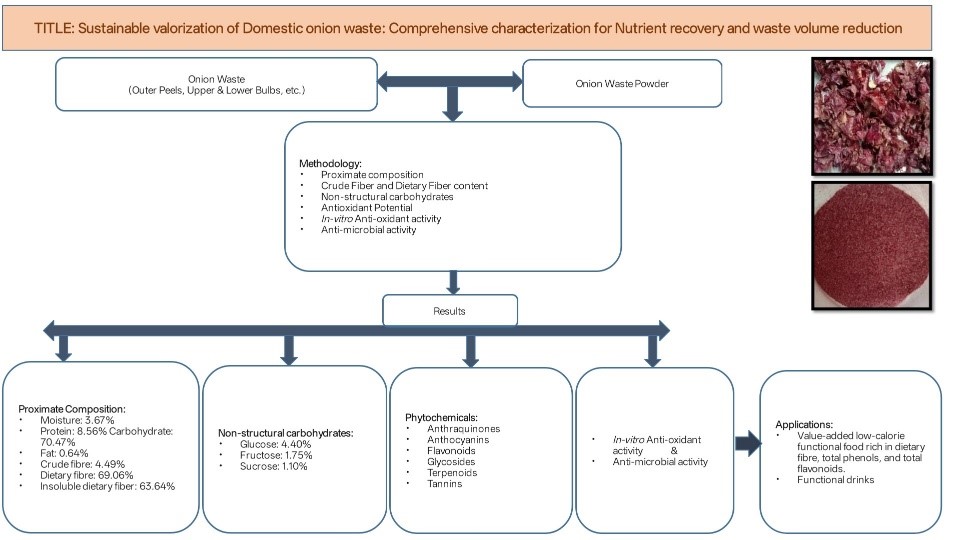
Allium cepa L., commonly known as onion, is one of the most widely cultivated vegetables worldwide, valued for its characteristic flavor, aroma, and pungency. It is extremely concerning that around one million tonne of onion waste is produced throughout distribution, processing, and consumption. Characterization of onion waste is essential for its valorization. The study’s goal was to identify the nutritional and nonstructural carbohydrate content, antioxidant, antimicrobial activity and phytochemical elements present in the waste. The onion waste was cleaned and dried at 60°C in an air-circulating tray dryer, and ground into a fine powder. It was found to contain moisture (3.67%), protein (8.56%), carbohydrate (70.47%), fat (0.64%), crude fibre (4.49%), dietary fibre (69.06%), and insoluble dietary fibre (63.64%) and provides 321.88 kcal of energy per 100 g. The non-structural carbohydrates in the onion waste were glucose (4.40%), fructose (1.75%) and sucrose (1.10%). The ethanolic onion waste extract was found to contain phytochemicals anthraquinones, anthocyanins, phenols, flavonoids, glycosides, terpenoids, flavonoids, and tannins. Using DPPH and hydroxyl radical scavenging activity, the antioxidant activity of ethanolic onion waste extract was revealed to be strong at various concentrations. These values ranged from 42.34% to 70.50%, 65.8 to 60.5%, respectively. The ethanol extract of onion waste was found to have the strongest anti-microbial effects on Escherichia coli and Staphylococcus aureus. Onion waste characterization provides valuable insights into its potential as a source of bioactive compounds facilitating its utilization in nutraceuticals and functional foods. This approach promotes sustainable waste management and resource utilization while unlocking the hidden potential of onion waste.
Article Details

This work is licensed under a Creative Commons Attribution-NonCommercial 4.0 International License.
Published articles are under the copyright of the Environment and Natural Resources Journal effective when the article is accepted for publication thus granting Environment and Natural Resources Journal all rights for the work so that both parties may be protected from the consequences of unauthorized use. Partially or totally publication of an article elsewhere is possible only after the consent from the editors.
References
American Association of Cereal Chemists (AACC). Approved Methods of Analysis. 11th ed. St. Paul, MN: AACC International; 2025.
Aisara J, Wongputtisin P, Deejing S, Maneewong C, Unban K, Khanongnuch C, et al. Potential of inulin-fructooligosaccharides extract produced from red onion (Allium cepa var. viviparum (Metz) Mansf.) as an alternative prebiotic product. Plants 2021;10(11):Article No. 2401.
Akdeniz B, Sumnu G, Sahin S. Microencapsulation of phenolic compounds extracted from onion (Allium cepa) skin. Journal of Food Processing and Preservation 2018;42(7):e13648.
Association of Official Analytical Chemists (AOAC). Official Methods of Analysis. 22nd ed. Arlington, VA: AOAC; 2023. p. 1-50.
Bag A, Chattopadhyay RR. Evaluation of synergistic antibacterial and antioxidant efficacy of essential oils of spices and herbs in combination. PLoS One 2015;10(7):e0131321.
Bilge G, Sezer B, Eseller KE, Berberoglu H, Koksel H, Boyaci IH. Ash analysis of flour sample by using laser-induced breakdown spectroscopy. Spectrochimica Acta Part B: Atomic Spectroscopy 2016;124:74-8.
Bose M. 80 to 90 lakh tonnes of onion get spoiled during storage and transportation. Deccan Herald [Internet]. 2025 [cited 2026 Feb 10]. Available from: https://www.deccanherald.com /india/maharashtra/80-to-90-lakh-tonnes-of-onion-get-spoiled-during-storage-and-transportation-pasha-patel-3674351.
Britannica. Onion plant [Internet]. 2025 [cited 2025 June 16]. Available from: https://www.britannica.com/plant/onion-plant.
Chakraborty AJ, Uddin TM, Matin Zidan BR, Mitra S, Das R, Nainu F, et al. Allium cepa: A treasure of bioactive phytochemicals with prospective health benefits. Evidence‐Based Complementary and Alternative Medicine 2022;1:Article No. 4586318.
Cho EJ, Choi YS, Bae HJ. Bioconversion of onion waste to valuable biosugar as an alternative feed source for honey bee. Waste and Biomass Valorization 2021;12(8):Article No. 4503-12.
Chorolque A, Pellejero G, Sosa MC, Palacios J, Aschkar G, García-Delgado C, et al. Biological control of soil-borne phytopathogenic fungi through onion waste composting: Implications for circular economy perspective. International Journal of Environmental Science and Technology 2022;19(7):6411-20.
Dalhat MH, Adefolake FA, Musa M. Nutritional composition and phytochemical analysis of aqueous extract of Allium cepa (onion) and Allium sativum (garlic). Asian Food Science Journal 2018;3(4):1-9.
Damanik M, Rosmiati R, Permatasari T, Surbakti TA, Ayuni S. Ash, protein and salinity analysis of integrated formulation of herbs and spices in typical Simalungun “Tinuktuk” North Sumatera-Indonesia. International Journal of Health and Pharmaceutical 2023;3(3):545-9.
Dinkecha K, Geleto G, Minuye M. Determination of nutritional profile and physicochemical properties of improved onion (Allium cepa L.) varieties in Ethiopia. Biochemistry and Molecular Biology 2017;2(6):86-93.
El Mashad HM, Zhang R, Pan Z. Onion and garlic. In: Pan Z, Zhang R, Zhicori S, editors. Integrated Processing Technologies for Food and Agricultural By-Products. Academic Press; 2019. p. 273-96.
Gupta AJ, Kaldate S, Volaguthala S, Mahajan V. Onion nutritional and nutraceutical composition and therapeutic potential of its phytochemicals assessed through preclinical and clinical studies. Journal of Functional Foods 2025;129:Article No. 106889.
Jaganmohanrao L. Valorization of onion wastes and by-products using deep eutectic solvents as alternate green technology solvents for isolation of bioactive phytochemicals. Food Research International 2025;206:Article No. 115980.
Jain N, Sharma OP, Chaudhary P. Medicinal uses of Palandu (Allium cepa L.): A review article. World Journal of Pharmaceutical and Medical Research 2019;5(1):188-91.
Khedkar R, Singh K. Food industry waste: A panacea or pollution hazard? In: Jindal T, editor. Paradigms in Pollution Prevention. Cham: Springer; 2017. p. 35-47.
Khedkar R, Singh K, Sharma V, Thakur M. Physicochemical properties and antioxidant potential of Curry leaf chutney powder: A traditional food adjunct. In: Thakur M, Belwal T, editors. Bioactive Components: A Sustainable System for Good Health and Well Being. Singapore: Springer Nature; 2023. p. 595-609.
Kherade M, Solanke S, Tawar M, Wankhede S. Fructooligosaccharides: A comprehensive review. Journal of Ayurvedic and Herbal Medicine 2021;7(3):193-200.
Kumar M, Barbhai MD, Hasan M, Dhumal S, Singh S, Pandiselvam R, et al. Onion (Allium cepa L.) peel: A review on the extraction of bioactive compounds, its antioxidant potential, and its application as a functional food ingredient. Journal of food science 2022a;87(10):4289-311.
Kumar M, Barbhai MD, Hasan M, Punia S, Dhumal S, Rais N, et al. Onion (Allium cepa L.) peels: A review on bioactive compounds and biomedical activities. Biomedicine and pharmacotherapy 2022b;146:Article No. 112498.
Kumari N, Sinha A, Sahu PR, Khalkho AS. Evaluation of antibacterial activities of ancient medicinal plants extracts against E. coli and S. aureus. Journal of Natural Products and Plant Resources 2016;6(2):1-5.
Liang X, Zhang Y, Wan S, Xia L, Li P, Wang S, et al. Impacts of sulphur application on microbial communities and functional attributes in rubber plantation soil. BMC Microbiology 2025;25(1):Article No. 265.
Letchuman S, Madhuranga HDT, Madhurangi BLNK, Premarathna AD, Saravanan M. Alkaloids unveiled: A comprehensive analysis of novel therapeutic properties, mechanisms, and plant based innovations. Intelligent Pharmacy 2025;2(4):268-76.
Marefati N, Ghorani V, Shakeri F, Boskabady M, Kianian F, Rezaee R, et al. A review of anti-inflammatory, antioxidant, and immunomodulatory effects of Allium cepa and its main constituents. Pharmaceutical Biology 2021;59(1):285-300.
Masood S, Ihsan MA, Shahzad K, Sabir M, Alam S, Ahmed W, et al. Antioxidant potential and α-glucosidase inhibitory activity of onion (Allium cepa L.) peel and bulb extracts. Brazilian Journal of Biology 2021;83:Article No. 00264.
Melani. The benefits of fibre-rich diets in maintaining digestive health and preventing constipation. Mandalika Journal of Medical and Health Studies 2025;3(1):9-14.
Naqvi SA, Irfan A, Zahoor AF, Zafar M, Maria A, Chand AJ, et al. Determination of antimicrobial and antioxidant potential of agro-waste peels. Anais da Academia Brasileira de Ciências 2020;92:e20181103.
Paesa M, Nogueira DP, Velderrain-Rodríguez G, Esparza I, Jiménez-Moreno N, Mendoza G, et al. Valorization of onion waste by obtaining extracts rich in phenolic compounds and feasibility of its therapeutic use on colon cancer. Antioxidants 2022;11(4):Article No. 733.
Puišo J, Paškevičius A, Žvirgždas J, Dimitrova TL, Litvakas A, Adliene D. Application of red onion peel extract for green synthesis of silver nanoparticles in hydrogels exhibiting antimicrobial properties. Gels 2023;9(6):Article No. 498.
Rodríguez-Arce E, Saldías M. Antioxidant properties of flavonoid metal complexes and their potential inclusion in the development of novel strategies for the treatment against neurodegenerative diseases. Biomedicine and Pharmacotherapy 2021;143:Article No. 112236.
Sayeed R, Thakur M, Gani A. Celosia cristata Linn. flowers as a new source of nutraceuticals: A study on nutritional composition, chemical characterization and in-vitro antioxidant capacity. Heliyon 2020;6(12):e05792.
Sayeed R, Thakur M. Comparative studies on extraction methods of betalain content and antioxidant activity of biocolorant obtained from Celosia cristata L. flowers. Medicinal Plants-International Journal of Phytomedicines and Related Industries 2019;11(4):396-403.
Shahid I, Hussain G, Anis M, Farooq MU, Usman M, Fouad Y, et al. Enzymatic co-fermentation of onion waste for bioethanol production using Saccharomyces cerevisiae and Pichia pastoris. Energies 2023;16(5):Article No. 2181.
Sidhu JS, Ali M, Al-Rashdan A, Ahmed N. Onion (Allium cepa L.) is potentially a good source of important antioxidants. Journal of Food science and Technology 2019;56(4):1811-9.
Singh A, Nagpoore NK, Sharma V, Singh BN, Thakur M. Ethnobotanical insights, antioxidant potential and cell line (RAW 264.7)-based anti-inflammatory activity of Cordia dichotoma G. Forst fruits. Journal of Food Science and Technology 2026;63(6):1173-85.
Singh G, Katoch M. Antimicrobial activities and mechanism of action of Cymbopogon khasianus (Munro ex Hackel) Bor essential oil. BMC complementary medicine and therapies 2020;20(1):Article No. 331.
Singh H, Khar A. Potential of onion (Allium cepa) as traditional therapeutic and functional food: An update. Indian Journal of Agricultural Sciences 2022;92(11):1291-7.
Singh V, Krishan P, Shri R. Extraction of antioxidant phytoconstituents from onion waste. Journal of Pharmacognosy and Phytochemistry 2017;6(1):502-5.
Singh V, Thakur M, Rai MK, Prakash S. Evaluation of in-vitro functional potential of developed synergistic Fe-Vit C rich powder for anemic adolescent girls. Indian Journal of Agricultural Biochemistry 2022;35(2):213-9.
Thakur M, Modi VK. Biocolorants in food: Sources, extraction, applications and future prospects. Critical Reviews in Food Science and Nutrition 2024;64(14):4674-713.
Timilsena YP, Phosanam A, Stockmann R. Perspectives on saponins: Food functionality and applications. International Journal of Molecular Sciences 2023;24(17):Article No. 13538.
World Population Review. Onion production by country 2026 [Internet]. 2025 [cited 20 June 2025]. Available from: https://worldpopulationreview.com/country-rankings/onion-production-by-country.
Zahid A, Khedkar R, Sharma S, Rajput S. Media optimization for amylase production through OFAT using onion peel as substrate. Proceedings of 8th AMIFOST- International Conference; 2025 March 27-28; Amity University, Noida, India; 2025.
Zahid A, Khedkar R. Valorisation of fruit and vegetable wastes: A review. Current Nutrition and Food Science 2022;18(3):315-28.
Zeb A. Concept, mechanism, and applications of phenolic antioxidants in foods. Journal of Food Biochemistry 2020;44(9):e13394.
