Process Optimization of Glycerol-to-Triacetin Conversion in Clean Technology Applications: In Situ Water Removal for Enhanced Reaction Performance in Sustainable Biodiesel Byproduct Valorization 10.32526/ennrj/24/20250278
Article Sidebar
Main Article Content
Abstract
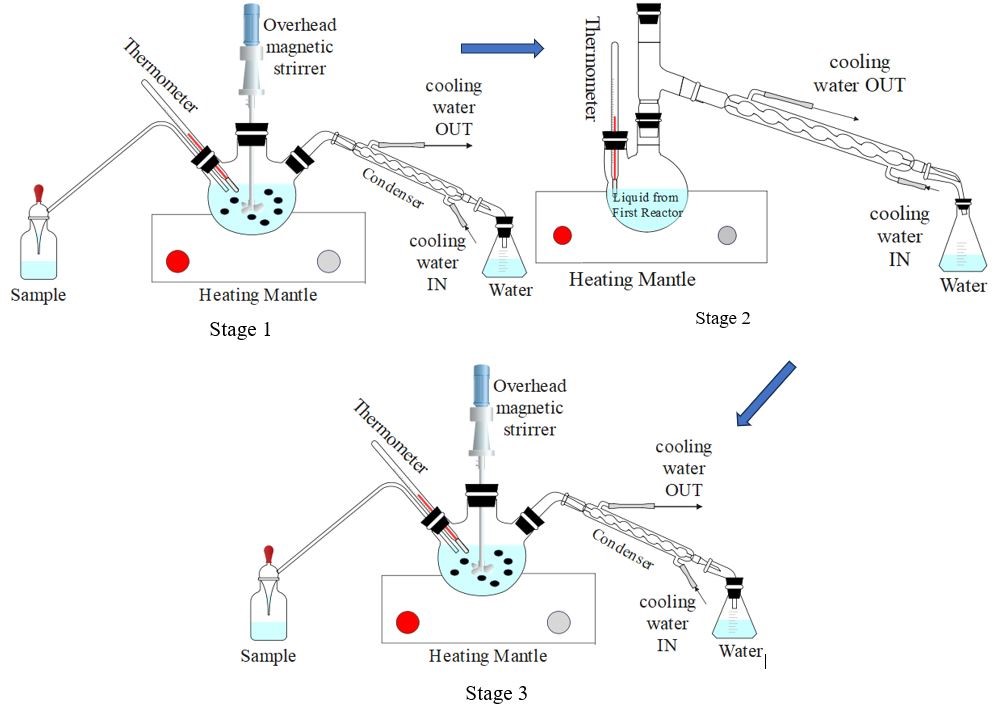
Increasing biodiesel production generates excess glycerol, which has a declining economic value. Converting glycerol into triacetin, a value-added fuel additive, offers a promising solution. However, the reversible nature of the esterification reaction and the formation of water reduce selectivity. Therefore, this study was conducted to evaluate the effect of in situ water removal on reaction performance in terms of acetic acid conversion and the resulting triacetin product. Experiments were conducted in a batch reactor through three clearly defined stages. In Stage 1, the optimal glycerol-acetic acid molar ratio (1:3-1:5) was determined at 100°C and 700 rpm, using a 5% natural zeolite catalyst (based on acetic acid mass), and a reaction time of 4 h with in situ water removal. In Stage 2, residual water was removed by fractional distillation at 105°C until bubbling ceased. Stage 3 comprised the main reaction, where the distillate containing monoacetin, diacetin, triacetin, and glycerol was reacted with fresh acetic acid at the optimal ratio, while in situ water removal continued to enhance triacetin formation. Acetic acid conversion was analyzed by acid-base titration using 0.5 N NaOH, and triacetin was identified by GC-MS. This innovation showed excellent results, achieving 94.00% conversion of acetic acid with 85.58% selectivity for triacetin at 110°C and a 1:5 glycerol-to-acetic acid molar ratio. These results showed that in situ water removal intensified esterification by shifting the equilibrium, enhancing triacetin conversion and selectivity. This strategy advances glycerol valorization and supports the production of sustainable fuel additives within integrated biorefinery systems.
Article Details

This work is licensed under a Creative Commons Attribution-NonCommercial 4.0 International License.
Published articles are under the copyright of the Environment and Natural Resources Journal effective when the article is accepted for publication thus granting Environment and Natural Resources Journal all rights for the work so that both parties may be protected from the consequences of unauthorized use. Partially or totally publication of an article elsewhere is possible only after the consent from the editors.
References
Aisyah A, Rezeki R, Firnanelty F, Abubakar ANF, Zahra U, Patunrengi II, et al. Esterification reaction of glycerol to the derivatives catalyzed by Amberlyst 36. Indonesia Chimica Acta 2021;14(1):7-11.
Akachat B, Himed L, Torche A, Khelef Y, Barkat M, Salah M, et al. Evaluation of glycerol concentration in the production of lemon oil incorporated pectin-based films using principal component analysis. Foods 2025;14(9):Article No. 1576.
Azmi N, Ameen M, Yashni G, Yusup S, Mohd Yusoff MH, Chai YH. In situ catalytic conversion of glycerol to triacetin under microwave irradiation with commercial palladium on activated carbon catalyst. Journal of Sustainable Development of Energy, Water and Environment Systems 2023;11(4): Article No. 1110465.
Baingam N, Wang LY, Chen SY, Hardhana F, Chang CK, Tateno H, et al. Sulfonic acid‐functionalized KIT‐6 solid acid catalysts for glycerol acetylation. Journal of ChemCatChem 2025;17(18):e00808.
Bansod Y, Ghasemzadeh K, D’Agostino C. Techno-economic assessment of biodiesel-derived crude glycerol purification processes. RSC Sustainability 2025;3(6):2605-18.
Bezerra RDC, Mota G, Vidal RMB, Carmo JV, Saraiva GD, Campos A, et al. Effect of basic promoters on porous supported alumina catalysts for acetins production. Catalysts 2022;12(12):Article No. 1616.
Da Silva MJ, Oliveira CM, Da Silva Andrade PH, Lopes NPG. Silicotungstate- or phosphotungstate-catalyzed glycerol esterification with acetic acid: A comparison of zinc and tin salts. Reactions 2025;6(1):Article No. 19.
Doukeh R, Joe AC, Onuțu I, Ghețiu IV, Băjan M, Vasilievici G,et al. A glycerol acetylation study on a tin ferrite nanocatalyst. ChemEngineering 2025;9(4):Article No. 86.
Feng A, Yu Y, Mi L, Cao Y, Yu Y, Song L. Synthesis and characterization of hierarchial Y zeolites using NH4HF2 as dealumination agent. Microporous and Mesoporous Materials 2019;280:211-8.
Fogler HS. Elements of Chemical Reaction Engineering. 4th ed. Upper Saddle River: Prentice Hall; 2006.
Guimarães KG, Oliveira HNM, Galvão JAE, Silva JNB, Silva IM, Azevedo SHG. Supercritical interesterification of corn oil using a continuous reactor for biodiesel production. Brazilian Journal of Petroleum and Gas 2025;18(4):225-35.
Hadi EP, Ilim I. Pyrolysis of crude palm oil using modified Lampung natural zeolite as catalyst and white sand as heat exchanger. Proceedings of the 5th International Conference on Applied Sciences, Mathematics, and Informatics; 2024 Oct 13-14; Emersia Hotel, Bandar Lampung: Inonesia; 2025.
Hauli L, Adiningrum CL, Safaat M, Adilina IB, Tursiloadi S, Marlinda L, et al. Hydrogen storage performance of activated natural zeolite and its modification with activated charcoal. Chemistry Journal of Moldova. General, Industrial and Ecological Chemistry 2025;20(1):79-85.
Hilmioğlu N. Optimization of synthesis of ethyl acetate by response surface method and investigation of reactive sorption effect of hydrogel in synthesis. European Journal of Science and Technology 2022;35:94-101.
Jagadish T, Ramudu MP, Swapna S, Challa P, Rao MV, Vinod G, et al. Synthesis of sustainable biochar acid catalyst by utilization of palmyra palm fruit shell waste biomass and application to glycerol esterification. Journal of Molecular Liquids 2025;424:Article No. 127039.
Khan SA, de Carvalho Arabidian V, da Silveira Junior N, de Farias BS, Kessler F, Paes RL, et al. Valorization glycerol produced as a by-product in the biodiesel industry: An insight into technical and economic studies. In: Naushad M, Mohamed Kutty SR, Hossain MS, Birniwa AH, Jagaba AH, editors. Biorefinery of Industrial Effluents for a Sustainable Circular Economy. Oxford: Elsevier; 2025. p. 307-16.
Manurung R, Anggreawan MD, Siregar AGA. Synthesis and characterization of phosphoric silica catalyst from bamboo leaves for production of triacetin. Journal of Biomimetics, Biomaterials and Biomedical Engineering 2022;54:129-37.
National Institute of Standards and Technology. Glycerin infrared spectrum. The U.S. Secretary of Commerce on behalf of the United States of America [internet]. 2025a [cited 2025 Sep 8]. Available from: https://webbook.nist.gov/cgi/cbook.cgi? ID=C56815&Type=IR-SPEC&Index=1.
National Institute of Standards and Technology. Triacetin infrared spectrum. The U.S. Secretary of Commerce on behalf of the United States of America [internet]. 2025b [cited 2025 Sep 8]. Available from: https://webbook.nist.gov/cgi/cbook.cgi? ID=C102761&Type=IR-SPEC&Index=3.
Nda-Umar UI, Ramli I, Muhamad EN, Azri N, Taufiq-Yap YH. Optimization and characterization of mesoporous sulfonated carbon catalyst and its application in modeling and optimization of acetin production. Molecules 2020;25(22): Article No. 5221.
Nuryoto N, Candra S, Kosimaningrum WE, Tahta Bagaskara RN. Valorization of glycerol into triacetin: Green innovation in sustainable biodiesel additive development for ecological stability. Journal of Ecological Engineering 2025;26(7):234-50.
Nuryoto N, Sulistyo H, Suprihastuti SR, Sutijan. Kinetics of glycerol esterification with acetic acid using Indion 225 Na catalyst. Journal of Process Engineering 2011;5(2):35-9 (in Indonesian).
Petchsoongsakul N, Ngaosuwan K, Kiatkittipong W, Wongsawaeng D, Mens W, Chuetor S, et al. Intensified process based on reactive distillation for triacetin production via glycerol esterification with acetic acid. Scientific Reports 2025;15(1):Article No. 29922.
Priebe JM, Dall’Oglio EL, Vasconcelos LG, Sousa Jr PT, Ramos AA, Rodrigues ED, et al. Dielectric properties during microwave-induced interesterification reactions for biodiesel and triacetin production. Journal of the Brazilian Chemical Society 2024;35(9):e-20240057.
Sandid A, Attarbachi T, Navarro-Tovar R, Pérez-Page M, Spallina V, Esteban J. Production of triacetin from industrially derived purified glycerol: Experimental proof of concept, kinetic model derivation and validation. Chemical Engineering Journal 2024;496:Article No. 153905.
Setyaningsih L, Siddiq F, Pramezy A. Esterification of glycerol with acetic acid over Lewatit catalyst. Proceedings of the 2nd International Conference on Engineering and Technology for Sustainable Development; 2017 Sep 13-14; Yogyakarata: Indonesia; 2018.
Sriratchatchawan P, Eaimsumang S, Luengnaruemitchai A. Triacetin production from acetylation of glycerol: A review. Proceedings of the 2022 Sustainable Research and Innovation Conference; 2022 Oct 5-6; JKUAT Main Campus, Kenya; 2022.
Singare S, Shah M, Namdeo A, Unnarkat AP. Catalytic conversion of glycerol to acetins: A waste management approach-insights to glycerol derived products, prospects, and exploring acetylation route. Journal of Material Cycles and Waste Management 2025;27:4059-83.
