Management Model for Rungan Watershed, Central Kalimantan, Indonesia: A Comprehensive Approach to Achieving Conservation and Community Development Goals 10.32526/ennrj/24/20250302
Article Sidebar
Main Article Content
Abstract
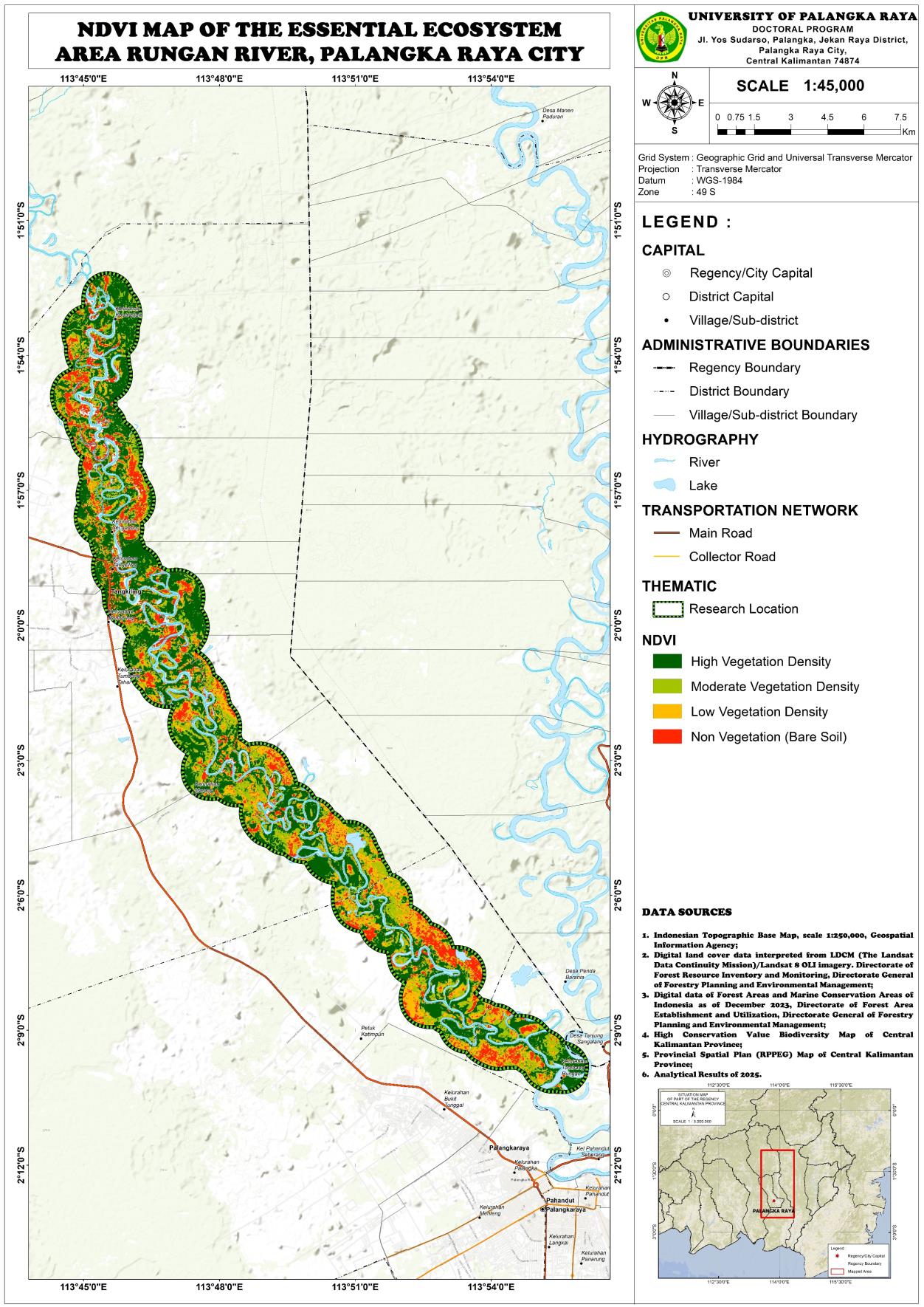
The Rungan Watershed is facing an alarming rate of environmental degradation yet continuing to support the livelihoods of local communities. Therefore, this study is essential for addressing these issues and formulating adaptive management model. This research aims to assess environmental conditions and social economic aspects to formulate management model that is expected to serve as a framework for sustainable development in Palangka Raya City. By applying both qualitative and quantitative approaches, the study collects ecological, economic, and socio-cultural data to inform the development of management strategies. Land cover, land use, and vegetation density are assessed using remote sensing imagery and land cover maps. The analysis of forest vegetation density classes is conducted through the Normalized Difference Vegetation Index (NDVI), utilizing data from Landsat imagery. Socio-cultural information is gathered through interviews and observations. The study identifies various land cover condition, information on social economic condition that serve as a basis for developing a zoning based management model that categorizes the Rungan Watershed into conservation, buffer, and general utilization zones. This model accommodates the diverse interests of multiple stakeholders within a sustainable development framework. The study concludes that the zonation management of the sub-basin must align with the biophysical ecological conditions of the area, address existing challenges, and promote community welfare.
Article Details

This work is licensed under a Creative Commons Attribution-NonCommercial 4.0 International License.
Published articles are under the copyright of the Environment and Natural Resources Journal effective when the article is accepted for publication thus granting Environment and Natural Resources Journal all rights for the work so that both parties may be protected from the consequences of unauthorized use. Partially or totally publication of an article elsewhere is possible only after the consent from the editors.
References
Addai G, Abunyewah M, Erdiaw-Kwasie MO, Okyere SA, Gyensare MA, Guodaar L. Application of the rural web framework within the context of sustainable development: A systematic literature review. Sustainability 2023;15(5):Article No. 4239.
Alhakim EE, Bondan A, Iswanto ER, Anzhar K, Indrawati Y, Solihat S, et al. Assessing watershed characteristics and hydrological response using SWAT: A case study in the Raya Watershed, West Kalimantan. Eksplorium 2025;46(1):47-58.
Arnillas CA, Yang C, Zamaria SA, Neumann A, Javed A, Shimoda Y, et al. Integrating watershed and ecosystem service models to assess best management practice efficiency: Guidelines for Lake Erie managers and watershed modellers. Environmental Review 2021;29(1):31-63.
Bannari A, Morin D, Bonn F, Huete A. A review of vegetation indices. Remote Sensing Reviews 1995;13(1-2):95-120.
Basuki TM, Indrawati DR, Setio Hadi Nugroho HY, Pramono IB, Setiawan O, Nugroho NP, et al. Water pollution of some major rivers in Indonesia: The status, institution, regulation, and recommendation for its mitigation. Polish Journal of Environmental Studies 2024;33(4):3515-30.
Birkmann J, Liwenga E, Pandey R, Boyd E, Djalante R, Gemenne F, et al. Poverty, livelihoods and sustainable development. In: Climate Change 2022: Impacts, Adaptation and Vulnerability. Contribution of Working Group II to the Sixth Assessment Report of the Intergovernmental Panel on Climate Change. Cambridge, UK and New York, USA: Cambridge University Press; 2022. p. 1171-274.
Creswell JW. A Concise Introduction to Mixed Methods Research. Thousand Oaks: SAGE Publications; 2021.
Dewi S, Belcher B, Puntodewo A. Village economic opportunity, forest dependence, and rural livelihoods in East Kalimantan, Indonesia. World Development 2005;33(9):1419-34.
Easter K, Hufschmidt M, McCauley DS. Integrated Watershed Management Research for Developing Countries: Workshop Report. Honolulu, HI, USA: East-West Environment and Policy Institute; 1985.
Government of Central Kalimantan. Sub Nasional Mid Period Development Planning. Palangka Raya Central Kalimantan Indonesia; 2024.
Hagras A. Estimating water erosion in the EL-Mador Valley Basin, South-West Matrouh City, Egypt, using revised universal soil loss equation (RUSLE) model through GIS. Environmental Earth Sciences 2023;82(1):Article No. 47.
Hagras A. Hydrological Modelling and Assessment in Arid Region Using Remote Sensing and GIS: A Case Study in Southeast Sinai, Egypt. 1st ed. Switzerland: Springer Cham; 2025. p. 1-132.
Hairani A, Noor M. Water management on peatland for food crop and horticulture production: Research review in Kalimantan. IOP Conference Series: Earth and Environmental Science 2020;499(1):Article No. 012006.
He S, Jiao W. Conservation-compatible livelihoods: An approach to rural development in protected areas of developing countries. Environmental Development 2023;45(1):Article No. 100797.
Islam SM, Gaihre YK, Islam MR, Ahmed MN, Akter M, Singh U, et al. Mitigating greenhouse gas emissions from irrigated rice cultivation through improved fertilizer and water management. Journal of Environmental Management 2022;307:Article No. 114520.
Ismanto A, Hadibarata T, Sugianto DN, Zainuri M, Kristanti RA, Wisha UJ, et al. First evidence of microplastics in the water and sediment of Surakarta city river basin, Indonesia. Marine Pollution Bulletin 2023;196:Article No. 115677.
Kaufmann RK, Zhou L, Myneni RB, Tucker CJ, Slayback D, Shabanov NV, et al. The effect of vegetation on surface temperature: A statistical analysis of NDVI and climate data. Geophysical Research Letters 2003;30(22):Article No. 214.
Lira MA. Integration of land rights and spatial zoning in the Indonesian land legal system. Lex Localis 2025;23(S5):208-17.
Mainardis M, Cecconet D, Moretti A, Callegari A, Goi D, Freguia S, et al. Wastewater fertigation in agriculture: Issues and opportunities for improved water management and circular economy. Environmental Pollution 2022;296:Article No. 118755.
Marselina M, Wibowo F, Mushfiroh A. Water quality index assessment methods for surface water: A case study of the Citarum River in Indonesia. Heliyon 2022;8(7):e09848.
Masot AN, Gascón JLG. Sustainable rural development: Strategies, good practices and opportunities. Land 2021;10(4): Article No. 366.
Meena DC, Pal S, Chand P. Assessment of watershed management ecosystem services in India: A meta-analysis. Current Science 2022;123(11):1352-8.
Mosaffaie J, Jam AS, Tabatabaei MR, Kousari MR. Trend assessment of the watershed health based on DPSIR framework. Land Use Policy 2021;100(1):Article No. 04911.
Mengistu F, Assefa E. Community participation in watershed management: Analysis of the status and factors affecting community engagement in the upper Gibe basin, South West Ethiopia. Journal of Environmental Planning and Management 2021;64(2):252-88.
Natarajan N, Newsham A, Rigg J, Suhardiman D. A sustainable livelihoods framework for the 21st century. World Development 2022;155(1):Article No. 105898.
Narendra BH, Siregar CA, Dharmawan IWS, Sukmana A, Pratiwi, Pramono IB, et al. A review on sustainability of watershed management in Indonesia. Sustainability 2021;13(19):Article No. 11125.
Ojelel BE, Okello-Okello F, Barakagira A. Implementing payments for ecosystems and its impact on community livelihoods: A case of Nyamwamba Sub-Catchment, Kasese District, Uganda. Journal of Agriculture and Ecology Research International 2024;25(5):23-36.
Okiria E, Zaki MK, Noda K. A review of payment for ecosystem services (PES) in agricultural water: Are PES from the operation of agricultural water control structures ubiquitous? Sustainability 2021;13(22):Article No. 12624.
Rahmadi. Introduction to Research Methodology. Banjarmasin: Antasari Press; 2011 (in Bahasa).
Ramadhan C, Dina R, Nurjani E. Spatial and temporal based deforestation proclivity analysis on flood events with applying watershed scale (case study: Lasolo watershed in Southeast Sulawesi, Central Sulawesi, and South Sulawesi, Indonesia). International Journal of Disaster Risk Reduction 2023;93:Article No. 103745.
Ruslan M, Fithria A, Budi S, Syam’ani SA. Model of land and forest rehabilitation efforts in Amandit Sub Sub Watersheed. International Journal of Forest, Soil and Erosion 2018;8(1):5-11.
Setiarno YS, Wittu S. Structure and composition of riparian vegetation at Pager River Rakumpit Subregion Palangka Raya City. Agrienvi: Journal of Agriculture Science 2018;13(1):14-24 (in Bahasa).
Srivastav AL, Dhyani R, Ranjan M, Madhav S, Sillanpää M. Climate-resilient strategies for sustainable management of water resources and agriculture. Environmental Science and Pollution Research 2021;28(31):41576-95.
Shunglu R, Köpke S, Kanoi L, Nissanka TS, Withanachchi CR, Gamage DU, et al. Barriers in participative water Governance: A critical analysis of community development approaches. Water 2022;14(5):Article No. 762.
Supangat AB, Basuki TM, Indrajaya Y, Setiawan O, Wahyuningrum N, Purwanto, et al. Sustainable management for healthy and productive watersheds in Indonesia. Land 2023;12(11):Article No. 1963.
Wang H, Huang L, Zhang H, Fu Y, Guo W, Jiao X, et al. Development of a decision framework for river health and water yield ecosystem service in watershed. Journal of Hydrology 2023;623:Article No. 129773.
Waskitho NT, Pratama AA, Muttaqin T. Sectoral integration in watershed management in Indonesia: Challenges and recommendations. IOP Conference Series: Earth and Environmental Science 2021;752(1):Article No. 012035.
Wunder S. Poverty alleviation and tropical forests—what scope for synergies? World Development 2001;29(11):1817-33.
Zhao X, Huang G. Urban watershed ecosystem health assessment and ecological management zoning based on landscape pattern and SWMM simulation: A case study of Yangmei River Basin. Environmental Impact Assessment Review 2022;95:Article No. 106794.
