Growth Responses and Phytoremediation Capacity of Colocasia esculenta under Drought Conditions in Pb-Contaminated Soil 10.32526/ennrj/24/20250312
Article Sidebar
Main Article Content
Abstract
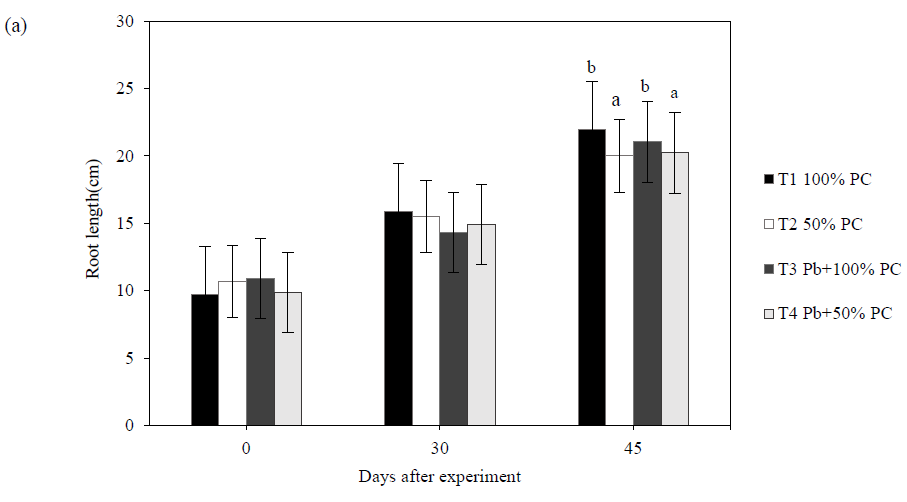
Phytoremediation is an effective, plant-based strategy for removing heavy metals from contaminated environments under various conditions. This study examines how lead (Pb) pollution and drought stress affect Colocasia esculenta’s physiological reactions and capacity to accumulate Pb. Plants were grown for 45 days under two soil moisture conditions (100% and 50% field capacity) and treated with 100 mg/kg Pb. The findings indicated that drought stress significantly diminished root growth, whereas Pb exposure exhibited no significant effect (p>0.05). No significant differences were observed in stem height, dry plant biomass, and relative growth rate (RGR) values (p>0.05). Under the combined Pb exposure and drought condition, the chlorophyll content and chlorophyll fluorescence parameters (PI and Fv/Fm) did not change. Under drought conditions, translocation factor (TF) levels were less than 1 (0.45-0.56) for the first 30 days; yet, following 45 days, they were more than 1 (1.17). Under drought stress, the bioaccumulation factor (BAF) values were over 1 (1.99-5.14), suggesting a high potential for Pb accumulation. All of these indicate that C. esculenta is resistant to Pb and has the capacity to phytoremediate Pb-contaminated dry soils.
Article Details

This work is licensed under a Creative Commons Attribution-NonCommercial 4.0 International License.
Published articles are under the copyright of the Environment and Natural Resources Journal effective when the article is accepted for publication thus granting Environment and Natural Resources Journal all rights for the work so that both parties may be protected from the consequences of unauthorized use. Partially or totally publication of an article elsewhere is possible only after the consent from the editors.
References
Acharya A, Kumar A, Sharma P, Verma S, Singh R. Current assessment and future perspectives on phytoremediation of heavy metals. Plants 2025;14(18):Article No. 2847.
Ahmad MS, Ashraf M, Tabassam Q, Hussain M, Firdous H. Lead (Pb)-induced regulation of growth, photosynthesis, and mineral nutrition in maize (Zea mays L.) plants at early growth stages. Biological Trace Element Research 2011;144(1-3):1229-39.
Apilux A, Thongkam T, Tusai T, Petisiwaveth P, Kladsomboon S. Determination of heavy metal residues in tropical fruits near industrial estates in Rayong Province, Thailand: A risk assessment study. Environment and Natural Resources Journal 2023;21(1):19-34.
Bacher H, Sharaby Y, Walia H, Peleg Z. Modifying root-to-shoot ratio improves root water influxes in wheat under drought stress. Journal of Experimental Botany 2022;73(5):1643-54.
Baker AJM. Accumulators and excluders—Strategies in the response of plants to heavy metals. Journal of Plant Nutrition 1981;3(1-4):643-54.
Baker NR. Chlorophyll fluorescence: A probe of photosynthesis in vivo. Annual Review of Plant Biology 2008;59:89-113.
Chayapan P, Kruatrachue M, Meetam M, Pokethitiyook P. Phytoremediation potential of Cd and Zn by wetland plants, Colocasia esculenta L. Schott., Cyperus malaccensis Lam., and Typha angustifolia L., grown in hydroponics. Journal of Environmental Biology 2015;36(5):1179-83.
Cui S, Zhou Q, Chao L. Potential hyperaccumulation of Pb, Zn, Cu, and Cd in endurant plants distributed in an old smeltery, Northeast China. Environmental Geology 2007;51:1043-8.
Davis LMM, Hidayati N, Firdaus AM, Talib C, Rini DS, Juhaeti T, et al. Uptake and translocation of lead and cadmium in wild-found plant species from Bekasi and Karawang, West Java, for phytoremediation. IOP Conference Series: Earth and Environmental Science 2023;1201(1):Article No. 012070.
Giannakoula A, Therios I, Chatzissavvidis C. Effect of lead and copper on photosynthetic apparatus in citrus (Citrus aurantium L.) plants. The role of antioxidants in oxidative damage as a response to heavy metal stress. Plants 2021;10(1):Article No. 155.
Guidi L, Lo Piccolo E, Landi M. Chlorophyll fluorescence, photoinhibition and abiotic stress: Does it make any difference the fact to be a C3 or C4 species? Frontiers in Plant Science 2019;10:Article No. 174.
Gupta A, Rico-Medina A, Caño-Delgado AI. The physiology of plant responses to drought. Science 2020;368(6488):266-9.
Holm G. Chlorophyll mutations in barley. Acta Agriculturae Scandinavica 1954;4(1):457-71.
Hunt R. Plant Growth Analysis. London: Edward Arnold; 1978.
Jabeen R, Ahmad A, Iqbal M. Phytoremediation of heavy metals: Physiological and molecular mechanisms. The Botanical Review 2009;75(4):339-64.
Kachenko AG, Bhatia N, Singh B. Influence of drought stress on the nickel-hyperaccumulating shrub Hybanthus floribundus (Lindl.) F. Muell. subsp. floribundus. International Journal of Plant Sciences 2011;172(3):315-22.
Khamsuk O, Sonjaroon W, Suwanwong S, Jutamanee K, Suksamrarn A. Effects of 24-epibrassinolide and the synthetic brassinosteroid mimic on chili pepper under drought. Acta Physiologiae Plantarum 2018;40(6):Article No. 106.
Korkmaz A, Korkmaz Y, Demirkiran AR. Enhancing chilling stress tolerance of pepper seedlings by exogenous application of 5-aminolevulinic acid. Environmental and Experimental Botany 2010;67(3):495-501.
Kumar A, Kumar A, Cabral-Pinto MMS, Chaturvedi AK, Shabnam AA, Subrahmanyam G, et al. Lead toxicity: Health hazards, influence on food chain, and sustainable remediation approaches. International Journal of Environmental Research and Public Health 2020;17(7):Article No. 2179.
Li X, Zhang W, Niu D, Liu X. Effects of abiotic stress on chlorophyll metabolism. Plant Science 2024;342:Article No. 112030.
Mariwy A, Selanno DAJ, Male YT, Tupan ChI. Heavy metal mercury accumulation using taro plant (Colocasia esculenta). Pakistan Journal of Life and Social Sciences 2024;22(2): 18851-62.
Maxwell K, Johnson GN. Chlorophyll fluorescence—a practical guide. Journal of Experimental Botany 2000;51(345):659-68.
Nugroho GA, Desmiaty Y, Sumiyati Y, Suherman SL, Lim H. Phenolic content and antioxidant activity of Colocasia esculenta in commercial herbal products. Sciences of Phytochemistry 2025;4(1):26-32.
Ozturk M, Turkyilmaz Unal B, García-Caparrós P, Khursheed A, Gul A, Hasanuzzaman M. Osmoregulation and its actions during the drought stress in plants. Physiologia Plantarum 2021;172(2):1321-35.
Pluciński B, Nowicka B, Waloszek A, Rutkowska J, Strzałka K. The role of antioxidant response and nonphotochemical quenching of chlorophyll fluorescence in long-term adaptation to Cu-induced stress in Chlamydomonas reinhardtii. Environmental Science and Pollution Research 2023;30:67250-62.
Porra RJ, Thompson WA, Kriedmann PE. Determination of accurate extinction coefficients and simultaneous equations for assaying chlorophylls a and b extracted with four different solvents: Verification of the concentration of chlorophyll standards by atomic absorption spectroscopy. Biochimica et Biophysica Acta 1989;975(3):384-94.
Qi X, Xu X, Zhong C, Jiang T, Wei W, Song X. Removal of cadmium and lead from contaminated soils using sophorolipids from fermentation culture of Starmerella bombicola CGMCC 1576. International Journal of Environmental Research and Public Health 2018;15(11): Article No. 2334.
Rahman SU, Qin A, Zain M, Mushtaq Z, Mehmood F, Riaz L, et al. Pb uptake, accumulation, and translocation in plants: Plant physiological, biochemical, and molecular response: A review. Heliyon 2024;10(6):e27724.
Sarma H. Metal hyperaccumulation in plants: A review focusing on phytoremediation technology. Journal of Environmental Science and Technology 2011;4(2):118-38.
Sekabira K, Oryem-Origa H, Mutumba G, Kakudidi E, Basamba TA. Heavy metal phytoremediation by Commelina benghalensis (L.) and Cynodon dactylon (L.) growing in urban stream sediments. International Journal of Plant Physiology and Biochemistry 2011;3(8):133-42.
Simmons RW, Pongsakul P, Saiyasitpanich D, Klinphklap S. Elevated levels of cadmium and zinc in paddy soils and elevated level of cadmium in rice grain downstream of a zinc mineralized area in Thailand: Implications for public health. Environmental Geochemistry and Health 2005;27(5-6):501-11.
Singh S, Singh R, Jha AB, Misra AN, Sharma P. Amorphophallus paeoniifolius corm: A potential source of peroxidase for wide applications. International Journal of Food Properties 2017;20:2658-64.
Srirueang C, Gongseng N, Saeng-ngam S, Jampasri K. Lead accumulation of Siam weed (Chromolaena odorata) grown in hydroponics under drought-stressed conditions. Environment and Natural Resources Journal 2022;20(2):148-56.
Stirbet A, Govindjee. On the relation between the Kautsky effect (chlorophyll a fluorescence induction) and Photosystem II: basics and applications of the OJIP fluorescence transient. Journal of Photochemistry and Photobiology B: Biology 2011;104:236-57.
Strasser RJ, Srivastava A, Tsimilli-Michael M. The Fluorescence transient as a tool to characterize and screen photosynthetic samples. In: Yunus M, editor. Probing Photosynthesis: Mechanisms, Regulation and Adaptation. London: Taylor and Francis; 2000. p. 445-83.
Song F, Yang Q, Huang J, Guo Z, Li Y, Deng W. Plant drought stress: Physiological, biochemical and molecular mechanisms. Plant Stress 2026;19:Article No. 101153.
Tangahu BV, Abdullah SRS, Basri H, Idris M, Anuar N, Mukhlisin M. A review on heavy metals (As, Pb, and Hg) uptake by plants through phytoremediation. International Journal of Chemical Engineering 2011;2011:1-31.
Thai Meteorological Department (TMD). Climate monthly summary: October 2025 [Internet]. 2025 [cited 2025 Oct 31]. Available from: https://www.tmd.go.th/en/climate/ summarymonthly/102025.
Vásquez Ortiz CE, Rodríguez Castillo N, Zuluaga Trochez A. Response of Chinese potato (Colocasia esculenta, Araceae) to abiotic and biotic stress, and the effectiveness of treatment with the fungus Trichoderma harzianum. Brazilian Journal of Biology 2025;84:e284571.
Wilson B, Pyatt FB. Heavy metal bioaccumulation by the important food plant, Olea europaea L., in an ancient metalliferous polluted area of Cyprus. Bulletin of Environmental Contamination and Toxicology 2007; 78(5):390-4.
Yongpisanphop J, Babel S, Kruatrachue M, Pokethitiyook P. Hydroponic screening of fast-growing tree species for lead phytoremediation potential. Bulletin of Environmental Contamination and Toxicology 2017;99(4):518-23.
Zhang E, Jiang W, Li W, Ansah EO, Yu X, Wu Y, et al. Drought stress inhibits starch accumulation in taro (Colocasia esculenta L. Schott). Frontiers in Bioscience - Landmark 2024;29(2):Article No. 57.
