Decadal Rainfall Distribution Shift in Northern Coastal Java: Histogram-Based Clustering Using Observations and CHIRPS 10.32526/ennrj/24/20250315
Article Sidebar
Main Article Content
Abstract
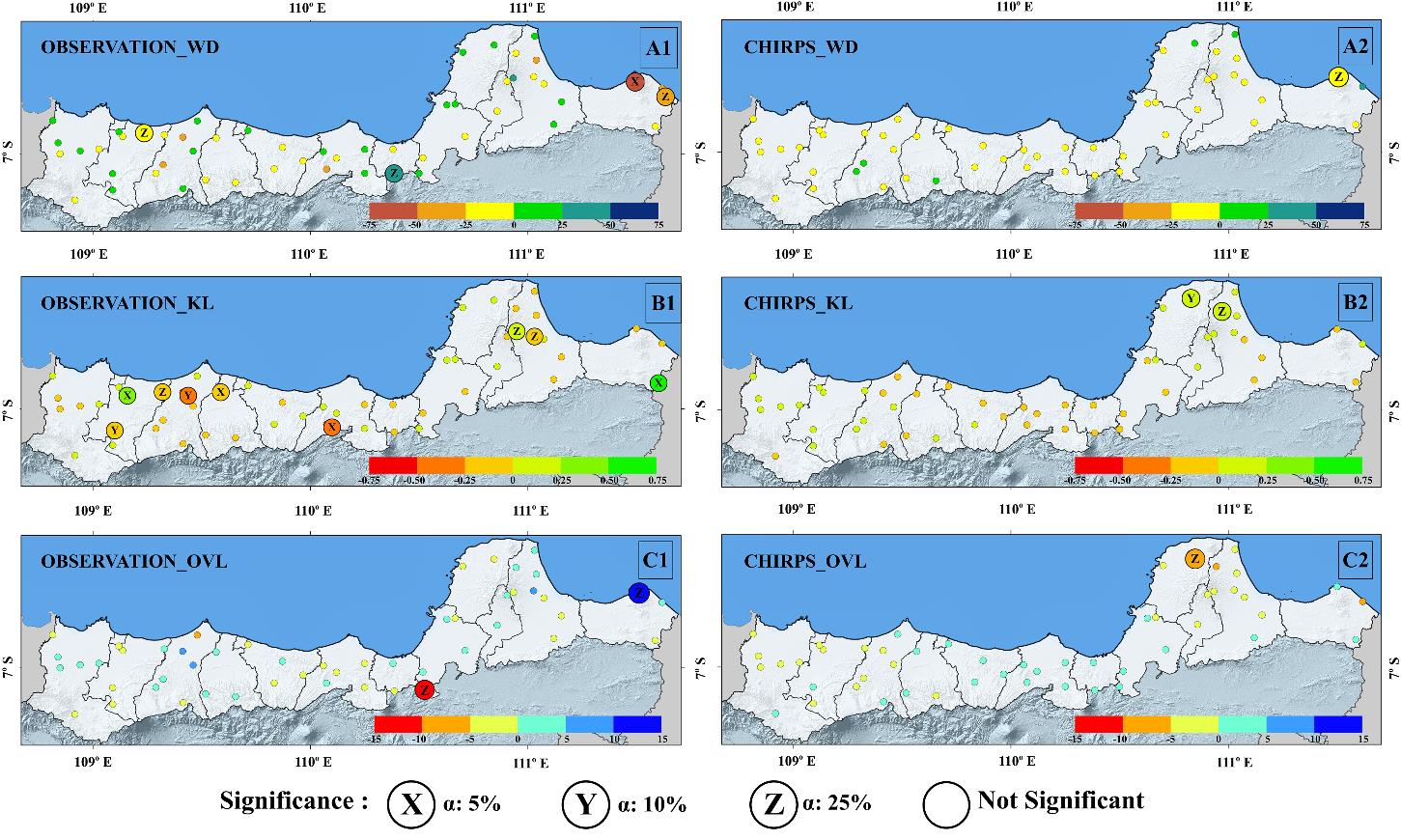
Coastal lowlands are highly vulnerable to seasonal changes and rainfall variability, which affect the risk of floods and droughts. Therefore, this study aimed to analyze decadal changes in the monthly rainfall distribution along the northern coast of Central Java (Pantura), using data from 51 stations of the Meteorology, Climatology, and Geophysics Agency (BMKG) and the Climate Hazards Group InfraRed Precipitation with Station data (CHIRPS) v2.0. A smoothed histogram was used to calculate the probability density of rainfall for each decade. Subsequently, the distribution between decades was compared using 6 metrics to assess distribution displacement, divergence, overlap, and shift in peak, centroid, and width. The level of uncertainty was measured using the bootstrap method at confidence levels of 5%, 10%, and 25%. The six metrics were normalized and combined into a single composite index called the Total Normalized Index (TNI). K-means clustering was then applied to map changes according to the same rainfall patterns. Analysis of both sources showed a gradient pattern from west to east. Rainfall was concentrated in the west, with moderate changes in structure in the central area, and a more dispersed rainfall pattern with high variability in the east, particularly from 2011 to 2020. CHIRPS data recorded the regional trends but tended to cloud out local fluctuations. This study contributed to new investigations since the implementation of histogram-based rainfall distribution analysis into a composite index. The application of this method as part of a spatial clustering model was proposed to map alterations in rainfall distribution each decade. The method also helped in evaluating coastal climate risk and adaptation planning.
Article Details

This work is licensed under a Creative Commons Attribution-NonCommercial 4.0 International License.
Published articles are under the copyright of the Environment and Natural Resources Journal effective when the article is accepted for publication thus granting Environment and Natural Resources Journal all rights for the work so that both parties may be protected from the consequences of unauthorized use. Partially or totally publication of an article elsewhere is possible only after the consent from the editors.
References
Afrifa‐Yamoah E, Mueller UA, Taylor SM, Fisher AJ. Missing data imputation of high‐resolution temporal climate time series data. Meteorological Applications 2020;27(1):e1873.
Agusta VC, Putri MR. Identification of rainfall variability in the northern coast of Java. AIP Conference Proceedings 2023;2719(1):Article No. 020015.
Aldrian E, Susanto RD. Identification of three dominant rainfall regions within Indonesia and their relationship to sea surface temperature. International Journal of Climatology 2003; 23(12):1435-52.
An D, Eggeling J, Zhang L, He H, Sapkota A, Wang YC, et al. Extreme precipitation patterns in the Asia-Pacific regions and its correlation with El Niño-Southern Oscillation (ENSO). Scientific Reports 2023;13(1):Article No. 11068.
Efron B, Tibshirani RJ. An Introduction to the Bootstrap. Boca Raton, FL, USA: Chapman and Hall/CRC; 1994.
Freedman D, Diaconis P. On the histogram as a density estimator: L2 theory. Zeitschrift für Wahrscheinlichkeitstheorie und verwandte Gebiete 1981;57(4):453-76.
Funk C, Peterson P, Landsfeld M, Pedreros D, Verdin J, Shukla S, et al. The climate hazards infrared precipitation with stations: A new environmental record for monitoring extremes. Scientific Data 2015;2(1):1-21.
Handayani W, Chigbu UE, Rudiarto I, Putri IHS. Urbanization and increasing flood risk in the northern coast of Central Java—Indonesia: An assessment towards better land-use policy and flood management. Land 2020;9(10):Article No. 343.
Hatvani IG, de Castro Souza NA, Harmon RS, Espinosa JA, Kern Z. Assessment of multidecadal precipitation seasonality in the Panama Canal Watershed. Journal of Hydrology: Regional Studies 2025;58:Article No. 102213.
Ikotun AM, Ezugwu AE, Abualigah L, Abuhaija B, Heming J. K-means clustering algorithms: A comprehensive review, variants analysis, and advances in the era of big data. Information Sciences 2023;622:178-210.
Jones MC, Marron JS, Sheather SJ. A brief survey of bandwidth selection for density estimation. Journal of the American Statistical Association 1996;91(433):401-7.
Kömüsçü AÜ, Turgu E, DeLiberty T. Dynamics of precipitation regions of Turkey: A clustering approach by K-means methodology in respect of climate variability. Journal of Water and Climate Change 2022;13(10):3578-606.
Kurniadi A, Weller E, Min S-K, Seong M-G. Independent ENSO and IOD impacts on rainfall extremes over Indonesia. International Journal of Climatology 2021;41(6):3640-56.
Kurnianingsih O, Hadiani RR, Setiawan B, Sobriyah. Evaluation and reliability of CHIRPS satellite rainfall products against station rainfall data in the Siwaluh Basin. Engineering Proceedings 2025;84(1):Article No. 94.
Li C, Liu J, Du F, Zwiers FW, Feng G. Increasing certainty in projected local extreme precipitation change. Nature Communications 2025;16(1):Article No. 850.
Magyar JC, Sambridge M. Hydrological objective functions and ensemble averaging with the Wasserstein distance. Hydrology and Earth System Sciences 2023;27(5):991-1010.
Mazziotta M, Pareto A. Normalization methods for spatio‐temporal analysis of environmental performance: Revisiting the Min-Max method. Environmetrics 2022;33(5):e2730.
McKay RC, Boschat G, Rudeva I, Pepler A, Purich A, Dowdy A, et al. Can southern Australian rainfall decline be explained? A review of possible drivers. Wiley Interdisciplinary Reviews: Climate Change 2023;14(2):e820.
Nur’utami MN, Hidayat R. Influences of IOD and ENSO to Indonesian rainfall variability: Role of atmosphere-ocean interaction in the Indo-Pacific Sector. Procedia Environmental Sciences 2016;33:196-203.
Parmesan C, Morecroft MD, Trisurat Y. Terrestrial and freshwater ecosystems and their services. In: Climate Change: Impacts, Adaptation and Vulnerability (Working Group II contribution to the Sixth Assessment Report of the Intergovernmental Panel on Climate Change). Cambridge (UK): Cambridge University Press; 2023. p. 197-378.
Pattipeilohy WJ, Barung FM, Ronsumbre EY. Analysis of changes in seasonal patterns and distribution of rainfall frequency in Sentani. Buletin GAW Bariri 2024;5(1):1-9 (in Indonesian).
Pertiwi DAS, Sutisna S, Supriyatno M, Yosik N, Paski JAI. Study of changes in the distribution of rainfall frequency in Jakarta for the period 1991-2020. Jurnal Geografi Edukasi dan Lingkungan 2024;8(2):183-91 (in Indonesian).
Pillai PA, Ramu DA, Nair RC. Recent changes in the major modes of Asian summer monsoon rainfall: Influence of ENSO-IOD relationship. Theoretical and Applied Climatology 2021; 143(3):869-81.
Pratama YD, Salam A. Comparison of data normalization techniques on KNN classification performance for Pima Indians Diabetes Dataset. Journal of Applied Informatics and Computing 2025;9(3):693-706.
Putri IHS, Buchori I, Handayani W. Hydrometeorological disaster assessment: Study of risk and loss assessment of disaster events in Central Java. Sustainability and Climate Change 2022;15(6):446-60.
Rahman FD, Mulki MIZ, Taryana A. Clustering and classification of Cilacap weather data using the K-means and random forest methods. Jurnal SINTA: Sistem Informasi dan Teknologi Komputasi 2024;1(2):90-7 (in Indonesian).
Roux S, Buis S, Lafolie F, Lamboni M. Cluster-based GSA: Global sensitivity analysis of models with temporal or spatial outputs using clustering. Environmental Modelling and Software 2021;140:Article No. 105046.
Roxy MK, Ghosh S, Pathak A, Athulya R, Mujumdar M, Murtugudde R, et al. A threefold rise in widespread extreme rain events over central India. Nature Communications 2017;8(1):Article No. 708.
Shen C, Liu H, Wang J, Yang Z, Hai C. Kullback-Leibler divergence-based distributionally robust chance-constrained programming for PV hosting capacity assessment in distribution networks. Sustainability 2025;17(5):Article No. 2022.
Supari, Tangang F, Salimun E, Aldrian E, Sopaheluwakan A, Juneng L. ENSO modulation of seasonal rainfall and extremes in Indonesia. Climate Dynamics 2018;51(7):2559-80.
Svensson C, Hannaford J, Prosdocimi I. Statistical distributions for monthly aggregations of precipitation and streamflow in drought indicator applications. Water Resources Research 2017;53(2):999-1018.
Tolhurst G, Hope P, Osburn L, Rauniyar S. Approaches to understanding decadal and long-term shift in observed precipitation distributions in Victoria, Australia. Journal of Applied Meteorology and Climatology 2023;62(1):13-29.
University of California, Santa Barbara (UCSB) Climate Hazards Center. CHIRPS: Rainfall Estimates from Rain Gauge and Satellite Observations [Internet]. 2025 [cited 2025 Jun 14]. Available from: https://data.chc.ucsb.edu/products/CHIRPS-2.0/.
Varghese SJ, Pentakota S, Thadivalasa P, Podapati G, Ashok K. Changes in physical characteristics of extreme rainfall events during the Indian summer monsoon based on downscaled and bias-corrected CMIP6 models. Scientific Reports 2025; 15(1):Article No. 3679.
Wani AA. Comprehensive analysis of clustering algorithms: Exploring limitations and innovative solutions. PeerJ Computer Science 2024;10:e2286.
World Meteorological Organization (WMO). WMO Guidelines on the Calculation of Climate Normals [Internet]. 2017 [cited 2026 Mar 6]. Available from: https://library.wmo.int/ records/item/55797-wmo-guidelines-on-the-calculation-of-climate-normals.
Xiong J, Yang Y. Climate change and hydrological extremes. Current Climate Change Reports 2024;11(1):Article No. 1.
Yamanaka MD. Physical climatology of the Indonesian maritime continent: An outline to comprehend observational studies. Atmospheric Research 2016;178:231-59.
