Changes in Carbon Stocks and the Economic Value of Forest Carbon in a Secondary Forest of Mt. Nacolod, Silago, Southern Leyte, Philippines 10.32526/ennrj/24/20250329
Article Sidebar
Main Article Content
Abstract
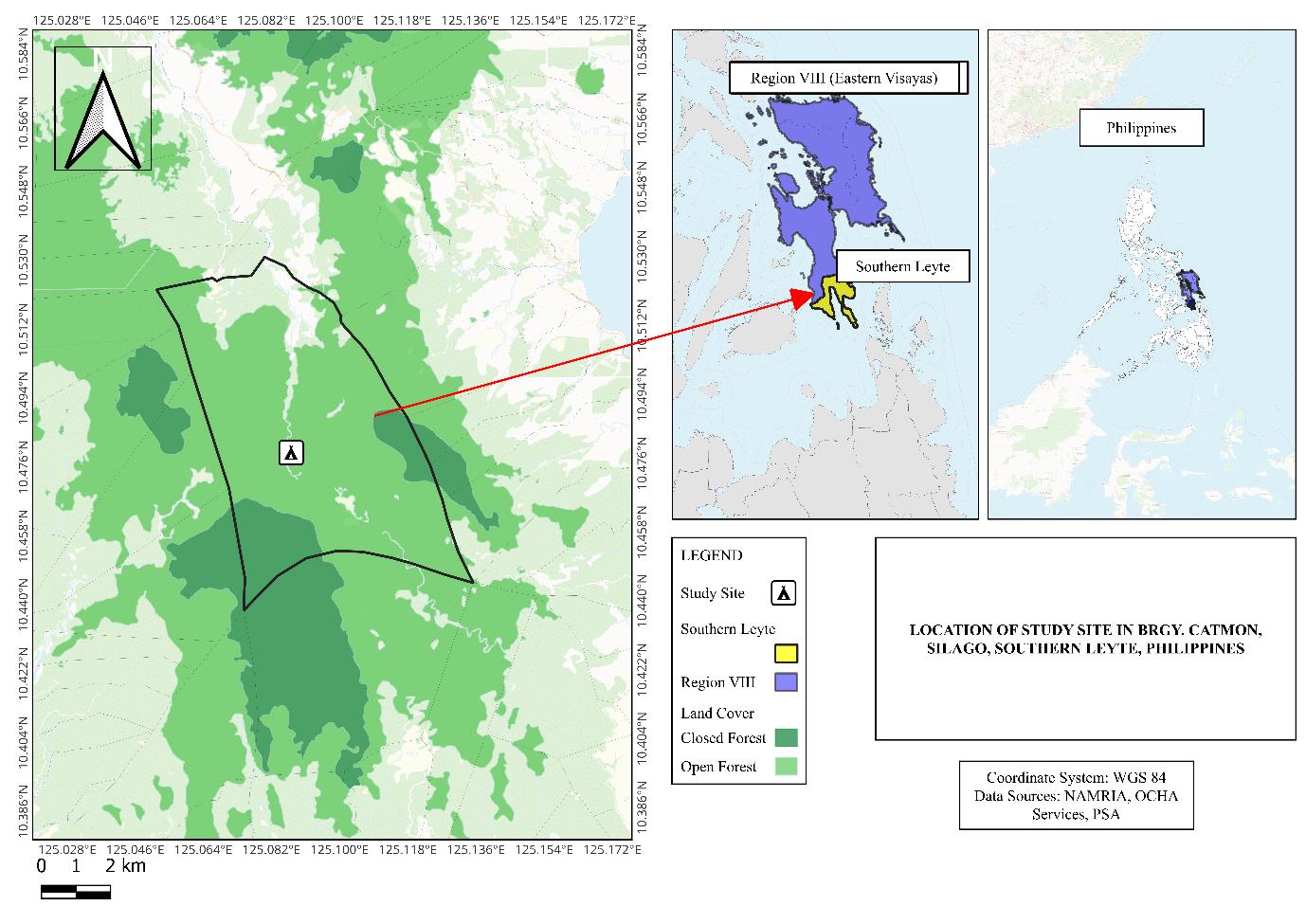
Tropical forests play a critical role in climate mitigation, yet long-term data on their carbon dynamics remain scarce, particularly in the Philippines. This study examines forest structure and carbon sequestration in a 1-hectare permanent plot established in a secondary forest on Mt. Nacolod, Southern Leyte, Philippines using 2012, 2016, and 2024 tree inventory data. The study aimed to (1) assess biomass and carbon storage trends, and (2) estimate the economic value of carbon. The secondary forest stored 202.4 Mg C/ha, comparable to reported values of old-growth forests in the Philippines. Its sequestration rate of 2.53 Mg C/ha/year is approximately nine times faster than old-growth forests and exceeds regional dipterocarp regrowth rates. Although sequestration slowed post-2016, the site remained a robust carbon sink. The estimated economic value of the stand’s carbon stock increased from USD 4,798 in 2012 to USD 7,220 in 2024, while carbon sequestered over the 12 years was valued at USD 1,076 under prevailing carbon credit prices. Key findings underscore the dominance of Dipterocarpaceae and the site’s high carbon sequestration capacity, emphasizing its critical role in regional climate mitigation strategies. Continuous monitoring reinforces its value as a long-term carbon sink, providing a benchmark for conservation and climate policy for tropical forests in the region.
Article Details

This work is licensed under a Creative Commons Attribution-NonCommercial 4.0 International License.
Published articles are under the copyright of the Environment and Natural Resources Journal effective when the article is accepted for publication thus granting Environment and Natural Resources Journal all rights for the work so that both parties may be protected from the consequences of unauthorized use. Partially or totally publication of an article elsewhere is possible only after the consent from the editors.
References
Abbass K, Qasim MZ, Song H, Murshed M, Mahmood H, Younis I. A review of the global climate change impacts, adaptation, and sustainable mitigation measures. Environmental Science and Pollution Research 2022;29(28):42539-59.
Abino AC, Castillo JAA, Lee YJ. Assessment of species diversity, biomass, and carbon sequestration potential of a natural mangrove stand in Samar, the Philippines. Forest Science and Technology 2014;10(1):2-8.
American Forest Foundation. A Trust for Permanence. Washington, DC: American Forest Foundation; 2025.
Araza A, De Bruin S, Herold M, Quegan S, Labriere N, Rodriguez-Veiga P, et al. A comprehensive framework for assessing the accuracy and uncertainty of global above-ground biomass maps. Remote Sensing of Environment 2022;272:Article No. 112917.
Asilo HAM, Yap-Dejeto LG. Understanding blue carbon management strategies: Quantitative assessment of blue carbon stock among three mangrove stands in Eastern Visayas, Philippines, W. Pacific Border. Carbon Research 2025;4(1):Article No. 63.
Baithalu S, Anbarashan M, Parthasarathy N. Two-decadal changes in forest structure and tree diversity in a tropical dry evergreen forest on the Coromandel Coast of India. Tropical Ecology 2013;54(3):397-403.
Barrera A, Aristirenas I, Tingzon J. Soil Survey of Leyte Province Philippines. Manila, Philippines: Bureau of Printing; 1954.
Beck HE, Zimmermann NE, McVicar TR, Vergopolan N, Berg A, Wood EF. Present and future Köppen-Geiger climate classification maps at 1-km resolution. Scientific Data 2018;5(1):Article No. 180214.
Becknell JM, Powers JS. Stand age and soils as drivers of plant functional traits and aboveground biomass in secondary tropical dry forest. Canadian Journal of Forest Research 2014;44(6):604-13.
Bonan GB. Forests and climate change: Forcings, feedbacks, and the climate benefits of forests. Science 2008;320(5882): 1444-9.
Brearley FQ, Adinugroho WC, Cámara-Leret R, Krisnawati H, Ledo A, Qie L, et al. Opportunities and challenges for an Indonesian forest monitoring network. Annals of Forest Science 2019;76(2):Article No. 54.
Brown S, Lugo AE. Aboveground biomass estimates for tropical moist forests of the Brazilian Amazon. Interciencia 1992;17(1):8-18.
Cabras AA, Senarillos TLP, Ibañez JC. Two new species of Metapocyrtus heller, 1912 (Curculionidae: Entiminae: Pachyrhynchini) from Leyte Island, Philippines. Ecologica Montenegrina 2023;67:66-76.
Carandang A, Bugayong L, Dolom P, Garcia L, Villanueva M, Espiritu N. Forestry Development Center, University of the Philippines Los Banos. Analysis of key drivers of deforestation and forest degradation in the Philippines. Germany: Deutsche Gesellschaft für Internationale Zusammenarbeit (GIZ) GmbH; 2013.
Chave J, Réjou-Méchain M, Búrquez A, Chidumayo E, Colgan MS, Delitti WBC, et al. Improved allometric models to estimate the aboveground biomass of tropical trees. Global Change Biology 2014;20(10):3177-90.
Chazdon RL, Redondo Brenes A, Vilchez Alvarado B. Effects of climate and stand age on annual tree dynamics in tropical second-growth rain forests. Ecology 2005;86(7):1808-15.
Condit R. Ecological implications of changes in drought patterns: Shifts in forest composition in Panama. Climatic Change 1998;39(2/3):413-27.
Cox PM, Betts RA, Jones CD, Spall SA, Totterdell IJ. Acceleration of global warming due to carbon-cycle feedbacks in a coupled climate model. Nature 2000;408(6809):184-7.
Cramer W, Bondeau A, Woodward FI, Prentice IC, Betts RA, Brovkin V, et al. Global response of terrestrial ecosystem structure and function to CO2 and climate change: Results from six dynamic global vegetation models. Global Change Biology 2001;7(4):357-73.
Dale VH, Joyce LA, McNulty S, Neilson RP. The interplay between climate change, forests, and disturbances. Science of the Total Environment 2000;262(3):201-4.
Dale VH, Rauscher HM. Assessing impacts of climate change on forests: The state of biological modeling. Climatic Change 1994;28:65-90.
Danardono, Haryono E, Widyastuti M. Potential of carbon stocks and its economic values in tropical karst landscape (case study in Biduk-Biduk Karst, East Kalimantan, Indonesia). Journal of Physics: Conference Series 2019;1373(1):Article No. 012030.
Deb JC, Rahman HMT, Roy A. Freshwater swamp forest trees of Bangladesh face extinction risk from climate change. Wetlands 2016;36(2):323-34.
Ediriweera S, Bandara C, Lakkana T, Jayasinghe S, Woodbury D, Dayanandan A, et al. Old-growth mixed dipterocarp forests show variable losses and gains in aboveground biomass and standing carbon over forty years. Forest Ecosystems 2024;11(1):Article No. 100163.
Elkin C, Gutiérrez AG, Leuzinger S, Manusch C, Temperli C, Rasche L, et al. A 2°C warmer world is not safe for ecosystem services in the European Alps. Global Change Biology 2013;19(6):1827-40.
Emerton L, Aung Y. Assessing, Demonstrating and Capturing the Economic Value of Marine and Coastal Ecosystem Services in the Bay of Bengal Large Marine Ecosystem. Phuket, Thailand: FAO Bay of Bengal Large Marine Ecosystem (BOBLME) Project; 2014.
Enviliance ASIA. The Philippines’ Legislative Initiatives on Carbon Crediting Systems. Enviliance ASIA [Internet]. 2023 [cited 2025 Apr 5]. Available from: https://enviliance.com/ regions/southeast-asia/ph/ph-carbon-credit.
Fernando E, Suh MH, Lee J, Lee DK. Forest Formations of the Philippines. Seoul, Korea: ASEAN-Korea environmental cooperation unit (AKECU); 2008.
Fuss S, Golub A, Lubowski R. The economic value of tropical forests in meeting global climate stabilization goals. Global Sustainability 2021;4:e1.
Gallant K, Withey P, Risk D, van Kooten GC, Spafford L. Measurement and economic valuation of carbon sequestration in Nova Scotian Wetlands. Ecological Economics 2020; 171:Article No. 106619.
Hairiah K, Sitompul S. Assessment and Simulation of Aboveground and Belowground C Stocks and Dynamics. Bogor, Indonesia: CDM IC-SEA, BIOTROP; 2000.
Hamrick K, Gallant M. Unlocking Potential: State of the Voluntary Carbon Markets 2017. Washington, DC: Forest Trends’ Ecosystem Marketplace; 2017.
Heriansyah I, Miyakuni K, Kato T, Kiyono Y, Kanazawa Y. Growth characteristics and biomass accumulations of Acacia mangium under different management practices in Indonesia. Journal of Tropical Forest Science 2007;19(3):226-35.
Huo LZ, Boschetti L, Sparks AM. Object-based classification of forest disturbance types in the conterminous United States. Remote Sensing 2019;11(5):Article No. 477.
Hussainzad EA, Mohd Yusof MJ. Assessing the economic value of carbon sequestration in Taman Negara Pahang. IOP Conference Series: Earth and Environmental Science 2020;540(1):Article No. 012058.
Intergovernmental Panel on Climate Change (IPCC). Summary for Policymakers. In: Climate Change 2022—Mitigation of Climate Change. Cambridge, UK: Cambridge University Press; 2023. p. 3-48.
Jarvis A, Reuter HI, Nelson A, Guevara E. Hole-filled SRTM for the Globe Version 4 [Internet]. 2008 [cited 2025 Apr 5]. Available from: https://srtm.csi.cgiar.org.
Jones IL, DeWalt SJ, Lopez OR, Bunnefeld L, Pattison Z, Dent DH. Above- and belowground carbon stocks are decoupled in secondary tropical forests and are positively related to forest age and soil nutrients respectively. Science of the Total Environment 2019;697:Article No. 133987.
Kaarakka L, Cornett M, Domke G, Ontl T, Dee LE. Improved forest management as a natural climate solution: A review. Ecological Solutions and Evidence 2021;2(3):e12090.
Kayode JO. Improved Logging in Tropical Rainforest for Carbon Sequestration: A Case Study in Borneo, Malaysia [dissertation]. Umeå: Swedish University of Agricultural Sciences; 2024.
Kurz WA, Stinson G, Rampley GJ, Dymond CC, Neilson ET. Risk of natural disturbances makes future contribution of Canada’s forests to the global carbon cycle highly uncertain. Proceedings of the National Academy of Sciences 2008;105(5):1551-5.
Langenberger G, Belonias B. The status of floristic analysis of Mt. Pangasugan, Leyte, Philippines – a conservation priority area classified as “Extremely High Critical.” Annals of Tropical Research 2011;33(2):1-21.
Lasco RD, Guillermo IQ, Cruz RVO, Bantayan NC, Pulhin FB. Carbon stocks assessment of a secondary forest in Mount Makiling Forest Reserve, Philippines. Journal of Tropical Forest Science 2004;16(1):35-45.
Lasco RD, Pulhin F. Carbon budgets of forest ecosystem in the Philippines. Journal of Environmental Science and Management 2009;12(1):1-13.
Lasco RD, Pulhin FB. Philippine forest ecosystems and climate change: Carbon stocks, rate of sequestration and the Kyoto Protocol. Annals of Tropical Research 2003;25(2):37-51.
Li Y, Nyongesah MJ, Deng L, Haider FU, Liu S, Mwangi BN, et al. Clustered tree size analysis of bio-productivity of Dinghushan National Nature Reserve in China. Frontiers in Ecology and Evolution 2023;11:Article No. 1118175.
Malhi Y, Baker TR, Phillips OL, Almeida S, Alvarez E, Arroyo L, et al. The above-ground coarse wood productivity of 104 Neotropical forest plots. Global Change Biology 2004;10(5):563-91.
Mallari NAD, Rico ELB, de Alban JD, Diesmos AC, Altamirano R, Puna N, et al. Biodiversity Baseline Assessment in the REDD-Plus Pilot and Key Biodiversity Area in Mt. Nacolod, Southern Leyte. Manila, Philippines: Deutsche Gesellschaft für Internationale Zusammenarbeit GmbH; 2014.
Marcos-Martinez R, Bryan BA, Schwabe KA, Connor JD, Law EA, Nolan M, et al. Projected social costs of CO2 emissions from forest losses far exceed the sequestration benefits of forest gains under global change. Ecosystem Services 2019;37:Article No. 100935.
Meniano S. DENR reactivates task force to protect E. Visayas Forest [Internet]. 2024 [cited 2025 Apr 5]. Available from: https://www.pna.gov.ph/articles/1231147.
Millar CI, Stephenson NL. Temperate forest health in an era of emerging megadisturbance. Science 2015;349(6250):823-6.
Mori AS, Dee LE, Gonzalez A, Ohashi H, Cowles J, Wright AJ, et al. Biodiversity-productivity relationships are key to nature-based climate solutions. Nature Climate Change 2021; 11(6):543-50.
Murthy IK, Bhat S, Sathyanarayan V, Patgar S, Beerappa M, Bhat PR, et al. Vegetation structure and composition of tropical evergreen and deciduous forests in Uttara Kannada District, Western Ghats under different disturbance regimes. Tropical Ecology 2016;57(1):77-88.
Nelson BW, Mesquita R, Pereira JLG, de Souza SGA, Batista GT, Couto LB. Allometric regressions for improved estimate of secondary forest biomass in the central Amazon. Forest Ecology and Management 1999;117(1):149-67.
NewCAPP. Managing the Mt. Nacolod landscape: A shared conservation challenge. Quezon City, Philippines: New Conservation Areas in the Philippines Project; 2014.
Ngo KM, Turner BL, Muller-Landau HC, Davies SJ, Larjavaara M, Nik Hassan NFB, et al. Carbon stocks in primary and secondary tropical forests in Singapore. Forest Ecology and Management 2013;296:81-9.
Oberleitner F, Egger C, Oberdorfer S, Dullinger S, Wanek W, Hietz P. Recovery of aboveground biomass, species richness and composition in tropical secondary forests in SW Costa Rica. Forest Ecology and Management 2021;479:Article No. 118580.
Ordoñez JC, Pinto E, Bernardi A, Cuesta F. Tree mortality and recruitment in secondary Andean tropical mountain forests along a 3,000 m elevation gradient. PLoS One 2024;19(3):e0300114.
Pache R-G, Abrudan IV, Niță M-D. Economic valuation of carbon storage and sequestration in Retezat National Park, Romania. Forests 2020;12(1):Article No. 43.
Pan Y, Birdsey RA, Fang J, Houghton R, Kauppi PE, Kurz WA, et al. A large and persistent carbon sink in the world’s forests. Science 2011;333(6045):988-93.
Pan Y, Birdsey RA, Phillips OL, Houghton RA, Fang J, Kauppi PE, et al. The enduring world forest carbon sink. Nature 2024;631(8021):563-9.
PennState Extension. Methods for estimating carbon within forests [Internet]. 2023 [cited 2025 Apr 5]. Available from: https://extension.psu.edu/methods-for-estimating-carbon-within-forests.
Peters F, Lippe M, Eguiguren P, Günter S. Forest ecosystem services at landscape level - why forest transition matters? Forest Ecology and Management 2023;534:Article No. 120782.
Peters-Stanley M, Gonzalez G, Yin D. Covering New Ground: State of the Forest Carbon Markets 2013. Washington, DC: Forest Trends’ Ecosystem Marketplace; 2013.
Philippine Tropical Forest Conservation Foundation. Terminal Report. Community-Based Forest Restoration and Biodiversity Protection and Management of Lowland Dipterocarp Forests in Silago, Southern Leyte. Philippines: Philippine Tropical Forest Conservation Foundation; 2013.
Phillips OL. Sensing forests directly: The power of permanent plots. Plants 2023;12(21):Article No. 3710.
Phillips OL, Baker TR, Arroyo L, Higuchi N, Killeen TJ, Laurance WF, et al. Pattern and process in Amazon tree turnover, 1976-2001. Philosophical Transactions of the Royal Society of London Series B: Biological Sciences 2004;359(1443):381-407.
Phillips OL, Gentry AH. Increasing turnover through time in tropical forests. Science 1994;263(5149):954-8.
Piamonte MK, Asio V, Lina S. Morpho-physical and chemical characteristics of strongly weathered soils in Silago, Southern Leyte, Philippines. Annals of Tropical Research 2014; 36(2):115-47.
Poorter L, Bongers F, Aide TM, Almeyda Zambrano AM, Balvanera P, Becknell JM, et al. Biomass resilience of Neotropical secondary forests. Nature 2016;530(7589):211-4.
Procton A. On the Path to Maturity: State of the Voluntary Carbon Markets 2024. Washington (DC): Forest Trends Association; 2024.
Racelis E, Racelis D, Luna A. Carbon sequestration by large leaf mahogany (Swietenia macrophylla King.) plantation in Mount Makiling forest reserve, Philippines: A decade after. Journal of Environmental Science and Management 2019;22(1): Article No. 1.
Raga-as M. Comparison of Carbon Benefits between Natural and Plantation Forests in Aurora Province, Philippines [dissertation]. Los Baños, Philippines: University of the Philippines Los Baños; 2004.
Raihan A, Begum R, Nizam M. A meta-analysis of the economic value of forest carbon stock. Malaysian Journal of Society and Space 2021;17(4):Article No. 22.
Reyer C, Lasch-Born P, Suckow F, Gutsch M, Murawski A, Pilz T. Projections of regional changes in forest net primary productivity for different tree species in Europe driven by climate change and carbon dioxide. Annals of Forest Science 2014;71(2):211-25.
Reyer CPO, Bathgate S, Blennow K, Borges JG, Bugmann H, Delzon S, et al. Are forest disturbances amplifying or canceling out climate change-induced productivity changes in European forests? Environmental Research Letters 2017;12(3):Article No. 034027.
Roy J, Saugier B, Mooney HA. Terrestrial Global Productivity. San Diego, CA: Academic Press; 2001.
Rumahorbo BT, Keiluhu HJ, Hamuna B. The economic valuation of mangrove ecosystem in Youtefa Bay, Jayapura, Indonesia. Ecological Questions 2019;30(1):47-54.
Scheinkman JA. Carbon prices and reforestation in tropical forest [Internet]. 2024 [cited 2025 Apr 5]. Available from: https://www.bis.org/publ/work1223.htm.
Seidl R, Thom D, Kautz M, Martin-Benito D, Peltoniemi M, Vacchiano G, et al. Forest disturbances under climate change. Nature Climate Change 2017;7(6):395-402.
Siregar CA, Heriyanto NM. Accumulation of carbon biomass under secondary forest scenario in Maribaya, Bogor, West Java. Jurnal Penelitian Hutan dan Konservasi Alam 2010;7(2):215-26.
Stephenson NL, Das AJ, Condit R, Russo SE, Baker PJ, Beckman NG, et al. Rate of tree carbon accumulation increases continuously with tree size. Nature 2014;507(7490):90-3.
Subiandono E, Bismark M, Heriyanto N. The ability of Avicennia marina (Forsk.) Vierh. and Rhizophora apiculata Bl. in absorbing heavy metal pollutants. Jurnal Penelitian Hutan Dan Konservasi Alam 2013;10(1):93-102 (in Indonesian).
Tian L, Tong Y, Cheng Y, Li M, Letcher SG, Zang R, et al. Drought diminishes aboveground biomass accumulation rate during secondary succession in a tropical forest on Hainan Island, China. Forest Ecology and Management 2023; 544:Article No. 121222.
Trumbore S, Brando P, Hartmann H. Forest health and global change. Science 2015;349(6250):814-8.
United Nations Development Programme. Forest Carbon Accounting: Overview and Principles. New York, NY: UNDP; 2015.
UN-REDD Programme. Pricing Forest Carbon: Implications of the Average Cost of REDD+ Emission Reductions. Nairobi, Kenya: United Nations Environment Programme; 2023.
Veridiano RK, Schröder JM, Come R, Baldos A, Günter S. Towards forest landscape restoration programs in the Philippines: Evidence from logged forests and mixed-species plantations. Environments 2020;7(3):Article No. 3.
Whitehead D. Forests as carbon sinks—benefits and consequences. Tree Physiology 2011;31(9):893-902.
