Land Use and Land Cover Dynamics of Small Inhabited Islands in South Bangka, Bangka Belitung, Indonesia (2004-2024) 10.32526/ennrj/24/20250333
Article Sidebar
Main Article Content
Abstract
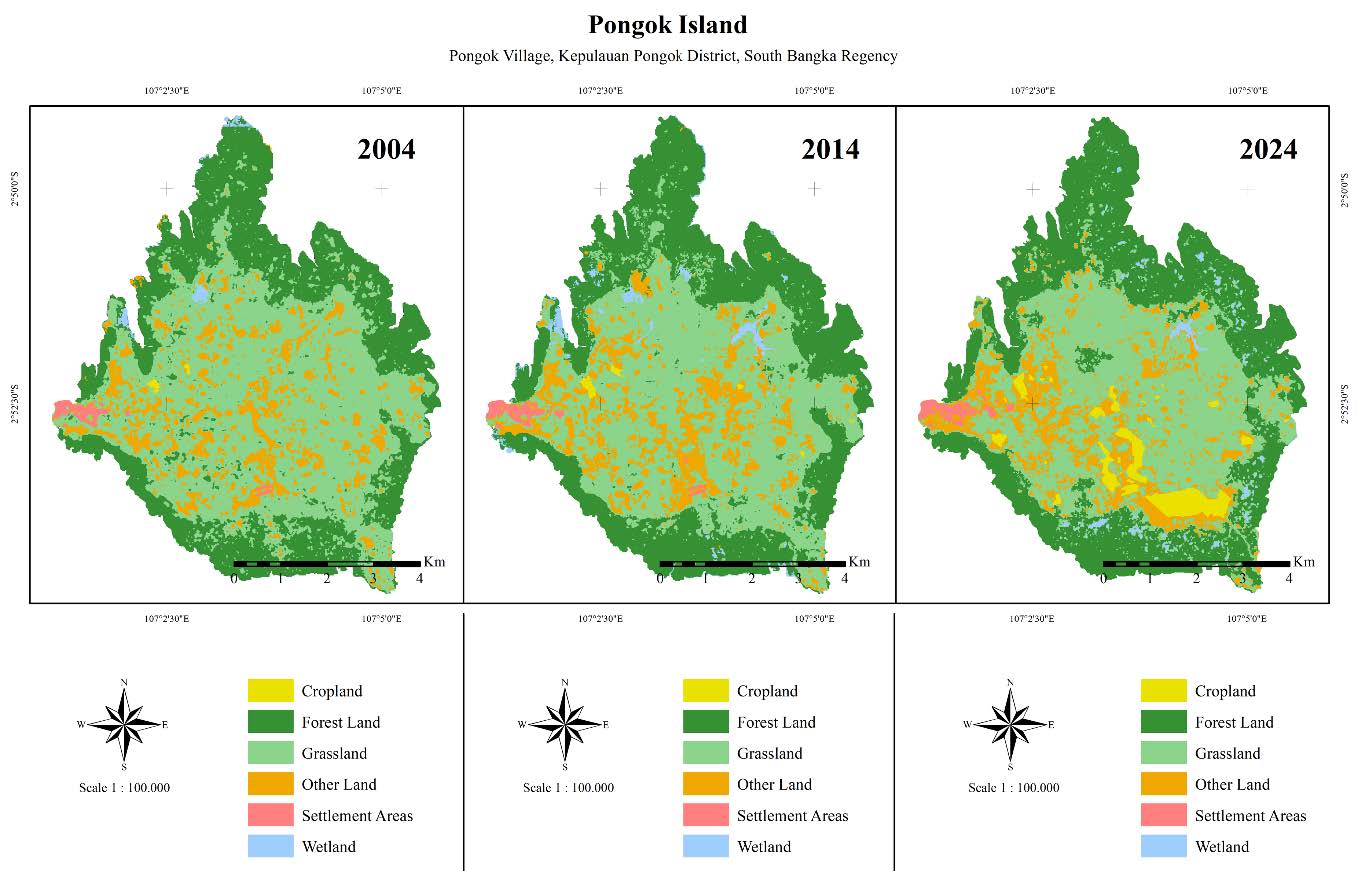
Anthropogenic land use and cover changes pose a significant threat to small island ecosystems, yet systematic monitoring remains limited. This study analyzes LULC dynamics over 20 years (2004-2024) on three inhabited islands in South Bangka, Bangka Belitung, Indonesia. The objectives were to assess LULC changes, evaluate their impacts on biodiversity, and examine the effectiveness of existing policies using multi-temporal Landsat and Sentinel-2 imagery. The supervised classification achieved an overall accuracy of 85.3-91.2% with Kappa coefficients of 0.82-0.89, indicating substantial to nearly perfect agreement. The results revealed distinct transformation patterns across the islands. Tinggi Island demonstrated resilience through the recovery of secondary dryland forests (from 68.52 ha to 113.48 ha), despite the presence of illegal tin mining activities that created artificial wetland systems. In contrast, Kelapan Island faced severe degradation, with extensive forest loss and habitat fragmentation. This resulted in a 29.5% decline in mean patch size and a critical loss of connectivity. Conversely, Pongok Island showcased successful conservation efforts, significantly expanding its mangrove ecosystem, which enhanced its blue carbon capacity, even amid agricultural intensification. The assessment of biodiversity impacts confirmed that maintaining patch sizes above 20 hectares and ensuring high connectivity are essential thresholds for species conservation. However, current LULC management policies demonstrate limited effectiveness due to regulatory gaps between marine and terrestrial governance frameworks. The study concludes that integrated conservation strategies, including adaptive management and corridor restoration, are urgently needed to balance development pressures with the preservation of ecosystem integrity.
Article Details

This work is licensed under a Creative Commons Attribution-NonCommercial 4.0 International License.
Published articles are under the copyright of the Environment and Natural Resources Journal effective when the article is accepted for publication thus granting Environment and Natural Resources Journal all rights for the work so that both parties may be protected from the consequences of unauthorized use. Partially or totally publication of an article elsewhere is possible only after the consent from the editors.
References
Achmad B, Sanudin B, Siarudin M, Widiyanto A, Diniyati D, Sudomo A, et al. Traditional Subsistence Farming of Smallholder Agroforestry Systems in Indonesia: A Review. Sustainability (Switzerland) 2022;14(7):Article No. 8631.
Ahmed R, Mahmud KH, Hafsa B, Tuya JH, Reza E, Coalee UM. Climate change impact on land use and land cover change on Saint Martin’s Island, Bangladesh. Journal of Coastal Conservation 2023;27(4):Article No. 26.
Alongi DM. Global significance of mangrove blue carbon in climate change mitigation. Science 2020;2(3):60-7.
Baidoo R, Arko-Adjei A, Poku-Boansi M, Quaye-Ballard JA, Somuah DP. Land use and land cover changes implications on biodiversity in the Owabi catchment of Atwima Nwabiagya North District, Ghana. Heliyon 2023;9(5):Article No. 15238.
Cameron C, Hutley LB, Friess DA, Brown B. Community structure dynamics and carbon stock change of rehabilitated mangrove forests in Sulawesi, Indonesia. Ecological Applications 2019;29(1):e01810.
Carugati L, Gatto B, Rastelli E, Lo Martire M, Coral C, Greco S, et al. Impact of mangrove forest degradation on biodiversity and ecosystem functioning. Scientific Reports 2018;8:Article No. 13298.
Chen C, Yang X, Jiang S, Liu Z. Mapping and spatiotemporal dynamics of land-use and land-cover change based on the Google Earth Engine cloud platform from Landsat imagery: A case study of Zhoushan Island, China. Heliyon 2023;9(9):Article No. 19654.
Congalton RG, Green K. Assessing the Accuracy of Remotely Sensed Data. Principles. Boca Raton: CRC Press; 2019.
Crouzeilles R, Ferreira MS, Chazdon RL, Lindenmayer DB, Sansevero JBB, Monteiro L, et al. Ecological restoration success is higher for natural regeneration than for active restoration in tropical forests. Science Advances 2017;3(11):Article No. 1701345.
Dastour H, Hassan QK. A comparison of deep transfer learning methods for land use and land cover classification. Sustainability (Switzerland) 2023;15(5):Article No. 7854.
Desjardins É, Lai S, Houle L, Caron A, Thériault V, Tam A, et al. Algorithms and predictors for land cover classification of polar deserts: A case study highlighting challenges and recommendations for future applications. Remote Sensing 2023;15(12):Article No. 3090.
Duan X, Haseeb M, Tahir Z, Mahmood SA, Tariq A. Analyzing and predicting land use and land cover dynamics using multispectral high-resolution imagery and hybrid CA-Markov modeling. Land Use Policy 2025;157(6):Article No. 107655.
Eddy S, Milantara N, Sasmito SD, Kajita T, Basyuni M. Anthropogenic drivers of mangrove loss and associated carbon emissions in South Sumatra, Indonesia. Forests 2021;12(2):Article No. 187.
Fahrig L. Ecological responses to habitat fragmentation per Se. Annual Review of Ecology, Evolution, and Systematics 2017;48:1-23.
Faizal A, Pratama IA, Hamzah A, Amran MA, Samad W, Werorilangi S, et al. Spatio-temporal dynamics of mangrove ecosystems using remote sensing and machine learning in Google Earth Engine: A case study of Tongke-Tongke, Indonesia. Proceedings of the 8th The International Symposium on Marine and Fisheries (SYMARFISH 2025); 2025 June 15; Unhas Hotel and Convention, Makassar: Indonesia; 2025.
Faruque MJ, Hasan MY, Islam KZ, Young B, Ahmed MT, Monir MU, et al. Monitoring of land use and land cover changes by using remote sensing and GIS techniques at human-induced mangrove forests areas in Bangladesh. Remote Sensing Applications: Society and Environment 2022;25(1):Article No. 100699.
Gaines WL, Hessburg PF, Aplet GH, Henson P, Prichard SJ, Churchill DJ, et al. Climate change and forest management on federal lands in the Pacific Northwest, USA: Managing for dynamic landscapes. Forest Ecology and Management 2022;504(10):Article No. 119794.
Gómez C, White JC, Wulder MA. Optical remotely sensed time series data for land cover classification: A review. ISPRS Journal of Photogrammetry and Remote Sensing 2016;116(3):55-72.
Gunawan H, Mulyanto B, Suharti S, Subarudi S, Ekawati S, Karlina E, et al. Forest land redistribution and its relevance to biodiversity conservation and climate change issues in Indonesia. Forest Science and Technology 2024a;20(2):213-28.
Gunawan H, Setyawati T, Atmoko T, Subarudi, Kwatrina RT, Yeny I, et al. A review of forest fragmentation in Indonesia under the DPSIR framework for biodiversity conservation strategies. Global Ecology and Conservation 2024b;51(3): Article No. 02918.
Hazwan M, Samantha LD, Tee SL, Kamarudin N, Norhisham AR, Lechner AM, et al. Habitat fragmentation and logging affect the occurrence of lesser mouse-deer in tropical forest reserves. Ecology and Evolution 2022;12(3):Article No. 8745.
Hemati M, Hasanlou M, Mahdianpari M, Mohammadimanesh F. A systematic review of Landsat data for change detection applications: 50 years of monitoring the earth. Remote Sensing 2021;13(15):Article No. 2869.
Kauffman JB, Adame MF, Arifanti VB, Schile-Beers LM, Bernardino AF, Bhomia RK, et al. Total ecosystem carbon stocks of mangroves across broad global environmental and physical gradients. Ecological Monographs 2020;90(2): Article No. 1405.
Kelman I. Islandness within climate change narratives of Small Island Developing States (SIDS). Island Studies Journal 2018;13(1):149-66.
Khakurel P, Leigh L, Kaewmanee M, Pinto CT. Extended pseudo-invariant site-based trend-to-trend cross-calibration of optical satellite sensors. Remote Sensing 2021;13(8):Article No. 1545.
Kueffer C, Kinney K. What is the importance of islands to environmental conservation? Environmental Conservation 2017;44(4):311-22.
Kusiima SK, Egeru A, Namaalwa J, Byakagaba P, Nfitumukiza D, Mukwaya P. Anthropogenic induced land use/cover change dynamics of Budongo-Bugoma landscape in the Albertine region, Uganda. Egyptian Journal of Remote Sensing and Space Science 2022;25(3):639-49.
Lacambra S CL, Spencer T, Munera C, Pizarro V, Lozano-Rivera P, Esquivel C, et al. Coastal ecosystems contribution to climate adaptation and disasters risk management in the tropical Americas. Nature-Based Solutions 2024;5(1):Article No. 100112.
Landis JR, Koch GG. Landis and Koch agreement on categorical data. Biometrics 1977;33(1):159-74.
Legleiter CJ, Stegman TK, Overstreet BT. Spectrally based mapping of riverbed composition. Geomorphology 2016;264(4):61-79.
Lennert J, Farkas JZ, Kovács AD, Molnár A, Módos R, Baka D, et al. Measuring and predicting long-term land cover changes in the functional urban area of Budapest. Sustainability (Switzerland) 2020;12(8):Article No. 3331.
Li S, Wang L, Zhao S, Gui F, Le Q. Landscape ecological risk assessment of Zhoushan Island Based on LULC Change. Sustainability (Switzerland) 2023;15(12):Article No. 9507.
Li W, Guo WY, Pasgaard M, Niu Z, Wang L, Chen F, et al. Unmanaged naturally regenerating forests approach intact forest canopy structure but are susceptible to climate and human stress. One Earth 2024;7(6):1068-81.
Lindenmayer DB. Forest biodiversity declines and extinctions linked with forest degradation: A case study from Australian Tall, wet forests. Land 2023;12(3):Article No. 528.
Loos J, Hanspach J, von Wehrden H, Beldean M, Moga CI, Fischer J. Developing robust field survey protocols in landscape ecology: A case study on birds, plants and butterflies. Biodiversity and Conservation 2015;24(1):33-46.
Masek JG, Wulder MA, Markham B, McCorkel J, Crawford CJ, Storey J, et al. Landsat 9: Empowering open science and applications through continuity. Remote Sensing of Environment 2020;248(10):Article No. 111968.
Mashala MJ, Dube T, Mudereri BT, Ayisi KK, Ramudzuli MR. A systematic review on advancements in remote sensing for assessing and monitoring land use and land cover changes impacts on surface water resources in semi-arid tropical environments. Remote Sensing 2023;15(16):Article No. 3926.
McGarigal K, Cushman S, Ene E. FRAGSTATS V4: Spatial pattern analysis program for categorical and continuous maps [Internet]. 2012. [cited 2025 Aug 18]. Available from: http://www.umass.edu/landeco/research/fragstats/ fragstats.html.
Médail F. The specific vulnerability of plant biodiversity and vegetation on Mediterranean islands in the face of global change. Regional Environmental Change 2017;17(6):1775-90.
Miller MA, Tonoto P. Leveraging plural valuations of mangroves for climate interventions in Indonesia. Sustainability Science 2023;18(3):1533-47.
Mukul SA, Herbohn J, Firn J. Rapid recovery of tropical forest diversity and structure after shifting cultivation in the Philippines uplands. Ecology and Evolution 2020;10(14): 7189-211.
Musselli I, Sonderegger G. Trade and biodiversity loss: Disentangling the complexities for effective policy action. Ecology and Society 2025;30(3):Article No. 1.
Obura DO, DeClerck F, Verburg PH, Gupta J, Abrams JF, Bai X, et al. Achieving a nature- and people-positive future. One Earth 2023;6(2):105-17.
Oktavia D, Pratiwi SD, Kamaludin NN, Widiawaty MA, Dede M. Dynamics of land use and land cover in the Belitung Island, Indonesia. Heliyon 2024;10(12):Article No. 33291.
Pham TD, Xia J, Ha NT, Bui DT, Le NN, Tekeuchi W. A review of remote sensing approaches for monitoring blue carbon ecosystems: Mangroves, seagrasses and salt marshes during 2010-2018. Sensors (Switzerland) 2019;19(8):Article No. 1933.
Phiri D, Morgenroth J. Developments in Landsat land cover classification methods: A review. Remote Sensing 2017;9(9):Article No. 967.
Pical VJ, Rahman R. Alternative livelihoods of traditional fishermen as the impact of climate change in Ambon City. Egyptian Journal of Aquatic Biology and Fisheries 2025; 29(1):243-65.
Pratiwi, Narendra BH, Siregar CA, Iskandar, Mulyanto B, Suwardi, et al. Tin mining and post-tin mining reclamation initiatives in Indonesia: With Special reference to Bangka Belitung Areas. Land 2025;14(10):Article No. 1947.
Purnama MI, Çoban HO. Dynamic trajectories of land use and land cover changes in Lombok Island, West Nusa Tenggara, Indonesia. Turkish Journal of Forestry 2024;25(4):447-58.
Puyravaud J. Standardizing the calculation of the annual rate of deforestation. Forest Ecology and Management 2003;177(1-3):593-6.
Rachman F, Huang J, Xue X, Marfai MA. Insights from 30 years of land use/land cover transitions in Jakarta, Indonesia, via intensity analysis. Land 2024;13(4):Article No. 545.
Radeloff VC, Roy DP, Wulder MA, Anderson M, Cook B, Crawford CJ, et al. Need and vision for global medium-resolution Landsat and Sentinel-2 data products. Remote Sensing of Environment 2024;300:Article No. 113918.
Reek JE, Crowther TW, Lauber T, Schemm S, Parastatidis D, Chrysoulakis N, et al. Forest edges are globally warmer than interiors and exceed optimal temperatures for vegetation productivity. Communications Earth and Environment 2025;6:Article No. 635.
Reksa AFA, Lissandhi AN, Syahid CN. Reimagining future island: The COVID-19 impacts on tourism sector in Small Island Developing States (SIDS) and strategies to moving forward. Journal of Indonesian Social Sciences and Humanities 2021;11(1):31-42.
Révillion C, Attoumane A, Herbreteau V. Homisland-io: Homogeneous land use/land cover over the small islands of the indian ocean. Data 2019;4(2):Article No. 82.
Rimmer MA, Larson S, Lapong I, Purnomo AH, Pong‐masak PR, Swanepoel L, et al. Seaweed aquaculture in Indonesia contributes to social and economic aspects of livelihoods and community wellbeing. Sustainability (Switzerland) 2021; 13(19):Article No. 946.
Saoum MR, Sarkar SK. Monitoring mangrove forest change and its impacts on the environment. Ecological Indicators 2024;159(1):Article No. 111666.
Saravia LA, Doyle SR, Bond-Lamberty B. Power laws and critical fragmentation in global forests. Scientific Reports 2018;8(1):Article No. 17766.
Setiawati MD, Nandika MR, Supriyadi IH, Iswari MY, Prayudha B, Wouthuyzen S, et al. Climate change and anthropogenic pressure on Bintan Islands, Indonesia: An assessment of the policies proposed by local authorities. Regional Studies in Marine Science 2023;66:Article No. 103123.
Shrestha M, Hasan MN, Leigh L, Helder D. Extended pseudo-invariant calibration sites (EPICS) for the cross-calibration of optical satellite sensors. Remote Sensing 2019;11(14):Article No. 1676.
Singh S, Bhardwaj A, Verma VK. Remote sensing and GIS-based analysis of temporal land use/land cover and water quality changes in the Harike wetland ecosystem, Punjab, India. Journal of Environmental Management 2020;262:Article No. 110355.
Sisay G, Gessesse B, Kassie M, Kebede B, de Aza CH. Exploring drivers of land use/land cover transformations in Goang watershed Ethiopia: Integrating local community perceptions with remote sensing data. Environmental Challenges 2024;17:Article No. 101043.
Smith HE, Ryan CM, Vollmer F, Woollen E, Keane A, Fisher JA, et al. Impacts of land use intensification on human wellbeing: Evidence from rural Mozambique. Global Environmental Change 2019;59:Article No. 101976.
Taillardat P, Friess DA, Lupascu M. Mangrove blue carbon strategies for climate change mitigation are most effective at the national scale. Biology Letters 2018;14(10):Article No. 251.
Timmers R, Côrtes MC, van Kuijk M, Canassa GG, Staneke R, Rosin FSO, et al. Landscape-scale forest cover shapes the complexity of seed-dispersal networks in regenerating forest fragments. Biological Conservation 2025;309(6):Article No. 111312.
Tolessa T, Kidane M, Bezie A. Assessment of the linkages between ecosystem service provision and land use/land cover change in Fincha watershed, North-Western Ethiopia. Heliyon 2021;7:Article No. 7673.
Tripathi S, Subedi R, Adhikari H. Forest cover change pattern after the intervention of community forestry management system in the mid-hill of Nepal: A case study. Remote Sensing 2020;12(17):Article No. 2756.
United Nations Environment Programme (UNEP). The Sustainable Development Goals Report. New York: United Nations; 2023.
Wintle BA, Kujala H, Whitehead A, Cameron A, Veloz S, Kukkala A, et al. Global synthesis of conservation studies reveals the importance of small habitat patches for biodiversity. Proceedings of the National Academy of Sciences of the United States of America 2018;116(3):909-14.
Yan Y, Jarvie S, Zhang Q, Han P, Liu Q, Zhang S, et al. Habitat heterogeneity determines species richness on small habitat islands in a fragmented landscape. Journal of Biogeography 2023;50(5):976-86.
Yetein MH, Houessou LG, Amadou Siako AS, Gbodja GT, Oumorou M. The impacts of land use/land cover changes on ecosystem service values in coastal lagoon landscapes of the 1017 Ramsar site, Benin. Scientific African 2025;28:Article No. 2695.
Zhang A, Tariq A, Quddoos A, Naz I, Aslam RW, Barboza E, et al. Spatio-temporal analysis of urban expansion and land use dynamics using Google Earth Engine and predictive models. Scientific Reports 2025a;15(1):Article No. 6993.
Zhang Y, Luo Y, Han L, Chen K, Wang Z, Yang Q. Importance of patches in maintaining forest landscape connectivity: A case study of Barluk, Xinjiang, China. Forests 2025b;16(1):Article No. 74.
