Identifying Geospatial Priority Hotspots of Tourism Sustainability Risk using a Destination Sustainability Index (DSI) Devised from Online Tourist Dissatisfaction and Getis-Ord Gi* Statistics 10.32526/ennrj/24/20250343
Article Sidebar
Main Article Content
Abstract
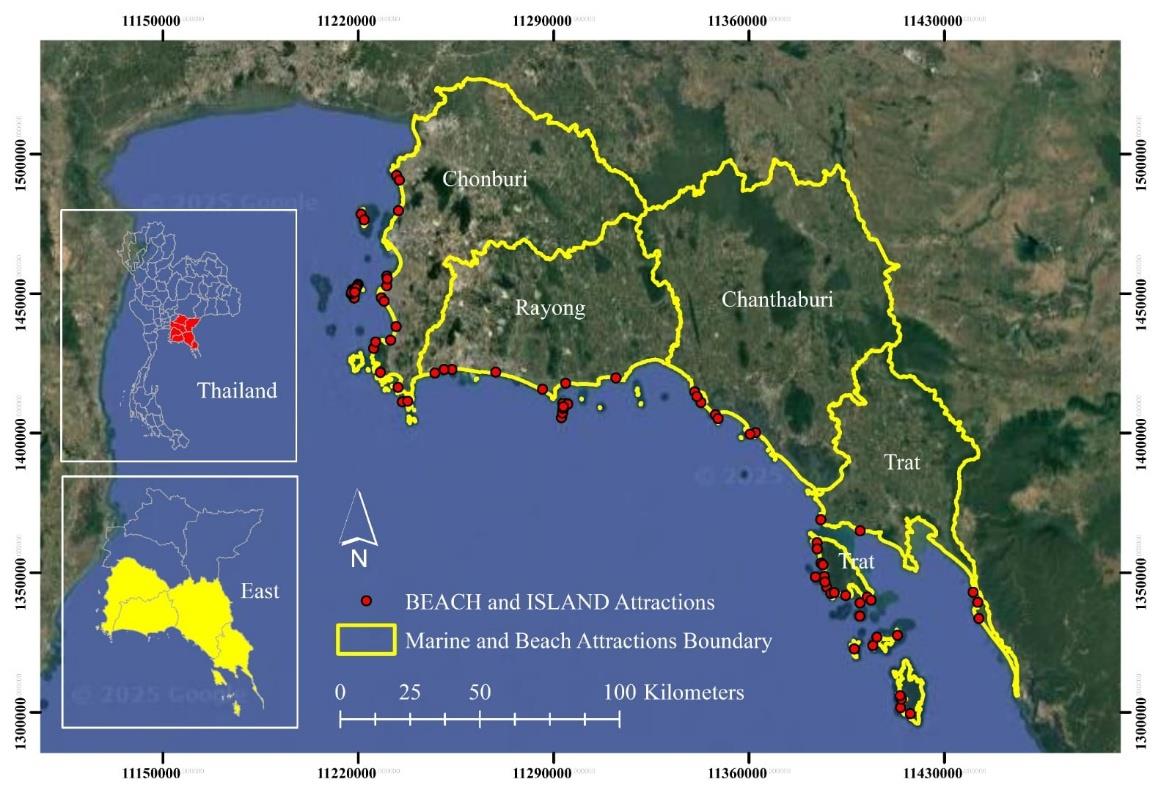
Managing tourism sustainability effectively requires identifying specific localized risks, which remains a significant challenge for many destinations. This research aims to identify priority hotspots of unsustainability in marine and beach tourism destinations in Eastern Thailand by employing geospatial analysis and tourist-perceived data to support targeted policy decisions. Drawing from 11,047 geotagged Tripadvisor reviews as a primary data source, the methodology commenced with processing these reviews using a high-precision transformer-based (BERT) sentiment analysis model, achieving 87% precision in the negative class. This was followed by N-gram analysis to extract specific problem phrases, which were used to construct the Destination Sustainability Index (DSI) across three main dimensions: Environmental (DSIEnv), Congestion/Access (DSIAcc), and Service/Value (DSISrv). The DSI was then subjected to hotspot analysis (Getis-Ord Gi*) to confirm the statistical significance of spatial clustering. Results confirm that Environmental problems (rubbish/dirty) and Congestion/Access issues (crowded, boat) are the most frequent concerns. The analysis clearly demonstrated that tourism dissatisfaction is not randomly distributed but localized in statistically significant spatial locations. Priority hotspots showing overlapping risks in Chonburi Province require immediate intervention, while the successful management of the Koh Kood cluster offers a blueprint for sustainable development.
Article Details

This work is licensed under a Creative Commons Attribution-NonCommercial 4.0 International License.
Published articles are under the copyright of the Environment and Natural Resources Journal effective when the article is accepted for publication thus granting Environment and Natural Resources Journal all rights for the work so that both parties may be protected from the consequences of unauthorized use. Partially or totally publication of an article elsewhere is possible only after the consent from the editors.
References
Abirami A. Marine pollution and waste management. Journal of Law and Legal Research Development 2024;1(2):20-4.
Alfred R, Chen Z, Eboy O, Luxuan Z, Renjie L. Analyzing trends in the spatial-temporal visitation patterns of mainland Chinese tourists in Sabah, Malaysia based on Weibo social big data. Heliyon 2023;11(15):e43981.
Baltranaite E, Inácio M, Pinto LV, Bogdziewicz K, Rocha J, Gomes E, et al. Tourism impacts on marine and coastal ecosystem services: A systematic review. Geography and Sustainability 2025;6(2):Article No. 100277.
Bird S, Klein E, Loper E. Natural Language Processing with Python. CA, USA: O’Reilly Media, Inc.; 2009.
Chakriswaran P, Vincent DR, Srinivasan K, Srinivasan K, Sharma V, Chang CY, et al. Emotion AI-driven sentiment analysis: A survey, future research directions, and open issues. Applied Sciences 2019;9(24):Article No. 5462.
Charfaoui K, Mussard S. Sentiment analysis for tourism insights: A machine learning approach. Stats 2024;7(4):1527-39.
Cui Y, He Q. Travel Behavior Analysis with Social Media Data and Smartphone GPS Data. NY, USA: University Transportation Center, University of Buffalo; 2019.
Devlin J, Chang MW, Lee K, Toutanova K. BERT: Pre-training of deep bidirectional transformers for language understanding. Proceedings of the 2019 Conference of the North American Chapter of the Association for Computational Linguistics: Human Language Technologies; 2019; Minneapolis, MN: USA; 2019.
Department of Tourism (DOT). Natural Tourist Attraction Quality Standard Assessment Manual. Office of Tourism Development [Internet]. 2018 [cited 2025 Nov 20]. Available from: https://www.dot.go.th/ebooks/ebooks-view/417.
Gadekar D. A study of tourist satisfaction index (TSI) of heritage tourist place of Ajanta Cave in Chatrapati Sambhaji Nagar District of Maharashtra State in India. Heritage: Journal of Multidisciplinary Studies in Archaeology 2024;11(2):1195-9.
Getis A, Ord K. The analysis of spatial association by use of distance statistics. Geographical Analysis 1992;24(3):189-206.
Jabalameli S, Xu Y, Shetty S. Spatial and sentiment analysis of public opinion toward COVID-19 pandemic using twitter data: At the early stage of vaccination. International Journal of Disaster Risk Reduction 2022;80:Article No. 103204.
Jeacle I, Carter C. In TripAdvisor we trust: Rankings, calculative regimes and abstract systems. Accounting Organizations and Society 2011;36(4):293-309.
Li X, Pan B, Law R, Huang X. Forecasting tourism demand with composite search index. Tourism Management 2017;59:57-66.
Ministry of Tourism and Sports Thailand (MOTS). National Tourism Development Plan No. 3 (2023-2027) [Internet]. 2023 [cited 2025 Nov 20]. Available from: https://online.anyflip.com/zzfck/rptc/mobile/index.html.
Muthukadan B. Selenium Python Bindings [Internet]. 2024 [cited 2025 Oct 7]. Available from: https://selenium-python. readthedocs.io/.
Ojo O, Gelbukh A, Calvo H, Adebanji OO. Performance study of N-grams in the analysis of sentiments. Journal of the Nigerian Society of Physical Sciences 2021;3(4):477-83.
Office of Natural Resources and Environmental Policy and Planning (ONEP). Environmental Quality Situation Report 2024 [Internet]. 2024 [cited 2025 Oct 7]. Available from: https://www.onep.go.th/book/soe2567/.
Pérez JM, Rajngewerc M, Giudici JC, Furman DA, Luque F, Alemany LA, et al. Pysentimiento: A Python Toolkit for Opinion Mining and Social NLP tasks [Internet]. 2023 [cited 2025 Oct 7]. Available from: https://doi.org/10.21203/rs.3.rs-3570648/v1.
Pleerux N, Boonpook W, Chaiyo A, Nardkulpat A. Trip advisor restaurant customer reviews analysis in Bangkok, Thailand. Proceedings of the International Conference on Cyber Management and Engineering (CyMaEn); 2023 Jan 26-27; Bangkok, Thailand; 2023.
Ramadhani A, Sutoyo E, Widartha VP. LSTM-based deep learning architecture of tourist review in Tripadvisor. Proceedings of the Sixth International Conference on Informatics and Computing (ICIC); 2021 Nov 3-4; Jakarta: Indonesia; 2021.
Sari PI, Lestari YD. Determinants of tourist satisfaction and dissatisfaction on tourism village. Journal Pendidikan Ekonomi Dan Bisnis 2021;9(1):9-24.
Singgalen YA, Wahyuningtyas SY, Widodo YE, Dasra MNA, Setiawan RW. Sentiment analysis for tourism destination reviews using cross-industry standard process for data-minning. Journal of Theoretical and Applied Information Technology 2024;102(17):6364-79.
Tourism Authority of Thailand (TAT). Survey Project for Analysis of International Tourist Behavior 2024 [Internet]. 2024 [cited 2025 Nov 20]. Available from: https://intelligencecenter.tat.or.th/articles/12311#tab-2.
Valdivia A, Luzón M, Herrera F. Sentiment analysis on TripAdvisor: Are there inconsistencies in user reviews? Proceedings of the International Conference on Hybrid Artificial Intelligence Systems (HAIS); June 21-23; La Rioja: Spain; 2017.
Xi Z, Min L, Yadong S. Night tourism satisfaction in the Qinghefang tourism and Leisure block based on an improved Kano Model. Journal of Resources and Ecology 2024; 15(1):55-65.
Yuan X. Evaluation of rural tourism development level using BERT-enhanced deep learning model and BP algorithm. Scientific Reports 2024;14:Article No. 25748.
Yusoh MP, Mapjabil J, Hanafi N, Idris MAM. Tourism carrying capacity and Social Carrying capacity: A literature review. SHS Web of Conferences 2021;124(4):Article No. 02004.
Zhu Y, Newsam S. Spatio-temporal sentiment hotspot detection using geotagged photos. Proceedings of the 24th ACM SIGSPATIAL International Conference on Advances in Geographic Information Systems; 2016 Oct 31-Nov 3; Burlingame, CA: USA; 2016.
