Performance of Microbial Fuel Cells Integrated with a Photo-Bioreactor: Effects of Light Regimes and Microalgae (Chlorella vs. Scenedesmus) 10.32526/ennrj/24/20250392
Article Sidebar
Main Article Content
Abstract
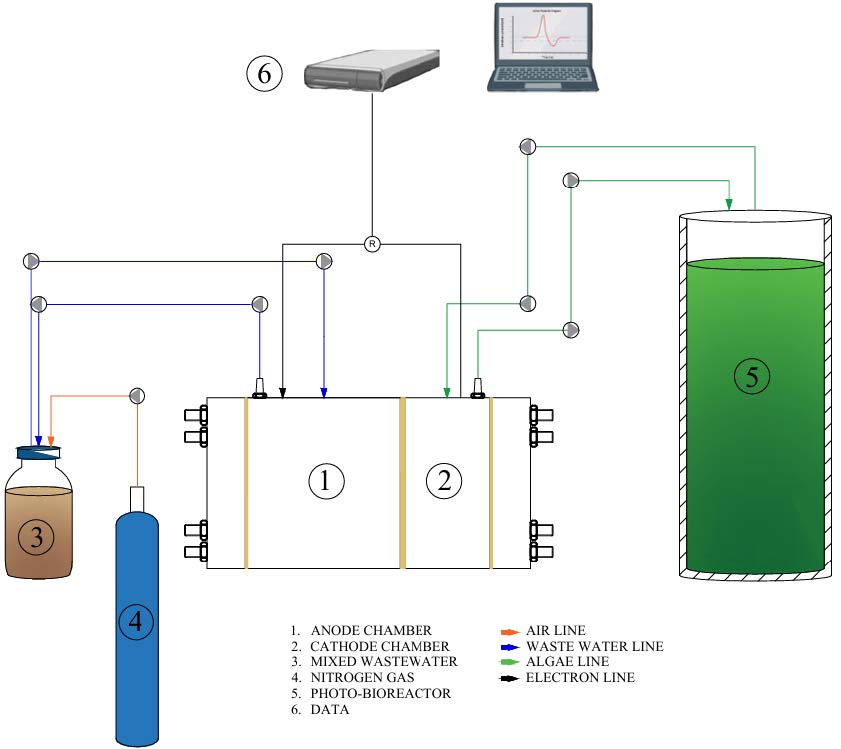
Microbial fuel cells (MFCs) represent a promising technology for wastewater treatment and energy recovery, because of their ability to simultaneously convert organic matter into electricity via electroactive bacteria in anode chambers. This technology can significantly decrease the high energy costs typically associated with conventional wastewater treatment. The incorporation of green microalgae to self-supply oxygen may further enhance the environmental sustainability of the MFC system. This study evaluates the feasibility of integrating a double-chamber MFC with a photo-bioreactor (PBR) using specific microalgae under different light conditions. The experimental results indicated that chemical oxygen demand (COD) removal efficiencies using Chlorella vulgaris and Scenedesmus protuberans were 76.28% and 86.71%, respectively. A notable variation in cell voltage was observed when shifting from continuous illumination to a 12-hour light/12-hour dark (12/12) cycle. Under the 12/12 light/dark regime, Chlorella and Scenedesmus produced voltages of 350 mV and 340 mV, respectively, while continuous light resulted in higher voltages of 390 mV and 400 mV. Power densities achieved under continuous and 12/12 lighting were 1,140 mW/m3 and 975 mW/m3 for Chlorella, and 1,350 mW/m3 and 1160 mW/m3 for Scenedesmus, respectively. Overall, the system’s performance could be substantially improved by stabilizing influent concentration and flow rate. The integration of PBR into MFCs proved effective for simultaneous wastewater treatment and bioenergy recovery, with Scenedesmus and continuous illumination yielding superior performance.
Article Details

This work is licensed under a Creative Commons Attribution-NonCommercial 4.0 International License.
Published articles are under the copyright of the Environment and Natural Resources Journal effective when the article is accepted for publication thus granting Environment and Natural Resources Journal all rights for the work so that both parties may be protected from the consequences of unauthorized use. Partially or totally publication of an article elsewhere is possible only after the consent from the editors.
References
Abdelfattah A, Ali SS, Ramadan H, El-Aswar EI, Eltawab R, Ho S-H, et al. Microalgae-based wastewater treatment: Mechanisms, challenges, recent advances, and future prospects. Environmental Science and Ecotechnology 2023;13:Article No. 100205.
Argiz L, Correa-Galeote D, Del Río ÁV, Mosquera-Corral A, González-Cabaleiro R. Valorization of lipid-rich wastewaters: A theoretical analysis to tackle the competition between polyhydroxyalkanoate and triacylglyceride-storing populations. Science of the Total Environment 2022; 807:Article No. 150761.
Edmundson SJ, Huesemann MH. The dark side of algae cultivation: Characterizing night biomass loss in three photosynthetic algae, Chlorella sorokiniana, Nannochloropsis salina, and Picochlorum sp. Algal Research 2015;12:470-6.
Elangovan K, Saravanan P, Campos CH, Sanhueza-Gómez F, Khan MMR, Chin SY, et al. Outline of microbial fuel cells technology and their significant developments, challenges, and prospects of oxygen reduction electrocatalysts. Frontiers in Chemical Engineering 2023;5:Article No. 1228510.
Ewusi-Mensah D, Huang J, Chaparro LK, Rodenas P, Ramírez-Moreno M, Ortiz JM, et al. Algae-assisted microbial desalination cell: Analysis of cathode performance and desalination efficiency assessment. Processes 2021;9(11): Article No. 2011.
Ge Z, He Z. Effects of draw solutions and membrane conditions on electricity generation and water flux in osmotic microbial fuel cells. Bioresource Technology 2012;109:70-6.
Li L, Gao K, Yang M, Zheng Q, Zhang M, Deng X. Challenges and potential solutions of microalgae-based systems for wastewater treatment and resource recovery. Frontiers in Bioengineering and Biotechnology 2023;11:Article No. 1210228.
Logan BE, Rossi R, Ragab A, Saikaly PE. Electroactive microorganisms in bioelectrochemical systems. Nature Reviews Microbiology 2019;17(5):307-19.
Logan BE. Energy diversity brings stability. Environmental Science and Technology 2006;40(17):Article No. 5161.
Mathimani T, Sekar M, Shanmugam S, Sabir JSM, Chi NTL, Pugazhendhi A. Relative abundance of lipid types among Chlorella sp. and Scenedesmus sp. and ameliorating homogeneous acid catalytic conditions using central composite design (CCD) for maximizing fatty acid methyl ester yield. Science of the Total Environment 2021;771:Article No. 144700.
Min B, Logan BE. Continuous electricity generation from domestic wastewater and organic substrates in a flat plate microbial fuel cell. Environmental Science and Technology 2004;38(21):5809-14.
Montoya-Vallejo C, Quintero Díaz JC, Yepes YA, Fernández-Morales FJ. Microalgal microbial fuel cells: A comprehensive review of mechanisms and electrochemical performance. Applied Sciences 2025;15(6):Article No. 3335.
Nguyen HD, Babel S. Bioelectricity recovery through isolation and removal of nitrogen from wastewater by shortcut nitrification-denitrification in a coupled microbial fuel cell system. Fuel 2024;359:Article No. 130497.
Potter MC. Electrical effects accompanying the decomposition of organic compounds. Proceedings of the Royal Society of London. Series B, Containing Papers of a Biological Character 1911;84(571):260-76.
Sforza E, Simionato D, Giacometti GM, Bertucco A, Morosinotto T. Adjusted light and dark cycles can optimize photosynthetic efficiency in algae growing in photobioreactors. PLoS One 2012;7(6):e38975.
Su Y, Mennerich A, Urban B. Municipal wastewater treatment and biomass accumulation with a wastewater-born and settleable algal-bacterial culture. Water Research 2011;45(11): 3351-8.
Valladares Linares R, Domínguez-Maldonado J, Rodríguez-Leal E, Patrón G, Castillo-Hernández A, Miranda A, et al. Scale up of microbial fuel cell stack system for residential wastewater treatment in continuous mode operation. Water 2019;11(2): Article No. 217.
Zarabadi MP, Charette SJ, Greener J. Toggling Geobacter sulfurreducens metabolic state reveals hidden behaviour and expanded applicability to sustainable energy applications. Sustainable Energy and Fuels 2019;3(9):22110-7.
Zhang X, He W, Ren L, Stager J, Evans PJ, Logan BE. COD removal characteristics in air-cathode microbial fuel cells. Bioresource Technology 2015;176:23-31.
Zhang Y, Cheng K, Mei H, Qin W. A novel algal-algal microbial fuel cell for enhanced chemical oxygen demand removal. Water 2024;16(19):Article No. 2798.
Zhang Y, Min B, Huang L, Angelidaki I. Electricity generation and microbial community response to substrate changes in microbial fuel cell. Bioresource Technology 2011;102(2): 1166-73.
