Scenario-Based Assessment of Greenhouse Gas Mitigation in the Municipal Solid Waste: Cambodia Case Study and Regional Comparison in Asia 10.32526/ennrj/24/20260009
Article Sidebar
Main Article Content
Abstract
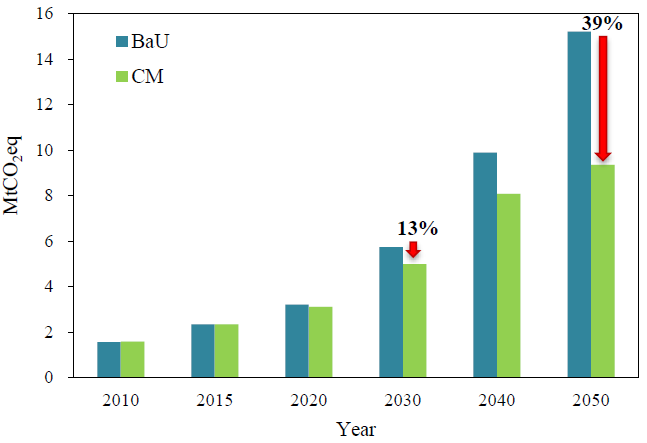
This study estimates future waste generation and evaluates greenhouse gas (GHG) mitigation potential under alternative waste management strategies in Cambodia. Key mitigation measures include waste reduction, improved collection efficiency, recycling, and methane recovery. Recycling is identified as the most effective option, contributing approximately 60% and 77% of total GHG reductions in 2030 and 2050, respectively, while methane recovery provides an additional 28% in 2030 and 22% in 2050. Under the Business-as-Usual (BaU) scenario, waste-sector GHG emissions are projected to increase from 1.6 MtCO₂eq in 2010 to 5.7 MtCO₂eq in 2030 and 15.2 MtCO₂eq in 2050. A regional comparison indicates that Cambodia’s waste-related GHG emissions are high relative to its income level and are comparable to those of more developed countries such as Japan, while exceeding those of Singapore, primarily due to limited waste treatment capacity and a high organic fraction in waste. Implementation of countermeasure strategies could reduce emissions by 13% in 2030 and 39% in 2050 compared to the BaU scenario, demonstrating substantial mitigation potential in Cambodia’s waste sector. The study employs the Extended Snapshot (ExSS)/Waste model (a bottom-up engineering approach) and provides evidence-based insights to support climate-oriented waste management policy in Cambodia and comparable developing countries in the region.
Article Details

This work is licensed under a Creative Commons Attribution-NonCommercial 4.0 International License.
Published articles are under the copyright of the Environment and Natural Resources Journal effective when the article is accepted for publication thus granting Environment and Natural Resources Journal all rights for the work so that both parties may be protected from the consequences of unauthorized use. Partially or totally publication of an article elsewhere is possible only after the consent from the editors.
References
Chan S, Oum S. Impact of Garment and Textile Trade Preferences on Livelihoods in Cambodia. Boston: Oxfam America; 2011.
Food and Agriculture Organization of the United Nations (FAO). FAOSTAT Database [Internet]. 2015 [cited 2024]. Available from: http://www.fao.org/faostat.
Hoornweg D, Bhada-Tata P. What a Waste: A Global Review of Solid Waste Management. Washington DC: World Bank; 2012.
Intergovernmental Panel on Climate Change (IPCC). 2006 IPCC Guidelines for National Greenhouse Gas Inventories, Volume 5: Waste. Hayama: Institute for Global Environmental Strategies; 2006.
Intergovernmental Panel on Climate Change (IPCC). Climate Change 2007: The Physical Science Basis. Cambridge: Cambridge University Press; 2007.
Intergovernmental Panel on Climate Change (IPCC). 2019 Refinement to the 2006 IPCC Guidelines for National Greenhouse Gas Inventories. Hayama: Institute for Global Environmental Strategies; 2019.
Intergovernmental Panel on Climate Change (IPCC). Climate Change 2021: The Physical Science Basis. Cambridge: Cambridge University Press; 2021.
Intergovernmental Panel on Climate Change (IPCC). Climate Change 2022: Mitigation of Climate Change. Contribution of Working Group III to the Sixth Assessment Report. Cambridge: Cambridge University Press; 2022.
Mao H. A design of Low-carbon Development Action Towards 2050 in Cambodia [dissertation]. Kyoto: Kyoto University; 2015.
Ministry of Economy and Finance (MEF). Macroeconomic Framework and Public Financial Management Reform Program. Phnom Penh: MEF; 2023.
Ministry of Environment. Cambodia’s Third Nationally Determined Contribution (NDC 3.0). Phnom Penh: Ministry of Environment; 2025.
National Institute of Statistics (NIS). Statistical Year Book of Cambodia 2024. Phnom Penh: Ministry of Planning; 2024.
Nguyen NU, Schnitzer H. Sustainable solutions for solid waste management in Southeast Asian countries. Waste Management 2009;29(6):1982-95.
Nguyen TKT. Municipal solid waste management in Vietnam: challenges and solutions. In: Pariatamby A, Tanaka M, editors. Municipal Solid Waste Management in Asia and the Pacific Islands. Singapore: Springer; 2014. p. 355-77.
Nguyen TH, Matsuoka Y. Analysis of greenhouse gas emissions and mitigation in the waste sector of Vietnam. Mitigation and Adaptation Strategies for Global Change 2017;22(3):427-46.
Ragossnig A, Hilger H. Waste management: Stepping up to the climate change challenge. Waste Management and Research: The Journal for a Sustainable Circular Economy 2008;26(1):3-4.
Royal Government of Cambodia. Sub-Decree on Solid Waste Management. Phnom Penh: Royal Government of Cambodia; 1999a.
Royal Government of Cambodia. Sub-Decree on Water Pollution Control. Phnom Penh: Royal Government of Cambodia; 1999b.
Royal Government of Cambodia. Rectangular Strategy Phase III (2013-2018). Phnom Penh: Royal Government of Cambodia; 2013.
Royal Government of Cambodia. National Strategic Development Plan 2014-2018. Phnom Penh: Royal Government of Cambodia; 2014a.
Royal Government of Cambodia. Cambodia Trade Integration Strategy 2014-2018. Phnom Penh: Royal Government of Cambodia; 2014b.
Royal Government of Cambodia. Rectangular Strategy Phase IV. Phnom Penh: Royal Government of Cambodia; 2018.
Sethy S. Solid Waste Management in Cambodia. Paper presented at: FY2012 Final Meeting of the Partnership Project; Okayama, Japan; 2013.
Siong HC, Wai CL, Matsuoka Y, Gomi K, Simon J, Osawa R, et al. Low-Carbon Society Scenarios Malaysia 2030. Tsukuba: National Institute for Environmental Studies (NIES); 2013.
United Nations, Department of Economic and Social Affairs (DESA), Population Division. World Population Prospects 2022. New York: United Nations; 2022.
United Nations Environment Programme (UNEP). Global Waste Management Outlook 2024. Nairobi: UNEP; 2024.
United Nations Framework Convention on Climate Change (UNFCCC). Key GHG Data. Bonn: UNFCCC; 2005.
United States Environmental Protection Agency (US EPA). Solid Waste Management and Greenhouse Gases: A Life-Cycle Assessment of Emissions and Sinks. 3rd ed. Washington DC: US EPA; 2006.
United States Environmental Protection Agency (US EPA). Global Anthropogenic Non-CO2 Greenhouse Gas Emissions: 1990-2030. Washington DC: US EPA; 2012.
World Bank. What a Waste 2.0: A Global Snapshot of Solid Waste Management to 2050. Washington DC: World Bank; 2018.
World Bank. Cambodia Country Environmental Analysis. Washington DC: World Bank; 2021.
World Bank. Cambodia Economic Update. Washington DC: World Bank; 2022.
Yim M, Lim S, Hoy SR, Pasicolan TJA, Pasicolan PN. Current situation of municipal solid waste management in the urban and peri-urban of Phnom Penh, Cambodia. Annals of Civil and Environmental Engineering 2023;7(1):67-72.
