Effect of Glycerol Substitution on the Physicochemical and Microbiological Properties of Tamarind Paste
Keywords:
Tamarind paste, Glycerol, Physicochemical properties, Water activityAbstract
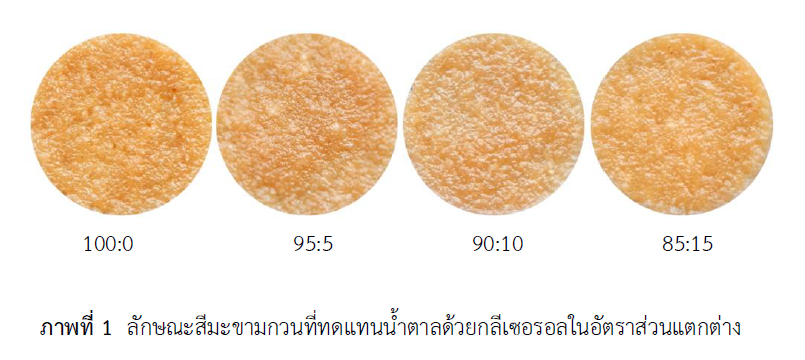
This study aimed to investigate the effects of sucrose substitution with glycerol on the physicochemical and microbiological properties of tamarind paste. Four sugar-to-glycerol ratios were formulated: 100:0 (control), 95:5, 90:10, and 85:15 (w/w). The results demonstrated that glycerol significantly influenced the product characteristics (p ≤ 0.05), with the 85:15 formulation showing the most desirable quality. Tamarind paste at this ratio exhibited reduced browning intensity, with the highest lightness value (L* = 38.38), and a softer texture, with the lowest hardness (524.87 g). The moisture content (17.77%) and total acidity (1.72%) were significantly higher than those of the control (p ≤ 0.05), while the total soluble solids (82.57 °Brix) and water activity (aw = 0.507) were significantly lower. The pH (3.00) did not differ from the control (p > 0.05). In addition, total viable counts, yeast, and mold were all less than 10 CFU/g, which
complied with the Thai Community Product Standard (TCPS 35/2015). In conclusion, sucrose substitution with glycerol improved the color and textural properties of tamarind paste while reducing the risk of microbial spoilage, highlighting its potential for application in the development of reduced-sugar fruit-based products with improved quality and safety.
References
กรรณิการ์ อ่อนสําลี. (2564). การใช้สารฮิวเมกเตนท์ในผลิตภัณฑ์มัลเบอร์รีกวน. วารสารวิชาการและวิจัย มทร.พระนคร, 15(1), น.14-25.
คณิตตา พัฒนาภา. (2553). การพัฒนากระบวนการผลิตส้มสายน้ำผึ้งแช่อิ่มอบแห้ง. (วิทยานิพนธ์วิทยาศาสตรมหาบัณฑิต, มหาวิทยาลัยเกษตรศาสตร์). https://doi.nrct.go.th/ListDoi/listDetail?Resolve_DOI=10.14457/KU.the.2010.218
นาฏชนก ปรางปรุ. (2560). การพัฒนากระบวนการทำแห้งน้ำมะขามเปียกด้วยเครื่องอบแห้งแบบลูกกลิ้ง. (วิทยานิพนธ์วิศวกรรมศาสตรดุษฎีบัณฑิต, มหาวิทยาลัยเทคโนโลยีสุรนารี). http://sutir.sut.ac.th:8080/jspui/handle/123456789/7520
เนตรนภา อาตวงษ. (2564). การส่งเสริมการแปรรูปมะขามของเกษตรกรในอำเภอหล่มเก่า จังหวัดเพชรบูรณ์. (วิทยานิพนธ์เกษตรศาสตรมหาบัณฑิต, มหาวิทยาลัยสุโขทัยธรรมาธิราช). https://ir.stou.ac.th/handle/123456789/11335
บังอร เมฆะ และสุระพงษ์ เตชะ. (2551). มะขามเปรี้ยวให้อะไรมากกว่าที่คิด. วารสารแม้โจ้ปริทัศน์, (3), น.16-18.
ปิยะนุช รสเครือ และ มลิวรรณ์ กิจชัยเจริญ. (2563). ผลของปริมาณน้ำตาล กรดซิตริก และเพคติน ที่มีต่อคุณภาพผลิตภัณฑ์มัลเบอรี่แผ่น. วารสารวิชาการและวิจัย มทร.พระนคร, 14(1), น.58-69.
วิชมณี ยืนยงพุทธกาล และธีรารัตน์ อิทธิโสภณกุล. (2561). การสร้างมูลค่าเพิ่มให้ผลไม้ไทยโดยการพัฒนาเป็นผลิตภัณฑ์ขึ้นรูปใหม่คล้ายของสดด้วยการเตรียมขั้นต้นวีออสโมซีสในสภาวะสุญญากาศ กรณีศึกษาน้อยหน่า ลองกอง และมังคุด (รายงานวิจัย). ชลบุรี: มหาวิทยาลัยบูรพา.
วิภา สุโรจนะเมธากุล. (2546). คุณสมบัติและประโยชน์ของกลีเซอรอล. วารสารอาหาร. 33(2), น.87-89.
วิภา ประพินอักษร และนันทา เป็งเนตร์. (2568). ผลของกระบวนการแช่อิ่มต่อคุณภาพและอายุการเก็บรักษาสับปะรดแช่อิ่มอบแห้ง. วารสารเกษตรศาสตร์และเทคโนโลยี มทร.อีสาน, 6(1), น.1-13.
วิภาดา มุนินทร์นพมาศ รอมลี เจะดอเลาะ และจีรวุธ มุนินทร์นพมาศ. (2565). การพัฒนาผลิตภัณฑ์ส้มแขกแผ่น:ศึกษาผลของสารละลายออสโมซีสและสารฮิวแมกแตนท์ (รายงานวิจัย). ยะลา: มหาวิทยาลัยราชภัฏยะลา.
ศิโยน กรพิบูลย์พวษ์ และวรภา คงเป็นสุข. (2563). ผลของชนิดกรด น้ำตาล และสารขึ้นรูปฟิล์มต่อสมบัติของฟิล์มปรุงรส. ในการประชุมวิชาการระดับชาติครั้งที่ 4 (น.188-195). ชลบุรี: มหาวิทยาลัยเกษตรศาสตร์ วิทยาเขตศรีราชา.
ศิริพรรณ ราชรองเมือง และดาริวรรณ เศรษฐีธรรม. (2561). การปนเปื้อนจุลินทรีีย์์ในผลไม้แปรรูปของผลติภัณฑ์ชุมชน จังหวัดหนองคาย. วารสารวิจัย มหาวิทยาลัยขอนแก่น (ฉบับบัณฑิตศึกษา), 18(3), น.104-111.
สำนักงานมาตรฐานผลิตภัณฑ์อุตสาหกรรม. (2558). มาตรฐานผลิตภัณฑ์ชุมชน ผักและผลไม้กวน มผช. 35/2558. https://tcps.tisi.go.th/public/StandardList.aspx
สิริการ หนูสิงห์ และบุศราภา ลีละวัฒน์. (2559). สมบัติทางรีโอโลยีและคุณภาพทางประสาทสัมผัสของถั่วขียว (Vigna radiate L.) กวน. วารสารวิทยาศาสตร์และเทคโนโลยี, 24(2), น.277-287.
สุธาทิพย์ ภัทรกุลวณิชย์ จิรวัฒน์ กันต์เกรียงวงศ์ ประเวทย์ ตุ้ยเต็มวงศ์ และวรพจน์ สุนทรสุข. (2549). การยืดอายุการเก็บรักษาทุเรียนกวนด้วยสารฮิวเมกแตนท์. ในการประชุมทางวิชาการของมหาวิทยาลัยเกษตรศาสตร์ ครั้งที่ 44 : สาขาวิทยาศาสตร์ (น.641-648). กรุงเทพฯ: มหาวิทยาลัยเกษตรศาสตร์ บางเขน.
สุนัน ปานสาคร จตุรงค์ ลังกาพินธุ์ ศุภณัฐ พริกบุญจันทร์ และอาทิพัฒน์ ศรีชุมพล. (2564). ผลของการดึงน้ำออกบางส่วนโดยวิธีออสโมซิสต่อคุณภาพของผลิตภัณฑ์เมล่อนกึ่งแห้ง. วารสารวิทยาศาสตร์และเทคโนโลยี, 29(2), น.714-727.
เสาวลักษณ์ จิตรบรรเจิดกุล และนพรัตน์ วงศ์หิรัญเดชา. (2551). การปรับปรุงคุณภาพและมาตรฐานผลไม้กวน (รายงานวิจัย). มหาวิทยาลัยสงขลานครินทร์.
Association of Official Analytical Chemists [AOAC]. (2000). Official methods of analysis (17th ed.). Gaithersburg, Maryland: AOAC International.
Bacteriological Analytical Manual. (2001). Chapter 3, Aerobic plate count. IN U.S. Food and Drug Administration (USFDA). http://www.cfsan.fda.gov
BeMiller, J. N., & Huber, K. C. (2019). Carbohydrates. In Damodaran, Parkin, K.L. & Fennema, O.R. (Eds.), Fennema’s food chemistry (5th ed.). (pp.81-154). Boca Raton, FL: CRC Press.
Bhadoriya, S.S., Ganeshpurkar, A., Narwaria, J., Rai, G. & Jain, A.P. (2011). Tamarindus indica: Extent of explored potential. Pharmacognosy Reviews, 5(9), pp.73-81.
Damodaran, S., Parkin, K. L., & Fennema, O. R. (2017). Fennema’s food chemistry (5th ed.). Boca Raton, FL: CRC Press.
Jay, J. M. (2000). Modern food microbiology (6th ed.). Gaithersburg, Maryland: Aspen Publishers.
Labuza, T. P., & Rahman, M. S. (2007). Water activity and food preservation. In Rahman, M.S. (Ed.), Handbook of food preservation (2nd ed.). (pp.447-452). Boca Raton, FL: CRC Press.
Quispe, C.A.G., Coronado, C. J.R. & Carvalho Jr, J.A. (2013). Glycerol: Production, consumption, prices, characterization and new Trends in combustion. Renewable and Sustainable Energy Reviews, 27, pp.475-493.
Rao, Y.S. & Mathew, K.M. (2012). Tamarind. In Peter, K.V. (Ed.) Handbook of herbs and spices Volume 2 (2nd ed.). (pp.512-533). Cambridge, UK: Woodhead Publishers.
Rahman, M. S. (2007). Water activity and glass transition concept in food preservation. Food Engineering Reviews. https://doi.org/10.1016/B978-0-08-100596-5.21184-0
Sorapukdee, S., Uesakulrungrueng, C. & Pilasombut, K. (2016). Effects of humectant and roasting on physicochemical and sensory properties of jerky made from spent hen meat. Korean Society for Food Science of Animal Resources, 36(3), pp.326-334.
Downloads
Published
How to Cite
Issue
Section
License
Copyright (c) 2025 SCIENCE AND TECHNOLOGY RESEARCH JOURNAL NAKHON RATCHASIMA RAJABHAT UNIVERSITY

This work is licensed under a Creative Commons Attribution-NonCommercial-NoDerivatives 4.0 International License.
เนื้อหาและข้อมูลในบทความที่ลงตีพิมพ์ในวารสารวิจัย วิทยาศาสตร์และเทคโนโลยี มหาวิทยาลัยราชภัฏนครราชสีมา ถือเป็นข้อคิดเห็นและความรับผิดชอบของผู้เขียนบทความโดยตรงซึ่งกองบรรณาธิการวารสาร ไม่จำเป็นต้องเห็นด้วย หรือร่วมรับผิดชอบใด ๆ
บทความ ข้อมูล เนื้อหา รูปภาพ ฯลฯ ที่ได้รับการตีพิมพ์ในวารสารวิจัย วิทยาศาสตร์และเทคโนโลยี มหาวิทยาลัยราชภัฏนครราชสีมา ถือเป็นลิขสิทธิ์ของวารสารวิจัย วิทยาศาสตร์และเทคโนโลยี มหาวิทยาลัยราชภัฏนครราชสีมา หากบุคคลหรือหน่วยงานใดต้องการนำทั้งหมดหรือส่วนหนึ่งส่วนใดไปเผยแพร่ต่อหรือเพื่อกระทำการใด ๆ จะต้องได้รับอนุญาตเป็นลายลักอักษรจากวารสารวิจัย วิทยาศาสตร์และเทคโนโลยี มหาวิทยาลัยราชภัฏนครราชสีมา ก่อนเท่านั้น