Water Management in Housing Developments on Wetlands
A Case Study of Chbar Ampov District, Phnom Penh, Cambodia
DOI:
https://doi.org/10.56261/built.v23.259502Keywords:
Urban housing, Development on Wetland, Water management, Urban planning policiesAbstract
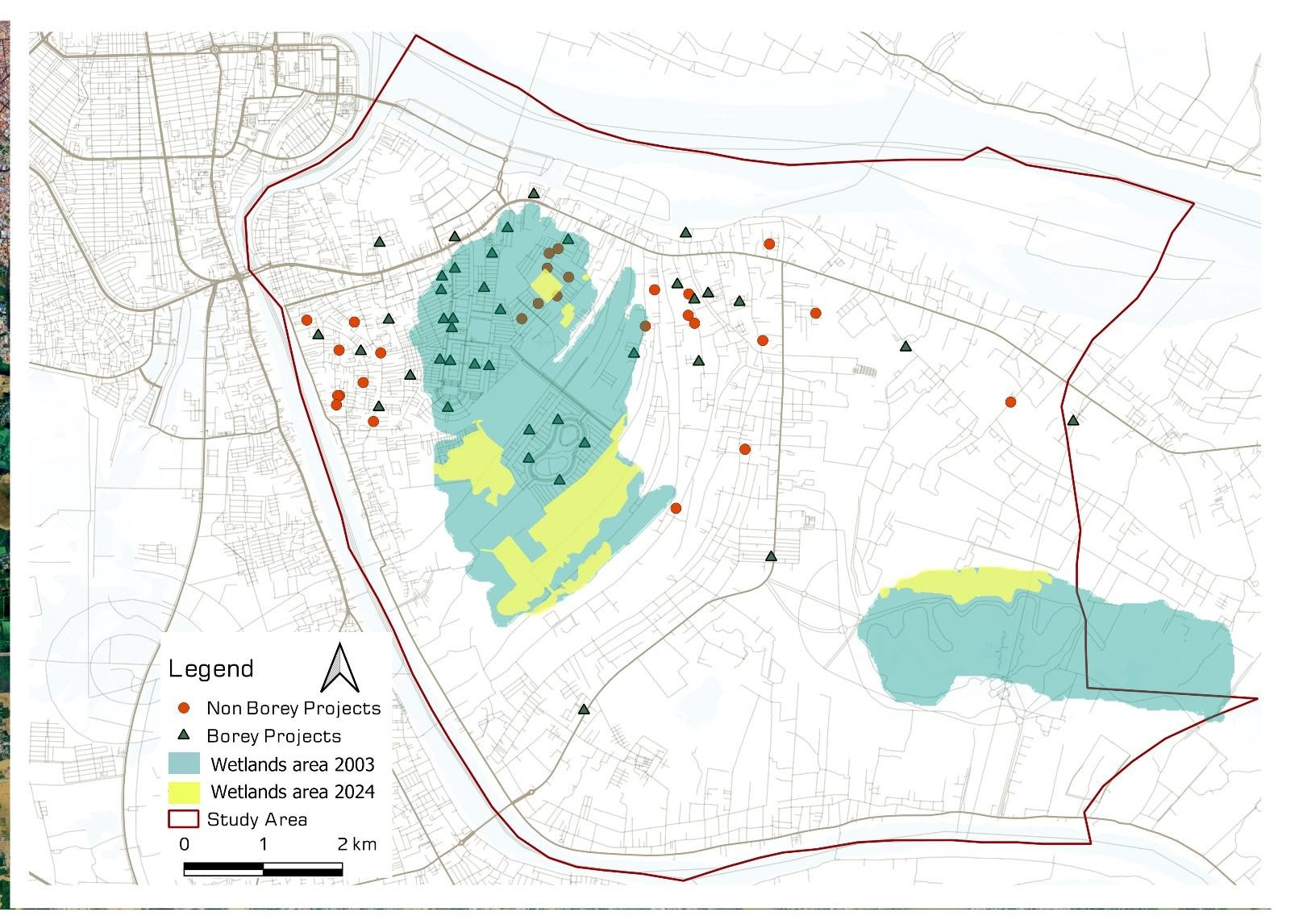
Phnom Penh’s rapid urban expansion has led to the large-scale conversion of wetlands into residential areas, undermining natural flood protection and accelerating environmental degradation. While previous studies have examined wetland loss and urban governance challenges in Cambodia, few have compared water management practices between Borey (gated communities) and non-Borey (non-gated) on both wetland and non-wetland. This study addresses that gap through a mixed-methods approach combining GIS mapping, field surveys, and semi-structured interviews with 27 stakeholders. Results show that while Borey developments feature planned layouts and green areas, these are predominantly decorative and provide limited flood mitigation. Non-Borey projects, particularly on wetlands, face severe flood risks due to inadequate drainage and minimal green space. Weak enforcement of wetland protection laws, fragmented governance, and the absence of water-sensitive design standards exacerbate these problems. Policy recommendations include mandating nature-based solutions, integrating Water Sensitive Urban Design principles into all housing developments, and strengthening enforcement of environmental regulations. By reframing wetlands as essential urban infrastructure, Phnom Penh can balance housing growth with climate resilience.
Downloads
References
Beckwith, L. (2020). When the lakes are gone: The political ecology of urban resilience in Phnom Penh [Doctoral’s dissertation], University of Ottawa. https://www.researchgate.net/publication/351480407_When_the_Lakes_Are_Gone_The_Political_Ecology_of_Urban_Resilience_in_Phnom_Penh
Chandran, Rina. (2020, July 27). Phnom Penh residents face increased flooding, displacement and loss of livelihoods as wetlands are filled in.
Chen, B., & Chui, T. F. M. (2025). A review on implementing sustainable drainage systems in sloping environments: understanding, approaches, and opportunities. Journal of Hydrology, 661(Part A), 1-14. https://doi.org/10.1016/j.jhydrol.2025.133577 DOI: https://doi.org/10.1016/j.jhydrol.2025.133577
Cui, M., Ferreira, F., Fung, T. K., & Matos, J. S. (2021). Tale of two cities: How nature-based solutions help create adaptive and resilient urban water management practices in Singapore and Lisbon. Sustainability, 13(18), 10427. https://doi.org/10.3390/su131810427 DOI: https://doi.org/10.3390/su131810427
Dietz, M. E. (2007). Low impact development practices: A review of current research and recommendations for future directions. Water, Air, and Soil Pollution , 186(1–4), 351–363. https://doi.org/10.1007/s11270-007-9484-z DOI: https://doi.org/10.1007/s11270-007-9484-z
Doyle, S. E. (2012). City of water: Architecture, urbanism and the floods of Phnom Penh. Nakhara Journal of Environmental Design and Planning, 151, 135-154. https://www.academia.edu/2502352/City_of_Water_Architecture_Urbanism_and_the_Floods_of_Phnom_Penh
European Commission. (2020). EU-Funded Nature-based solutions research projects addressing Societal Challenges across Ecosystems. https://networknature.eu/sites/default/files/uploads/nn662visualisation.pdf
Fletcher, T. D., Shuster, W., Hunt, W. F., Ashley, R., Butler, D., Arthur, S., Trowsdale, S., Barraud, S., Semadeni-Davies, A., Bertrand-Krajewski, J. L., Mikkelsen, P. S., Rivard, G., Uhl, M., Dagenais, D., & Viklander, M. (2015). SUDS, LID, BMPs, WSUD and more – The evolution and application of terminology surrounding urban drainage. Urban Water Journal, 12(7), 525–542. https://doi.org/10.1080/1573062X.2014.916314 DOI: https://doi.org/10.1080/1573062X.2014.916314
Fredriech, I. C. (2022, January 12). Bay Area Economic Circle” starting to form in Phnom Penh. Realestate.Com.Kh.
Hails, A. J. (1996). Wetlands, biodiversity and the Ramsar Convention: The role of the Convention on Wetlands in the conservation and wise use of biodiversity. Ramsar Convention Bureau. https://www.ramsar.org/sites/default/files/documents/library/wetlands_biodiversity_and_the_ramsar_convention.pdf
Hui, C. X., Dan, G., Alamri, S., & Toghraie, D. (2023). Greening smart cities: An investigation of the integration of urban natural resources and smart city technologies for promoting environmental sustainability. Sustainable Cities and Society, 99(2210–6707), 104985. https://doi.org/10.1016/j.scs.2023.104985 DOI: https://doi.org/10.1016/j.scs.2023.104985
Jia, H., Yao, H., & Yu, S. L. (2013). Advances in LID BMPs research and practice for urban runoff control in China. Frontiers of Environmental Science and Engineering, 7(5), 709–720. https://doi.org/10.1007/s11783-013-0557-5 DOI: https://doi.org/10.1007/s11783-013-0557-5
Kosal, K. (2018, November 17). Chbar Ampov: From traditional to modern. Khmer Times.
Li, H., Ding, L., Ren, M., Li, C., & Wang, H. (2017). Sponge city construction in China: A survey of the challenges and opportunities. Water, 9(9). https://doi.org/10.3390/w9090594 DOI: https://doi.org/10.3390/w9090594
Lloyd, S. D. (2001). Water sensitive urban design in the Australian context. Synthesis of a Conference Held 30-31 August 2000, Melbourne, Australia. CRC For Catchment Hydrology.
Marks, D., & Baird, I. G. (2025). The urban political ecology of worsening flooding in Phnom Penh, Cambodia: Neopatrimonialism, displacement, and uneven harm. International Journal of Disaster Risk Reduction, 118. https://doi.org/10.1016/j.ijdrr.2025.105229 DOI: https://doi.org/10.1016/j.ijdrr.2025.105229
Mialhe, F., Gunnell, Y., Navratil, O., Choi, D., Sovann, C., Lejot, J., Gaudou, B., Se, B., & Landon, N. (2019). Spatial growth of Phnom Penh, Cambodia (1973–2015): Patterns, rates, and socio-ecological consequences. Land Use Policy, 87. https://doi.org/10.1016/j.landusepol.2019.104061 DOI: https://doi.org/10.1016/j.landusepol.2019.104061
Phnom Penh Municipality. (2019). Phnom Penh, extension et mutations. Atelier Parisien D’urbanisme. https://www.apur.org
PUB Singapore. (2017). Active,beautiful, clean waters. https://www.pub.gov.sg
Sahmakum Teang Tnaut. (2019). The last lakes. www.teangtnaut.org
Santos, E. (2025). Nature-based solutions for water management in Europe: What works, what does not, and what’s next? Water, 17(15), 2193. https://doi.org/10.3390/w17152193 DOI: https://doi.org/10.3390/w17152193
Sharma, S. N., & Ayuba, D. (2024). Nature based solutions to prevent urban flooding (1st ed.). Edupedia Publications. https://doi.org/10.5281/zenodo.10651295
Susilo, K., Matasovic, N., & Johnson, R. S. (2009). Considerations, opportunities, and strategies for infiltration stormwater BMPS. Proceedings of World Environmental and Water Resources Congress 2009 - World Environmental and Water Resources Congress 2009: Great Rivers, 342, 971–980. https://doi.org/10.1061/41036(342)97 DOI: https://doi.org/10.1061/41036(342)97
Tochaiwat, K., Kulintonprasert, W., Jiraprasertkun, C., & Yang, C. Y. (2018). Influence of Master Plan Designs on Housing Project Purchase Decisions in Bangkok Metropolitan Areas. International Journal of Building, Urban, Interior and Landscape Technology, 11, 43–54. https://ph02.tci-thaijo.org/index.php/BUILT/article/view/167878 DOI: https://doi.org/10.56261/built.v11.167878
United States Environmental Protection Agency New England. (2009). Incorporating low impact development into municipal stormwater programs. https://www3.epa.gov/region1/npdes/stormwater/assets/pdfs/IncorporatingLID.pdf
Wong, T. H. (2000). Improving urban stormwater quality-from theory to implementation. Water-Melbourne Then Artarmon, 27(6), 28-31.
Wong, T. H. (2001). A changing paradigm in Australian urban stormwater management. 2nd South Pacific Stormwater Conference, pp. 1-18.
Wong, T. H. (2002). Urban stormwater management and water sensitive urban design in Australia. Global Solutions for Urban Drainage, pp. 1-14. DOI: https://doi.org/10.1061/40644(2002)22
Yin, D., Xu, C., Jia, H., Yang, Y., Sun, C., Wang, Q., & Liu, S. (2022). Sponge city practices in China: from pilot exploration to systemic demonstration. Water, 14(10). https://doi.org/10.3390/w14101531 DOI: https://doi.org/10.3390/w14101531
Yin, S., Kikutake, N., Lin, S. X., Johnson, E. C., Baker, J. L., & Ou, N. (2017). Urban Development In Phnom Penh. http://documents.worldbank.org/curated/en/286991511862455372/Urban-development-in-Phnom-Penh
Zhang, Y. (2016). Sponge city theory and its application in landscape. Urban Transportation & Construction, 3(1), 5. https://doi.org/10.18686/utc.v3i1.2 DOI: https://doi.org/10.18686/utc.v3i1.2
Downloads
Published
How to Cite
Issue
Section
License
Copyright (c) 2025 International Journal of Building, Urban, Interior and Landscape Technology

This work is licensed under a Creative Commons Attribution-NonCommercial-NoDerivatives 4.0 International License.