
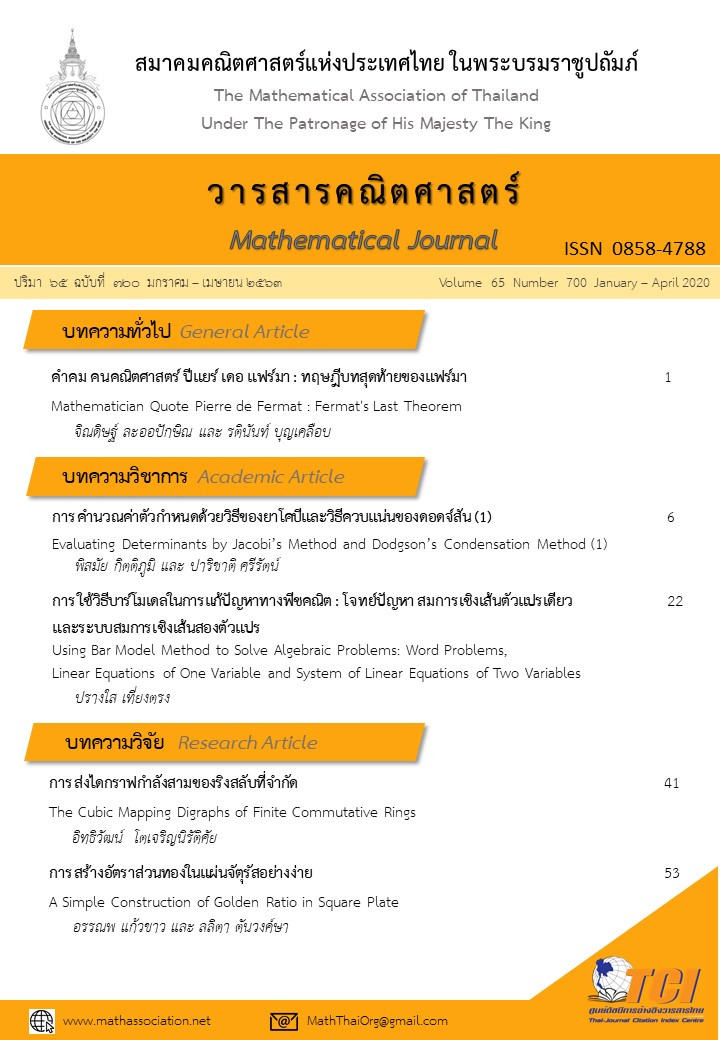
การใช้วิธีบาร์โมเดลในการแก้ปัญหาทางพีชคณิต: โจทย์ปัญหา สมการเชิงเส้นตัวแปรเดียว และระบบสมการเชิงเส้นสองตัวแปร
Article Sidebar
Main Article Content
บทคัดย่อ
วิธีบาร์โมเดลเป็นวิธีการแก้โจทย์ปัญหาคณิตศาสตร์ที่บรรจุอยู่ในหลักสูตรการเรียนคณิตศาสตร์ตั้งแต่ระดับประถมศึกษาของประเทศสิงคโปร์ ทั้งนี้มีงานศึกษาวิจัยมากมายที่ศึกษาวิธีการใช้และผลสัมฤทธิ์จากการแก้ปัญหาคณิตศาสตร์ด้วยวิธีบาร์โมเดล ซึ่งงานวิจัยต่าง ๆ ให้ผลลัพธ์ตรงกันว่าวิธีบาร์โมเดลส่งผลให้ผู้เรียนมีผลสัมฤทธิ์ทางการเรียนคณิตศาสตร์ดีขึ้น อย่างไรก็ตามงานศึกษาวิจัยในประเทศไทยส่วนใหญ่จะเน้นการนำวิธีบาร์โมเดลไปใช้ในการแก้ปัญหาคณิตศาสตร์ในระดับประถมศึกษาตอนต้น บทความฉบับนี้ผู้เขียนต้องการนำเสนอแนวทางและตัวอย่างการใช้วิธีบาร์โมเดลในการแก้ปัญหาคณิตศาสตร์ที่มีความซับซ้อนมากขึ้น ได้แก่ โจทย์ปัญหาทางพีชคณิตในระดับประถมศึกษาตอนปลายจนถึงระดับมัธยมศึกษาตอนต้น การใช้วิธีบาร์โมเดลในการแก้สมการเชิงเส้นตัวแปรเดียวและระบบสมการเชิงเส้นสองตัวแปร ผู้เขียนหวังว่าบทความนี้จะเป็นแนวทางในการนำวิธีบาร์โมเดลไปใช้แก้ปัญหาบทเรียนอื่นในคณิตศาสตร์ได้ต่อไป
Article Details
เอกสารอ้างอิง
โครงการ PISA ประเทศไทย สถาบันส่งเสริมการสอนวิทยาศาสตร์และเทคโนโลยี. (2552). ตัวอย่างการประเมินผลนานาชาติ PISA: คณิตศาสตร์. กรุงเทพมหานคร: อรุณการพิมพ์.
PISA Thailand, The Institute for the Promotion of Teaching Science and Technology (IPST). (2009). PISA International Assessment Example: Mathematics. Bangkok: Aroonprinting.
นวลฤทัย ลาพาแว. (2559). การจัดกิจกรรมการเรียนรู้เพื่อพัฒนาทักษะการแก้โจทย์ปัญหาทางคณิตศาสตร์ตามกระบวนการแก้โจทย์ปัญหาของโพลยาร่วมกับเทคนิคการวาดรูปบาร์โมเดลสำหรับนักเรียนชั้นประถมศึกษาปีที่ 2. วารสารการวิจัยกาสะลองคำ, 10 (2), น. 55 – 64.
Lapawae, N. (2016). Organizing Learning Activity for Problem Solving Development by Polyas Problem Solving Processes Co-operate with Bar Model for Second Grade Students. Kasalongkham Research Journal, 10 (2), p. 55 – 64.
ศรันย์ เปรมปรีดา. (2559). การพัฒนาชุดฝึกทักษะในการแก้โจทย์ปัญหาทางคณิตศาสตร์ ด้วยทฤษฎีบาร์โมเดล สำหรับนักเรียนชั้นประถมศึกษาปีที่ 3. (ปริญญานิพนธ์ครุศาสตรมหาบัณฑิต, มหาวิทยาลัยราชภัฏธนบุรี).
Prempreeda, S. (2016). Development of Learning Package on Solving Mathematical Problems using Bar Model Theory for Grade 3 Students. (Master’s Thesis, Dhonburi Rajabhat University).
สถาบันส่งเสริมวิทยาศาสตร์และเทคโนโลยี. (2561). คู่มือการใช้หลักสูตร กลุ่มสาระการเรียนรู้คณิตศาสตร์ (ฉบับปรับปรุง พ.ศ. 2560) ระดับประถมศึกษา. กรุงเทพฯ: สถาบันส่งเสริมวิทยาศาสตร์และเทคโนโลยี.
The Institute for the Promotion of Teaching Science and Technology. (2018). Course manual of Mathematics (2017 Revised version) Primary level. Bangkok: The Institute for the Promotion of Teaching Science and Technology.
สถาบันส่งเสริมวิทยาศาสตร์และเทคโนโลยี. (2561). คู่มือการใช้หลักสูตร กลุ่มสาระการเรียนรู้คณิตศาสตร์ (ฉบับปรับปรุง พ.ศ.2560) ระดับมัธยมศึกษาตอนต้น. กรุงเทพฯ: สถาบันส่งเสริมวิทยาศาสตร์และเทคโนโลยี.
The Institute for the Promotion of Teaching Science and Technology. (2018). Course manual of Mathematics (2017 Revised version) Lower-secondary level. Bangkok: The Institute for the Promotion of Teaching Science and Technology.
Bruner, J. S. (1973). Beyond the Information Given: Studies in the Psychology of Knowing. Oxford England: W. W. Norton.
Choo, M. (2017). The Model Method – A Bridge to Introducing Algebra. Retrieved August 1, 2019, from https://www.mceducation.com/social-media-page-sharing/ spark/2017/06/05/the-model-method-a-bridge-to-introducing-algebra.
Clark, A. (2013). Singapore Math: A Visual Approach to Word Problems. Math in Focus: Singapore Math by Marshall Cavendish. p. 1 – 7.
Dienes, Z. P. (1971). The Elements of Mathematics. New York: Herder and Herder.
Er, A. (2016). How to Improve Your Mathematics: Primary 4. Singapore: Educational Publishing House Pte.
Gani, M. A., Tengah, K. A. and Said, H. (2019). Bar Model as Intervention in Solving Word Problem Involving Percentage. International Journal on Emerging Mathematics Education, 3 (1), p. 69 – 76.
Kaur, B. (2019). The Why, What and How of the ‘Model’ Method: a Tool for Representing and Visualising Relationships When Solving Whole Number Arithmetic Word Problems. ZDM: The International Journal on Mathematics Education, 51 (1), p. 151 – 168.
Kho, T. H., Yeo, S. M., & Lim, J. (2009). The Singapore Model Method for Learning Mathematics. Singapore: EPB Pan Pacific.
Kintsch, W. and Greeno, J. G. (1985). Understanding and Solving Word Arithmetic Problems. Psychological Review, 92 (1), p. 109-129.
Ng, S. F. and Lee, K. (2009). The Model Method: Singapore Children's Tool for Representing and Solving Algebraic Word Problems. Journal for Research in Mathematics Education, 40 (3), p. 282 – 313.
OECD. (2018) PISA 2015 Results in Focus. Retrieved from the OECD website: https://www.oecd.org/pisa/pisa-2015-results-in-focus.pdf.
Spencer, R. and Fielding, H. (2015). Using the Singapore Bar Model to Support the Interpretation and Understanding of Word Problems in Key Stage 2. Proceedings of the British Society for Research into Learning Mathematics, 35 (3), p. 114 – 119.
Thirunavukkarasu, M. and Senthilnathan, S. (2014). Effectiveness of Bar Model in Enhancing the Learning of Mathematics at Primary Level. International Journal of Teacher Educational Research (IJTER), 3 (1), p. 15 – 22.
Yeap, B. H. (2010). Bar Modeling: A Problem-Solving Tool. Singapore: Marshall Cavendish Education.
