
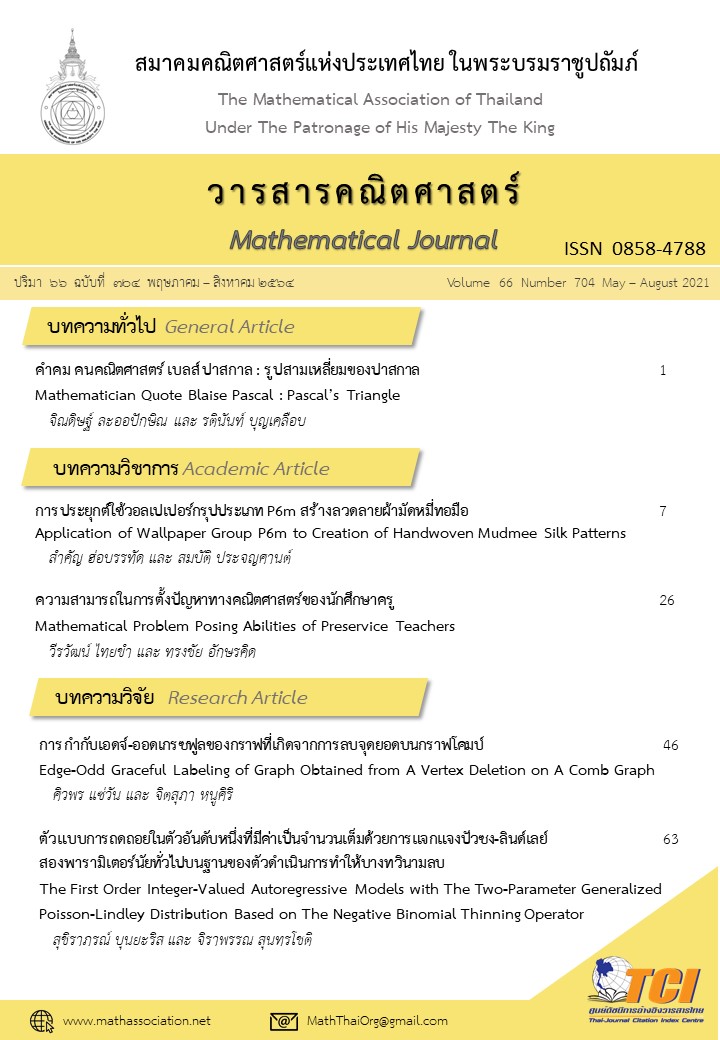
ความสามารถในการตั้งปัญหาทางคณิตศาสตร์ของนักศึกษาครู
Article Sidebar
Main Article Content
บทคัดย่อ
การตั้งปัญหาทางคณิตศาสตร์เป็นความสามารถที่สำคัญอีกความสามารถหนึ่งที่ ควรส่งเสริมให้เกิดขึ้นกับผู้เรียนในทุกระดับการศึกษา โดยเฉพาะอย่างยิ่งกับนักศึกษาครู หากนักศึกษาครูมีความสามารถดังกล่าวแล้วจะตั้งปัญหาที่ส่งเสริมการเรียนรู้ทางคณิตศาสตร์ให้กับนักเรียนในอนาคตต่อไปได้ จากการศึกษาและรวบรวมงานวิจัยเกี่ยวกับความสามารถในการตั้งปัญหาทางคณิตศาสตร์ของนักศึกษาครู สามารถแบ่งได้เป็น 5 ประเภท ได้แก่ (1) ความสามารถในการตั้งปัญหาตามเทคนิคหรือยุทธวิธีการตั้งปัญหาที่กำหนดให้ (2) ความสามารถในการตั้งปัญหาให้สอดคล้องกับลักษณะของเงื่อนไขหรือสถานการณ์ที่กำหนดให้ (3) ความสามารถในการตั้งปัญหาโดยใช้ยุทธวิธีในการแก้ปัญหาที่กำหนดให้ (4) ความสามารถในการตั้งปัญหาแบบบูรณาการและเชื่อมโยงกับบริบทจริง และ (5) ความสามารถในการตั้งปัญหาทางคณิตศาสตร์ให้เหมาะสมกับผู้เรียน ผู้เขียนได้นำเสนอรายละเอียดและตัวอย่างประกอบของความสามารถในการตั้งปัญหาทางคณิตศาสตร์ในแต่ละประเภท และหวังว่าบทความนี้จะเป็นแนวทางในการพัฒนาความสามารถในการตั้งปัญหาทางคณิตศาสตร์ให้กับนักศึกษาครูต่อไป
Article Details
เอกสารอ้างอิง
Brown, S. I., and Walter, M. I. (2005). The Art of Problem Posing. Psychology Press.
Crespo, S. (2003). Learning to Pose Mathematical Problems: Exploring Changes in Preservice Teachers' Practices. Educational Studies in Mathematics, 52 (3), p. 243 - 270.
Crespo, S., and Sinclair, N. (2008). What Makes A Problem Mathematically Interesting? Inviting Prospective Teachers to Pose Better Problems. Journal of Mathematics Teacher Education, 11 (5), p. 395 - 415.
Grundmeier, T. A. (2015). Developing The Problem-Posing Abilities of Prospective Elementary and Middle School Teachers. Mathematical Problem Posing (p. 411 - 431). Springer, New York.
Kılıç, Ç. (2017). A New Problem-Posing Approach Based on Problem-Solving Strategy: Analyzing Pre-service Primary School Teachers’ Performance. Educational Sciences: Theory & Practice, 17 (3), p. 771 – 789.
Lappan, G. (1991). Professional Standards for Teaching Mathematics. Reston (Virginia): National Council for Teachers of Mathematics. Houston.
Leavy, A., and Hourigan, M. (2020). Posing Mathematically Worthwhile Problems: Developing The Problem-Posing Skills of Prospective Teachers. Journal of Mathematics Teacher Education, 23, p. 1 - 21.
Lee, Y., Capraro, R. M., and Capraro, M. M. (2018). Mathematics Teachers’ Subject Matter Knowledge and Pedagogical Content Knowledge in Problem Posing. International Electronic Journal of Mathematics Education, 13 (2), p. 75 - 90.
Nicol, C., and Bragg, L. (2009). Designing Problems: What Kinds of Open-Ended Problems Do Preservice Teachers Pose?. Proceedings of 33rd Annual Meeting of The International Group for The Psychology of Mathematics Education (p. 225 - 232). Thessaloniki, Greece.
Rellensmann, J., and Schukajlow, S. (2017). Does Students’ Interest in A Mathematical Problem Depend on The Problem’s Connection to Reality? An Analysis of Students’ Interest and Pre-service Teachers’ Judgments of Students’ Interest in Problems With and Without A Connection to Reality. ZDM – Mathematics Education, 49 (3), p. 367 - 378.
Silber, S., and Cai, J. (2017). Pre-service Teachers' Free and Structured Mathematical Problem Posing. International Journal of Mathematical Education in Science and Technology, 48 (2), p. 163 - 184.
Silver, E. A. (1994). On Mathematical Problem Posing. For The Learning of Mathematics, 14 (1), p. 19 - 28.
Unver, S. K., Hidiroglu, C. N., Dede, A. T., and Guzel, E. B. (2018). Factors Revealed while Posing Mathematical Modelling Problems by Mathematics Student Teachers. European Journal of Educational Research, 7 (4), p. 941 - 952.
